


These days, standing out in local search results is a must for your business. With so many people grabbing their phones to find services nearby, you want to make sure your business shows up right when they’re looking.
And that’s where local business schema comes in—it can really help boost your local SEO and drive more traffic to your site. If you’re working with the best SEO agency, they’ll likely recommend implementing this strategy for your business.
In fact, businesses that use schema markup can see up to a 30% boost in click-through rates, according to Search Engine Journal.
So, not only are you getting more visibility, but you’re getting it from the right people at the right time.
So, what exactly is schema? Think of it as a guide for Google, helping it understands your business better and show the important stuff—like your location, hours, and reviews—directly in the search results. It’s a simple but powerful tool that can make a huge difference for your local SEO. Let’s explore how it works and why it’s so effective.
What is Local Business Schema?
Structured data markup, also known as Local Business Schema, is a type of code added to your website to help search engines better understand your business. When combined with GMB (Google My Business) services, it allows you to include crucial details such as:
- Name of your business
- Address
- Phone number
- Working hours
- URL of your website
This helps Google show the right information regarding your business when searched for. The more that Google knows about your business, the more it can show your business to people searching for services like yours.
Suppose you own a bakery in New York. When someone searches “bakery near me” on Google, schema markup helps. It allows Google to display your bakery’s name, location, phone number, hours, and more in the search results.
Rich snippets are special search results that include extra details. These results can show your location on the map, user reviews, and other important information. This extra info can make your listing stand out, leading to more clicks.
Why Does Local Business Schema Matter for SEO?
Local SEO services caters specifically to a small business serving a particular locality. For example, a bakery located in New York or a dental clinic in Mumbai are all catered to under local SEO. Local Business Schema helps Google to understand your business better and, thereby, presents it to the correct customers when they search locally.
For example: Imagine someone is searching for a bakery nearby. Google needs to know details like your location and business hours to show accurate results. With schema markup, you are telling Google your bakery is in New York, it’s open between 9 AM – 6 PM, and it sells fresh pastries.” This makes it easier for Google search rankings to feature your bakery in local search results.
Incorporating Local Visibility
Using local business schema can greatly improve your chances of being featured in rich snippets. Without schema markup, you risk missing out on this opportunity to make your business stand out. Rich snippets provide helpful information, like your business hours and a clickable map link, which makes it easier for potential customers to find and trust you.
According to Ahrefs, businesses that use schema markup see up to a 31% increase in click-through rates. This means more people are likely to visit your website, especially if you’ve hired SEO for your small business to help it stand out in search results.
Improvement in User Experience
Schema markup is not just for Google. It also helps the users. Without having to go to your website, a user may quickly get your company’s address, phone number, and hours by conducting a search. This information reaches the users fast, improving their experience.
Example: If a customer is searching for “dentist in Mumbai,” adding schema can help display the dentist’s address and operating hours directly in the search results. This saves the customer time and makes it more likely they’ll contact you.
Schema isn’t just code—it’s visibility, clicks, and conversions. Let SEO Discovery turn traffic into revenue.
How to Implement a Local Business Schema?
Although it may seem difficult, adding schema markup to your website is actually quite simple—as long as it’s relevant to your content. That’s why it’s a good idea to work with a professional digital marketing agency like SEO Discovery. Here’s an in-depth guide that the agency uses to help businesses rank higher in search results.
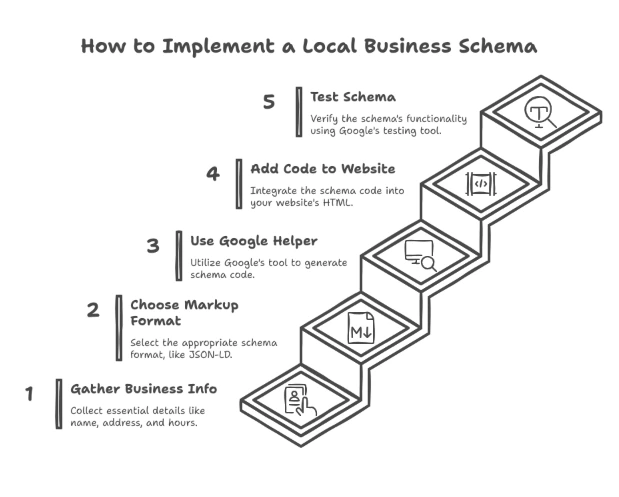
1. Gather Your Business Information
- Gather Your Business Information
The first step is to gather the important details about your business. This is what you should include:
- Business Name: The official name of your business.
- Address: Complete physical address.
- Phone Number: The number people can call to reach your business.
- Business Hours: The hours you’re open for customers.
- Website URL: A link to your website.
For example, if you operate a bakery, your business information could be:
- Business Name: “Sweet Delights Bakery”
- Address: 1234 Main St, New York, NY 10001
- Phone Number: +1 212-555-1234
- Business Hours: Monday to Friday, 9 AM to 6 PM
- Website URL: www.sweetdelightsbakery.com
2. Pick a markup format
Through our technical SEO services, there are three varieties of schema markup formats you may use:
JSON-LD: Most simplest and most widely used format. Google prefers this one. And it does not require changes to your website’s HTML.
Microdata: Can be incorporated directly into your website’s HTML
RDFa: It is not often used, but it is also an option.
Example: JSON-LD is the easiest to implement. An example of a JSON-LD schema for a bakery:
{
“@context”: “http://schema.org“,
“@type”: “Bakery”,
“name”: “Sweet Delights Bakery”,
“address”: {
“@type”: “PostalAddress”,
“streetAddress”: “1234 Main St”,
“addressLocality”: “New York”,
“addressRegion”: “NY”,
“postalCode”: “10001”
},
“telephone”: “+1 212-555-1234”,
“openingHours”: “Mo-Fr 09:00-18:00”,
“url”: “http://www.sweetdelightsbakery.com“
}
3. Use the Google's Structured Data Markup Helper
Google offers a Structured Data Markup Helper to facilitate schema markup. Our SEO specialists simply add your company’s information, and the program will generate the code on its own. For example, on the Structured Data Markup Helper, select the type “Local Business” and then fill in the business details; Google will automatically generate the markup code to include in your website.
4. Add Schema Code to Your Website
<head>
<script type=”application/ld+json”>
{ “schema code here” }
</script>
</head>
5. Test Your Schema
Make sure your schema is working properly before launching it. A Structured Data Testing Tool from Google can be used to ensure that everything is configured correctly.
Example: Go to the testing tool, input your webpage URL or schema code and Google will give you the information about errors.
Main Components of Local Business Schema
In order to have the best experience in the local business schema, you need to include these important details;
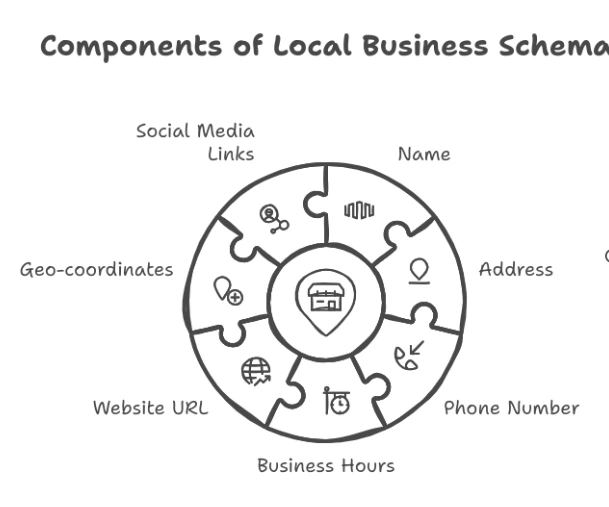
- Name: This is the name of your business.
- Address: This is where your business physically is.
- Phone Number: Your best number for contact.
- Business Hours: Days and hours your business operates.
- Website URL: Link to your website.
- Geo-coordinates: Latitude and longitude, which will help Google show your location on the map.
- Social Media Links: Adding links to your social media profiles enhances visibility.
All these details added in the schema markup make it easier for Google to display your business correctly in search results.
Reviews in Local Business Schema
One extra feature you can add to your schema is reviews. Schema allows you to display customer ratings, which can attract more customers. People trust reviews; good reviews can take your business to a very appreciable position in the search results.
Example: If the 5-star rating of the bakery contains lots of customer’s reviews, they can also be displayed on the search result by schema markup. By doing this, it will convince people to visit your bakery.
Why Reviews Matter: Reviews are a good way to create trust with potential customers. When they read good feedback about your business, they tend to click on your website.
Drive Local Growth with SEO Discovery’s Schema Markup Techniques
Local business schema is a powerful tool for boosting your online presence and enhancing your local SEO. By adding structured data to your website, you not only help search engines better understand your business, but you also make it easier for customers to find you.
Rich snippets, reviews, business hours, and location details directly in search results lead to more clicks, ultimately driving more traffic to your website.
Take your business to the next level by optimizing your SEO strategy with SEO Discovery. Hire an SEO specialist and see how we can help businesses improve their SEO performance with customized solutions to make your website stand out in local search results.
By combining schema markup with expert SEO services, you can increase your local visibility, reach a broader audience, and stay ahead of the competition.
Trusted by hundreds of local businesses, SEO Discovery helps you rank smarter, not harder—with proven schema strategies.
FAQs For Local Business Schema
Local business schema is a type of structured data you add to your website’s code. It helps search engines understand key business details like name, location, hours, and services. This improves how your business appears in search results and increases your chances of attracting local customers.
Structured data makes your site more visible in search results by enabling rich snippets like reviews, business hours, and directions. These extras catch users’ attention and can boost your click-through rate, bringing more traffic to your website.
Schema markup gives search engines detailed information about your business, which helps them show your listing to the right local audience. This improves your local rankings and makes your business more competitive in local search results.
While schema markup helps, it works best when combined with a full SEO strategy. This includes keyword optimization, content updates, backlinks, and mobile-friendly design—all of which SEO Discovery can help you with.
SEO Discovery offers tailored local SEO solutions, including schema implementation, keyword strategy, on-page SEO, and content marketing. Their experts help your website rank higher locally and drive more foot traffic to your business.