

Imagine asking Google a question and instantly receiving a detailed, AI-generated summary—no need to click a single link. That’s not the future—it’s right now. Google’s AI Overview (formerly known as SGE) is transforming how users interact with search results, offering instant, synthesized answers at the top of the page. For businesses and SEO professionals, this is more than just a shift in layout—it’s a whole new game.
Over 78% of users prefer AI-generated summaries when searching for quick answers, and AI Overview now appears in more than 60% of search queries in select markets.
If your content isn’t optimized for this AI-driven interface, it’s likely being skipped altogether. The traditional “top 10 blue links” are fading into the background, replaced by contextual, conversational AI snippets. So, how do you adapt? How do you get your content featured in these AI summaries?
Welcome to the era of Answer Engine Optimization (AEO)—a new wave in search marketing where your content must be tailored not for users to click, but for AI to summarize. If you’re still optimizing for blue links, you’re missing the real opportunity.
In this blog, we will walk you through exactly how to do SEO for Google AI Overview—using entity-based optimization, semantic structure, conversational intent, and more.
Table of Contents
- What is an AI Overview?
- Why Google AI Overview Matters to SEO
- How AI Content SEO Works in This New Landscape
- Google Search AI Overview Impact on SEO: What’s Really Changing?
- How to Optimize Your Content for Google AI Overview
- Tools for AI-Driven SEO Success
- Common Mistakes to Avoid in AI Overview SEO
- Future of AI Overview: What to Expect Next
- Partner with SEO Discovery for AI-Optimized Search Success
- FAQs About Google AI Overview SEO
What is an AI Overview?
Let’s start with the basics: What is AI Overview? Google AI Overview is a feature within Google Search that delivers AI-generated summaries at the top of the SERP (Search Engine Results Page). Powered by generative AI and Large Language Models (LLMs), this feature offers users synthesized, easy-to-read answers pulled from multiple sources.
Unlike featured snippets that rely on one link, AI Overview combines information from across the web to create a paragraph-like response, often enriched with citations, visuals, and follow-up questions.
Why Google AI Overview Matters to SEO
The Google AI Overview SEO impact is massive. Here are just a few ways it changes the game:
- Clicks drop for standard organic results when AI Overview is active.
- Authority matters more: AI pulls from trustworthy, semantically strong content—something an experienced SEO agency can help you build through strategic content and structured optimization.
- Context is king: Pages that provide context-rich answers are more likely to be featured.
- Structured data counts: Schema markup and entity tagging are more important than ever.
If your page doesn’t communicate relevance and authority through both content and code, you’re invisible in this AI-first search environment.
How AI Content SEO Works in This New Landscape
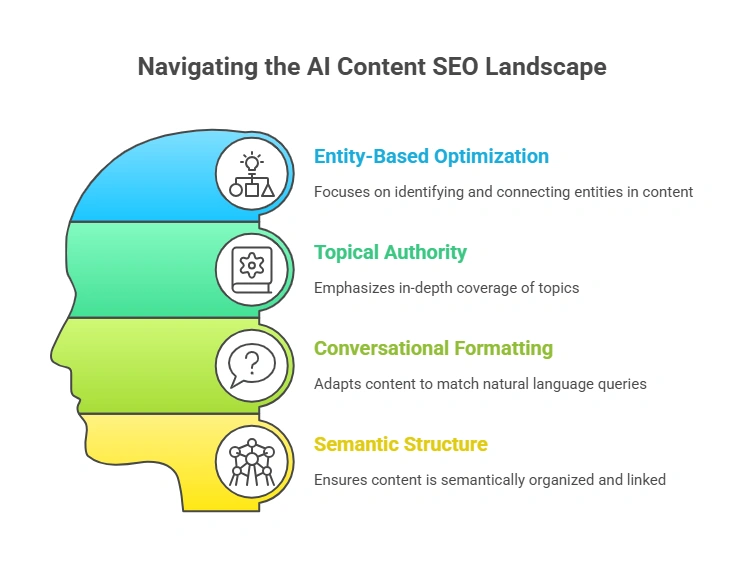
AI content SEO isn’t just about keywords anymore. It’s about:
- Entity-based optimization
- Topical authority
- Conversational formatting
- Semantic relationships
Let’s break these down:
1. Entity-Based Optimization
Search engines now focus on entities, not just keywords. Google’s algorithms map out relationships between concepts, brands, people, and places.
To rank in Google AI SEO, you need to:
- Clearly identify entities in your content.
- Use structured markup (e.g., JSON-LD).
- Connect your content to well-known entities in tools like Google’s Knowledge Graph.
2. Topical Authority
AI Overviews SEO favors sources that cover entire topics deeply rather than shallow articles. You need:
- Long-form, in-depth guides.
- A content cluster strategy.
- Interlinked pillar and subtopic pages.
Google rewards domain expertise, not just individual page quality.
3. Conversational Formatting
Since Google AI Overview delivers answers in a natural tone, your content must reflect how people ask and answer questions.
Use:
- FAQs formatted with H2s or H3s.
- Conversational headings like “How do I…” or “What is the best way to…”
- Short paragraphs, lists, and step-by-step instructions.
4. Semantic Structure
Semantics matter. You must:
- Use natural language and related keywords.
- Implement internal links that reflect topical connections.
- Tag headings correctly (H1, H2, H3).
- Add schema for FAQs, How-Tos, Reviews, Products, etc.
Google Search AI Overview Impact on SEO: What’s Really Changing?
The Google search AI Overview impact on SEO includes a few radical shifts:
Change | Traditional SEO | AI Overview SEO |
Ranking Signals | Backlinks, keywords | Authority, semantics, entities |
User Behavior | Click-heavy | Interaction-light |
Content Format | Static, keyword-stuffed | Conversational, context-rich |
SERP Features | Snippets, blue links | AI-generated summaries |
How to Optimize Your Content for Google AI Overview
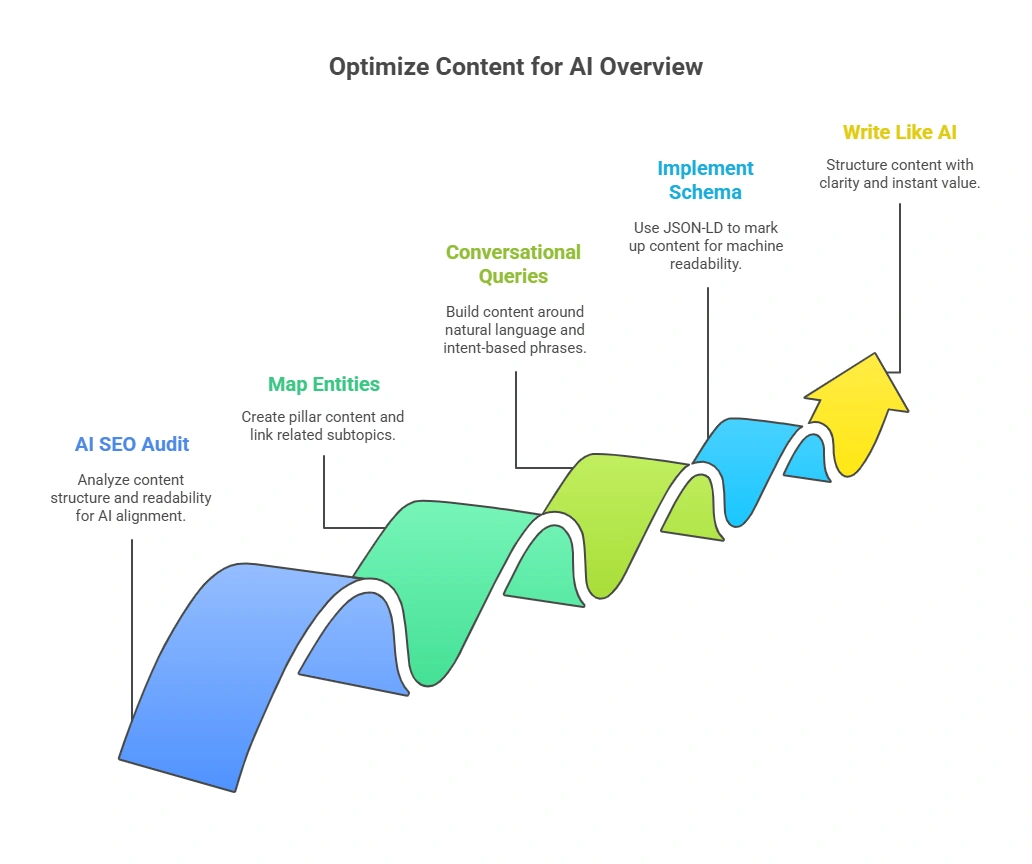
Ready to get featured in the AI Overview? Follow this actionable guide:
Step 1: Perform an AI SEO Audit
Analyze existing pages for structure, entities, and readability to ensure alignment with how AI models process and evaluate content. Use tools like Surfer SEO, Clearscope, or MarketMuse for NLP optimization, identifying keyword gaps, topic relevance, and entity coverage. Prioritize user-focused improvements and consistent formatting across your site.
Step 2: Map Entities and Build Topical Clusters
Create pillar content for core topics to serve as authoritative resources that anchor related information. Link to semantically related subtopics throughout your site to build depth and support contextual understanding. Consider partnering with a reputable link building service to secure high‑authority backlinks that reinforce those entity connections and boost topical authority.
Step 3: Use Conversational Queries
Build content around how users naturally speak, reflecting real-world language and tone to match conversational search behavior. Integrate long-tail questions and intent-based phrases throughout headings and paragraphs. This approach increases chances of being selected for AI-generated answers that prioritize relevance, context, and natural dialogue patterns.
Step 4: Implement Schema Markup
Use JSON-LD to mark up FAQs, reviews, product info, etc., making your data machine-readable and more likely to be featured. Test with Google’s Rich Results Testing Tool to confirm proper implementation. Schema increases the clarity of content types for AI systems and supports visibility in enhanced search features.
Step 5: Write Like You’re the AI
Think: If you were summarizing the answer, what would you include? Structure your content with clarity, highlighting clear definitions, comparisons, steps, and stats that provide instant value. If writing AI-optimized content in-house is challenging, consider using a professional content writing service to ensure quality and alignment with AI expectations.
Want Your Content Featured in Google AI Overview?
Tools for AI-Driven SEO Success
Some of the best Google AI SEO tools include:
Surfer SEO: Helps build content with NLP suggestions that align with Google’s AI processing. It provides keyword frequency recommendations, content structure insights, and SERP data analysis. Surfer SEO enables creators to optimize content based on semantic relevance and competitive benchmarks, increasing the likelihood of being featured in AI-generated overviews.
InLinks: Great for internal linking and entity optimization through its AI-powered content analysis. It identifies gaps in semantic coverage, suggests relevant internal link structures, and highlights missing entities that improve topic authority. InLinks helps you connect content contextually, making it easier for Google to understand the relationships between your pages.
Schema Markup Generator: Easy schema implementation for structured data elements like FAQs, products, reviews, and articles. This tool allows users to create JSON-LD code effortlessly, helping Google’s AI interpret and categorize content accurately. Valid schema improves chances of being featured in rich snippets and AI overview panels in search results.
AlsoAsked & AnswerThePublic: Find conversational queries by uncovering how real users phrase their search questions. These tools gather data from search engines and visualize question-based keywords, offering insight into long-tail, natural language queries. Incorporating these questions into your content supports alignment with AI-generated summaries and voice search intent.
Google Search Console & Bing Webmaster: Monitor AI overview appearances and track overall performance metrics. These platforms provide insights into visibility, impressions, and search behavior. They help identify which queries trigger AI results and offer data to refine content, enhancing both discoverability and alignment with AI-powered search features.
You can also harness the power of a SEO AI agent—an AI-driven assistant that helps automate tasks like content audits, entity identification, internal linking suggestions, and semantic optimization. These agents use natural language processing to ensure your content aligns with Google’s AI priorities.
Common Mistakes to Avoid in AI Overview SEO
- Overusing keywords: Google’s AI favors natural language.
- Ignoring structure: No H2s, no schema = no inclusion.
- Writing too vaguely: The AI wants clarity.
- Not answering questions: Your content must directly respond to user queries.
Future of AI Overview: What to Expect Next
Google continues to evolve its AI capabilities. Here’s what might be next:
- Hyper-personalized overviews based on user history
- Voice-optimized summaries for mobile and smart devices
- Dynamic content updating where overviews evolve in real time
The impact of Google AI Overview SEO is still unfolding—but what’s certain is that early adopters will benefit the most.
Partner with SEO Discovery for AI-Optimized Search Success
Navigating the new era of AI-powered search isn’t easy—but with the right partner, you don’t have to go it alone.
SEO Discovery is a leading SEO and digital marketing agency, trusted by 18,000+ global clients and backed by 22+ years of proven success. As AI reshapes the way search works, we’re helping businesses like yours stay ahead of the curve—optimizing for Google AI Overview, semantic search, entity signals, and conversational content strategies.
Why Choose SEO Discovery?
AI-Driven SEO Strategies: We don’t just follow trends—we build future-ready SEO frameworks that align with Google’s evolving AI algorithms, from entity-based content to schema-optimized site structures.
Full-Service Digital Expertise: From technical SEO to PPC, social media, and AI content marketing, our experts craft comprehensive digital solutions tailored to your growth goals.
Advanced Tools & Analytics: We use industry-leading tools like Surfer SEO, InLinks, MarketMuse, and our proprietary tech to audit, optimize, and measure your content’s readiness for AI-driven visibility.
Transparent Reporting & Growth Dashboards: Track your Google AI Overview appearances, organic ranking improvements, and conversion growth—all in real time.
Global Reach, Local Focus: Whether you’re a startup, enterprise, or ecommerce brand, we deliver tailored strategies for your industry, audience, and market—with specialists in every niche.
Now’s the Time to Optimize Your Content for the AI-First Future!
FAQs About Google AI Overview SEO
Google AI Overview provides AI-generated summaries at the top of search results, pulling information from multiple sources. Unlike featured snippets that pull from one page, AI Overview combines content contextually using generative AI.
To be included, your content must be semantically rich, clearly structured, aligned with conversational queries, and supported by schema markup. Focus on entities, topical authority, and clear answers to user questions.
Yes, but it has evolved. While keywords and backlinks still play a role, AI Overview SEO now prioritizes authority, semantic relevance, entity optimization, and conversational content formats.
Absolutely. Schema markup helps Google understand your content structure. Implementing JSON-LD for FAQs, How-Tos, Reviews, and Products improves your chances of being featured in AI summaries.
Yes. Both rely on natural language and conversational intent. Structuring content to answer questions concisely benefits both AI Overviews and voice assistants like Google Assistant.
We conduct AI SEO audits, map entities, build topical clusters, and implement schema using tools like Surfer SEO, InLinks, and MarketMuse—ensuring your content is aligned with AI inclusion criteria.
If you’re not trained in conversational, entity-driven writing, yes. SEO Discovery offers professional content writing services tailored for AI-readability, semantic structure, and contextual value.
Yes. Our link building services focus on acquiring high-authority, semantically relevant backlinks that enhance your topical authority—vital for inclusion in AI Overviews.
We use advanced tools like Surfer SEO, InLinks, Schema Markup Generators, MarketMuse, Clearscope, and SEO AI Agents to automate optimization, track entity coverage, and boost semantic strength.
Using tools like Google Search Console, we monitor impressions, performance shifts, and AI inclusion metrics. Our custom dashboards give real-time visibility into how your content performs in AI-generated results.