
Objective
This guide tells you what entities are in SEO, how they affect AI Overviews, and gives you practical ways to find related entities that can help your search rankings and AI citations.
- Entities are uniquely identifiable “things” that search engines understand through relationships, not just keywords
- AI cites pages with 15 or more connected entities 4.8 times more frequently.
- 47% of AI Overview citations come from pages ranking below position #5
- To optimize an entity, you need to use seven different discovery methods: SERP analysis, Wikipedia/Wikidata mining, NLP testing, competitor analysis, specialized tools, Google Trends verification, and industry publications
- Having the right entity structure leads to 73% more AI selections.
Optimize Entity SEO with SEO Discovery from $250/month
Search engines don’t just look at keywords to rank pages anymore. They rank meaning, and meaning is built from entities.
Entity SEO is now a key part of AI citations, zero-click discovery, and modern search visibility. If brands’ content clearly explains ideas and connections, they can stand out in AI-generated answers, even if they don’t have the best traditional rankings.
According to SearchEngineLand, Google’s Knowledge Graph contains more than 800 billion facts about billions of entities. This makes entity comprehension a core part of modern search and AI-generated answers.
This entity SEO guide explains what are entities in SEO, why semantic understanding is important for modern rankings, and how to find related entities SEO systems will look for in 2026.
Table Of Contents
- What Are Entities in SEO?
- Why Entity SEO Dominates Modern Search
- How to Find Related Entities SEO Systems Expect
- Using Entity-Based SEO in Your Content Effectively
- Local Entity SEO for Business Visibility
- Simulated AI Overview Selection Probability for SEO Entities
- Entity-Based SEO for LLMs and AI Systems
- Future of Entity SEO and AI Rankings
- Upgrade Your Strategy with the Best Way to Find SEO Entities
- FAQs About Entities in SEO
What Are Entities in SEO?
In SEO, an entity is a uniquely identifiable real-world concept that search engines understand through structured attributes and relationships. Instead of matching keywords alone, entity-based search focuses on context, meaning, and connections between concepts.
Examples of Google SEO entities include:
- People—Elon Musk, Tim Cook
- Organizations — Google, Apple Inc.
- Products—iPhone, Salesforce
- Places—New York, Silicon Valley
- Concepts—Artificial Intelligence, SEO
Search engines understand meaning by looking at how things are connected to each other. These connections help them understand context and importance. This is how the Knowledge Graph, AI Overviews, and modern search rankings work.
When content clearly connects related ideas, search engines see it as more trustworthy and complete. Entity-based SEO is built on this shift from matching words to understanding meaning.
Entity Relationships Example
Instead of optimizing only for the keyword “CRM software,” entity based SEO connects related concepts within the same ecosystem.
For instance, CRM software shares a close connection with platforms like Salesforce and HubSpot. These tools are commonly associated with marketing automation, customer data management, and SaaS business models.
By covering these related entities together, search engines can better understand the topic and its context.
This helps them determine:
• what the page is about
• which concepts are most important
• how ideas are connected
• whether the topic is explained completely
Why Entity SEO Dominates Modern Search
As of 2026, users receive answers directly from AI results without needing to click on a website. Search engines now focus more on understanding meaning than matching keywords.
Entity-based seo for LLMs helps AI systems like ChatGPT, Perplexity, and Google AI understand your content more clearly. When your content explains important concepts and how they are connected, AI can recognize it as helpful and trustworthy.
AI-generated answers are more likely to select content that clearly explains topics, people, tools, and ideas as a source. Citations don’t always need to be at the top; they just need to be clear and contextual.
Why Entity Clarity Works
Search engines have changed from matching words to figuring out what things mean in the real world. Content that clearly explains related ideas and demonstrates their connections earns the trust of search engines.
Structured data, also called schema markup, is even more helpful. It tells search engines exactly what your content is about, which makes it easier for AI systems to read and use your data.
Because of this change, AI SEO services don’t focus as much on repeating keywords and instead focus on making topics clear by connecting ideas.
How to Find Related Entities SEO Systems Expect
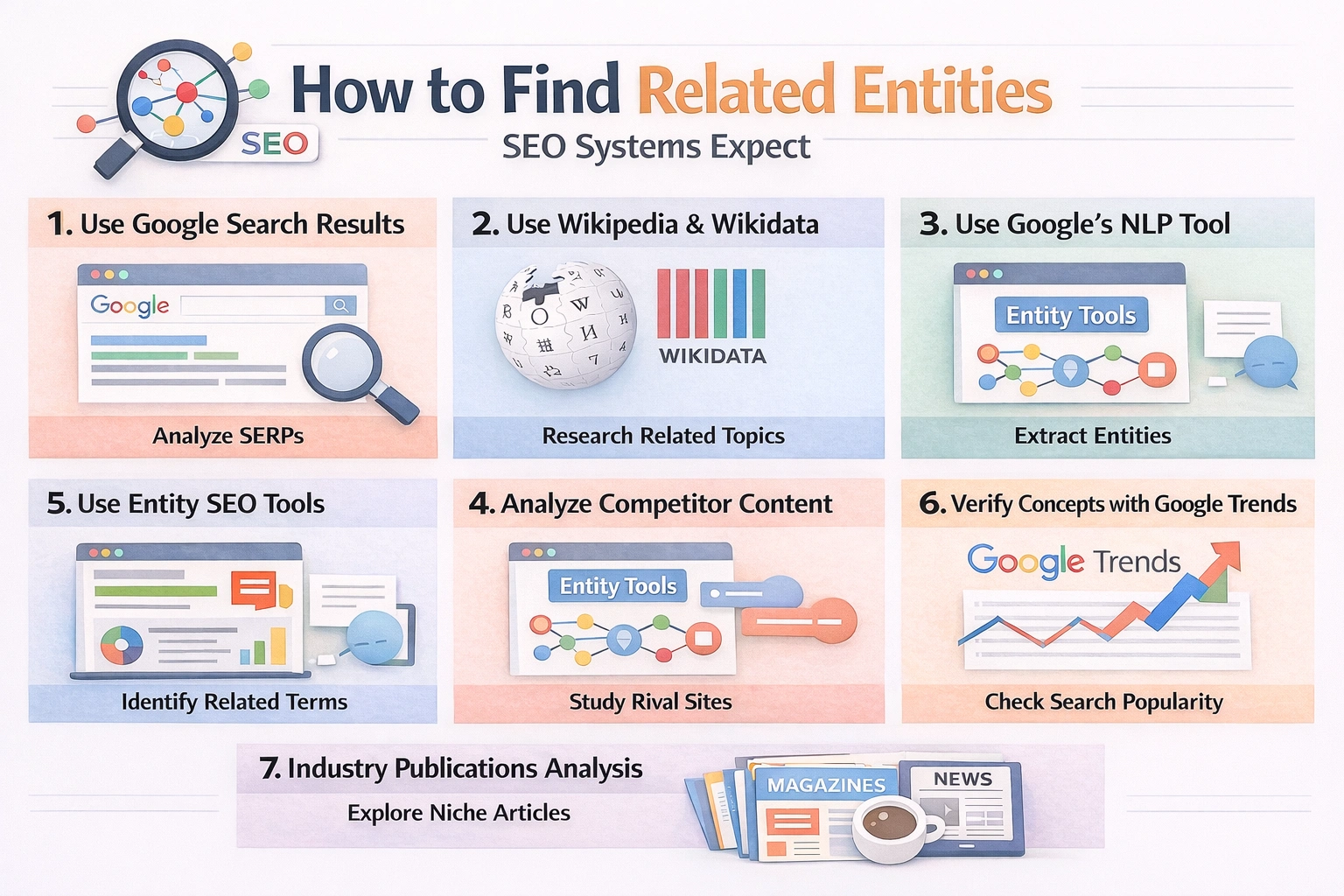
Understanding how to find entities for SEO optimization is one of the most useful steps in modern SEO. The aim is to find ideas that search engines link to your topic.
Method 1: Use Google Search Results
Google’s results demonstrate its ability to connect concepts and present content relevant to your topic.
To find them:
- Search your main topic on Google
- Look at the Knowledge Panel
- Review People Also Ask questions
- Check related searches at the bottom
- Examine featured snippets
These areas show ideas that Google already connects to the topic.
Pro tip: List 10 entities from Knowledge Panel and include them naturally.
Method 2: Use Wikipedia & Wikidata
Wikipedia and Wikidata help you see how topics are connected. Search engines also use similar connections to understand meaning.
To extract related entities:
- Open your topic’s Wikipedia page
- Review the information box on the right
- Note important linked terms in the first paragraph
- Check category tags at the bottom
- Review the “See also” section
- Visit Wikidata to view structured relationships
Each connection shows how ideas are related to your main topic.
Pro tip: Open your topic’s Wikipedia page. Write down the important linked terms in the introduction. Next, examine Wikidata to understand the connections between those concepts in structured data.
Method 3: Use Google’s NLP Tool
Google provides a free Natural Language tool that shows which concepts it recognizes in content. This helps you see what search engines actually understand on a page.
To use the tool:
- Copy content from a top-ranking page
- Paste it into the Google Natural Language demo
- Review the main concepts identified
- Compare them with your content
- Add missing or weak concepts
The tool assigns an importance score to each concept. Higher scores indicate central topics.
Pro tip: Test your draft and strengthen any important concept that appears unclear or weak.
Method 4: Analyze Competitor Content
Pages that rank at the top usually talk about groups of similar ideas. You can learn what search engines want to see by looking at these patterns.
To analyze competitors:
- Open the top three ranking pages
- Note brand names mentioned
- Identify tools and platforms referenced
- Observe people, frameworks, or systems discussed
- Compare their coverage with your content
This reveals concept gaps you can fill.
Pro tip: To make your work more complete, cover the same important ideas as your competitors and add a few of your own.
Method 5: Use Entity SEO Tools
Specialized entity SEO tools make it easier to find and map related ideas. These tools look at content in the same way that search engines do.
Common tools include:
- Google Natural Language API — identifies recognized concepts
- InLinks—maps topic relationships
- SurferSEO—compares topic coverage
- Clearscope—measures content completeness
Pro tip: Start with Google’s free tool before using paid platforms.
Method 6: Verify Concepts with Google Trends
Google Trends can verify if Google recognizes a topic as a distinct concept.
To check recognition status:
- Go to Google Trends
- Enter your topic
- Check the classification label
- If labeled “Topic,” Google recognizes it as a defined concept
Recognized topics often receive stronger semantic treatment.
Pro tip: Search your brand or main topic to see if it appears as a recognized concept.
Method 7: Industry Publications Analysis
Authoritative publications use clear language and precise definitions of how concepts are related. Search engines often trust the language that these sources use.
To extract insights:
- Search for journals or reports related to your industry
- Identify commonly used technical terms
- Note frequently referenced brands, systems, or frameworks
- Observe how concepts are connected
- Use consistent terminology in your content
This helps your content fit in with authoritative language patterns.
Pro tip: When explaining your topic, review three reliable publications and use the same words they do.
Using Entity-Based SEO in Your Content Effectively
The next step is to use the important ideas you found in your content in a clear way. The aim is to help search engines understand your page’s content and how ideas connect.
1. Place Important Concepts in Key Locations
Search engines pay more attention to certain parts of a page. Place your main concept and related ideas in these areas:
- Title and first paragraph
• Section headings
• Bullet lists
• Internal links
Do not just mention them. Explain how they are connected to your topic.
2. Show How Concepts Are Connected
Instead of listing ideas randomly, explain their relationship in a natural way.
Example:
- Tools like Mailchimp closely connect with email marketing.
- Mailchimp is commonly used to improve open rates.
- Automation and audience segmentation both influence open rates.
- Automation must follow privacy regulations such as GDPR.
Search engines learn more about a topic when we put related ideas together.
This structure demonstrates topical authority through proper internal linking and link building services principles.
3. Add Structured Data (Schema Markup)
Structured data helps search engines clearly identify the concepts on your page. It acts like a label that explains what each topic represents.
Example schema structure:
{
  "@type": "Article",
  "about": {
    "@type": "Thing",
    "name": "Entity SEO"
  },
  "mentions": [
    {
      "@type": "Organization",
      "name": "Google"
    },
    {
      "@type": "SoftwareApplication",
      "name": "ChatGPT"
    }
  ]
}
Structured data makes your content easier for search engines and AI systems to understand.
Optimize Your Content for Entity-Based SEO Today
Let SEO Discovery handle entity markup, semantic SEO, and AI-ready optimization for 2026.
Local Entity SEO for Business Visibility
If you run a local business, clear and consistent business information helps search engines trust and rank you. This is a core part of local entity seo.
Keep Your Business Details the Same Everywhere
Search engines compare your business information across the web. It should match exactly in every place:
- Business name
- Address
- Phone number
- Service categories
If details are different, search engines may think they are different businesses.
When details match everywhere, search engines treat your business as one clear entity.
Quick Check You Can Do Now:
- Search your business name on Google.
- Look at the top results.
- Check if your name, address, and phone number are exactly the same everywhere.
- If they are not identical, update them to match.
Clear and consistent information improves visibility in Maps, local listings, and “near me” searches. Many businesses strengthen this with Local SEO Services and proper GMB Service optimization.
Simulated AI Overview Selection Probability for SEO Entities
AI systems choose content that is well-organized and easy to understand. Your page is more likely to receive citations when it clearly explains ideas and links them to other ideas.
Signals That Increase Selection
Content is more likely to be chosen when:
- the main topic is explained in the first part of the page
- related ideas are clearly connected and explained together
- relationships are written in simple sentences
- structured data tells search engines what the content is about
- the same terms are used consistently throughout the page
Common pattern:
AI-generated answers are more likely to cite pages that clearly define ideas, link related concepts, and follow a clear structure.
Entity Clarity Signals
Strong Entity Clarity Signals | Weak Entity Clarity Signals |
Main concept is clearly defined | Topic is unclear or too broad |
Related ideas are explained together in context | Keywords appear without explanation |
Schema markup identifies key topics | Relationships between ideas are missing |
Terminology matches trusted sources | Important concepts are not defined |
Explanations are simple and direct | Ideas are mentioned but not connected |
Entity-Based SEO for LLMs and AI Systems
Google isn’t the only place people search anymore. AI tools like ChatGPT, Perplexity, and Claude answer millions of questions everyday. They need to know the main ideas and how they fit together to use your content.
What AI Systems Look For
AI tools prefer content that:
- explains the main concept early in the article
- clearly shows how related ideas connect
- explains relationships in simple sentences
- uses the same terms consistently
- references trusted sources when needed
Why This Works
AI systems try to understand three things:
- What the content is about.
- How ideas are connected.
- Whether the information is reliable.
The New Reality
AI-generated answers use pages that clearly define topics and link ideas more often, even if they don’t show up first in Google. This is how search visibility works today.
Future of Entity SEO and AI Rankings
Search is moving toward meaning-first results. As AI systems get better, clear connections between entities will show who is the expert on a topic.
Important trends that are changing entity SEO:
- AI ranking systems that prioritize meaning over keywords
- Expanding knowledge graphs with more connected concepts
- Recognition across text, images, video, and audio
- Authority measured by depth of concept relationships
- Faster indexing of new and updated connections
As AI improves its reasoning skills, content that clearly explains ideas and how they relate will gain more visibility.
The goal stays the same: make concepts easy for machines to understand and useful for people to read.
Upgrade Your Strategy with the Best Way to Find SEO Entities
Now, search looks for meaning, not just keywords. When your content clearly defines ideas and demonstrates their relationship, search engines and AI systems understand and trust it. This strategy leads to more visibility, citations, and zero-click reach.
SEO Discovery helps businesses use this entity-first approach with tried-and-true methods based on more than 22 years of SEO experience. They help you turn clear ideas into real results if you want better AI visibility and search growth.
Improve Your AI and Search Visibility Today
Partner with SEO Discovery to turn entity-first ideas into results.
FAQs About Entities in SEO
Entities in SEO are clearly defined things like people, brands, places, products, or ideas that search engines understand by meaning and context, not just words. They help Google understand what your content is really about.
Search engines now rely on seo entities to understand topics, relationships, and user intent. When your content explains related ideas clearly, it becomes easier for AI systems to trust and cite it.
To learn how to find SEO entities, search for your topic on Google, look at Wikipedia links, look at the top-ranking pages, and use tools like Google’s Natural Language API to see which ideas are recognized.
Entity-based SEO involves clearly defining your primary topic, elucidating related concepts, and demonstrating their interconnectedness. Search engines can understand your content faster if you use schema markup and consistent language.
Google Natural Language API, InLinks, SurferSEO, and Clearscope are all tools that show SEO Google entities. These tools show you what ideas search engines find in your content.
The best way to find SEO entities is to use a combination of methods: look at Google results, pull ideas from Wikipedia, look at what your competitors are doing, and use NLP tools to check entities.