

Objective
Understand why automobile repair shops and dealerships fail to show up on Google Search, Google Maps, and AI-based searches, and receive an effective automotive SEO strategy that generates visibility and bookings.
Your Google Business Profile is your most valuable local SEO asset, and its completeness is now a hard ranking gate.
Dedicated service pages outrank one generic “Services” page for high-intent searches.
Review recency now matters as much as review volume.
AI Overviews are cutting how many businesses get shown at all, rewarding structured, entity-clear content.
Dealerships and independent shops need different keyword strategies, even under one automotive SEO plan.
Turn More Automotive Searches Into Customers With SEO Discovery, starting at $250/month.
Your shop has the best mechanics, real reviews, and a location people can drive to. So why is your organic traffic flat when a competitor with inferior service quality ranks above you on every search that matters?
Automotive SEO in 2026 rarely fails because of one big mistake. Most auto repair shops and dealerships fail because Google just doesn’t have enough evidence to recommend them: an incomplete Google Business Profile, thin service pages, inconsistent business information, and weak local authority all stack up at once even when the service is better than the competition.
Did You Know?
Nearly 46% of all Google searches carry local intent, a figure that has climbed steadily since Google first disclosed it, according to Search Engine Roundtable’s coverage of Google’s own local search data.
That single statistic should change how any shop owner thinks about ranking. This article breaks down what’s blocking your visibility right now, a practical framework to fix it, and what strong AI and organic performance actually looks like for a real automotive client.
Table Of Contents
- What Is Automotive SEO?
- What Changes When Your Auto Shop Has Strong SEO?
- How Is Dealership SEO Different From Auto Repair Shop SEO?
- What's Actually Blocking Your Rankings?
- How Do You Perform Effective Automotive SEO?
- How Does SEO Drive Business Growth Across the Automotive Industry?
- Which Automotive SEO Mistakes Are Hurting Your Rankings?
- How SEO Discovery Increased AI Visibility for a Multi-Location Automotive Group
- What Strong Automotive AI Visibility Looks Like for a Multi-Location Group
- Frequently Asked Questions About Automotive SEO
What Is Automotive SEO?
Automotive SEO is about making a repair shop or dealership show up higher in Google Search, Google Maps, and AI-powered search so that local customers can easily find and book services. It’s not like general SEO. It’s targeting hyper-local, high-intent searches like “brake repair near me” or “oil change in Boston.” That’s generally not someone who is researching to do something later. That’s someone who needs help today.
In 2026, customers will frequently click right from Google Maps, AI Overviews, reviews, and click-to-call buttons without having to visit 10 different websites first. That’s why Search Everywhere Optimization matters. Your shop needs to appear everywhere your customer might look, not just in the traditional organic rankings.
What Changes When Your Auto Shop Has Strong SEO?
Without SEO | With SEO |
Hard to find on Google Maps | Strong local visibility |
Generic website | Service-focused landing pages |
Few, outdated reviews | Steady, recent reviews |
Slow mobile experience | Fast, mobile-friendly site |
Low online enquiries | More calls and bookings |
Limited AI visibility | Greater exposure across AI search |
How Is Dealership SEO Different From Auto Repair Shop SEO?
Although repair shops and dealerships sit in the same industry, they need different strategies.
Aspect | Auto Repair Shop SEO | Dealership SEO |
Focus | Repair services | Vehicle inventory |
Target searcher | Local repair need | Vehicle buyer |
Page priority | Service pages | Inventory + service pages |
Goal | Repair bookings | Vehicle and service enquiries |
Businesses searching for SEO for car dealers, car dealership SEO, SEO for car dealerships, or car dealer SEO typically need inventory optimization, financing pages, and manufacturer-specific content. It’s the toughest for groups with multiple rooftops: Multi-location SEO requires a separate verified GBP and unique location page for each rooftop, because duplicate or templated location pages suppress rankings for all locations, not just the weak ones. That’s the kind of task SEO Discovery’s franchise digital marketing team does for dealership groups. Instead, repair shops should focus on service pages, local authority, reviews, and GBP management.
What's Actually Blocking Your Rankings?
There is rarely just one reason. Most shops lose visibility because several ranking signals are weak at the same time.
Your Google Business Profile Isn't Fully Optimized
For local businesses, GBP has a bigger impact on visibility than the website itself. Wrong categories, missing services, outdated hours, and thin photo libraries make it harder for Google to recommend you. While a complete, regularly updated profile is the first step to strong Google Maps SEO, continuous GBP service is just as important as the initial setup. Google’s own Business Profile guidance states this directly: businesses that keep their profile complete and up-to-date with accurate categories, services, and photos are more likely to appear in local search and Maps results.
Your Website Doesn't Match Search Intent
Many shops still run on a simple four-page site: home, about, services, and contact. Search Engine Land’s guide to service area pages found that duplicating the same content across multiple pages with only a city name swapped produces thin, templated pages that barely help local rankings, while those built around genuinely unique, location-specific content perform meaningfully better. A generic services page competes with everyone and ranks for no one. A dedicated brake-repair-in-your-city page competes for one searcher and ranks for that searcher.
“The shops winning right now are the ones whose websites actually read like they were written by someone who fixes cars for a living, not a template. That’s most of the gap.”
— Sachin Bhatt, SEO Strategist, SEO Discovery.
Your Reviews Aren't Building Trust
Google looks at quality, frequency, average rating, and your response, not just your total number. In 2026 the rules changed dramatically. Recency counts as much as volume. A shop with fifty reviews in the past three months can outrank a competitor with two hundred mostly year-old reviews. Regular review generation enhances brand reputation management in traditional and AI-powered search and is a core component of SEO Discovery’s reputation management services.
Your Website Loads Too Slowly
Most automotive searches are done on mobile devices, often by someone who is stranded on the side of the road with a dashboard warning light. A slow site loses that visitor before they ever see your services. Regular website performance optimization keeps visitors on the site and helps search engines crawl your site effectively.
Your Business Information Is Inconsistent
If you have a different name, address, or phone number on directories and social sites, Google gets mixed signals about which listing to trust.
Your Shop Has Limited Local Authority
Chamber of Commerce listings, local news coverage, and automotive associations all give it a sense of legitimacy. Strategic local link building services bolster the authority that Google is already trying to measure.
AI-Powered Search Is Changing What "Ranking" Even Means
AI visibility now depends on whether an LLM can confidently cite your business, and generative search systems prefer clean, structured, fact-dense content over vague marketing copy. Zero-click search optimization, AEO, and GEO are no longer optional extras. About four in ten U.S. adults now use AI chatbots specifically for information searching, according to Pew Research Center’s 2026 survey on American AI use, and that share is climbing. Google’s May 2026 core update made this concrete, placing new weight on local entity signals like GBP completeness, citation consistency, and review velocity, as Search Engine Land reported directly from the rollout.
Most shops don’t fail because of one missing keyword. They struggle because several trust signals are weak at once. Fixing GBP, reviews, and content structure together is what gets you into both the map pack and the AI Overviews sitting above it.
Not Sure Which Fix Matters Most for Your Shop?
SEO Discovery’s free website audit shows you exactly what’s holding your rankings back and what to fix first.
How Do You Perform Effective Automotive SEO?
Ranking higher isn’t about chasing algorithm updates. It’s about building a complete local search presence.
Step | Action | Why It Matters |
1. Optimize Google Business Profile | Correct categories, complete service list, updated hours, real photos, weekly posts | Improves Google Maps SEO visibility directly |
2. Create dedicated service pages | One page per service, covering symptoms, process, and timeline | Matches high-intent, exact-match searches |
3. Build a review system | Request within hours of service; respond within one business day | Increases trust and prominence signals |
4. Strengthen technical SEO | Mobile-friendly, fast load time, clean schema, fixed broken links | Improves crawling and user experience |
5. Build local authority | Chamber listings, associations, local press, location-specific content | Reinforces the trust signals Google measures |
6. Optimize for AI-powered search | Structured data, concise direct answers, complete business info | Improves visibility across AI Overviews and assistants |
Build your review system on a schedule, not a hope:
Customer Stage | Action |
Vehicle pickup | Thank the customer personally |
Within two hours | Send an SMS review request |
Next day | Send a follow-up email |
Every review received | Respond within one business day |
Write for the NLP-driven systems that are trying to summarize your page in an AI Overview, not just for a human skimming it. Provide a direct answer in the first two sentences, followed by supporting details. A quarterly technical SEO audit snags the crawl errors and broken links that silently cap every other fix on this list.
How Does SEO Drive Business Growth Across the Automotive Industry?
SEO isn’t just about rankings. It’s about generating bookings from customers already searching for your services, and unlike paid ads, it continues to deliver value long after a page is published.
SEO Improvement | Business Benefit |
Better Google Maps visibility | More calls and direction requests |
Dedicated service pages | More qualified leads |
Faster website | Better user experience and conversions |
Strong review profile | Higher customer trust |
Local authority | Sustainable, durable rankings |
AI-ready content | Increased visibility across AI search |
Every optimized service page becomes a long-term asset. It keeps attracting customers months after you publish it, unlike a paid ad that stops the moment you stop paying.
Which Automotive SEO Mistakes Are Hurting Your Rankings?
Before you scale your SEO efforts, make sure these common issues aren’t holding your automotive business back. Fixing them often leads to quicker improvements in rankings, traffic, and local visibility.
Mistake | Why It Hurts |
One generic services page | Limits keyword relevance |
Ignoring Google Business Profile | Reduces Maps visibility |
Slow mobile website | Increases bounce rate |
Inconsistent NAP information | Weakens trust signals |
No structured data | Misses rich search opportunities |
Ignoring customer reviews | Lowers credibility and AI citability |
Weak internal linking | Makes crawling difficult |
What Strong Automotive AI Visibility Looks Like for a Multi-Location Group
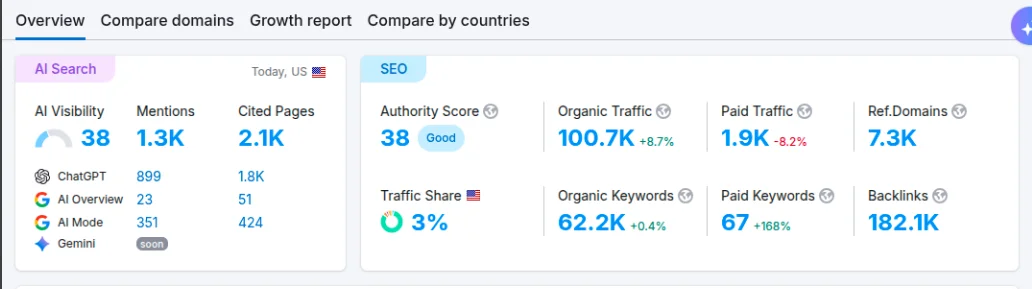
Numbers speak louder than promises. Here’s a real-world snapshot of SEO Discovery in action, from a current multi-location auto group client, demonstrating measurable organic and AI search performance across every rooftop the group owns.
AI Search Visibility
- 38 AI visibility score, with 1.3K total mentions and 2.1K cited pages across AI platforms
- ChatGPT: 899 mentions, 1.8K cited pages
- Google AI Overview: 23 mentions, 51 cited pages
- Google AI Mode: 351 mentions, 424 cited pages
Underlying SEO Strength
- Authority Score of 38, rated Good
- 100.7K organic traffic, up 8.7%, against 1.9K paid traffic, down 8.2%
- 62.2K organic keywords, up 0.4%, and 67 paid keywords, up 168%
- 7.3K referring domains and 182.1K backlinks
- 3% traffic share in its market
ChatGPT is responsible for almost all the AI citations here, with 899 mentions and 1.8K cited pages compared to just 23 mentions for Google AI Overview. For a multi-location group, that tracks it: vehicle purchases and service comparisons are high-consideration decisions, and ChatGPT is where a lot of that comparison research now happens before someone ever calls a specific rooftop.
The other signal worth noticing is that organic traffic grew 8.7% while organic keywords barely moved, up just 0.4%. That’s not new content sprawl. That’s the same keyword set ranking better, which is exactly what GBP completeness and location-page fixes produce, not a blog expansion. And with traffic share still sitting at 3%, there’s a lot of room left before national marketplace and comparison sites stop eating the difference.
Turn Automotive Searches Into Customers with SEO Discovery
Fixing every gap on this list at once isn’t realistic, and it isn’t necessary. Start with what’s costing you the most traffic right now, usually an incomplete GBP, a homepage doing the job of ten service pages, or a review pipeline that dried up months ago.
What makes automotive SEO different in 2026 is that the finish line moved. Ranking in classic search still matters, but shops and dealership groups earning AI Overview and AI Agent visibility are pulling ahead of competitors who don’t even know they’re losing ground.
SEO Discovery is a digital marketing agency that builds exactly this stack for automotive businesses: technical health, content depth, real authority, and AI SEO services covering both today’s search results and tomorrow’s AI answers. Whether you operate a single garage or a multi-rooftop dealership group, a focused audit usually surfaces the two or three fixes doing most of the damage.
Find Out Where You Stand
SEO Discovery helps auto shops and dealership groups increase rankings, AI visibility, and qualified bookings with dedicated local SEO services.
Frequently Asked Questions About Automotive SEO
Optimize your Google Business Profile, build dedicated service pages, collect reviews on a schedule, improve technical SEO, and create AI-friendly content.
It connects high-intent local searches directly to bookings, turning “brake repair near me” traffic into calls and appointments rather than lost visibility.
Look for specialists with a track record in local and dealership-specific SEO, not generalist agencies applying one playbook everywhere.
Most repair shops see measurable improvements within three to six months.ow do you perform
Yes. It’s one of the strongest local ranking factors for Google Maps and local search.
Yes. AI search systems increasingly prioritize businesses with strong reviews, structured data, and well-organized content.
Yes, but modern SEO rewards matching user intent and local relevance over repeating exact-match phrases.
Yes. Each location needs its own Google Business Profile and unique page to rank independently in its own market.
They work best once reviews and response times are already strong, since Google gates eligibility behind those signals.
Yes. Local SEO covers your GBP and map pack visibility; general SEO covers site content, technical health, and backlinks.