

Objective
This guide explains how to improve Shopify SEO for AI Overviews. It covers technical SEO, product pages, structured data, reviews, content, and brand visibility for ecommerce stores.
- Make Shopify pages easy for Google to crawl, read, and index.
- Write clear product content that answers common shopper questions.
- Use accurate structured data to help Google understand product details.
- Improve collection pages with useful content and relevant internal links.
- Add genuine reviews, original photos, and first-hand product information.
- Build brand mentions through trusted websites, reviews, and relevant publications.
- Track AI visibility, organic traffic, brand searches, and conversions regularly.
Shopify SEO for AI Overviews means ecommerce brands need to move beyond keyword stuffing and embrace Generative Engine Optimization (GEO). Your Shopify store needs clear product descriptions, machine-readable facts, helpful customer reviews, and clean structured data. These elements make it easier for AI models to crawl, understand, extract, and cite your product information.
Did You Know?
Shopify recommends detailed specifications, comparisons, descriptions, structured data, sizing, material information, and care instructions to make product pages easier for AI systems to process
AI overviews can change how shoppers discover products, compare choices, and reach ecommerce brands. That makes it important to keep your product data, structured markup, reviews, category pages, and answers clear and useful. When information is easy for search systems to understand, your Shopify store can provide stronger signals for AI-powered search.
In this guide, we’ll explain how ecommerce brands can optimize Shopify stores for AI overviews, from technical SEO to content and authority. So read until the end.
Get Professional Shopify SEO Support from SEO Discovery
Table Of Contents
- What Shopify SEO for AI Overviews means
- How AI Overviews change ecommerce search
- How can you improve Shopify SEO for AI Overviews?
- How can you measure AI Overview visibility for Shopify?
- What common Shopify SEO mistakes should ecommerce brands avoid?
- Your 30-day action plan
- Get your Shopify store ready for AI search
- How we helped a Shopify brand win visibility in AI search
- FAQs about Shopify SEO for AI Overviews
What Shopify SEO for AI Overviews means
Shopify SEO for AI Overviews is the practice of structuring your store’s pages, product data, and brand signals so Google’s AI-generated summaries can understand, trust, and cite your content.
AI Overviews are the AI-written answers that appear at the top of many Google results. They pull from pages Google already indexes and considers helpful. Google has said publicly that there are no special technical requirements to appear in them beyond being indexed and eligible to show with a snippet.
That doesn’t make the work easy. It means the winners are the stores that do the basics well and do them clearly enough for a machine to extract a confident answer.
At a glance, the priorities are:
- Pages that are crawlable, indexable, and fast
- Product and collection pages that answer real buyer questions
- Accurate structured data and product feeds
- Proof of experience: reviews, original photos, testing, specifics
- Brand mentions across the wider web
How AI Overviews change ecommerce search
Traditional SEO rewarded the page that ranked first. AI Overviews reward the page that best answers a specific part of the question, even if it isn’t first.
Three shifts matter for Shopify brands:
- Long, conversational queries are growing: Shoppers describe their situation instead of typing keywords. “Running shoes for flat feet and long distances” is a different query from “running shoes.”
- The click is no longer guaranteed: Some searches are answered on the results page. Pages that get cited still earn visibility and brand recall, and cited sources tend to be the ones users trust enough to click.
- Product discovery is blending with research: The informational stage (what to look for) and the commercial stage (what to buy) now happen in one place. Your content has to serve both.
Is AI Finding Your Products?
Let our Shopify SEO experts improve your store’s visibility.
How can you improve Shopify SEO for AI Overviews?
Below are the key methods ecommerce brands can use to improve Shopify SEO for AI Overviews and make their store easier for search systems to understand.
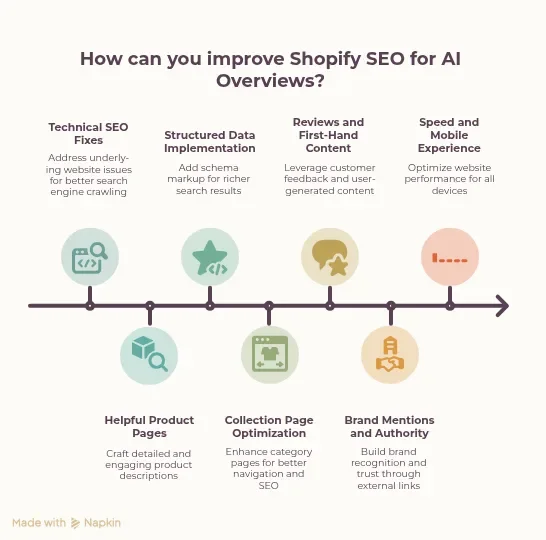
1. Fix your technical foundation first
AI features can only cite what Google can crawl, render, and index. Before touching content, run through this checklist.
- Indexation and crawlability
- Confirm your key products, collections, and blog posts are indexed in Google Search Console.
- Review your robots.txt.liquid file. Shopify lets you edit it, and mistakes there can block important sections.
- Check that filtered and sorted collection URLs aren’t wasting crawl budget or creating duplicate content.
- Canonical tags and duplicate URLs: Shopify can serve the same product under /products/handle and /collections/collection-name/products/handle. Themes normally canonicalize to the main product URL. Verify it on your own store rather than assuming.
- Sitemaps: Shopify generates sitemap.xml automatically. Submit it in Search Console and watch for “Discovered, currently not indexed” pages. Thin or near-duplicate pages are a signal to consolidate.
- Variant and tag page bloat: Every tag or filter page you let search engines index should have a reason to exist. If it doesn’t, noindex it or remove it.
Pro tip: Sort your Search Console coverage report by page type. If collection pages are indexed well but products aren’t, the problem is usually internal linking or thin descriptions, not Google. |
If you’d rather have specialists audit this layer, a dedicated Shopify SEO service can catch template-level issues that a manual check often misses.
2. Write product pages that answer questions
Most Shopify product pages contain a manufacturer blurb, a size chart, and a shipping policy. AI systems have little to extract from that.
Build product pages that answer the questions a buyer would ask a store assistant:
- Who is this for, and who is it not for? Honest exclusions build trust and give AI a clear answer, to quote.
- What are the specs, in plain language? Materials, dimensions, ingredients, compatibility, and care instructions.
- How does it compare to alternatives? A short “how to choose” block beats a generic feature list.
- What problems does it solve? Frame benefits around the situation, not the product name.
Add a compact FAQ block to high-value products, with five to six real questions pulled from customer emails, live chat, and reviews. Keep each answer to two or three sentences, with the direct answer first.
Expert Insight |
3. Structured data and merchant center
Structured data doesn’t guarantee AI citations, but it removes ambiguity about what your page is about.
- Product schema: Make sure every product page includes accurate product markup such as name, image, description, SKU, brand, price, currency, and availability. Many Shopify themes output some of this by default, often incompletely. Test your pages in Google’s Rich Results Test and fill the gaps, especially GTIN or MPN identifiers, brand, and review data.
- Review and aggregate rating markup: Only mark up reviews that appear on the page and come from real customers. Faked or mismatched markup is a fast way to lose trust.
- Organization schema: Add it site-wide, with your brand name, logo, and official social profiles. It helps Google connect your store to the entity behind it.
- FAQ and article schema: Use them on content that genuinely fits. Don’t add them everywhere for the sake of it.
- Google Merchant Center: Product data quality now matters beyond shopping ads. A clean feed with accurate titles, prices, availability, GTINs, and images strengthens how Google understands your catalog. Keep feed data consistent with what’s on your product pages. Mismatches cause disapprovals and confuse everything downstream.
4. Build collection pages and topic clusters
Collection pages usually carry your highest-value commercial keywords, and most Shopify stores leave them as a grid of products with no copy.
Improve them by:
- Adding a short intro (80 to 150 words) that defines the category and helps buyers choose
- Including a “how to choose” section below the products
- Linking to related collections and supporting guides
- Answering two or three category-level questions
Then support those collections with educational content. A store selling running shoes might publish guides on choosing shoes for flat feet, how often to replace trainers, and trail and road shoes. Each guide links to the relevant collection and product pages.
This cluster structure shows topical authority, which matters when Google decides who deserves to be cited on a subject. A content marketing strategy built for Shopify can help map these clusters to buyer intent rather than publishing volume.
5. Use reviews and firsthand proof
Generic content is easy for AI to produce, which makes first-hand evidence more valuable.
Show proof that a real business tested, sold, and supported the product:
- Original photography and video, not supplier images
- Customer reviews with detail and store replies that add information
- Testing notes, sizing feedback, and care lessons from your own team
- Named authors or founders on guides, with relevant credentials
Encourage reviews that describe use cases: “bought for a 10-hour flight, kept my skin hydrated.” Those phrases mirror how people ask questions, and they give AI models real language to draw on.
6. Earn brand mentions and authority
AI answers lean on sources that appear trustworthy across the web, not only on your own domain. Mentions on credible sites, reviews on third-party platforms, and consistent brand information all feed that picture.
Practical moves:
- Pitch data, original research, or expert commentary to publications in your niche
- Get listed in respected roundups and buying guides honestly, through outreach and quality products
- Keep your brand name, description, and profiles consistent everywhere
- Monitor unlinked brand mentions and turn them into relationships
Avoid bought links and mass guest-post schemes. They create risk without building the kind of reputation AI systems reward. If you’re planning a serious push, Shopify link building built on digital PR is a safer route than volume tactics.
“Based on my experience working with ecommerce brands across different niches, the stores that get named in AI answers tend to be the ones people already talk about elsewhere. Visibility in AI search often follows brand reputation, not the other way around. ”
Arjun Mehta, SEO Strategist, SEO Discovery
7. Speed and mobile experience
Most Shopify traffic is mobile, and slow pages hurt both rankings and conversions. Common causes:
- Too many apps injecting scripts on every page
- Uncompressed hero images and autoplay video
- Heavy sliders and pop-ups that shift the layout
- Leftover code from apps you’ve uninstalled
Audit your app stack every quarter. Remove anything that doesn’t earn its load time, compress images, lazy-load below-the-fold media, and watch Core Web Vitals in Search Console. A specialist team can handle the deeper theme-level work through Shopify speed optimization.
Need a Shopify SEO Strategy?
Our experts can help improve your store’s search visibility.
How can you measure AI Overview visibility for Shopify?
AI visibility is harder to track than rankings, so combine several signals.
What to Track | Where to Look | Why It Matters |
Impressions and clicks on question-style queries | Google Search Console | Shows demand for conversational searches |
Branded search growth | Search Console, Google Trends | Indicates changes in brand awareness |
Citations in AI answers | Manual checks, AI visibility tools | Shows whether AI platforms reference your brand |
Referral traffic from AI platforms | GA4 referral and source reports | Tracks visits coming from AI platforms |
Revenue from organic landing pages | GA4, Shopify Analytics | Connects SEO performance with business outcomes |
Run a monthly check: search your top 20 buying questions, note whether an AI overview appears, and record which sources it cites. Over a few months, you’ll see patterns in what gets cited and what doesn’t.
For brands wanting to go beyond Google’s AI Overviews into ChatGPT, Gemini, and Perplexity, a generative engine optimization service covers those platforms alongside traditional SEO.
What common Shopify SEO mistakes should ecommerce brands avoid?
Below are the mistakes you should avoid when optimizing your Shopify store for AI overviews.
- Chasing “AI hacks” while ignoring crawl and indexation problems: If Google can’t index the page, nothing else matters.
- Mass-producing AI-written product descriptions: Thin, generic copy gives search engines no reason to prefer you.
- Adding schema that doesn’t match the page: Inaccurate markup can undermine trust and trigger manual actions.
- Neglecting collection pages: They’re often your best commercial entry points.
- Publishing blog posts with no connection to products: Content should lead shoppers somewhere.
- Blocking crawlers without understanding the trade-offs: Some brands block AI crawlers to control usage. That’s a legitimate business decision, but understand how it affects visibility before you do it.
- Measuring only rankings: In an AI-summary world, impressions, brand searches, and conversions tell the fuller story.
Your 30-day action plan
Below are the key steps ecommerce brands can follow to improve Shopify SEO for AI Overviews within 30 days.
- Week 1: Audit: Check indexation, canonicals, robots.txt, and sitemap health. List your top 20 products and top 10 collections by revenue.
- Week 2: Fix data: Complete the product schema, clean up Merchant Centre feed issues, and add Organization schema.
- Week 3: Upgrade content: Rewrite your top 10 product pages with clear answers, specs, comparisons, and FAQs. Add intro copy and “how to choose” sections to top collections.
- Week 4: Build authority: Publish two supporting guides linked to your key collections, request detailed reviews from recent buyers, and start outreach for two or three relevant mentions.
Then repeat monthly, expanding to the next set of pages.
How we helped a Shopify brand win visibility in AI search
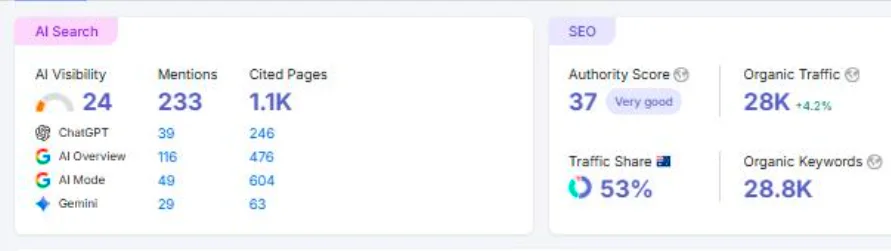
We helped one of our clients, an Australian Shopify brand, that struggled to appear in AI-generated answers. Despite steady organic rankings, its products rarely surfaced in Google AI Overviews or ChatGPT, so competitors captured high-intent shoppers while the brand lost visibility at the discovery stage.
We optimized product and collection pages with clear, structured answers, added the Product, FAQ, and Review schema, and strengthened Shopify metadata and internal linking. We built topical authority through buyer-focused content, improved entity signals across trusted sources, and tracked mentions across ChatGPT, AI Overviews, AI Mode, and Gemini to refine results.
Results:
- AI Visibility score reached 24, with 233 total brand mentions across AI search platforms.
- Google AI Overviews generated 116 mentions, the highest mention count among all AI platforms.
- AI Mode contributed 49 mentions and 604 cited pages, the most cited pages overall.
- ChatGPT mentioned the brand 39 times, citing 246 pages; Gemini added 29 mentions.
- Overall AI search performance recorded 1.1K cited pages across major AI platforms.
- Authority Score stands at 37, rated Very good, strengthening trust signals.
- Organic traffic reached 28K, growing 4.2%, supported by 28.8K ranking keywords.
- The brand captured a 53% traffic share in its Australian target market.
Get your Shopify store ready for AI search
Shopify SEO for AI Overviews requires more than keyword optimization. Ecommerce brands need technically sound stores, clear product information, structured data, useful content, customer reviews, brand mentions, and strong mobile experiences to stay visible as search continues to change.
At SEO Discovery, we help ecommerce brands improve Shopify SEO through technical optimization, product and collection SEO, content marketing, link building, and AI search strategies. Our Shopify-focused approach helps brands build a store that is easier for search engines and AI systems to understand.
Want a professional review of where your store stands? Book a free audit with SEO Discovery or talk to the Shopify specialists at RankMyShopify.
Ready to Strengthen Your Shopify Presence?
Get practical Shopify SEO guidance from SEO Discovery experts.
FAQs about Shopify SEO for AI Overviews
Yes. Shopify stores can appear in Google AI Overviews when their pages are crawlable, indexable, relevant, and useful. Clear product information, structured data, original content, and strong topical relevance can help Google identify suitable sources.
Make product pages easy to interpret by adding detailed descriptions, specifications, sizing, materials, comparisons, FAQs, reviews, and relevant structured data. Answer common buying questions directly so search systems can identify useful information.
Structured data helps search engines interpret product information such as names, prices, availability, reviews, and identifiers. It does not guarantee AI Overview citations, but accurate markup can make important ecommerce information easier to process.
Not necessarily. Start by improving existing product, collection, comparison, FAQ, and buying-guide pages. Clear answers, specific product information, useful evidence, and logical internal linking can serve both traditional search and AI-powered search.
Product pages, collection pages, buying guides, comparison content, FAQs, and informational articles can provide useful sources. Content is more suitable when it answers specific shopper questions with clear, factual, and product-related information.
Track citations in AI Overviews, impressions and clicks from relevant queries, branded searches, referral traffic from AI platforms, and organic conversions. Combining these signals provides a broader view than traditional keyword rankings alone.
RankMyShopify focuses specifically on Shopify and Shopify Plus stores, offering services including technical SEO, content, link building, and AI-search visibility. The agency says it has worked exclusively with Shopify since 2009 and serves 500+ Shopify brands.
Yes. AI Overviews change how shoppers find information, but traditional SEO fundamentals still matter. Crawlability, relevant content, product data, technical performance, internal links, and authority help search systems access and interpret your Shopify store.