

Objective
This guide breaks down how a modern B2B SaaS marketing strategy works in 2026: ICP, channels, AI search visibility & the metrics that predict revenue.
A working B2B SaaS marketing strategies program now has to win visibility in AI answers, not just Google rankings.
Buying committees run six to ten stakeholders deep, and they loop back through decisions instead of moving in a straight line.
Net Revenue Retention is a marketing metric now. Acquisition without retention is a leaking bucket.
Channel choice depends on deal size and GTM motion, not on what’s trending on LinkedIn this month.
CAC payback period and LTV to CAC ratio matter more than traffic or MQL volume ever did.
Grow Your B2B SaaS Business With SEO Discovery, starting at $250/month.
Most software companies are executing a B2B SaaS marketing plan from 2022 in which their first touchpoint was Google. It’s problematic now that the first stop is an AI assistant that summarizes your category before your homepage ever loads.
Then how is B2B SaaS marketing done in 2026? By marketing your subscription software in a manner that generates qualified leads and recurring revenue instead of traffic. And the thing that changed is the research that precedes it.
Did You Know?
68% of B2B buyers already have a preferred vendor before formally evaluating solutions, and that vendor wins 80% of the time, according to Forrester research.
This guide walks through what a rebuilt B2B SaaS growth strategy looks like this year and the B2B SaaS growth marketing strategies behind it: the funnel, the channels, the AI search layer, and the metrics that prove any of it worked.
Table Of Contents
- What Is B2B SaaS Marketing?
- How B2B SaaS Marketing Changed
- Why Update Your Strategy Now?
- How Do You Build a B2B SaaS Marketing Plan?
- Demand Generation vs Demand Capture
- How Do You Rank in AI Search?
- What Metrics Predict Revenue?
- How Do Sales and Marketing Align?
- A B2B SaaS Case Study
- B2B SaaS Marketing Trends 2026
- Common B2B SaaS Marketing Mistakes
- Frequently Asked Questions About B2B SaaS Marketing Strategy
What Is B2B SaaS Marketing?
B2B SaaS marketing is how subscription software companies attract, convert, and retain business customers across a full lifecycle. Unlike a one-time purchase, a SaaS sale is the start of a relationship, not the end of one
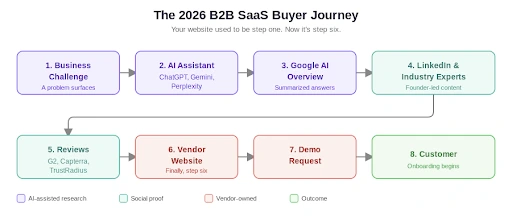
Three things make this model different from marketing in any other B2B category:
What Has Changed | Its Significance |
Buying group is large | Six to ten stakeholders typically weigh in, from the end user to finance to IT security |
Journey is not linear | Gartner’s six “buying jobs” get revisited; ~90% of buyers loop back through at least one before signing |
Discovery starts before your site | A buyer may ask an AI assistant to compare tools in your category before searching your brand name |
There are two audiences reading every asset you publish today. A human deciding on fit and a language model deciding whether to cite you at all.
How B2B SaaS Marketing Changed
Factor | Old Approach (Pre-2024) | 2026 Approach |
Discovery starting point | Google search | AI assistant summary, then search |
Content goal | Rank for keywords | Rank and get cited in AI answers |
Funnel shape | Awareness, consideration, decision | Awareness, AI search, evaluation, trial, expansion |
Core metric | Traffic, MQLs | CAC payback, NRR, pipeline sourced |
Review platforms | Nice to have | Trust signal for humans and AI systems alike |
Retention | Customer success owns it | Marketing owns a real share of it |
Why Update Your Strategy Now?
The difference between organizations succeeding in 2026 and falling behind is direction, not effort. Organizations produce the same amount of content as two years ago, but more of it is never seen by a human being since it is not optimized for AI indexing and referencing.
Prospects continue to land on websites and ask for demonstrations, but the short list of vendors deemed worthy of the attention is based on their initial impressions. Content that is unclear or out-of-date does not give an AI assistant anything specific to cite, leaving the competitor with better content as the winner.
Three trends are forcing the update:
Force | Effect |
AI-assisted research | Now an early funnel stage, not a fringe behavior |
Harder-to-reach committees | One generic message no longer lands with every stakeholder |
Recurring revenue math | Churn compounds against every dollar already spent on acquisition |
How Do You Build a B2B SaaS Marketing Plan?
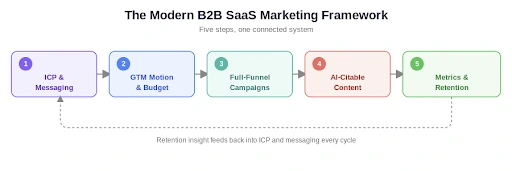
Step 1: Define Your ICP and Message Every Stakeholder
Stop writing one message and hoping it lands with everyone. Document your Ideal Customer Profile with specifics, not a vague aspirational persona:
ICP Component | Question to Answer |
Industry | Which sectors benefit most from the product? |
Company Size | Startup, SMB, mid-market, or enterprise? |
Buying Committee | Who actually approves the purchase? |
Existing Tech Stack | What tools does this account already run? |
Primary Challenges | What is slowing their growth right now? |
Purchase Triggers | What event creates buying intent? |
Each stakeholder inside that account is hiring your product to do a different job, so each one needs a different angle on the same value proposition. Sell outcomes, not features:
- Weaker: “AI-powered workflow automation platform.”
- Stronger: “Saves 12 hours a week of manual administrative tasks and allows your team to close deals faster.”
The latter addresses the only thing that matters to a purchasing committee: How will this solution help the business?
Step 2: Match Channels to Your GTM Motion and Budget
Your B2B SaaS growth strategy should follow your sales motion, not the other way around.
GTM Motion | Marketing Focus | Example |
Product-led (PLG) | In-app activation, self-serve onboarding | Slack, Notion, Figma |
Sales-led (SLG) | Case studies, ROI calculators, outbound | Enterprise software |
Hybrid | Self-serve plus sales-assisted expansion | Most mid-market SaaS |
Stage | Organic / Compounding | Paid / Experimental |
Under $1M ARR | 60-70% | 30-40% |
Scaling | 40-50% | 50-60% |
This split is one of the key considerations for sustainable investing in early B2B SaaS. Compounding channels are cheap to start and expensive to rebuild if you neglect them. Top marketing tactics for SMB 2026 include founder-led LinkedIn content, referral programs once retention is solid, and G2 reviews, which are now a trust signal for humans and AI alike.
“The B2B SaaS teams pulling ahead this year aren’t spending more. They’re spending on fewer channels, chosen deliberately.”
— Shweta Gupta, B2B SaaS Strategist, SEO Discovery
Step 3: Run a Full-Funnel B2B SaaS Marketing Campaign
A single B2B SaaS marketing campaign touches every stage of awareness, not just the bottom of the funnel:
Funnel Stage | Content Type |
Problem aware | Industry trend pieces, frameworks, original research |
Solution aware | Comparison content, “how to evaluate” guides |
Product aware | Demos, ROI calculators, customer proof |
Ready to buy | Pricing clarity, onboarding previews, clear next step |
This is also where marketing B2B SaaS teams build a comprehensive B2B content marketing engine, not one-off posts. ABM makes sense when the deal size is big enough to justify the manual effort, especially in regulated verticals. A B2B fintech SaaS marketing campaign strategy for 2026 typically leans more heavily on ABM than a horizontal SMB tool would, since fintech committees are larger and require content tailored for compliance stakeholders.
Depending on a single channel for your SaaS B2B marketing strategy is a risk. One built over three or four channels keeps churning out a pipeline, even when one is underperforming.
Demand Generation vs Demand Capture
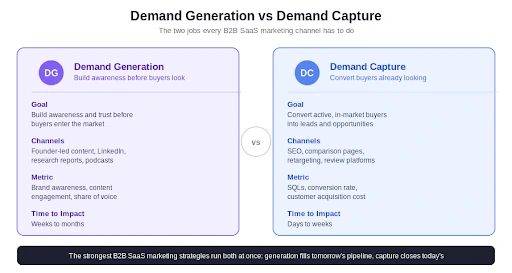
Every channel listed above serves one of two purposes. Confusing the two jobs is why some teams spend heavily and still see a flat pipeline.
Demand Generation | Demand Capture | |
Goal | Build awareness before buyers are looking | Convert active, in-market buyers |
Channels | Founder content, LinkedIn, research reports | SEO, comparison pages, retargeting |
Metric | Brand awareness, content engagement | SQLs, conversion rate, CAC |
Time to impact | Weeks to months | Days to weeks |
The strongest B2B SaaS marketing strategies run both at once. Demand generation fills tomorrow’s pipeline; demand capture closes today’s.
How Do You Rank in AI Search?
This is the step most teams still skip. Getting cited in an AI-generated answer isn’t separate from good content strategy. It’s what good content strategy looks like now.
AEO (Answer Engine Optimization) and GEO (Generative Engine Optimization) describe the same discipline: structuring content so a generative system can extract a clear answer from it.
Mechanic | What It Does |
Direct-answer openers | Answers the core question in the section’s first 1-2 sentences |
Specific language | Names real products, data, and competitors instead of vague claims |
Entity-Based SEO | Anchors content to named, recognizable entities AI systems can attach to your brand |
Fresh documentation | Keeps comparison and how-to pages current, since stale content loses citations fast |
Zero-Click Search Optimization and Voice Search Optimization | Lets the answer stand on its own without requiring a click-through |
Concept | Role in AI Citation |
NLP and Generative Search | Evaluate Contextual Relevance, how well content answers the surrounding question |
Topical Authority | Built across a full content cluster, not one standalone article, earning consistent citations |
AI Agents | Increasingly do the research work buyers used to do manually |
AI Visibility and LLM Optimization | Measurable outcomes now, tracked through AI search optimization and LLM SEO services |
A cluster on customer onboarding, for example, might pair a beginner’s guide with an integration walkthrough, an ROI calculator, and customer stories, all interlinked.
See How AI Recommends Your Brand
Find out what ChatGPT, Perplexity, and Google AI Overviews say about your business.
What Metrics Predict Revenue?
Metric | What It Measures | Healthy Benchmark |
LTV to CAC ratio | Revenue earned vs. cost to acquire | 3:1 minimum, 5:1 strong |
CAC payback period | Months to recover acquisition cost | Under 12 months |
Monthly churn rate | Customers lost per month | Below 2% for SMB SaaS |
Net Revenue Retention | Revenue retained plus expansion, minus churn | 100%+ healthy, 120%+ strong |
Pipeline sourced | Revenue potential tied to a channel or content cluster | Tracked per channel, not blended |
Vanity metrics like raw traffic or MQL count look good in a slide deck and say little about real growth. Stop reporting on vanity metrics, and instead link every channel to revenue. A strong B2B SaaS marketing strategies program also includes onboarding and expansion messaging for current accounts because growing an existing customer is far cheaper than acquiring a new one.
How Do Sales and Marketing Align?
If marketing is all about lead volume and sales is only concerned with closed revenue, then none of these assumptions hold up. That mismatch is where the budget quietly leaks.
Marketing Owns | Sales Owns | Shared Goal |
Awareness and content | Qualifying opportunities | Pipeline growth |
Educating buyers | Handling objections | Faster sales cycles |
Demand generation | Closing deals | Revenue |
Case studies and proof | Feedback on real objections | Sharper messaging |
Feed sales objections and lost-deal reasons straight back into your content calendar. It is the fastest way to fix weak messaging without waiting for the next quarterly review.
A B2B SaaS Case Study
Here’s what six months of the framework above looked like for one of our B2B SaaS clients, pulled straight from Google Search Console.
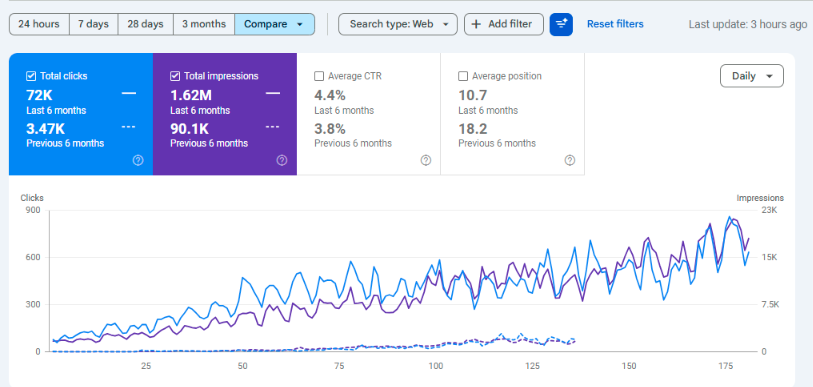
Metric | Previous 6 Months | Last 6 Months |
Organic clicks | 3,470 | 72,000 |
Organic impressions | 90,100 | 1.62 million |
Average CTR | 3.80% | 4.40% |
Average position | 18.2 | 10.7 |
It is the position change that was really significant: from 18.2 to 10.7. The things that made the difference: topic clusters with buyer intent questions, technical SEO audit and optimization, and restructure of content for direct answer extraction.
This wasn’t a result of just one successful piece of content. It’s the result of doing all three strategies in tandem with each other.
B2B SaaS Marketing Trends 2026
The B2B SaaS marketing trends worth actually paying attention to this year, not the ones that make for a flashy LinkedIn post:
Trend | What It Means |
AI search visibility grows | Becomes an earlier funnel stage, ahead of the direct website visit |
First-party intelligence rises | Support tickets and sales calls replace static personas |
Trust signals outweigh reach | Reviews and documentation quality carry more weight than paid spend |
Retention gets dedicated budget | No longer leftover budget after acquisition is funded |
Full-funnel ABM spreads | Real-time intent tracking moves from enterprise into mid-market |
Common B2B SaaS Marketing Mistakes
Mistake | Why It Costs You |
Targeting everyone | A message built for every buyer resonates with none of them |
Chasing traffic over revenue | Traffic without qualified pipeline is a vanity number |
Ignoring bottom-funnel SEO | Comparison and alternatives pages convert differently, and skipping them hands that traffic to a competitor |
One message for every stakeholder | Finance, IT, and end users need different proof points from the same pitch |
No retention strategy | Strong acquisition cannot offset a leaky base |
Ignoring AI search entirely | Content a generative system can’t parse or trust doesn’t get cited, no matter how well it ranks on Google |
Build a Strategy That Actually Compounds
A modern B2B SaaS marketing strategy isn’t a checklist of channels. It’s a system: a clear ICP, messaging built for every stakeholder in the room, content a human and an AI assistant can both trust, and a retention motion that protects everything acquisition worked to build.
Most teams don’t need more tactics. They need someone to connect the ones they have to actual pipeline. That’s the gap SEO Discovery fills. A digital marketing agency and search engine optimization company that provides a full range of B2B marketing services. An organic growth strategy based on real content optimization, ethical link building, digital PR services that get real mentions, and scalable SEO solutions combined with lead generation services that deliver a sales-qualified pipeline, not raw form fills.
Ready to Grow Your SaaS Pipeline?
Discover what’s working, what’s missing, and what to fix.
Frequently Asked Questions About B2B SaaS Marketing Strategy
A plan for acquiring, converting, and retaining business customers for subscription software, covering positioning, channels, content, and revenue metrics.
B2B SaaS involves buying committees, longer sales cycles, and recurring revenue. B2C relies on faster, more individual purchase decisions.
No single best channel. Content-led SEO, ABM, and LinkedIn thought leadership perform well together, based on deal size and motion.
Buyers increasingly ask AI tools to summarize and compare vendors before visiting a website, so content must be structured for clear, citable answers.
100 percent or higher is healthy. Leading SaaS companies in 2026 target 120 percent or above.
Paid and outbound channels show traction within weeks. SEO, content, and AI search visibility typically take three to six months to compound.
Only about 5 percent of buyers are actively shopping at any moment. The other 95 percent need brand and educational content ready for when they are.
Yes, one of the most sustainable, compounding investments available, even though it pays off slower than paid channels.
A targeted approach that treats specific high-value accounts as a market of one, using personalized content and outreach instead of broad campaigns.
Track CAC payback period, LTV to CAC ratio, NRR, and pipeline sourced per channel, not traffic or MQL volume alone.