

Objective
This blog explains how AI optimization for ecommerce helps brands appear in ChatGPT, Gemini, and Perplexity. It covers the 10-step strategy, common mistakes, tracking methods, and typical AI SEO costs.
- Make product information clear, accurate, detailed, and easy for AI platforms to understand.
- Allow AI crawlers to access important product and category pages.
- Add structured data to help AI understand products, reviews, ratings, and FAQs.
- Build brand authority through trusted reviews, mentions, citations, and external sources.
- Research real shopper questions to identify valuable AI search opportunities.
- Keep pricing, availability, reviews, and product information regularly updated.
- Track AI mentions, citations, referrals, and conversions to measure visibility.
Improve Product Visibility Across AI Platforms with Ecommerce AI SEO Services from SEO Discovery at just $250/month.
AI optimization for ecommerce helps brands in achieving greater visibility on AI platforms like ChatGPT, Gemini, and Perplexity by emphasizing clear, useful information over keyword stuffing. AI platforms want correct facts, trustworthy sources, and helpful content. Brands need to provide better product details, gather trusted reviews, and provide clear answers.
Did You Know?
Google Search Central recommends using structured data to clearly show your ecommerce return policies and loyalty programs to search engines.
As shoppers increasingly use AI platforms to discover and compare products, ecommerce brands could lose visibility if they depend only on traditional search. Generative AI optimization for ecommerce is enabling brands to remain visible in these new search experiences, affect buying decisions, and remain competitive as AI-powered shopping keeps on expanding.
In this guide, we will explain what ecommerce AI SEO means, how AI platforms select products, the complete 10-step playbook, common mistakes to avoid, and how to track your results, so keep reading till the end.
Table Of Contents
- What is ecommerce AI SEO, and how is it different from traditional SEO?
- How ecommerce AI optimization help products get chosen across platforms?
- How to track generative AI optimization ecommerce results?
- What are the common ecommerce AI optimization mistakes to avoid?
- How much do agencies charge for ecommerce AI SEO?
- How we helped an ecommerce brand get cited across AI search platforms
- Turn AI search into more ecommerce sales with SEO Discovery
- FAQs about AI optimization for ecommerce
What is ecommerce AI SEO, and how is it different from traditional SEO?
Ecommerce AI SEO is the process of optimizing an online store for AI search engines such as ChatGPT, Gemini, and Perplexity. This allows AI to comprehend products, brands, and content and to confidently present, summarize, cite, or suggest ecommerce businesses to prospective customers.
Below are the key differences between ecommerce AI optimization and traditional SEO:
Factor | Traditional SEO | Ecommerce AI SEO |
Search Platform | Google and Bing | ChatGPT, Gemini, Perplexity, and AI search experiences |
Optimization Focus | Keywords, rankings, backlinks, and technical SEO | Entities, product data, citations, structured content, and brand authority |
Content Approach | Targets keywords and traditional search intent | Provides clear, factual, conversational information AI can understand and reuse |
Authority Signals | Backlinks, domain authority, reviews, and E-E-A-T | Brand mentions, third-party sources, reviews, citations, and consistent brand information |
Primary Goal | Increase rankings, clicks, and organic traffic | Increase AI visibility, citations, recommendations, and product discovery |
Ecommerce SEO services can combine both approaches, helping brands strengthen traditional search performance while preparing their product pages, content, and brand signals for AI-driven discovery.
How ecommerce AI optimization help products get chosen across platforms?
Products can become more visible across ChatGPT, Perplexity, and Gemini when product information is adapted to how each platform discovers, evaluates, and presents recommendations. Gen AI optimization for digital marketing ecommerce websites focuses on making product data accurate, accessible, and easy for AI systems to understand and interpret.
Below are the three key sources AI assistants use for product information.
- Live web retrieval: AI assistants access relevant webpages to retrieve current product information, provided the content is crawlable and accessible. Strong ecommerce on-page optimization ensures important product details remain clear and accessible.
- Training data: Language models learn from previously collected information, allowing established brands and products to influence future AI-generated responses.
- Structured data feeds: Organized product data gives AI systems clear details about products, including pricing, availability, specifications, and attributes.
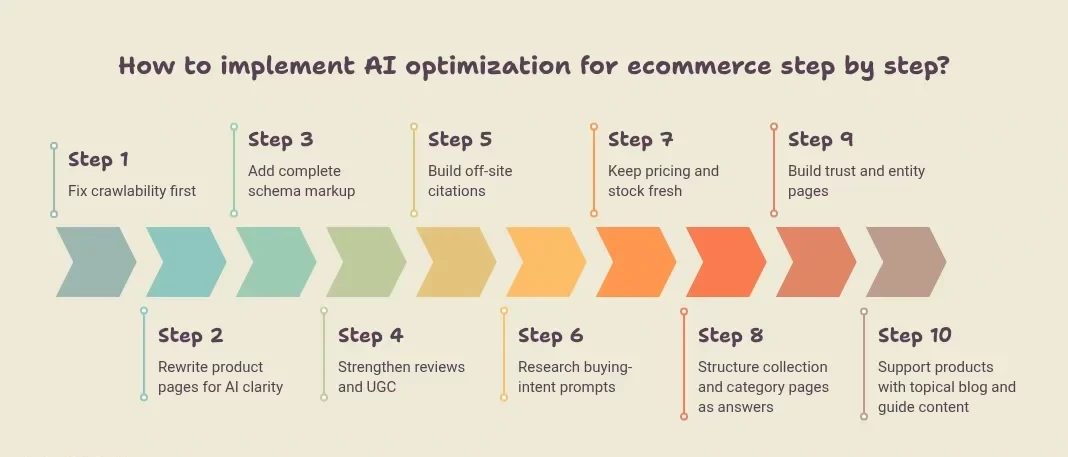
How to implement AI optimization for ecommerce step by step?
The following steps cover the key factors for AI e-commerce optimization, helping brands improve product visibility, attract customers, and increase online sales through AI search.
Step 1: Fix crawlability first
If you want to know how to start AI e-commerce optimization, the first step is to check your robots.txt file and make sure crawlers like GPTBot, ClaudeBot, and PerplexityBot can crawl the right pages. Blocking these crawlers may prevent AI platforms from finding, understanding, and potentially citing your ecommerce content.
Pro tip: Open your robots.txt file, search for AI bot names, delete any “disallow” lines, then add an llms.txt file listing your public, citable pages. |
Step 2: Rewrite product pages for AI clarity
Use simple, specific product information instead of vague words like “lightweight” or “comfortable.” Mention the exact weight, material, size, and best use. Artificial intelligence systems don’t understand marketing language; AI just understands clear facts, so generative engine optimization is important for helping AI platforms comprehend and utilize product details easily.
Pro tip: Add a 40–60-word answer block at the top of each product page covering who the product suits, its key specifications, and one useful comparison. |
Step 3: Add complete schema markup
Add Product, FAQPage, Review, and AggregateRating schema to relevant ecommerce pages. Structured data allows artificial intelligence systems to understand relevant information such as product details, reviews, ratings, and FAQs without any guesswork. This makes generative AI optimization ecommerce more effective by giving AI platforms clear, organized signals about your content.
Pro tip: Check each page using Google’s Rich Results Test to see what schema fields are missing, then fill them in through your platform’s app or a JSON-LD snippet. |
Step 4: Strengthen reviews and UGC
Collect detailed customer reviews instead of generic praise. Reviews that mention specific uses, features, experiences, or results give AI systems useful information to understand your products. Strong online reputation management also helps build trust by creating a consistent and credible picture of your brand across customer feedback and review platforms.
Pro tip: Email customers 10 days after delivery and ask one simple question, such as “How did you use this product?” to encourage detailed reviews. |
Step 5: Build off-site citations
Get your products mentioned on Reddit, YouTube, comparison sites, and relevant category roundups. These outside mentions help AI platforms learn more about your products and brand. AI optimization for ecommerce should include trusted third-party sources that share real customer opinions, product uses, and helpful recommendations.
Pro tip: Join two relevant subreddits, answer real customer questions honestly for a month, then host an AMA once you’ve built credibility. |
Step 6: Research buying-intent prompts
Use similar words consumers would use to naturally ask real customer questions to ChatGPT and Perplexity. See which brands and products show up in the answers and how many times they are mentioned. ChatGPT SEO and Perplexity SEO can uncover opportunities where your products are absent or poorly represented in AI-generated recommendations.
Pro tip: Build a simple sheet with columns for prompt, AI platform, current cited brand, and your opportunity score to prioritize action. |
Step 7: Keep pricing and stock fresh
Keep your product feed up to date, so the AI agents are getting the right pricing, availability information, and product details. Old information may lower customer confidence and result in poor shopping experiences. Using an AEO AI approach helps e-commerce brands keep their product data accurate and prepared for AI-powered search.
Pro tip: Set a weekly sync reminder for fast-moving SKUs and a monthly check for evergreen products through your merchant feed dashboard. |
Step 8: Structure collection and category pages as answers
Add a 150–250-word introduction to every collection page that explains the exact use case instead of showing only a product grid. Relevant link building services can help these collection pages gain useful mentions and links from other websites, making them easier to discover.
Pro tip: Write a short paragraph about the product use, add a 3-row comparison table, and include FAQ schema for the two main questions. |
Step 9: Build trust and entity pages
Keep your About Us, founder bio, and policy pages clear and informative. Share your experience, business details, and important policies so shoppers and AI platforms can see that your brand is genuine. AI e-commerce optimization for small businesses and large businesses should make these trust signals easy to find and understand.
Pro tip: Rewrite your About page with the founder’s name, years in business, and one real credential, then link it from every product page footer. |
Step 10: Support products with topical blog and guide content
Publish buying guides and comparison posts that answer real shopper questions in depth. Link them internally to relevant collection and product pages to connect related topics and show expertise. You can improve your ranking through content marketing by providing helpful information that promotes product discovery and helps AI platforms learn about your expertise.
Pro tip: Use AI content optimization to build an online retail guide that responds to common shopper questions, evaluates products, explains use cases, and lets customers make informed buying decisions. |
Ready to Improve Your AI Visibility?
SEO Discovery experts improve product visibility across leading AI platforms.
How to track generative AI optimization ecommerce results?
Measuring AI visibility shows whether your products appear in relevant AI answers and recommendations. Brands can track mentions, citations, product recommendations, and visibility changes across ChatGPT, Gemini, Perplexity, and other AI platforms. This data helps identify what is working and where further optimization is needed.
For AI optimization for digital marketing ecommerce websites, monitor these key performance signals:
- Brand mentions: Check ChatGPT, Gemini, and Perplexity for your brand and products across relevant customer prompts.
- AI citations: Review which pages and external sources AI platforms cite when answering product-related questions.
- Referral traffic: Use GA4 to identify website visits coming from AI platforms and compare their engagement and conversions.
What are the common ecommerce AI optimization mistakes to avoid?
Avoid these common mistakes to make generative AI optimization ecommerce more effective, support crawlability improvements, strengthen credibility, and increase your chances of appearing in AI-generated product recommendations.
- Blocked crawlers: Blocking AI crawlers will prevent your ecommerce pages from being used in AI-generated responses and product recommendations.
- Hidden content: Hiding product specifications and FAQs in JavaScript may prevent artificial intelligence systems from accessing important information.
- One-time GEO: AI search platforms and user behaviour are constantly changing, so treating ecommerce AI SEO as a one-time job can lead to lost visibility.
- Stale reviews: If you don’t pay attention to the freshness of the reviews, it will impact your brand’s trustworthiness and people’s confidence in AI recommendations.
- Platform overload: Targeting every AI platform equally wastes resources instead of focusing on high-intent searches that drive conversions.
How much do agencies charge for ecommerce AI SEO?
Agency pricing for ecommerce AI SEO varies based on website size, product count, competition, technical needs, and ongoing strategy. AI e-commerce optimization consulting can help businesses identify the right level of support and choose services based on their specific AI search goals.
Ecommerce AI SEO Service | Typical Monthly Cost |
AI SEO Audit | Free–$50+ |
Small Ecommerce Website | $200–$450+ |
Large Ecommerce Website | $300–$800+ |
Custom Ecommerce Website | $350–$1000+ |
Want Proven Ecommerce AI Results?
Our team builds strategies that improve AI visibility and citations.
How we helped an ecommerce brand get cited across AI search platforms
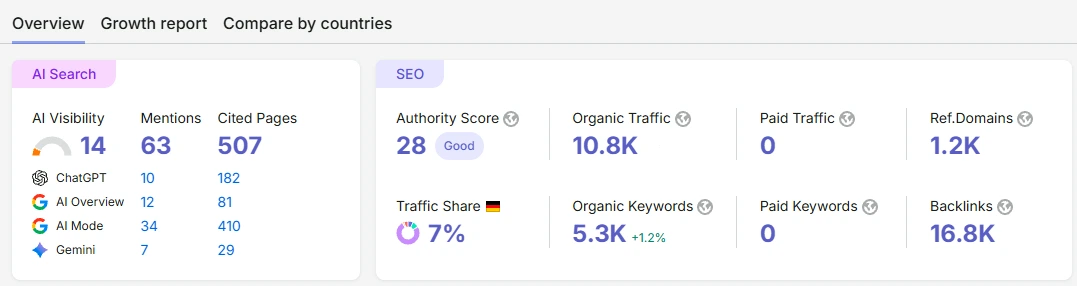
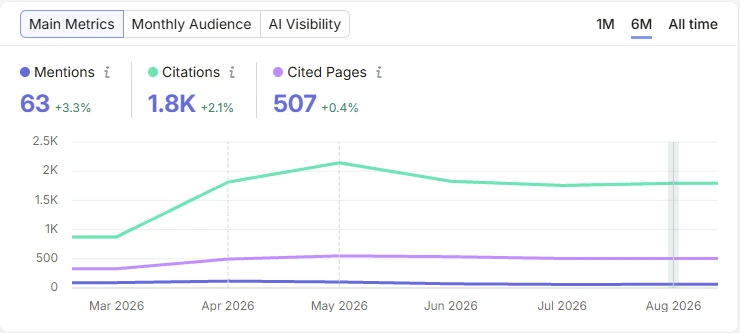
We helped one of our ecommerce clients who struggled with almost zero visibility inside AI search tools. Their products never appeared when shoppers asked ChatGPT, Gemini, or Google AI Overview for recommendations, despite decent traditional Google rankings and steady organic traffic.
We audited their product pages, fixed missing schema markup, and rewrote PDP copy with direct, fact-dense answers. We also built off-site citations through Reddit threads, review platforms, and category roundups, then tracked prompt-level visibility weekly across every major AI engine.
The Results:
- Reached an AI Visibility score of 14, with real citations across all major engines
- Earned 63 total brand mentions across ChatGPT, AI Overview, AI Mode, and Gemini
- Got cited on 507 individual pages, up 0.4% in the latest reporting period
- Secured 182 cited pages specifically through ChatGPT alone
- Google’s AI Mode cited the brand on 410 separate pages
- AI Overview referenced the brand across 81 cited pages
- Citations climbed to 1.8K total, growing 2.1% in the tracked period
- Grew organic traffic to 10.8K sessions with an Authority Score of 28
- Built 16.8K backlinks from 1.2K referring domains
Turn AI search into more ecommerce sales with SEO Discovery
Ecommerce brands can’t rely only on traditional rankings to connect with shoppers anymore. Ecommerce AI optimization enhances product data, content readability, reviews, citations, and technical accessibility to build more possibilities for finding, recommendations, and sales across AI platforms.
SEO Discovery enables ecommerce brands to navigate AI-driven search by bridging the gap between traditional SEO and generative search visibility. Our AI SEO services target product optimization, structured data, brand authority, content, and AI visibility to enable businesses to attract shoppers across emerging search experiences.
Grow your brand with ecommerce AI SEO. Contact SEO Discovery today for expert guidance.
Need a reliable ecommerce SEO partner?
Our experts provide reliable strategies tailored to your ecommerce growth goals.
FAQs about AI optimization for ecommerce
Ecommerce AI SEO means optimizing product pages, content, structured data, and brand signals so AI platforms like ChatGPT, Gemini, and Perplexity can understand, cite, and recommend your products in relevant shopping searches.
Yes. Traditional SEO still matters because strong rankings, crawlability, quality content, backlinks, and authority help AI platforms discover, understand, and cite trustworthy ecommerce pages in their answers.
Use clear product schema, collect fresh and detailed reviews, and earn mentions from trusted websites, Reddit, YouTube, and expert roundups. An AEO AI approach for ecommerce brands helps make product information easier for ChatGPT to understand, trust, and cite.
Start by making product information accurate, improving crawlability, adding structured data, collecting detailed reviews, and creating helpful content. Follow the best practices for AI SEO optimization to make products easier for AI platforms to understand, evaluate, cite, and recommend.
Costs vary based on website size, product count, competition, technical needs, and service scope. Businesses can pay for AI e-commerce optimization services through one-time audits, monthly packages, or customized plans based on their AI visibility goals.
Start with Perplexity because it clearly displays citations, making visibility easier to track and evaluate. Once you understand your presence there, expand your ecommerce AI optimization efforts across ChatGPT, Gemini, and other AI search platforms.
Yes. AI e-commerce optimization for small businesses can improve product visibility, strengthen brand credibility, and help smaller ecommerce stores appear in AI-generated recommendations without competing solely on traditional search rankings.
Most brands may see early AI citations within 60–90 days after improving schema, content structure, reviews, and external mentions. AI e-commerce optimization consulting can help identify gaps and prioritize changes that support faster, sustainable AI visibility.
SEO Discovery combines ecommerce SEO expertise with AI-focused strategies to improve product visibility across ChatGPT, Gemini, Perplexity, and traditional search while building a stronger foundation for long-term growth.