

Objective
This blog looks at how search engines really work, how AI is changing the way they operate, and why your business needs a new visibility strategy in 2026.
For over 25 years search engines have run on the same core mechanics (crawling, indexing, ranking) but AI is rewriting how every layer works
68% of Google searches now end without a single click and that number continues to go up every quarter
Search is moving from short strings of keywords to full conversational questions
Visibility today means getting cited inside an AI answer, not just ranking on page one.
AEO and GEO are the new disciplines businesses need to run with traditional SEO
Get Your Website Ready for AI Search with SEO Discovery, starting at $250/month.
Type a question into Google today, and something strange happens. You can hardly get the words out before an answer is sitting right at the top of the page, fully written. No click. No scrolling down ten blue links. Just an answer.
AI search is changing everything because it replaces browsing and clicking with a single synthesized answer drawn from multiple trusted sources at once. With more and more searches never reaching a traditional results page, businesses have to compete for a citation in that answer, not a click.
That is why search engine behavior has changed more in the last two years than in the previous 20 years combined. AI is rewriting the plumbing underneath search, the crawling, the indexing, and the ranking. Businesses that don’t get the new mechanics are vanishing in ways their old SEO reports don’t even measure.
Did You Know?
According to SparkToro and Similarweb’s June 2026 study, 68% of US Google searches now end without a click, up from 60% just two years ago. That’s not a glitch. That’s the new baseline.
This post covers search engine basics that many people miss, explains what changes when AI enters the picture, and outlines what your business needs to do about it starting now.
Table Of Contents
- What Is a Search Engine?
- The Evolution from Traditional Search to AI Search
- How Does a Search Engine Work, Step by Step?
- How AI Search Is Changing Site Search and Web Search
- What's Actually Different About AI Search in 2026?
- Why Are Zero-Click Searches Taking Over?
- How Do You Build Authority AI Actually Trusts?
- What Happens When AI Agents Start Searching For You?
- What AI Visibility Actually Looks Like
- A Practical Framework for Showing Up in AI Search
- Ready to Be the Answer, Not Just a Link?
- Frequently Asked Questions About Search Engines and AI Search
What Is a Search Engine?
A search engine is a program that searches, sorts, and ranks information from all over the internet so people can find what they need in seconds. That’s it. No magic, just organization on a large scale.
Search engine basics start with one question: Why is a search engine important in the first place? Before search engines, finding information on the web was a matter of either navigating directories manually or guessing web addresses. Search engines fixed that by creating a searchable map of the entire internet.
The importance of search engines is everywhere in daily life. You use it to find a recipe, compare flight prices, or find out what that weird noise your car is making is. Businesses depend on them just as much. Every customer that types a question into a search bar is a potential lead, and being there in the moment is often the difference between winning and losing the sale.
So how many search engines are there? More than you’d think. Google dominates with the largest share globally, but Bing, Yahoo, DuckDuckGo, Baidu (dominant in China), and Yandex (widely used in Russia) all run their own indexes. And if you throw in AI-native tools like Perplexity, Gemini, and ChatGPT, which now serve as search engines in their own right, the scene looks a lot more crowded than most people think.
The fundamental features of search engine platforms are consistent across all of them:
- A crawler that discovers pages
- An index that catalogs what it discovers
- A ranking system that decides what to display first
- A results interface that displays answers to the user
The purpose of a search engine hasn’t changed since the 1990s, i.e., match intent to information as fast and accurately as possible. What has changed is how that match gets made.
The Evolution from Traditional Search to AI Search
Before going deeper into mechanics, here’s the fastest way to see what’s actually shifting:
Aspect | Traditional Search | AI Search |
Output | A list of 10 blue links | One synthesized answer |
Query style | Short keywords (“best laptop 2026”) | Full conversational questions |
Click behavior | User clicks through to read | Often zero clicks, answer is on the page |
Ranking signal | Backlinks, relevance, on-page SEO | Citation, authority, structured clarity |
Winning metric | Page one ranking | Being named inside the answer |
This table alone accounts for most of the anxiety in the marketing world today. Getting to number one on Google guaranteed traffic. It promises a spot on the source list in 2026 but doesn’t guarantee a click.
Curious Where Your Brand Stands Today?
SEO Discovery’s AI-ready website audit shows you exactly what AI tools currently say about your business.
How Does a Search Engine Work, Step by Step?
It’s important to understand the plumbing, because AI has not replaced it. AI builds on this foundation. Here is how google search engine works step by step. It is divided into four core stages:
Stage | What Happens | Why It Matters |
Crawling | Bots scan the web, following links from page to page | If a crawler can’t reach your page, nothing else happens |
Indexing | Discovered pages get stored in a massive searchable database | This is what is search engine indexing in plain terms |
Ranking | An algorithm scores every indexed page against the query | This determines what is the purpose of a search engine ranking system |
Serving | Results (or an AI-generated answer) get displayed to the user | The final step where intent finally meets information |
Let’s unpack some of these terms, because they get thrown around loosely.
What is a search engine index? It’s like a giant library catalog that’s always being updated. It’s not books but web pages that are indexed, not a librarian but algorithms that determine where they go. This is also what is a search-engine database in casual conversation, but technically the index is a specialized data structure built for speed, not a traditional database.
The anatomy of a search engine has several working parts: a crawler, an indexer, a query processor, and a ranking algorithm. These are the main parts of search engine infrastructure, and each piece has to be right for the others to work.
How does a search engine find results then? When you type a query, the engine doesn’t search the live internet in real time. That would take ages. Instead, it searches its pre-built index and runs your query through indexing algorithms that search engines rely on to score relevance, freshness, authority, and dozens of other factors.
Curious about what the functions of a search engine are besides just giving links? Today’s engines also autocomplete queries, correct spelling, personalize results based on location and history, and now generate synthesized answers directly. This evolution has made the search engines’ algorithm design many times more complicated, adding machine learning algorithms on top of the original keyword-matching logic.
One lesser-known variation: how does a meta search engine work? A meta search engine, for example, Dogpile or MetaCrawler, does not build its own index. Instead, it sends your query to many other search engines simultaneously and combines the results. It is a search engine of search engines.
How AI Search Is Changing Site Search and Web Search
What is site search? It’s the search bar you see inside a single website, like an ecommerce store’s product finder. It only searches that one site’s content, using a much smaller, purpose-built index.
The on-site experiences are driven by tools for website search functionality. They are built for narrow intent (find this product, find this article), not for the open-ended intent that Google or ChatGPT has to deal with.
Web search, however, searches the entire Internet. Google’s web search results come from billions of indexed pages across millions of domains, not just one site.
When you enter a query in a search engine like Google, the system performs crawling, indexing, and ranking in a fraction of a second and then displays the closest matches or, now, a generated answer that synthesizes several of those matches at once.
What's Actually Different About AI Search in 2026?
This is where the real change occurs. Traditional search engine optimization was all about one thing: ranking higher on a results page filled with links. AI search optimization is a whole different game: getting cited, quoted, or recommended in an AI-generated answer, even when there is no results page at all.
Here’s why this approach feels so different, a few mechanics tell us:
- Generative Search utilizes natural language processing (NLP) to interpret full sentences and implied meaning, not just keywords.
- Contextual relevance now outweighs exact keyword matches, rewarding content that answers the full question.
- Voice search optimization matters more too, since spoken queries are naturally conversational.
Three things people often confuse, and it’s worth making the distinction, are Google’s old-style search results, AI Overviews (the AI-created summary box above the old-style links) and AI Mode (a completely separate, chat-style search experience with no blue links at all). The AI Overviews still have the supporting links below the summary. Often, AI Mode shows no sources, just an answer and a short list of sources you have to expand to see. Each has slightly different rules for who gets cited, but all three reward the same basic signals: clarity, structure, and trustworthy sourcing.
And it’s not just Google you want to be. Today, people use Perplexity, Gemini, Microsoft Copilot, Reddit, LinkedIn, YouTube, and TikTok to research and discover brands, often before a traditional search ever occurs. You need a modern visibility strategy that appears across the entire map, not just in a single search bar.
What this approach means for your site:
If your content is written well for humans but not well for machines, with buried claims, no clear headers, and no direct answers, you’re now invisible to an increasing share of searches that never even make it to a traditional results page at all.
Publishing Across Multiple Regions or Languages?
SEO Discovery’s international SEO services team makes sure your content holds up for AI crawlers in every market you operate in.
Why Are Zero-Click Searches Taking Over?
The data here is grim. Here’s what’s different in the last two years, in plain numbers:
- In the U.S., 68% of Google searches in early 2026 ended without a click, compared with 60% in 2024.
- When an AI Overview appears, click-through drops even further, with some studies showing an 83% zero-click rate on those queries
- search queries have evolved from short 2 to 3 word phrases to full 10 to 11 word conversational questions
- Brands that appear in AI answers get about 35% more organic clicks than those that rank but do not appear
This is the move from search engine optimization to search everywhere optimization. Goodbye link ranking. Hello showing up as the answer itself, wherever that answer gets delivered.
The practical upside: clicks from AI-driven traffic convert better. Visitors arriving from an AI citation have usually already done their research. They’re not browsing, they’re deciding.
Getting into that smaller, higher-value pool means building topical authority, structuring content around clear entity-based SEO principles, and treating zero-click search optimization and AI visibility as measurable goals, not afterthoughts.
How Do You Build Authority AI Actually Trusts?
AI tools don’t pull random pages. They point to sources that demonstrate consistent, verifiable authority building signals across the web, not just in one website.
Here’s a real world example of what that looks like in practice:
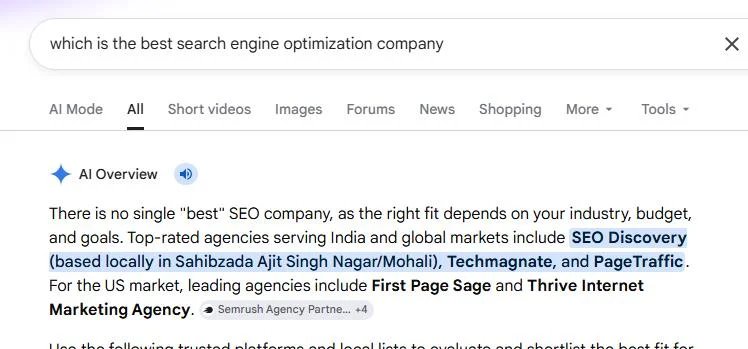
That’s not the kind of citation you get by accident. It is a combination of factors working together:
- Brand mentions on review sites, forums and industry publications (even without a link back to your site)
- Brand authority built through consistent, accurate information appearing in multiple independent places
- AI content optimization on your own site, meaning clear structure and direct answers an AI system can extract confidently
- AI-ready website audit to identify technical blockers such as crawler restrictions or missing structured data
So what does this mean in practice? Imagine two agencies competing. One writes a single blog post about AI search. The other builds a full hub covering AEO, GEO, entity SEO, AI citations, local AI search, and technical SEO for AI, all of which are interconnected. The AI system can connect those signals to one trusted entity much faster than it can connect to one isolated page. That’s the whole idea behind entity-based SEO: to identify brands as reliable, interlinked authorities and not a bunch of individual pages.
This means your site can’t just be one polished page anymore. Artificial intelligence systems verify multiple sources before trusting a person.
Want the Same Kind of Citation for Your Business?
SEO Discovery’s LLM SEO services are built specifically for this.
What Happens When AI Agents Start Searching For You?
The next shift is already underway. Google’s 2026 Search updates featured information agents that run all the time in the background, watching the web for a user and telling them the second something relevant changes. So, no manual search needed.
AI agents are also beginning to directly take over tasks. Now, all of this can happen within the search experience itself: reserving a table, comparing prices, buying a product without ever visiting a business’s website. For businesses, this means visibility must extend to the data level as well. Accurate pricing, clear availability, and structured product information that an agent can understand and respond to in real time.
The timeline is still early. Adoption is measured in single-digit percents of total search volume today. But the pattern is clear, and the companies doing the right groundwork today will have a huge advantage when agentic search becomes the rule rather than the exception.
What AI Visibility Actually Looks Like
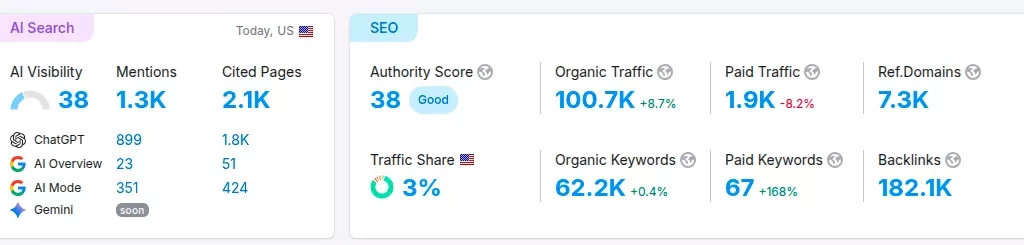
Numbers are more evident than promises. Here is a real-life look at AI visibility and SEO performance data pulled directly from a live tracking dashboard:
The Results:
- Visibility is not restricted to a single tool, as evidenced by 1.3K mentions and 2.1K cited pages on AI platforms. ChatGPT alone accounted for nearly 900 mentions.
- Organic traffic still climbed 8.7%, proving traditional SEO and AI visibility reinforce each other rather than compete.
- Paid keyword growth of 168% alongside strong organic numbers shows investment across every visibility channel at once.
This is exactly what a modern, blended strategy looks like. Traditional SEO builds the foundation. AI visibility work builds on top of it, capturing the buyers who now initiate their research inside a chat window rather than a search bar.
A Practical Framework for Showing Up in AI Search
No need to sacrifice SEO. You need to expand it. Five steps get you most of the way:
- Build connected topic clusters, not isolated posts. Trustworthy depth that an AI system can rely on, far beyond a single article. A hub of interconnected pages covering every angle of your niche.
- Publish original research. If your site has the original source of unique data, surveys, or benchmarks that can’t be copied from a competitor, it will be the original source that artificial intelligence systems point back to.
- Strengthen your presence off-site too. Reviews, forums, industry publications, LinkedIn, and YouTube all feed the same trust signals AI systems check before citing anyone.
- Fix the technical basics. Fast load times, clean schema markup, clear headings, and crawlable architecture make content easier for both search engines and AI systems to read.
- Track AI-specific metrics in addition to traditional ones. Rankings and traffic still matter, but so do AI mentions, citation frequency, and AI Overview appearances.
Check if your website is ready for AI search:
- Comprehensive topic coverage
- Original insights and expertise
- Structured data
- Strong internal linking
- Fresh, updated content
- Mobile-friendly performance
- Consistent brand presence across the web
Ready to Be the Answer, Not Just a Link?
Search isn’t disappearing. It’s splitting into two paths: one where you still need to rank, and one where you need to be cited and trusted enough that an AI system will recommend you by name. Most businesses are only prepared for the first track.
SEO Discovery builds strategies for both, from foundational technical SEO to full AI search optimization and LLM SEO services, helping brands show up wherever their customers are actually searching.
If your business isn’t showing up in AI answers yet, that’s fixable. Talk to SEO Discovery, a digital marketing agency, about an AI visibility audit and see exactly where you stand today.
The question used to be “How do I rank #1?”
Now it’s “Will AI trust my brand enough to recommend it?”
Find Out Where You Stand
Book a free AI visibility consultation with SEO Discovery.
Frequently Asked Questions About Search Engines and AI Search.
Site search is the internal search bar on a single website that helps users find content or products within that site only.
Dozens exist globally, but Google, Bing, Yahoo, Baidu, Yandex, and DuckDuckGo dominate, alongside newer AI-native tools like ChatGPT and Perplexity.
Search engines connect people to information instantly, and for businesses, they’re often the first point of contact with a potential customer.
Indexing is the process of storing and organizing crawled web pages into a searchable database so they can be retrieved quickly.
A meta search engine sends your query to multiple other search engines at once and combines their results into a single list.
It’s the structured index where a search engine stores information about every page it has crawled, used to generate fast, relevant results.
It decides which results appear first by scoring pages on relevance, authority, freshness, and dozens of other quality signals.
AI Overviews show an AI summary above traditional search links. AI Mode is a separate, fully conversational search experience with no traditional link list at all.