

Objective
Explain the difference between SEO and content marketing, show how technical SEO and content SEO work together in an AI-powered search environment, and guide you in choosing the best course of action for your business.
- Technical SEO helps Google and AI search systems find and understand your website. Content SEO gives them useful information to show or cite.
- Core Web Vitals are still important for website performance, especially INP, which measures how quickly a page responds to user actions.
- Google’s updates continue to place more focus on helpful, trustworthy, and relevant content that demonstrates experience and expertise.
- AI Overviews and other AI search features are changing how people find information, making visibility beyond traditional search results more important.
- Technical SEO and content SEO work best together. A website needs both a strong technical foundation and useful content to succeed in modern search.
Technical SEO vs. content SEO isn’t an either-or scenario, even though most SEO advice treats it as such. The two concepts are subdivisions of the same branch of knowledge known as search engine optimization. They just tackle different facets of the challenge.
Technical SEO deals with the technical aspects of website performance: speed, crawlability, indexing, structured data, and now, AI crawler access.
Content SEO is about building ranking after the search engine has been able to read through your web page: search intent, expertise, depth, and freshness.
Did You Know?
Bots now account for 57.5% of HTML web traffic, highlighting how increasingly important it is to make websites accessible to both human users and AI crawlers
Table Of Contents
- The Difference Between SEO and Content Marketing
- What Is Technical SEO?
- What Is Content SEO?
- How Technical and Content SEO Work Together in AI Search
- What Happens When One Is Strong and the Other Is Weak?
- How One Business Combined Both to Win AI Citations
- Technical SEO Audit vs Content SEO Audit: How to Check Both
- How to Write an SEO Content Brief That Actually Works
- Which Should You Prioritize First?
- FAQs About Technical SEO vs Content SEO
The Difference Between SEO and Content Marketing
Technical SEO helps people discover your website, while content SEO helps you attract and engage the right audience.
|
Aspect |
Technical SEO |
Content SEO |
|
Main purpose |
Makes your website easy to crawl, index, and use |
Makes your content useful and relevant |
|
What it focuses on |
Site speed, schema, crawling, and site structure |
Search intent, topics, depth, and freshness |
|
Typical tasks |
Fixing Core Web Vitals, robots.txt, canonicals, and redirects |
Keyword research, content planning, writing, and editing |
|
Usually handled by |
Developers and technical SEO experts |
Writers, content strategists, and marketers |
|
Impact on AI search |
Helps AI crawlers access and understand your pages |
Helps AI systems see your content as useful and worth citing |
This is a content marketing best practice technical SEO teams can’t ignore, either. A brilliant article buried behind a slow, unindexed page never gets read. A technically flawless site with thin content never gets cited. Now both disciplines deal with the same problem underneath, machine legibility, from opposite directions.
Consider it a process where technical groundwork is followed by content accessibility, followed by relevancy, followed by visibility, followed by traffic, followed by conversions. Every weak point in this chain limits everything downstream from it.
What Is Technical SEO?
Technical SEO definition, in one sentence: It is the set of optimizations that allow search engines and AI crawlers to discover and interpret your site so your content can be found and considered for visibility.
If you’re wondering what is technical SEO in digital marketing specifically, think of it as plumbing. Nobody sees it directly, but everything relies on it functioning well.
Some technical SEO examples that you will probably find in almost every audit
- Core Web Vitals optimization. INP (Interaction to Next Paint) replaced FID as the interactivity metric in 2024, and it’s brutal. Roughly 64% of sites that were previously passing Core Web Vitals failed once INP became the standard, mostly because of JavaScript-heavy interactions nobody had optimized. Target under 200ms.
- Crawlability and indexability improvements. Clean robots.txt, a healthy XML sitemap, correct canonical tags, and no orphaned pages.
- Website architecture. Organize your pages and links in a clear, simple structure so both users and search engines can easily navigate your site.
- Schema markup. Add structured data to help search engines better understand your content and make your pages eligible for certain rich search results.
- AI crawler access. This is the newest layer. In 2026, robots.txt decisions now cover GPTBot, ClaudeBot, and PerplexityBot too, since these AI systems crawl the web directly for their own answers. Blocking them by accident, or by outdated default, means losing AI visibility with those specific tools.
- LLM optimization: Make your website and content easy for AI systems to understand and use. This can include clear content, structured information, and files such as llms.txt, although Google does not currently use llms.txt for Search.
- Rendering. Do not forget to put essential content within the page’s HTML. Content that appears only after JavaScript runs may be harder for some AI crawlers to access.
Why is technical SEO important if your content is already good? Because none of that content matters if it can’t be crawled, rendered, or indexed first. It’s the ceiling on everything else you do, and in our audits it’s usually the first thing we check because a content fix on a technically broken page wastes the budget.
This is when advanced technical SEO work (log file analysis, crawl budget optimization, and server-side rendering strategy) begins to pay off and where most in-house teams eventually bring in a technical SEO tool like Screaming Frog or a specialized SEO platform to keep the audit process repeatable for sites handling multiple domains, complex JavaScript frameworks, or large catalogs.
What Is Content SEO?
Once search engines can actually see a page, content SEO is the stuff that makes it worth ranking: search intent matching, depth, structure, and proven expertise.
This is about content optimization on existing pages and on-page optimization decisions (heading structure, internal links, and keyword placement), but the bigger lever in 2026 is having a real content marketing strategy behind the individual pages, not just optimizing them one at a time.
Google’s Core Update in March 2026 made E-E-A-T signals the primary ranking factor, affecting the rankings of approximately 55% of websites. Sites with deep topical authority rose. Sites with scattered, thin content fell. That’s a direct answer to ‘does content marketing benefit SEO’: it’s arguably the biggest lever left.
The data backs up why SEO is actually about content marketing more than most people assume. An analysis of roughly 14 billion web pages found that 96.55% get zero organic traffic from Google. Simple surface content is no longer enough. Websites that create topical authority first, through the creation of about 25 to 30 linked articles as a part of a single content cluster, rank up to three times faster than websites that just use backlinks and domain authority.
Freshness matters more too, especially for AI visibility. Pages updated within the last two months earn an average of 5.0 AI citations, compared to 3.9 for pages older than two years.
It is not enough to perform content SEO only once. Keep producing, improving, and updating quality content to stay competitive in Google Search and AI search.
How Technical and Content SEO Work Together in AI Search
AI Overviews decide whether a searcher will ever see your link, which means a page must be both technically accessible and genuinely citable to get any traffic. That’s the part of most technical SEO vs. content SEO comparisons that people skip over. And it’s why the stakes are higher now than they were even two years ago.
Google’s AI search features use information from its search index to generate answers. This means your pages still need to be crawled, indexed, and eligible for Google Search before they can appear in AI Overviews.
Google also introduced a generative AI performance report in Search Console in June 2026, giving eligible site owners more insight into how their pages appear in AI-powered search.
Technical SEO helps artificial intelligence systems find your pages, and content SEO provides them useful information they can use to understand and potentially cite.
“Technical SEO and content are no longer seen as distinct processes. A technically optimized site that lacks quality content will fail, as will amazing content if AI can’t get to it.”
Atul Singh, SEO strategist, SEO Discovery
None of them can substitute for the other. A technically good site with poor content might not have enough substance to be cited, whereas exceptional content that does not get indexed by search and AI engines will never get noticed.
That’s why both concepts matter more than ever. Technical SEO makes your content discoverable, whereas content SEO makes it relevant and helpful enough to be shared.
It also explains the concept of “Search Everywhere Optimization,” which is the transition from optimizing only for a single search engine to optimizing for discoverability on various channels where people seek information, such as Google, ChatGPT, and Gemini. Under these conditions, AI SEO services become a natural part of technical and content SEO.
See Where You Stand in AI Search, starting at $250/month.
What Happens When One Is Strong and the Other Is Weak?
The fastest way to see why these disciplines depend on each other is to imagine the three outcomes side by side.
Strong content, weak technical SEO. A detailed, well researched guide sits on a page with no internal links, a canonical pointing elsewhere, and content that only renders after heavy JavaScript loads. The information is genuinely useful. Search engines and AI crawlers may never reliably see it.
Strong technical SEO, weak content. Fast pages, clean URLs, correct canonicals, and airtight sitemaps. Everything is easy to crawl and index. But the articles are generic, don’t match what the searcher actually needed, and offer nothing an AI system would choose to cite over a more useful competitor.
Strong technical SEO and strong content. Search engines can efficiently reach the site, and once they do, the content gives them a real reason to rank and cite it. This is the only one of the three outcomes that’s sustainable, and it’s the combination every audit should be working toward.
How One Business Combined Both to Win AI Citations
The Impact
One SEO Discovery client had a technically sound website with decent load times, but the content needed more depth and structure. The site also lacked a clear strategy for improving visibility across AI-powered search.
The Fix
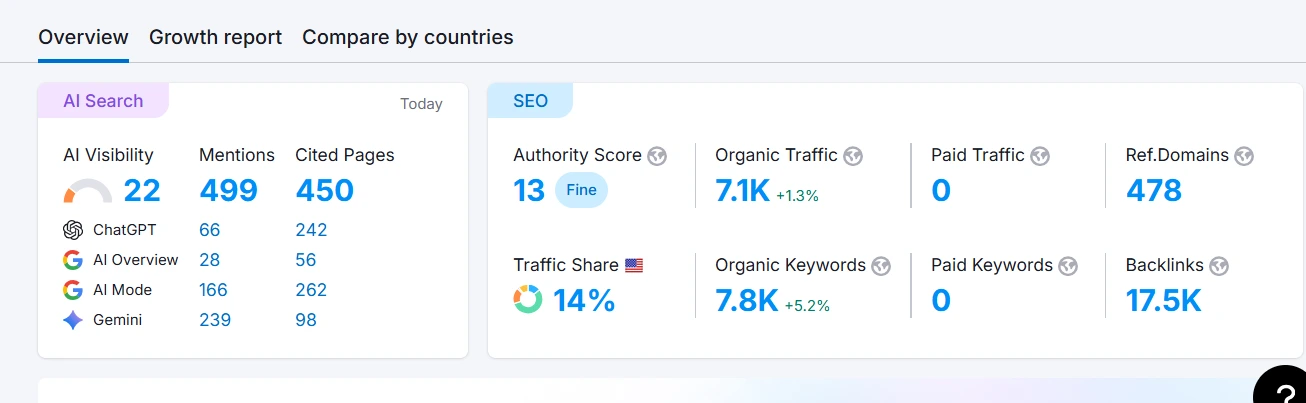
Six months in, the site’s organic traffic sits at 7.1K monthly visits, up 1.3%, with organic keyword rankings climbing 5.2% to 7.8K keywords. The backlink profile grew to 17.5K links across 478 referring domains, pushing the Authority Score to 13.
AI Visibility Result:
- 22 AI Visibility Score
- 499 total AI mentions
- 450 cited pages
- 66 ChatGPT mentions and 242 cited pages
- 28 Google AI Overview mentions and 56 cited pages
- 166 Google AI Mode mentions and 262 cited pages
- 239 Gemini mentions and 98 cited pages
- 14% US traffic share
All of this was achieved by merging both parts of SEO. Technical changes made it possible for the search and AI systems to index and process the website, whereas high-quality structured content provided useful data for them to display.
Technical SEO Audit vs Content SEO Audit: How to Check Both
A technical SEO audit checks whether search engines and AI crawlers can reach, render, and index your site, while a content SEO audit checks whether what they find is worth ranking. The difference between technical and content SEO audits is that split, and in the audits we run for clients, the two almost always uncover different problems on the same site.
How do you perform a technical SEO audit?
Start with Core Web Vitals (LCP, INP, CLS) on your top landing pages, then crawl for broken links, duplicate content, missing schema, and orphaned pages. Make sure you’re not blocking AI crawlers unintentionally with robots.txt and test your structured data with Google’s Rich Results Test.
Why is a technical SEO audit important?
Even if your website looks fine, there might be certain problems that could influence its visibility. Although your web page seems alright to visitors, it might be under-indexed, hard to find for AI crawlers, and useless in terms of crawling.
Conversely, a content SEO audit looks at existing pages against search intent, finds topical gaps against competitors, points out old stats and thin sections, and checks internal linking between cluster pages.
How to choose the right technical SEO agency
Look for an agency that shares real crawl data and Core Web Vitals results, not just a standard checklist. They should also understand AI crawler access and llms.txt.
If an agency only provides technical SEO services, ask how they work with your content team. Technical fixes alone rarely improve rankings without strong content.
The same applies to link building services. Backlinks can help, but they work best when your website has a strong technical and content foundation.
How to Write an SEO Content Brief That Actually Works
If you’re getting low SEO results from your content but your technical setup is sound, the problem often lies in the lack of a good content brief.
How to create a standard SEO content brief
Begin by identifying the target query and its intent, not just the keyword. Come up with a list of questions that your competitors have answered and those they haven’t answered. The latter will form your unique differentiator. State your target word count, sub-topics, internal links to clusters, and stats/experts to feature.
How to write a brief outline for SEO content
Begin with an answer, structure the content in easy-to-understand sections, answer the questions fully, and end with a useful takeaway. The outline will help people as well as AI comprehend the content better.
Which Should You Prioritize First?
Address the one that is currently limiting your visibility, rather than the one that’s easier to tackle first. Do this test before you determine how to allocate your resources next.
Fix technical SEO first if:
- Core Web Vitals are failing, especially INP
- Pages are missing from Google’s index
- Your site depends on JavaScript rendering that AI crawlers can’t process
- robots.txt is accidentally blocking GPTBot, ClaudeBot, or PerplexityBot
Fix content SEO first if:
- The site is fast and fully indexed, but rankings are flat
- Content is scattered across topics instead of clustered
- Pages haven’t been updated in over a year
- Competitors are earning AI citations you aren’t
Most sites need both eventually, but auditing which one is actively holding you back tells you where to spend the next dollar.
Find What’s Holding Your Rankings Back
Your issue could be technical, content-related, or both. Find out with a free technical & content SEO audit.
FAQs About Technical SEO vs Content SEO
SEO includes technical work like site speed and crawlability. Content marketing focuses on creating material that satisfies search intent and earns rankings.
Neither team owns it alone. Technical SEO usually sits with developers, content SEO with marketers, and both need a shared roadmap to avoid working against each other.
Neither works without the other. Technical SEO gets you crawled and indexed. Content SEO gets you ranked and cited.
Rarely for long. Even excellent content underperforms on a slow, poorly indexed, or AI crawler blocked site.
Quarterly for most sites and monthly for large or fast-changing ones, especially to catch new INP or crawl budget issues.
Yes, significantly. Robots.txt now has to account for AI crawlers like GPTBot and ClaudeBot, not just Googlebot, or the site loses visibility with those specific tools. llms.txt can help with AI systems that choose to read it, but it has no effect on Google Search itself, since Google’s own documentation confirms it doesn’t use llms.txt files.
Publish 25 to 30 interlinked articles within one tightly connected content cluster rather than scattering content across unrelated topics.
No. Core Web Vitals, schema coverage, and crawl health need regular reauditing as sites, frameworks, and crawler behavior change.