

Objective
This blog aims to clarify what negative SEO entails, teach readers to recognize the indications of a negative SEO attack, and provide them with the precise measures to safeguard their websites from negative SEO and maintain their rankings.
- Negative SEO is a deliberate attack on a competitor’s search rankings using black-hat tactics.
- Sudden backlink spikes, ranking drops, and scraped content are the main signs of a negative SEO attack.
- Google Search Console, Ahrefs, and Copyscape are the main tools to detect.
- A robust and well-diversified backlink profile will weaken the threat of negative SEO attacks.
- Reporting, disavowing, and DMCA requests are your primary recovery actions.
Protect Your Website from Negative SEO with Experts from SEO Discovery, Starting at $250/month.
Building strong organic rankings takes months or even years of consistent effort. Yet that progress can be threatened not by your own mistakes, but by someone else’s deliberate external actions designed to damage your search visibility. This is the reality of negative SEO, and it is something every website owner should understand and prepare for.
According to Google Search Central, Google’s algorithms can automatically ignore many spammy backlinks, making modern negative SEO attacks more focused on hacking, content scraping, and technical sabotage.
Understanding negative SEO meaning is your first line of defense. The term stands for intentional harmful strategies aimed at lowering your site’s position and reputation by third parties. You may not even realize it when the attack happens. A website, whether it belongs to a law firm, local shop, or online store, can affect people. Yet, having the proper awareness, means, and plan, one is able to identify risks at the beginning, respond quickly after a hack, and know how to prevent negative SEO from causing significant harm.
- What is negative SEO?
- What are negative keywords in SEO?
- Is negative SEO illegal?
- Signs of a negative SEO attack
- How to protect your website from negative SEO
- What are the negative impacts of AI Overviews on SEO?
- How to remove negative SEO
- How to report negative SEO to Google
- How SEO Discovery built a stronger SEO foundation that increased organic clicks
- Protect your website and grow with SEO Discovery
- FAQs about negative SEO
What is negative SEO?
Simply put, negative SEO is when someone, typically a competitor, intentionally uses underhanded tactics to lower your website’s search engine ranking. They aim to get Google to penalize your site, all while the perpetrator stays hidden.
Some of the most frequent negative SEO attacks include
- Toxic Backlink Bombing: Loads of spammy links directed at your site to get you algorithmically penalized.
- Content Scraping: Your articles are copied and republished across low-quality sites to create duplicate content problems.
- Site Hacking: Injection of concealed spam links in your source code or changing meta tags without your knowledge to divert your SEO authority elsewhere.
- Fake Reviews: Flooding your Google Business Profile with fake negative reviews to harm your brand image.
- Crawl Budget Manipulation: Using fake bot traffic to throw off how often Google indexes your pages.
Here’s one big reality: Negative SEO does not work effectively against websites that have a large number of credible backlinks. In fact, the better your SEO, the more difficult it is for someone to attack you.
What are negative keywords in SEO?
So what do we mean by negative keywords in SEO? That’s a tricky question for many site owners. In paid search, negative keywords are the terms you More exactly, exclude them from your ads so that you don’t get clicks from people who are not really interested. For organic SEO, the same principle applies during keyword research: by getting rid of words that bring the wrong kind of visitors or cause your main pages to compete with one another, you can safeguard your plan. Knowing how to find negative keywords in SEO means checking Search Console for terms that have received several impressions but have not resulted in worthwhile user engagement.
Is negative SEO illegal?
Well, it depends on the method used. Pointing spam links to a competitor’s site is mostly unethical and definitely a violation of Google’s guidelines, but it remains legally ambiguous. But website hacking is a crime under legislation like the Computer Fraud and Abuse Act in the US. Other environmentally harmful acts like fraudulent DMCA takedowns and commissioning DDoS attacks are illegal no matter the location.
Signs of a negative SEO attack
Spotting signs of a negative SEO attack on time can save you from a long recovery process instead of only a quick fix. The checklist below comprises the ways to detect such attacks:
Warning Sign | Where to Check |
Sudden rankings or traffic drop | Google Search Console, Google Analytics |
Spike in new toxic backlinks | Ahrefs or SEMrush, Referring Domains report |
Unexpected jump in indexed pages | GSC, Pages, Indexed section |
Your content appearing on other sites | Copyscape, Google Alerts |
Security warnings on your property | GSC, Security and Manual Actions tab |
Surge in negative fake reviews | Google Business Profile dashboard |
In case several signals manifest simultaneously, you should consider it a coordinated negative SEO attack and react immediately.
How to protect your website from negative SEO
Below is a useful guide on how to protect your website from negative SEO, divided into four main aspects.
1. Monitor your backlink profile
An extremely popular tactic of negative seo is to purposely connect your site to a tremendous number of harmful, spammy backlinks. Here is how to protect your website from negative SEO through backlink vigilance:
- Set up weekly backlink alerts in Ahrefs or SEMrush and watch for spikes in spammy referring domains.
- Analyze anchor text distribution. An unnatural flood of exact-match or irrelevant anchors is a big warning signal.
- Use the Google Disavow Tool carefully. Only submit a disavow file when you spot a clear, coordinated spam campaign, not for isolated junk links Google will likely ignore anyway.
- Keep investing in legitimate link building services to develop an authoritative profile so that a few hundred spam links become statistically insignificant noise.
2. Lock down website security
Hackers looking to do you a negative SEO could, for example, add hidden spam links to your website, modify the canonical tags, or even create thousands of doorway spam pages under your domain. Here is how to prevent negative SEO through site security:
- Always keep your Content Management System (CMS), themes, and plugins up to the minute. Most hacks take advantage of vulnerabilities in outdated software.
- Make it mandatory to use Two-Factor Authentication on administrator accounts and restrict login attempts.
- Keep track of your indexed page number in Google Search Console. An unexpected increase indicates, almost surely, that your site has been compromised.
- Schedule regular technical SEO services evaluations to detect weak points before attackers can exploit them.
3. Protect against content scraping
Attackers steal your very best material and reuse it in hundreds of low-quality websites to get you into trouble for duplicate content with Google. Here are a few ways to protect your SEO content writing investment:
- Use Copyscape regularly to scan for unauthorized copies of your articles.
- Make use of Google Alerts for unique fragments of your important pages so you can discover content scraping early on.
- Publish and get crawled without delay. Google benefits the first publisher. A strong internal linking network and an uploaded sitemap assist Google in crawling your fresh content quickly.
- If you find the exact scraping, you may submit a DMCA takedown notice via Google’s Copyright Removal tool.
4. Build an unshakeable authority profile
The best long-term strategy for how to protect a website from negative SEO is straightforward: make your site so strong that it can’t be harmed. When you regularly use guest posting services, you acquire real editorial links from very authoritative domains in your niche. But digital PR services, when perfectly done, bring branded mentions and trust signals, which make your site almost impossible to damage by external manipulations. And a strong E-E-A-T profile will transform these authority signals from negative attacks into mere background noise.
Want a Full SEO Health Check?
What are the negative impacts of AI Overviews on SEO?
The negative impacts of AI overviews on SEO are a growing concern in 2026. Google’s AI Overviews give brief answers on the search results page, which unfortunately brings new issues for the publishers:
- Decrease in click-through rates as people get their informational queries answered without a click.
- Content misattribution where AI extracts your content summary but does not channel traffic back to your website.
- Brand misrepresentation when AI Overviews wrongly describe your business or services.
The negative impact of AI on SEO affects thin, generic content the most. Turning to highly unique, experience-based content and specialist AI SEO services will safeguard your site from being replaced by AI, as it will be cited by AI.
How to remove negative SEO
Upon confirmation of a negative SEO attack, these are the steps you need to take to get rid of the damage caused by negative SEO:
- Export your full backlink profile from Ahrefs or Google Search Console and filter by spam score.
- Compile a disavow file listing all confirmed toxic domains in .txt format.
- Submit the disavow file via the Google Search Console Disavow Tool.
- File DMCA requests for any scraped content through Google’s copyright removal form.
- Restore any hacked files, remove injected spam links, and update all access credentials.
- Uploading your sitemap again in Google Search Console will request a new crawl of your site.
- Watch your Search Console weekly for 60 to 90 days to track recovery.
How to report negative SEO to Google
Negative SEO via official Google channels can be reported in these ways:
- Spam Report: Use Google Search Console’s Spam Report to flag coordinated link attacks.
- DMCA Takedown: Send a takedown notice to Google via the legal removal form if your content has been scraped.
- Reconsideration Request: This one can be issued via Search Console if you were hit by a manual penalty after you have rectified the violations.
- Fake Review Flagging: You can report fake Google reviews straight from your GMB services dashboard by marking each of them as violating the policy.
Always document everything with screenshots and dated exports before you report negative SEO to google.
How SEO Discovery built a stronger SEO foundation that increased organic clicks
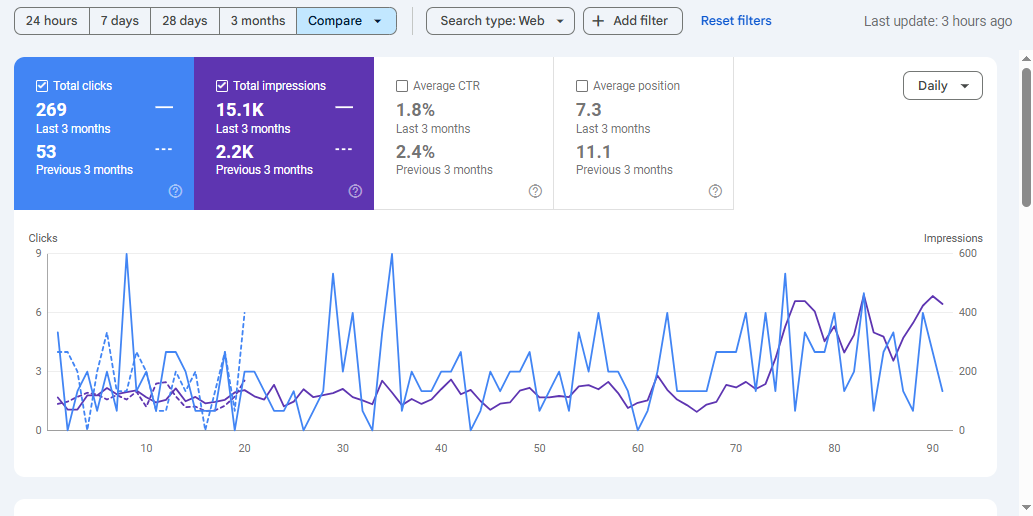
A legal firm’s website has excellent content but very little visibility in search. In the three months before our involvement, it had only 53 clicks and 2,200 impressions. The average position was 11.1, and CTR was 2.4%, indicating that the site was virtually invisible.
By improving technical health, local visibility, content quality, and authority signals, SEO Discovery helped transform a nearly invisible website into a growing organic asset with significantly improved search performance.
Results Achieved in Just 3 Months
- 407% increase in organic clicks, growing from 53 to 269 clicks.
- 586% growth in search impressions, increasing from 2,200 to 15,100.
- Average keyword position improved from 11.1 to 7.3.
- Higher visibility for valuable legal search terms, driving more qualified exposure.
- Stronger competitive positioning against established law firms in the market.
- A more resilient SEO foundation, better equipped to withstand algorithm updates and potential negative SEO threats.
Protect your website and grow with SEO Discovery
Negative SEO is a real threat, but the right strategy can significantly reduce its impact. Websites with strong technical foundations, quality backlinks, and proactive monitoring are far more resilient against malicious attacks.
At SEO Discovery, we help businesses strengthen their online presence through expert SEO, technical optimization, and long-term growth strategies. With 22+ years of experience and a proven track record across industries, we know how to protect rankings while driving sustainable organic growth.
FAQs about How to protect your website from negative SEO
Negative SEO refers to the use of dishonest techniques by individuals who want to damage a rival’s search engine standings. These methods may include harmful linking practices, stealing content, and hacking websites.
Negative SEO tactics hardly affect sites with a strong, varied backlink profile. Google is regularly updating its algorithms to identify and disregard manipulative behavior, so maintaining your site’s authority is the most effective way to protect yourself.
Really, negative SEO is still on the move in 2026. Strategies have been modified, but backlink bombing, content scraping, and fake reviews continue to be a threat to unprotected websites.
Yes. A sudden and well-coordinated influx of toxic and spammy backlinks can activate Google’s spam filters, and a manual penalty may be applied, resulting in a major loss of rankings.
Keep track of backlink spikes through Ahrefs, observe the number of indexed pages in Google Search Console, and create Google Alerts for your main content phrases as a way to detect attacks early.
Establish a healthy backlink profile, make sure to keep your CMS updated with 2FA enabled, do backlink monitoring on a weekly basis, and immediately detect scraped content with the help of Copyscape.
Only resort to it if you have found a concerted spam campaign. Google will generally discredit all those random trash links on its own. Besides that, disavowing indiscriminately can do more harm than good, Mainly to your already existing quality links.
Use Copyscape to scan for duplicate content, set Google Alerts for unique phrases, publish quickly, and file DMCA takedown requests for any confirmed scraping cases.
For example, a competitor that sends thousands of links from gambling or adult websites to your domain with the anchor text being excessively packed with keywords is a classic case of a deliberate negative SEO attack.
Monitor backlinks consistently, lock down site security, build high-authority links, protect your content with DMCA tools, and report confirmed attacks to Google promptly.