
Objective
This blog explains the most effective 10-step AI search content optimization checklist to help businesses win visibility in generative AI platforms. It includes actionable steps, platform insights, and common mistakes to avoid.
- AI search optimization is about creating clear, structured, trustworthy content for AI citation.
- AI search strategy differs from SEO, prioritizing answers over keyword rankings.
- Clear headings, BLUF, and FAQs make AI content extraction and visibility better.
- Technical setup, like crawling and schema, ensures that AI can access content.
- Brand consistency across platforms enhances the trust and recommendations of AI.
- To maintain visibility in AI search, it’s important to continuously monitor and update.
Turn AI Visibility into Real Business Leads with Expert AI SEO Services from SEO Discovery, Starting at $250/month
AI search optimization is the process of creating content that AI search engines and large language models (LLMs) can readily comprehend, summarize, and reference. It follows the BLUF (Bottom Line Upfront) approach, has a clear structure, defines key entities, and shows strong E-E-A-T to increase visibility and trust.
Did You Know?
According to Ahrefs, AI Overviews reduce organic click-through rates by around 34.5%.
As AI-powered search platforms become more prevalent, businesses must optimize their content beyond traditional SEO. Tools like ChatGPT, Google AI Overviews, Perplexity AI, Claude, and Microsoft Copilot are increasingly recommending and summarizing trusted content, which makes AI search optimization a must to improve visibility, authority, and organic traffic.
In this guide, we’ll cover what AI search optimization is, how it differs from traditional SEO, which platforms to target, the full 10-step checklist, the best tools, and the most common mistakes to avoid, so keep reading until the end.
Table Of Contents
- What is AI Search optimization and why does it matter?
- How does an AI search strategy differ from traditional SEO?
- Which AI platforms should you target for AI search optimization?
- How to optimize content for an AI search engine?
- What are the best AI search optimization tools?
- What mistakes should you avoid in an AI search strategy?
- How we helped a client win AI search visibility
- Enhance your AI presence with SEO Discovery
- FAQs about AI search optimization
What is AI Search optimization and why does it matter?
AI search optimization is the process of developing content that helps optimize a site for AI search algorithms, making it easier for AI search engines and LLMs to understand, summarize and recommend it.
Here is why it is important
- For many everyday information queries, AI-powered search is replacing traditional search.
- AI content optimization improves visibility and increases the chances of AI-generated citations.
- As AI search evolves, businesses need strong, trustworthy content to stay competitive.
How does an AI search strategy differ from traditional SEO?
Traditional SEO is about ranking pages in search engines, but an effective AI search strategy is about getting content cited in AI-generated answers.
The table below summarizes the main differences.
|
Feature |
Traditional SEO |
AI Search Strategy |
|
Main Goal |
Rank webpages in search results. |
Get content cited in AI-generated answers. |
|
Content Focus |
Targets keywords, backlinks, and pages. |
Prioritizes clear answers with AI content optimization. |
|
User Search |
Focuses on short keyword searches. |
Optimizes for conversational questions and natural language. |
|
Success Metrics |
Measures rankings, traffic, and clicks. |
Tracks citations and brand mentions. |
Which AI platforms should you target for AI search optimization?
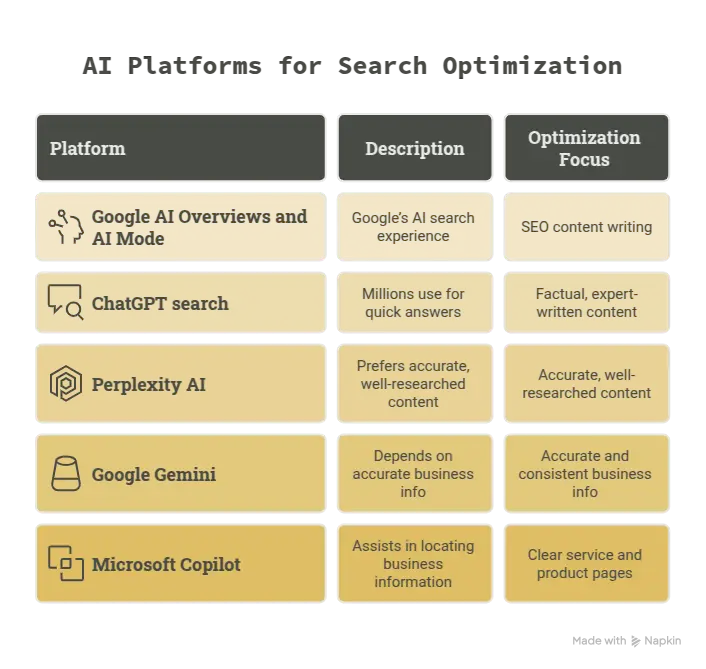
If you want to win at AI search, prepare your content for the big AI platforms. Adopting generative AI SEO best practices improves visibility, enhances citations, and helps engage audiences across multiple AI-powered search experiences.
Below are the five major AI platforms
- Google AI Overviews and AI Mode: This is Google’s AI search experience, providing a summary of trustworthy information. Using SEO content writing helps improve visibility.
- ChatGPT search: Millions of people use ChatGPT to get quick answers. It likes factual, expert-written and trustworthy content.
- Perplexity AI: Perplexity prefers accurate, well-researched content, making it a great platform to build topical authority over time.
- Google Gemini: Gemini depends on accurate and consistent business info to understand and recommend brands across Google services.
- Microsoft Copilot: Copilot assists users in quickly locating business information. Clear service and product pages increase the chances of showing up in AI responses.
How to optimize content for an AI search engine?
Optimizing content for AI search engines requires more than traditional SEO. This 10-step AI search content optimization checklist will help you produce content that is clear, trustworthy, and well-structured so that it is easy for AI platforms to understand, summarise, and recommend.
Step 1: Enable smooth crawling and indexing for AI bots
First, ensure your website is readable by AI tools. If they can’t get in, nothing else on this list matters.
Here’s what to check first:
- In your robots.txt file, make sure you do not block GPTBot, ClaudeBot, and PerplexityBot from crawling your pages.
- Ensure your website loads content directly in the HTML and does not hide it behind JavaScript that AI crawlers cannot read.
- Improve slow-loading pages, as AI crawlers avoid pages that load too slowly.
Pro Tip: Many old websites accidentally block AI crawlers. Check this first before you make any content changes.
Step 2: Define the AI search prompts and user journeys you want to win
Find out the questions that people are asking AI tools before you start creating or optimizing content. These questions, as opposed to traditional keywords, help improve AI and search engine optimization by matching how people naturally search.
Follow this process step by step:
- Consider what your customers ask you at each stage: when they first see a problem, when they are considering their options, and when they are ready to buy.
- Look at your customer reviews, support emails, and sales calls and discover the precise words real buyers use.
- Focus on non-branded questions like “best SEO service for small ecommerce brands” rather than just your company name.
Pro Tip: The best prompts are extremely specific. For example, “What are the best search engine optimization services for a startup with a $500 monthly budget?” is more likely to be cited than a broad search query.
Step 3: Structure every page for snippet extraction using the BLUF method
AI tools don’t read every single word on a page. They are looking for the most useful, clearest answer. If the key information is hidden deep within the content, the AI might skip over it, which means less visibility and makes it harder to improve brand trust.
The simplest way to implement this is the following:
- Begin with your direct answer first, and then explain further below. This is called the BLUF (Bottom Line Up Front) method.
- Keep each paragraph short and focused on just one idea. Aim for 60 to 90 words per paragraph.
- Use bullet points, numbered lists, and tables so that your content is easy to scan and pull.
Pro Tip: Try reading any paragraph completely on its own. If it does not make sense without reading the one before it, rewrite it. AI needs every paragraph to stand alone.
Step 4: Optimize content for AI retrieval with clear structure
How to optimize content for AI search engines starts with making your pages easy for AI to navigate. Imagine your page as a database of answers, not as a long article that is read from top to bottom.
Here’s what you need to do:
- Write each section so it contains a clear question, a direct answer, and a short explanation, all in one place.
- Use FAQ formats and step-by-step lists because AI retrieves these content types most consistently.
- Create comparison pages such as “X vs Y” to assist users in making choices, enhancing engagement and aiding link-building services by providing more relevant content.
Pro Tip: Comparison pages are one of the most cited content types across all AI platforms. If you don’t have them, build them now.
Step 5: Use clear headings and named entities throughout your content
AI tools read your content based on the words in your headings and the particular names you use in your text. AI engines get confused by vague or clever headers.
Here are some practical steps to follow:
- Write H2, H3, and H4 headings clearly so sections are easy to understand.
- Use specific names throughout your content: your brand name, your service names, industry terms, and product names.
- Use your primary topic keyword organically in the first heading (H1) of each main section.
Pro Tip: The clear headings make AI search and traditional Google ranking work at the same time. This is one of the easiest wins on the entire list.
Step 6: Build citation-worthy content with strong E-E-A-T signals
AI tools only refer to sources they trust. To earn that trust, your content has to clearly demonstrate real experience, expertise, and credibility. That’s a key part of AI content optimization best practices.
Do this to implement properly:
- Use content marketing to back up every claim with real sources, studies, or data points so AI can trust and cite your content.
- Add author bios on every content page that show real credentials, work experience, and professional links.
- Update your best pages regularly because AI tools prefer fresh, current content over outdated information.
Pro Tip: One original fact, statistic, or case study makes your page far more citable than ten pages of generic advice. Give AI something special to attribute to you.
Step 7: Optimize your brand entity consistently across the web
This is one of the key parts of AI local search optimization. AI tools build their understanding of your brand from every mention they find on the internet, not just on your website. Inconsistent information means wrong or missing AI-generated brand results.
Take these actions to proceed:
- Mention your brand name, services, and key messages naturally throughout your content, not just at the end or in your meta tags.
- Create and update profiles on Google Business Profile, G2, Clutch, and other relevant industry directories as AI tools verify these for brand validation.
- Make sure your business name, description, and service details are exactly the same everywhere online
Pro Tip: If you have a good Google Business Profile and positive reviews on Clutch or G2, this can have more impact on AI recommendation answers than your own homepage. Keep these up to date.
Step 8: Implement schema markup for machine-readable signals
Schema markup is a simple code that you add to your pages that helps AI tools understand your content better. It is also a major part of technical SEO services, as it improves the machine readability and interpretation of your site.
Apply the steps given below:
- Add FAQ schema to your FAQ pages, Product schema to your product pages, and Organization schema to your home page and about page.
- Use schema to clearly mark up your services, pricing, reviews, and business information so AI can read it without guessing.
- Use Google’s free Rich Results Test tool to regularly test your schema to make sure it’s working properly.
Pro Tip: AI tools often pull directly from schema markup rather than reading your actual page text. Getting your schema right is one of the fastest wins for AI visibility.
Step 9: Consolidate thin content into comprehensive topic clusters
If you have multiple short, shallow pages on the same topic, AI tools often get confused and may ignore them. This is why a clear content optimization AI search guide recommends combining weak pages into one strong, detailed page instead of competing versions.
Here is how you do it:
- Scan your website for multiple short pages on the same or very similar topics.
- Combine those thin pages into one strong, detailed page and redirect the old pages to the new one.
- Build a topic cluster with one main page that covers the big topic, and several deeper pages that cover specific subtopics, all linking back to each other.
Pro Tip: A fast way to improve AI search and traditional SEO simultaneously is to fix content cannibalization. The whole system works better when there’s strong internal linking between cluster pages.
Step 10: Measure your AI search visibility and continuously optimize
You cannot improve what you do not measure. Set up tracking before you start optimizing so you can see what is actually working.
Follow this process step by step:
- Set up GA4 to track traffic from AI platforms like ChatGPT, Perplexity, and Google AI Mode separately from regular organic traffic, as a proper technical SEO audit requires.
- Track three simple numbers for each topic you are targeting: how often you appear in AI answers, how often those answers include a link to your site, and how often you win against competitors in comparison answers.
- Check your key prompts in AI tools every month and note how your brand is described, then fix anything that is wrong or missing.
Pro Tip: Never combine your numbers from different AI platforms into one overall score. Each platform works differently and needs its own tracking, especially for GEO results.
What are the best AI search optimization tools?
Here are the recommended tools for accurate data in AI search optimization that real SEO teams use every day.
|
Tool |
What It Does Best |
|
Google Search Console |
Tracks your AI Overview appearances and organic performance |
|
Semrush |
Keyword research, content audits, and competitor gap analysis |
|
Ahrefs |
Backlink analysis and topical authority mapping |
|
BrightEdge |
Tracks AI search visibility and citation performance |
|
Schema App |
Makes schema markup simple for enterprise websites |
|
Authoritas |
Monitors brand mentions across generative AI platforms |
|
Perplexity API |
Tests how your content actually appears in Perplexity answers |
These tools cover every part of the how to optimize for AI search engines process from technical fixes to content performance tracking.
What mistakes should you avoid in an AI search strategy?
Avoiding common mistakes in an AI search strategy helps improve visibility, accuracy, and chances of being cited in AI-generated answers.
- Crawlers blocked: Accidentally blocking AI crawlers like GPTBot, ClaudeBot, or PerplexityBot prevents your site from being discovered and used in AI search results.
- Weak content strategy: Writing for keywords instead of real questions, ignoring third-party platforms, skipping schema, or having too many thin pages reduces AI visibility.
- No ongoing updates: Treating optimization as a one-time task leads to poor performance, since AI search needs regular tracking, updates, and content improvements to stay relevant.
How we helped a client win AI search visibility
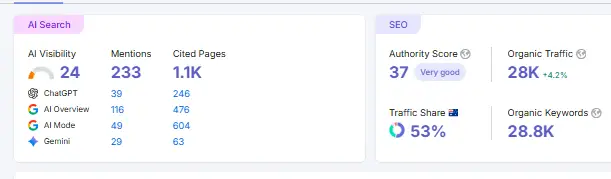
We helped one of our clients who was struggling with low AI search visibility and poor citation rates across major generative AI platforms. Their content was not structured for AI retrieval, and their brand was barely mentioned across ChatGPT, Google AI Overview, and Gemini.
Our team conducted a full AI content audit, fixed crawlability issues, implemented schema markup, and restructured key pages using the BLUF method to improve citation-worthiness and brand entity consistency across all major AI platforms.
The Results
- AI Visibility Score improved to 24 across all major platforms.
- Brand secured 233 total mentions across AI search platforms.
- Content cited across 1.1K pages in AI-generated answers.
- ChatGPT generated 39 mentions with 246 cited pages.
- Google AI Overview delivered 116 mentions and 476 cited pages.
- Google AI Mode recorded 49 mentions across 604 cited pages
- Gemini contributed 29 mentions with 63 cited pages.
Enhance your AI presence with SEO Discovery
People are now using AI search to find, compare, and choose businesses online. To be visible, brands need to create clear, structured, and trustworthy content that AI systems can easily extract and cite. This 10-step AI search content optimization checklist offers an easy, step-by-step method for optimizing visibility on the major AI search platforms.
SEO Discovery helps companies improve their visibility in AI search results through professional optimization techniques. With professional AI SEO services, our team delivers content audits, schema implementation, crawlability fixes, entity optimization, and ongoing prompt tracking. This helps keep your brand competitive as AI search continues to evolve and influence buying decisions.
Contact us today to improve your AI search visibility and grow your business with expert SEO support.
Ready to Rank in AI?
SEO Discovery improves visibility across generative search tools.
FAQs about AI search optimization
AI search optimization tools are platforms that assist with improving visibility in AI-generated search results by supporting keyword research, technical SEO, schema markup, content optimization, and tracking AI search performance.
It’s a practical, step-by-step framework covering everything from fixing crawl access to AI bots to tracking your citation rate across platforms like ChatGPT, Perplexity, and Google AI Mode.
Traditional SEO helps pages rank in search engine results. AI search optimization helps your content get cited in AI-generated answers. The content format, the structure, and the success metrics are totally different.
Start each section with a direct answer at the top. Use clear headings, short, focused paragraphs, and FAQ content. Add schema markup and ensure AI bots can crawl your pages without restrictions.
The best AI search optimization tools include Google Search Console, Semrush, Ahrefs, BrightEdge, Schema App, Authoritas, and Perplexity API. They help improve AI visibility through keyword research, technical SEO, schema markup, content optimization, and tracking performance in AI-generated search results across platforms.
BLUF stands for Bottom Line Upfront. It means writing your direct answer at the very start of each section so AI engines can find and extract it immediately without reading the whole page.
Check your robots.txt file and look for any rules that block GPTBot, ClaudeBot, or PerplexityBot. Also, make sure your site uses server-side rendering so AI crawlers can see your full content.
Schema gives AI engines a direct, machine-readable summary of your page. AI tools can pull accurate information from your schema even when your body content is too long to extract cleanly.
Refresh your most important pages at least every three months. Freshness is a real factor in how AI tools prioritize and retrieve content during answer generation.
SEO Discovery provides complete AI SEO services including content audits, crawlability fixes, schema implementation, brand entity optimization, and monthly AI prompt tracking for businesses of all sizes.