


Objective
In this blog we will discuss how law firms can use voice search optimization techniques for legal services to acquire conversational, high intent calls from clients.
- Voice queries for legal help are longer, local, and urgent, so law firms need conversational answers, not just short keywords
- A complete Google Business Profile decides who gets picked when someone asks their phone for a lawyer “near me.“
- LegalService and Person schema, not the retired Attorney type, help AI systems verify and cite your firm correctly
- Direct, 40 to 60 word answers win both voice results and AI Overviews at the same time
- Voice search has quietly merged with AI search, since ChatGPT, Perplexity, and Gemini now answer spoken legal questions too.
Reach more legal clients through voice and AI search with SEO Discovery, starting at $250/month.
Someone’s been rear-ended on the freeway. They don’t type. The phone’s still in their hand. They speak. “Hey Siri, find a car accident lawyer near me that offers free consultations.” Three seconds later the answer comes back. To a company, that is a new customer. For every other firm on the map it’s a call they’ll never know they missed.
Voice search optimization techniques for legal services are the specific content, local search, and technical changes that help law firms show up when Siri, Alexa, Google Assistant, or an AI chatbot reads out an answer to a spoken legal question. It blends SEO for lawyers with natural, question-based writing, so your site sounds like a real answer instead of a keyword list.
This approach isn’t a fringe tactic anymore. It sits at the center of modern law firm SEO, because the way people ask for legal help out loud is entirely different from how they type it.
💡 In Simple Terms
To enhance legal services for voice search, create conversational Q&A content, keep Google Business Profile and directory listings up-to-date, add LegalService and Person schema, make your mobile site faster, and answer common client questions in 40 to 60 words. That’s what makes voice assistants and AI search tools sound confident when they read aloud the answer your firm provides.
Did You Know?
According to eMarketer, 88.1% of U.S. voice assistant users search on smartphones, reinforcing why mobile optimization and local SEO are critical for law firms.
In this guide, we will walk through how voice search actually works for legal queries, the techniques that get firms picked, a real case study near the end, and an FAQ section built around the same questions people ask their phones.
Table Of Contents
- What Is Voice Search Optimization for Law Firms?
- Why Is Voice Search Important For Law Firms?
- How Does Voice SEO Differ From Traditional SEO?
- What Keywords Should Your Firm Target for Voice Search?
- How Do You Build FAQ Pages That Voice Assistants Can Actually Read Aloud?
- How Does Local SEO Win Voice Search for Law Firms?
- What Schema Markup Do Law Firms Need for Voice and AI Search?
- How Do You Win Featured Snippets for Legal Voice Queries?
- Is Voice Search the Same as AI Search Optimization Today?
- Is Your Website Ready for Voice Search?
- What Mistakes Quietly Kill Voice Search Rankings?
- How We Improved Voice and Local Visibility for a Law Firm
- Win the Voice Search Moment With SEO Discovery
- FAQs About Voice Search Optimization for Legal Services
What Is Voice Search Optimization for Law Firms?
Voice search optimization is the process of optimizing your website’s content, structure, and local listings so that voice assistants can find, understand, and read your company’s response aloud.
Consider the difference between spoken language and written language. Search Tips: “divorce attorney New York.” Spoken search: “Best child custody divorce lawyer near me?” That’s the essence of conversational SEO: writing your practice area pages. This is how a client will actually ask the question, not how a keyword tool presents it.
This is more important for law firms than almost any other industry. Legal searches carry urgency. When someone is looking into a DUI, eviction, or workplace injury, they are not casually browsing. They want an answer now, and they want to speak to a real person. Whether the question goes to Siri, Alexa, or Google Assistant, the same fundamental work of voice assistant SEO applies to each platform.
Why Is Voice Search Important For Law Firms?
Voice search matters for law firms because it captures people at their moment of need for representation, and it rewards the firm that provides a clear answer, not the one that has the highest rank on a traditional results page.
Here is what that looks like in practice:
- Legal voice queries average close to 30 words, far longer than the 2 to 4 word phrases people type
- Over 40% of voice answers are pulled straight from featured snippets, so a well-formatted page can leapfrog bigger competitors
- Local intent runs through the majority of voice queries, which means “near me” is doing a lot of quiet, unpaid advertising for whoever ranks
- People searching by voice after an accident, arrest, or emergency convert faster, because they are already past the research stage
Ignoring this costs more than rankings. Strong voice search SEO is what turns that moment into a booked consultation instead of a competitor’s new client.
How Does Voice SEO Differ From Traditional SEO?
Voice SEO is about full spoken questions and a single spoken answer. Traditional SEO is about short typed-in phrases and a page of results to scroll through.
Traditional SEO | Voice Search SEO |
Targets short keywords like “personal injury lawyer” | Targets full questions like “what should I do after a car accident” |
Success means ranking on page one | Success means being the one answer read aloud |
Optimized for scrolling and comparison | Optimized for a single, immediate decision |
Desktop and mobile behavior | Overwhelmingly mobile and hands-free |
Relies on backlinks and keyword density | Relies on direct answers, schema, and local accuracy |
Traditional legal SEO still matters. All the other stuff is built on a foundation of domain authority, backlinks, and solid on-page work. But voice adds a second, sharper layer: your content has to work as a spoken sentence, not just a ranked link.
What Keywords Should Your Firm Target for Voice Search?
Target full questions and long-tail phrases organized by practice area, not short generic terms.
Start with real questions, not guesses. Tools like Google’s “People Also Ask,” AnswerThePublic, and your own call transcripts are gold for this kind of keyword research because they show you the exact phrasing real clients use under stress.
Practice Area | Typed Search | Voice Search Query |
Personal Injury | personal injury lawyer cost | “How much does a personal injury lawyer cost in Ohio?” |
Family Law | divorce papers next steps | “What should I do after being served divorce papers?” |
Criminal Defense | DUI lawyer first offense | “Do I need a lawyer for a DUI first offense?” |
Estate Planning | probate timeline | “How long does probate take without a will?” |
Group these by practice area, then build or update pages around each cluster. A firm doing family law, criminal defense, and estate planning needs three separate conversational content maps, not one blended list.
How Do You Build FAQ Pages That Voice Assistants Can Actually Read Aloud?
Write each FAQ as a real spoken question, followed by a short, direct answer a non-lawyer could understand in one read.
That’s where legal content marketing is most important. Forget the technicalities. Disregard the disclaimers on top of the answer. Voice assistants reward the page that answers the fastest and cleanest, not the one that sounds most like a legal brief.
Here’s a quick example:
Question: How much does a personal injury lawyer cost?
Answer: Most personal injury lawyers work on a contingency fee basis. You don’t pay a dime up front; the fee, usually 33 to 40 percent, is deducted from your settlement only if you win.
That’s a full answer, in quotes, under 33 words. That’s what good SEO content writing is: simple language, a real number, and no fluff between question and answer.
Turn Website Visitors Into Consultations
Let SEO Discovery rebuild your FAQ pages around the questions your clients are actually asking.
How Does Local SEO Win Voice Search for Law Firms?
Local SEO wins voice search as it feeds assistants the right business information that they read out loud when someone asks for help nearby.
Over 75% of smart speaker owners do local searches weekly, and legal searches are highly local because clients need a lawyer who knows their courts and jurisdiction. Which makes local SEO for law firms the highest leverage piece of this entire strategy.
- Complete your Google Business Profile, including every practice area and service.
- Keep your name, address, and phone number same across your site, directories, and Google Maps
- Collect and respond to reviews consistently, since assistants prefer businesses with strong, recent ratings
- List your firm on major legal directories and Apple Business Connect, since Siri and other assistants pull from different sources
Continued GMB services, i.e., routine posts, photo updates, and Q&A management on your profile, keep that listing fresh enough for assistants to have faith in it. If you have a company with multiple offices, you should get local SEO services for each location page. This will make sure that all branches are visible and not just one office that gets all the traffic.
What Schema Markup Do Law Firms Need for Voice and AI Search?
Law firms need a LegalService schema on the homepage, a Person schema for each attorney, and an FAQPage schema on question-driven content.
Schema.org has retired the old attorney type, and it is no longer rewarded by Google. Currently, the standard links LegalService, which describes your firm, to the Person schema for each lawyer through the “worksFor” property. It’s a type of entity-based SEO where you’re explicitly telling search engines and AI models who you are, what you do, and where you operate, rather than leaving it up to them to figure out.
Schema alone won’t get ChatGPT or Google’s AI Overviews to cite your firm. Google itself says there is no special markup needed for AI citations. What schema does deliver is clean, verified entity data that removes doubt when an assistant is deciding whom to trust, which matters just as much for AI visibility as it does for classic rich results.
How Do You Win Featured Snippets for Legal Voice Queries?
Answer the question in the first sentence, keep it under 60 words, and place it directly beneath a matching H2 or H3 heading.
Voice assistants and featured snippets are taken from the same pool. Organize your page so the machine doesn’t have to dig:
- Open the section with the question as a heading
- Answer it immediately, in plain language, in one short paragraph
- Follow with supporting detail, examples, or a list underneath
This organization also helps contextual relevance by telling search engines and AI crawlers exactly which question each block of text is answering, instead of having them infer it from the surrounding paragraphs.
Is Voice Search the Same as AI Search Optimization Today?
Voice search and AI answer engines are now the same thing. Assistants like Gemini, Siri, and the voice mode of ChatGPT now generate spoken answers from the same generative models as AI Overviews.
Now, that answer no longer comes from one place. Now prospective clients are asking legal questions via Google AI Mode, ChatGPT Voice, Gemini, Siri, Alexa, in-car assistants, and wearable devices, and each one evaluates your firm’s expertise and trustworthiness before recommending you.
This is why planning for AI search optimization and voice work can no longer be done separately. The contributing disciplines are:
- AEO, or answer engine optimization, which structures content so it gets pulled into direct-answer boxes
- GEO, or generative engine optimization, which builds authority and clarity so AI models trust and reuse your content
- LLM Optimization, tuning how clearly your content explains legal concepts so language models summarize it accurately
- Topical authority, built by covering a practice area thoroughly instead of publishing one thin page per keyword
As AI agents start booking consultations and comparing law firms on a client’s behalf, this combined approach stops being optional. A firm optimized only for the old blue links is invisible to the growing slice of searches happening through generative search and natural language processing (NLP)-driven assistants.
Is Your Website Ready for Voice Search?
7 essentials every voice-optimized law firm website needs:
- Conversational, client-focused content.
- Question-and-answer sections for every legal service.
- LegalService and Person schema markup.
- A fast, mobile-first website.
- A fully optimized Google Business Profile.
- Consistent NAP information across directories.
- Dedicated pages for each office or service area.
Missing a Few Essentials?
SEO Discovery helps law firms build a voice-search-ready website with expert content, schema markup, local SEO, and technical optimization.
What Mistakes Quietly Kill Voice Search Rankings?
- Publishing dense pages full of jargon that read more like a filed brief than an answer
- Getting your NAP details out of sync across directories
- Ignoring page speed as voice assistants skip slow mobile pages entirely
- Seeing zero-click search optimization as a loss rather than a gain for brand visibility, because being the answered voice builds trust even without a click
- Leaving entity recognition to chance and skipping structured data altogether
How We Improved Voice and Local Visibility for a Law Firm
We worked with a mid-sized personal injury law firm that had great case results but very little visibility for local, question-based searches. No FAQ structure on their site, inconsistent listings on directories, and no schema markup.
We rebuilt their practice area pages around real client questions, fixed their citations in 40+ directories, added LegalService and Person schema, and layered in a link building services and digital PR services push to beef up domain trust. We also cleaned up internal linking between blog content and practice area pages so that authority flowed to the pages that actually convert.
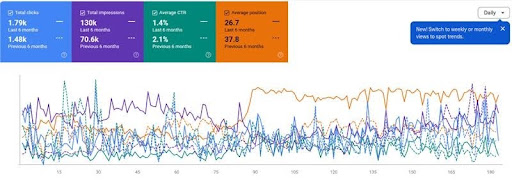
The results, comparing the last 6 months to the previous 6 months in Google Search Console:
- Total impressions jumped from 70.6k to 130k, an 84% increase, as the site started surfacing for far more question-based and long-tail queries
- Total clicks grew from 1.48k to 1.79k, up roughly 21%
- Average position improved from 37.8 to 26.7, moving key pages more than a full page closer to the top of results
- Average CTR dipped slightly from 2.1% to 1.4%, which tracks with the impression surge. A significant portion of the new visibility came from broader, answer-style queries and AI Overview placements, which are seen far more often than they are clicked, reflecting the exact zero-click pattern produced by voice and AI search optimization.
Win the Voice Search Moment With SEO Discovery
Voice search is not a side project. It’s where an increasing percentage of your prospective clients are already asking for help, loudly, at the very moment they need you the most.
At SEO Discovery, we build these services as an integrated system. We provide technical SEO services, AI SEO services, and hands-on content marketing to make sure your firm appears when people type, tap, or talk. We make sure your firm is the answer assistants read aloud, whether you need one practice area rebuilt or a full overhaul of your best SEO services.
FAQs About Voice Search Optimization for Legal Services
It is the process of structuring a law firm’s content, local listings, and technical setup so voice assistants can find and read out accurate answers.
It connects firms with clients at the exact moment they need urgent legal help, often before they have compared any other options.
Voice queries are longer, phrased as full questions, and carry stronger local and emotional intent than typed keywords.
Yes. The LegalService and Person schemas help assistants and AI tools verify your firm’s identity, practice areas, and location accurately.
Aim for 40 to 60 words per answer, written in plain language a non-lawyer would understand on first read.
Yes, it is one of the biggest ranking factors, since most voice queries for lawyers include local or “near me” intent.
You can start with FAQ pages and Google Business Profile updates yourself, though schema, technical fixes, and content scale faster with expert help.
Most firms see measurable movement in featured snippets and local visibility within three to five months of consistent optimization.
Yes. Voice assistants favor relevance and trust over firm size, so accurate local listings and clear answers often outweigh brand recognition.