
Objective
In this blog, we explain how you can structure your content so that ChatGPT, Perplexity, and other AI assistants can find it, trust it, and cite it as an answer.
AI assistants don’t deliver keywords, they deliver answers. Your content should answer questions in the first sentence.
AI Overviews and in fact, ChatGPT draw from question-based headers, tables, and lists.
Schema and llms.txt help AI systems understand you, but neither one guarantees a citation on its own.
Citation visibility fades without regular updates, so treat this as an ongoing habit, not a one-time project.
Most AI citations come from third-party mentions, not your own website, so earned visibility matters as much as on-site fixes.
Improve Your AI Search Visibility with SEO Discovery, starting at $250/month.
Want your content to be recommended over your competitor’s on ChatGPT, Perplexity, and Google AI Overviews? AI assistants don’t see a page the same way a human would. They find a clean passage and see if it directly answers the question and decide if they trust it enough to cite. The first step to learning how to optimize content for AI search engines is to write for that machine-first read: a direct answer at the top, real sourcing underneath, and a structure that survives being pulled out of context.
Did You Know?
ChatGPT Search processes 250 to 500 million queries a week, per Similarweb’s 2026 AI Search report.
Consider this a practical content optimization AI search guide: what actually earns you a citation in 2026, what’s overhyped, and how to build a page that can survive being read by a model instead of a human.
Table Of Contents
- What Is AEO, GEO, and AIO?
- How Do You Optimize a Website for ChatGPT and Perplexity AI Search Visibility?
- What Should Your AI Content Checklist Include for 2026?
- How Do You Optimize Content for AI Search Engines, Step by Step?
- Why Does AI Need Passage-Level Optimization?
- How Do You Get Content Considered for AI Recommendations?
- What Is AI Brand Optimization Regression to the Mean?
- How to Choose an AI Search Optimization Platform
- How Do You Earn More Brand Citations in AI Overviews?
- How to Create AI-Friendly Content for Featured Snippets?
- What Common Mistakes Hurt AI Search Visibility?
- How Did We Help a Client Improve AI Citation Visibility?
- Your Pre-Publish AI Content Checklist
- Make ChatGPT and AI Search Work For Your Brand With SEO Discovery
- FAQs About Optimizing Content for ChatGPT and AI Assistants
What Is AEO, GEO, and AIO?
AEO, GEO, and AIO all describe the same core discipline, i.e., structuring content so AI assistants can extract, trust, and cite it, with small differences in emphasis.
AI search optimization is the umbrella term most people mean. AEO is all about getting a direct answer extracted, GEO is about citation inside a longer summary, and AIO is the broader, ongoing work of making AI systems trust and recommend your brand. But in practice, one content strategy covers all three.
Traditional search engine optimization asks how to rank a link on page one. This newer discipline asks how to become the fact a model reaches for when it writes its answer. Both share a foundation, technical health, clear writing, and real authority, but this layer adds requirements a link-ranking system never needed.
Traditional SEO | AI Content Optimization |
Optimizes pages | Optimizes information |
Targets keywords | Targets user intent |
Measures clicks | Measures usefulness and citations |
Competes for rankings | Competes for citations |
How Do You Optimize a Website for ChatGPT and Perplexity AI Search Visibility?
You optimize a website for ChatGPT and Perplexity AI search visibility by giving crawlers clean access, publishing answer-first pages, and backing claims with citable sources.
The customer journey itself has evolved. It was a three-step process: you got ranked by Google, you clicked on a website, you converted.
Now there’s a retrieval layer in between before a human ever sees your page:
- User asks a question
- AI retrieves multiple sources
- AI generates an answer
- Selected sources get cited
- User visits a trusted site
Each platform crawls and retrieves differently, so a single-fix approach won’t cover all of them:
Platform | Crawler/Fetcher | What It Rewards |
ChatGPT (training) | GPTBot | Broad, well-structured, factual pages |
ChatGPT Search | OAI-SearchBot, ChatGPT-User | Fresh pages, direct answers, clear sourcing |
Perplexity | PerplexityBot, Perplexity-User | Inline-citable evidence, named data |
Claude | ClaudeBot | Clarity, retrievability, trust signals |
Ensure your robots.txt allows the crawlers relevant to your goals, because blocking one will silently exclude you from that platform’s answers. If you do just one thing this month, optimize website for ChatGPT, Perplexity, AI search visibility. Combine that crawler access with an answer-first format on top pages. That’s the heart of how to optimize website for ChatGPT and Perplexity before any advanced tactics matter.
What Should Your AI Content Checklist Include for 2026?
Here are the AI search optimization best practices that appear repeatedly in current guidance for 2026:
- Answer the question first, in 40 to 60 words. Then add context.
- Use question-based H2s and H3s that mirror how people actually talk to AI assistants
- Back up claims with named statistics and sources, not vague phrases like “studies show.”
- Add comparison tables and numbered lists wherever there’s a process or a choice
- Update high-value pages at least twice a year; AI citations for commercial queries favor recently updated content.
These sit on top of ordinary on-page SEO best practices; they don’t replace them. A page with strong headings, fast load times, and clean HTML will always beat a cluttered page in terms of citations.
Know Exactly Where You Stand With AI Search
Get a free AI visibility check across ChatGPT, Perplexity, and Google AI Overviews.
How Do You Optimize Content for AI Search Engines, Step by Step?
Knowing how to optimize for AI search engines comes down to this sequence:
- Audit your visibility. Ask ChatGPT, Perplexity, and AI Mode your core category questions and see if you show up.
- Rewrite top pages answer-first. Move the direct answer to the first line of each section.
- Add structure. Use bullet points, numbered steps, or tables to break up long paragraphs.
- Cite real data. Replace generic claims with named statistics and sources.
- Implement schema. Add Article, FAQPage, and Organization JSON-LD so entities are unambiguous.
- Check crawler access. Confirm GPTBot, OAI-SearchBot, and PerplexityBot aren’t blocked.
- Track and refresh. Re-check citations monthly and update pages that go stale.
And the same goes for how to do AI optimization without hiring a full team: go through the checklist, page by page, starting with content that already ranks well. Step five trips up most teams because a broken JSON-LD block nullifies an otherwise solid page. This approach is precisely how you optimize site for AI search algorithms to provide structured data.
Why Does AI Need Passage-Level Optimization?
Passage optimization for AI means writing each section so it can stand alone as a complete, accurate answer, since AI models often cite a single passage rather than a whole page.
A model might pull the third paragraph under your fourth heading if that’s the cleanest passage answering the query, not your headline or conclusion. Thus, each section should have its topic sentence, a clear boundary, and be able to stand alone, even when lifted out of the page altogether. Avoid pronouns that only make sense with prior context (“this approach”) and instead name the subject directly.
How Do You Get Content Considered for AI Recommendations?
You optimize content for AI model recommendations by building topical depth across a whole subject, not just a single page, and by earning mentions on third-party sites the model already trusts.
Models value consistency. If your brand is defined the same way across your site, industry publications, and comparison articles, a model has more confidence recommending you by name. Don’t bet everything on a long article; cover a topic from multiple angles, definitions, comparisons, FAQs, and case studies. Reinforce it with coverage on sites outside your own domain.
What Is AI Brand Optimization Regression to the Mean?
AI brand optimization regression to mean is the tendency for a brand’s AI citation visibility to move back toward an average level over time without proactive reinforcement.
Usually a single well-optimized page or lucky citation spike won’t last. Models are retrained, retrieval indexes are refreshed, and competitors publish newer content, so a citation advantage that isn’t maintained tends to fade back toward the pack. There’s a second force pulling in the same direction: as AI models train on more of the same generic advice, average articles become harder to distinguish, and the model has less reason to prefer any one of them. The practical takeaway is similar to classic SEO: optimizing for AI search is a maintenance habit, not a launch event, and original insight is what keeps a page from blending into that average. Think of every citation win as a line to defend, not a finish line.
How to Choose an AI Search Optimization Platform
Selecting the right AI search optimization platform doesn’t have to be complicated. Start with these three questions.
- Does it track citations across ChatGPT, Perplexity, and Google AI Overviews?
- Does it show competitor share of voice?
- Does it turn gaps into specific page level fixes rather than just a score?
No one tool guarantees a citation, so most teams use several:
Tool | Best For |
Google Search Console | Indexing and existing search performance |
ChatGPT / Perplexity | Manually spot-checking your own citation visibility |
Semrush or Ahrefs | Keyword research and backlink authority |
Screaming Frog | Technical crawl and schema audits |
There are many tools out there claiming to be the top user friendly AI search optimization tools, but few of them are built for a solo marketer, not an enterprise team with engineers on call. If you’re specifically after the best AI search optimization platform for beginners, Search Console and manual checks with tools like ChatGPT and Perplexity are sufficient to cover the basics without any unnecessary complexity before investing in anything specialized.
How Do You Earn More Brand Citations in AI Overviews?
The best practices for increasing brand citations in AI-powered search overviews start from one uncomfortable fact: brand websites make up a small share of what artificial intelligence systems actually cite, often just 5 to 10%, while sites like Reddit and Wikipedia carry disproportionate weight. Your own blog can’t be the whole strategy.
- Strengthen brand trust signals with author bios, consistent naming, a clear “about” presence
- Pursue digital PR and guest placements on sites AI models already consider authoritative
- Maintain consistency with your GMB, review sites and social media profiles
- Be proactive in building brand mentions; don’t just wait for them to happen organically
How to Create AI-Friendly Content for Featured Snippets?
To create AI-friendly content for featured snippets, follow these steps: Match the exact format the answer needs, whether it’s a paragraph, list, or table, and place it directly under a matching question header.
Use a table if a comparison is made in a query. If it’s a process, list steps numerically. Be short and concise in definitions. Both AI overviews and featured snippets prefer content that already resembles the answer they need, so if you get the structure wrong, they may cite you or completely ignore you.
What Common Mistakes Hurt AI Search Visibility?
- Burying the answer three paragraphs deep instead of leading with it
- Blocking AI crawlers by accident through hosting or CDN rules
- Publishing once and never refreshing high-value pages
- Trying to optimize website for AI search with schema alone, skipping the writing changes that actually earn citations
- Forgetting to optimize content for answer engines on service and comparison pages, not just blog posts
Search your own brand and category questions directly in ChatGPT and Perplexity before rewriting anything. What’s missing tells you exactly where to begin, more useful than most of the best practices for content optimization for AI search platforms floating around online.
How Did We Help a Client Improve AI Citation Visibility?
One of our clients had strong traditional rankings but almost no presence when we tested their category questions in ChatGPT and Perplexity. We restructured top pages with answer-first openers, added FAQ and Article schema, built comparison tables for core service pages, and secured third-party mentions on trusted sites.
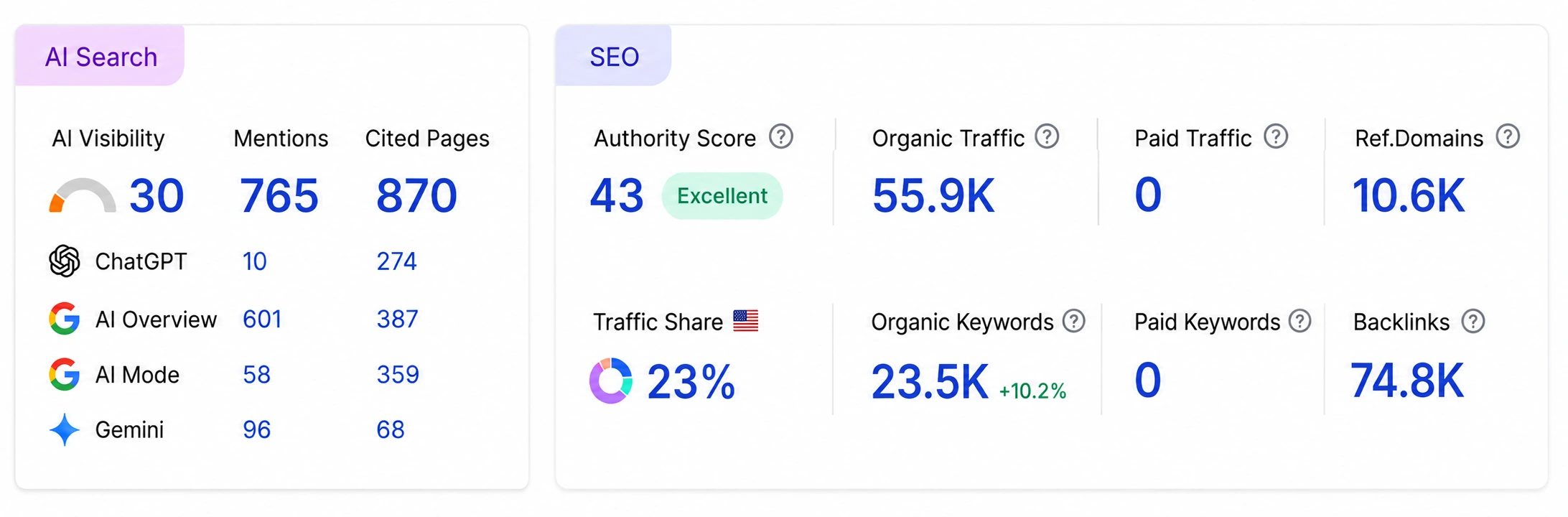
The Results:
AI Search Visibility
- 30 AI visibility score, with 765 total mentions and 870 cited pages across AI platforms
- ChatGPT: 10 mentions, 274 cited pages
- Google AI Overview: 601 mentions, 387 cited pages
- Google AI Mode: 58 mentions, 359 cited pages
- Gemini: 96 mentions, 68 cited pages
Underlying SEO Strength
- Authority Score of 43, rated Excellent
- 55.9K organic traffic and 23.5K organic keywords, with zero reliance on paid traffic
- 10.6K referring domains and 74.8K backlinks supporting citation trust
- 23% US traffic share, showing consistent visibility beyond a single platform
Google’s AI Overview and AI Mode cited the client’s pages far more often than ChatGPT or Gemini did, which tracks with how much more of Google’s index those surfaces draw from. This disparity is why a single-platform strategy is insufficient.
Want Results Like This for Your Brand?
SEO Discovery builds AI visibility strategies backed by real technical SEO.
Your Pre-Publish AI Content Checklist
Before you hit publish, run every page through this list:
- Does this section answer a real question within the first two sentences?
- Is there at least one table, list, or checklist breaking up the text?
- Is every claim backed by a named source, not a vague “studies show”?
- Would this section still make sense if an AI model quoted it alone, with no surrounding context?
- Has this page been updated in the last six months?
If you can check every box, you’re already ahead of most of what’s currently ranking for AI citations.
Make ChatGPT and AI Search Work for Your Brand with SEO Discovery
Getting your content found, trusted, and cited by ChatGPT and other AI assistants isn’t a one-off task. It’s an ongoing habit, the same way traditional SEO always was, except now you’re earning trust from a model instead of an algorithm. Brands that treat this process as large-scale search optimization across their whole content library are the ones still showing up in AI answers a year from now.
At SEO Discovery, our LLM optimization agency team combines technical SEO, content restructuring, schema implementation, and our dedicated Search Everywhere Optimization service to get brands cited across ChatGPT, Perplexity, Gemini, and Google AI Overviews. Whether you need a single audit or ongoing digital marketing services across your whole content strategy, we build the plan around where your buyers are actually asking questions, not just where they’re typing them.
Ready to Show Up in AI Answers?
Get a tailored AI visibility roadmap from SEO Discovery.
FAQs About Optimizing Content for ChatGPT and AI Assistants
It’s structuring content so AI assistants like ChatGPT and Perplexity can extract, trust, and cite it as a direct answer.
No. Schema helps AI systems understand your content, but current research shows it doesn’t reliably increase citations on its own.
Allow crawlers like GPTBot and OAI-SearchBot if you want visibility in ChatGPT; blocking them removes you from that platform’s answers.
Early structural fixes can show up within weeks, but measurable citation gains typically take a full ingestion cycle of two to three months.
They overlap heavily. AEO focuses on direct-answer extraction, GEO focuses on citation in generative summaries, and both fall under AI optimization.
It’s low-cost and forward-compatible, but as of 2026, there’s no confirmed citation lift from having one, so it shouldn’t be your top priority.
We combine proven technical SEO with dedicated AEO strategies built for how people actually use AI assistants today.