
Objective
This blog highlights practical strategies to improve brand visibility in AI search engines like ChatGPT, Gemini, Perplexity, and others. It also explains how to earn AI citations, increase authority, and achieve sustainable growth.
- GEO and AEO are the two most critical strategies for getting your brand cited in AI-generated answers.
- Structured data, fast load times, and clear site architecture are essential for AI-friendly Technical SEO.
- Building brand authority through E-E-A-T signals helps AI engines trust and recommend your brand.
- Monitoring AI search engine brand visibility strategies using specialized tools keeps you ahead of competitors.
- Common mistakes like ignoring unstructured content and weak digital PR can severely hurt your brand visibility on AI search engines.
Get Your Brand Mentioned in AI Search Engines with SEO Discovery, Starting at $300/month
You can improve brand visibility in AI search engines by optimizing your website for generative responses, building domain authority, and aligning with AI-friendly technical standards. More importantly, you must position your brand as a reliable source that AI systems can confidently quote, summarize, and recommend in generative responses.
Did you know? According to McKinsey & Company, approximately 50% of consumers use AI-powered search engines to guide their buying decisions and research
With AI Overviews, ChatGPT, and Perplexity becoming everyday search tools, the fight for brand visibility AI search engines bring has never been more intense. AI search engines no longer just list blue links. They summarize, recommend, and answer questions directly. If your brand is not part of that answer, you are losing traffic, trust, and revenue.
This guide breaks down exactly what you need to improve brand visibility in AI-driven search engines. So, read till the end!
Table Of Contents
- How Do AI Search Engines Actually Work?
- Why Brand Visibility on AI Search Engines Is Essential in 2026
- Most Important Strategies to Improve Brand Visibility on AI Search Engines
- How We Helped a Client Improve Its Brand Mentions on AI Search Engines
- Common Mistakes to Avoid When Optimizing for AI Search Visibility
- Make Your Brand Visible in AI Search Engines with SEO Discovery!
- FAQs about Improving Brand Visibility in AI Search Engines
How Do AI Search Engines Actually Work?
Traditional search engines match web pages with keywords. AI search engines are far more advanced. To comprehend intent, compile data, and produce direct responses, they employ large language models (LLMs).
Platforms like Google AI overviews, Chatbot, Perplexity, and Bing Copilot pull from indexed content. They assess sources for clarity, applicability, and reliability. They then come up with a coherent answer, often citing just a handful of trusted sources.
Key factors AI search engines evaluate:
- Entity Authority and Brand Recognition: AI determines if your brand is acknowledged online as a genuine entity.
- Semantic Clarity and Content Structure: AI favours text that is rationally arranged with bullet points, headings, subheadings, and concise explanations.
- Topical Depth and Context Coverage: AI programs evaluate how well a topic is covered in your writing. Comprehensive resources are more likely to be cited than thin or surface-level content.
- Signals of Source Authority and Trust: AI assesses domain reputation, author trustworthiness, backlinks, and citations. Your chances of appearing in AI-generated responses are increased when you are cited by reliable websites.
- Structured Data and Technical Signals: AI can better comprehend and rank your content when it has schema markup, clear HTML structure, appropriate internal linking, and a fast page speed.
User Intent Alignment: Content that directly responds to user enquiries is given priority by AI. Pages that clearly solve a problem or provide actionable steps are more likely to appear in AI summaries.
Most Important Strategies to Improve Brand Visibility on AI Search Engines
Here are the key strategies for increasing AI search presence and brand awareness on AI search engines. These methods help build authority, trust signals, and consistent visibility throughout modern AI search results.
1. Master Generative Engine Optimization (GEO)
Generative Engine Optimisation (GEO) is the practice of optimizing content so that AI-generated search results on ChatGpt, Gemini, Perplexity, and others include or cite your brand. In contrast to traditional SEO, GEO focuses on getting your content into AI answers, not just ranked on a list.
How to implement GEO effectively:
- Write in a Q&A format. AI engines love clear question-and-answer structures.
- Use concise, authoritative paragraphs. Each paragraph should make one clear point.
- Include statistics and data. AI citations favour factual, well-cited claims.
- Build topical authority. Cover your subject deeply across multiple pages and posts.
- Use natural language. Conversational phrasing matches how users query AI tools.
For example: By posting case studies, whitepapers, and expert information that AI engines index and trust, a B2B software company can control AI responses regarding project management tools. This is the fundamental method of brand optimisation for AI search engine visibility.
2. Implement Answer Engine Optimization (AEO)
Making your content the direct answer to frequently asked user questions is the goal of Answer Engine optimization, or AEO. This is particularly effective for appearing in chatbot responses, AI overviews, and voice search results
AEO best practices include:
- Target question-based keywords. Use tools like AnswerThePublic and Google People Also Ask.
- Structure content with clear headers. H2 and H3 tags help AI identify distinct topic sections.
- Add FAQ sections. The FAQ schema is a direct signal to AI engines.
- Use schema markup. Add FAQPage, HowTo, and Article schema wherever applicable.
- Provide definitions. Define key terms clearly. AI loves encyclopedic, precise explanations.
AEO aims to provide the most reliable and accurate response possible. When AI looks for a response, you want it to find yours first.
3. Optimize for AI Overviews
Google AI Overviews now appear at the very top of many search results. Depending on whether Google cites you, these AI-generated summaries have the potential to either boost or completely eradicate your organic traffic.
Steps to optimize for AI Overviews:
- Write comprehensive content. Cover topics thoroughly. Shallow content rarely gets cited.
- Use clear, simple sentences. AI prefers content it can easily summarize.
- Include expert quotes and sources. External citations boost your credibility signals.
- Optimize metadata. Clear titles and meta descriptions help AI understand your page’s purpose.
- Update content regularly. Fresh, accurate information performs better in AI Overviews.
For example: A healthcare website with monthly content updates that follow YLYM guidelines, including expert interviews and quoted figures, has a much higher chance of showing up in AI Overviews than one with out-of-date, generic articles.
4. AI-Friendly Technical SEO
Your AI visibility will be limited by poor technical SEO, regardless of how good your content is. Like conventional search engines, AI search engines crawl and assess your website. They are significantly more vulnerable to crawl mistakes, duplicate material, slow load times, and poorly designed websites.
Key Technical SEO elements for AI visibility:
- Implement Schema Markup. Structured data helps AI search engines understand your content type and context clearly. Add JSON-LD schema to all important pages.
- Improve Site Speed. Fast-loading pages support better crawling and indexing. Use a CDN, compress images, enable caching, and minify CSS and JavaScript files.
- Optimize for Mobile. Most AI queries happen on mobile devices. Use responsive design and follow mobile-first indexing best practices.
- Strengthen Internal Linking. Clear internal links help AI engines understand your site structure and topical authority. Use descriptive anchor text and logical linking hierarchy.
- Use Canonical Tags Properly. Canonical tags prevent duplicate content confusion and guide AI crawlers toward the preferred version of a page.
For example: If an e-commerce website opts for structured data, optimised internal linking, fixed duplicate URLs, and increased site speed. In comparison to competitors, its site will get crawled more effectively and begin to appear more prominently in AI search settings within weeks.
Is Your Brand Visible in AI Search?
Get a free AI Visibility Audit to make your brand visible in AI search engines.
5. Utilize AI Visibility Tools
What you don’t measure, you can’t improve. Beyond conventional rank trackers, you need specialised solutions to monitor your AI search engine brand visibility strategies.
Top AI visibility monitoring tools to use:
- Semrush AI Overview Tracker: Monitors when your content appears in Google AI Overviews.
- Perplexity AI Search: Let’s you manually test how AI answers queries in your niche.
- BrightEdge Generative Parser: Tracks generative AI citations and brand mentions.
- Mention.com: Tracks brand mentions across the web, including AI-cited sources.
- Google Search Console: Still a powerful tool for monitoring click-through rates and impressions.
To find out how frequently your brand shows up in AI-generated results, set up weekly checks. After obtaining backlinks or releasing new content, monitor any changes. This data will directly shape your AI SEO services strategy over time.
6. Build Brand Authority for AI Recognition
Authoritative brands are preferred by AI engines. They are trained to suggest sources that demonstrate the four pillars Google refers to as E-E-A-T: expertise, experience, authority, and trustworthiness.
How to build brand authority for AI engines:
- Earn high-quality backlinks. Link building services from authoritative domains signal trust directly to AI engines.
- Get featured in Digital PR. Press mentions, news articles, and expert interviews all contribute to authority.
- Publish expert-authored content. Author bios with verifiable credentials boost E-E-A-T signals strongly.
- Engage in Guest Posting. Guest posting services on niche-relevant sites build authority quickly and consistently.
- Get listed in industry directories. Consistent NAP data across listings also supports Local SEO performance.
For example: A law firm with a rudimentary website is much less likely to be included in AI answers than one that regularly publishes well-cited legal guidelines and receives mentions in legal news sites.
Want More AI Search Citations?
With SEO Discovery, improve your brand’s chances of being cited in AI-generated search results.
How We Helped a Client Improve Its Brand Mentions on AI Search Engines
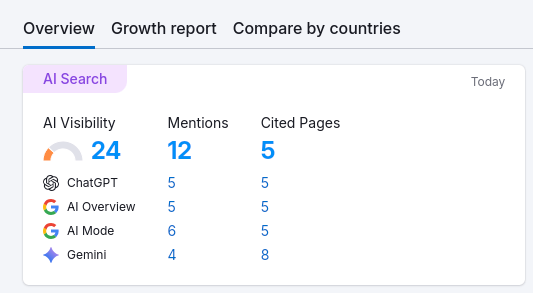
Despite having consistent keyword rankings, one of our clients’ AI search visibility was quite low. Their brand received few mentions and citations, lowering zero-click discovery and overall authority, whereas competitors were often mentioned across AI platforms. We assisted our client in increasing its AI search visibility through the implementation of an appropriate approach.
Results:
- AI visibility increased from 5 to 24 appearances in 90 days
- Brand mentions doubled across major AI platforms (ChatGPT, Gemini, and Google)
- Cited pages improved, strengthening authority signals and source reliability
- Competitor citation gaps successfully closed by targeting specific GEO and AEO strategies
- Higher assisted conversions from AI-driven discovery and direct brand summaries
Common Mistakes to Avoid When Optimizing for AI Search Visibility
Unknowingly, a lot of brands make critical mistakes that lower discoverability and restrict their visibility in AI searches. Outdated information, shallow content, poor technical SEO, and poor organization can all subtly hinder AI systems’ ability to trust and properly rank your content.
- Ignoring structured data: AI systems find it difficult to accurately classify your material if schema markup is missing.
- Writing just for keywords: AI readability is harmed by keyword cramming. Write for humans first, always.
- Neglecting brand mentions: Unlinked brand mentions across the web still carry weight. Track and encourage them.
- Skipping mobile optimisation: Mobile devices account for the majority of AI searches. Mobile-first is not optional.
- Publishing thin content: AI-generated responses hardly ever cite brief, ambiguous sites.
- Ignoring Digital PR: A Digital PR Services strategy builds the off-page authority that AI tools trust most.
- Lack of a content refresh strategy: AI citations quickly disappear from outdated information. Regularly review and update the content.
Weak internal linking: A poorly designed website makes it difficult for AI algorithms to understand the structure and relevancy of your content
Make Your Brand Visible in AI Search Engines with SEO Discovery!
The rules for search have changed permanently. These days, traffic, attention, and trust are all controlled by AI search engines. Brands will own their markets in the future if they understand which strategies increase brand visibility in AI search engines and use them now.
Partner with SEO Discovery, one of the best SEO companies with deep expertise in AI SEO services, and the offers best digital marketing services. We help brands like yours get found, trusted, and chosen by AI search engines every single day.
Contact SEO Discovery today and let us build your AI search visibility from scratch.
Don’t Let Competitors Own Your AI Citations !
Partner with SEO Discovery, secure your brand’s authority and get cited in AI search results.
FAQs about Improving Brand Visibility in AI Search Engines
Brand visibility on AI search engines definition refers to how often and prominently your brand appears in AI-generated answers and citations across tools like Google AI Overviews, ChatGPT, and Perplexity.
You can improve it by publishing authoritative content, implementing structured data, earning quality backlinks, and consistently following GEO and AEO best practices across your entire website.
GEO is the practice of optimizing content so AI engines include it in generated responses. It focuses on content clarity, topical authority, structure, and direct relevance to user questions.
Yes. Traditional SEO forms the foundation. But it must be combined with GEO, AEO, structured data, and brand authority building to perform well in AI-powered search results.
Schema markup provides machine-readable context about your content. It helps AI engines correctly identify, categorize, and cite your pages in generated answers and voice search results.
Top tools include Semrush AI Overview Tracker, BrightEdge Generative Parser, Mention.com, Perplexity AI, and Google Search Console for tracking AI-related impressions and brand citations.
E-E-A-T signals tell AI engines your brand is experienced, expert, authoritative, and trustworthy. Higher E-E-A-T leads directly to more citations in AI-generated search responses.
Absolutely. Local SEO signals like Google Business Profile, consistent NAP data, and local citations help AI engines surface your brand for location-specific and near-me search queries.
Ideally, review and update key content every 3 to 6 months. AI engines favor fresh, accurate content, especially for topics where information changes or evolves frequently.
Yes. By focusing on niche authority, high-quality content, structured data, and consistent brand building, small businesses can absolutely earn AI citations within their specific market segments.