

Objective
This guide explains the six steps your website needs to pass to get cited on Perplexity in 2026, including crawlability, discovery, retrieval, trust, citation, and visibility, with simple, practical tips to improve each step.
- Perplexity SEO has six steps, and each step supports the next.
- Allow PerplexityBot in robots.txt so Perplexity can access your content.
- Being indexed does not guarantee that Perplexity will cite your content.
- Fresh content and trusted mentions help build stronger Perplexity trust.
- Track citations, traffic, leads, and conversions instead of traditional rankings.
Improve Your AI Search Visibility With SEO Discovery, starting at $250/month.
Getting your website cited and featured in Perplexity AI requires more than traditional rankings. Strengthen semantic SEO, improve AI crawler access, and build topical authority to improve visibility in Perplexity. These strategies help AI understand your content, recognize its relevance, and select your website as a trusted source.
Did You Know?
Perplexity interprets query context and nuances before searching, making semantically structured content valuable for AI search.
Unlike traditional search engines, Perplexity collects information from multiple web sources to answer user questions. Your content needs to be accessible, relevant, and clearly structured so AI systems can understand its meaning, connect it with search intent, and potentially use it when generating cited answers.
In this guide, we will explain how to optimize your website, earn citations, and drive traffic from Perplexity AI. So read until the end.
What Is Perplexity SEO, and How Is It Different From Google SEO?
Perplexity SEO means preparing and updating your website so Perplexity can easily crawl, understand, trust, and cite your content in its answers. It is different from traditional SEO because Perplexity does not focus on blue-link rankings. Instead, it creates an answer using information from selected sources.
Here’s how the two systems actually compare:
Google Search | Perplexity | |
Output | Ranked list of links | One synthesized answer with citations |
Primary signal | Backlinks and on-page relevance | Extractability, freshness and relevance |
Update speed | Days to weeks | Often within hours |
Domain authority weight | Very high | Present, but secondary to precision |
Off-site sources used | Indirect (via links) | Direct (Reddit, G2, YouTube cited inline) |
Classic SEO is still your entry ticket. Clean indexation, HTTPS, fast load times, and topical authority all still matter; they just aren’t the finish line anymore, they’re the qualifying round for the funnel below.
The Perplexity SEO Journey: Six Steps to a Citation
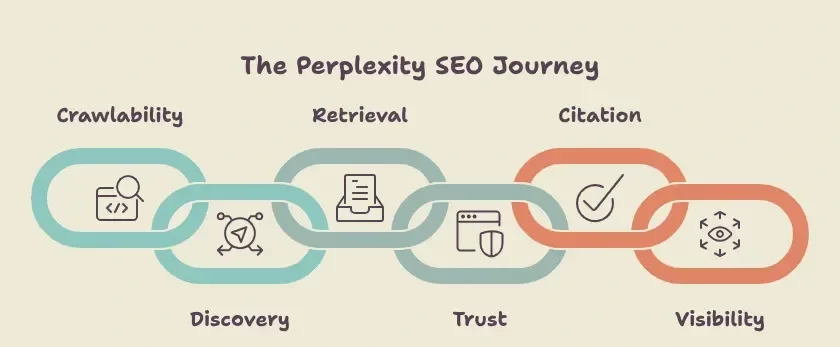
Think of Perplexity visibility as a step-by-step process, not a ranking list. Your page must pass each step before it can move to the next one.
Crawlability, then Discovery, then Retrieval, then Trust, then Citation, then Visibility.
- Crawlability: Can PerplexityBot access the page at all?
- Discovery: Can Perplexity find the page and understand where it fits in your site?
- Retrieval: Does the page provide useful information that directly answers the user’s question?
- Trust: Does your website and content seem reliable enough for Perplexity to cite?
- Citation: Does Perplexity choose your page as a source over other websites?
- Visibility: Does the citation bring more brand awareness, traffic, or leads?
What this means for you: Creating content in bulk is not always the solution. A website can have hundreds of pages and still have poor AI visibility if Perplexity cannot find or access those pages.
Step 1: Crawlability, Can Perplexity Access Your Page?
Before changing your content, make sure Perplexity can access your pages. Access comes first because Perplexity cannot use content it cannot reach. A technical SEO audit can identify these access issues before you spend time improving your content.
Perplexity uses two different crawlers, and each one has a different purpose:
- PerplexityBot regularly scans websites to build and update Perplexity’s search index, even when no one is currently searching for that information.
- Perplexity-User accesses a webpage in real time when someone asks Perplexity to find specific information.
The Fix: Make sure your robots.txt allows PerplexityBot to access your website. You can still block other AI crawlers if needed.
User-agent: PerplexityBot Allow: / User-agent: Perplexity-User Allow: / Sitemap: https://yourdomain.com/sitemap.xml |
Step 2: Discovery, Can Perplexity Find and Place Your Page?
Being crawlable does not mean Perplexity will find your page. Discovery is about helping Perplexity locate your page and understand how it connects to the rest of your website.
This is also where your Perplexity search index presence begins. Perplexity first needs to find and index your page before it can use it in an answer. Strong internal links, an updated sitemap, and proper canonical tags help Perplexity find and index your pages more reliably.
What this means for you: Do a proper AI SEO audit to check internal links and indexation first. If Perplexity cannot find your page, it cannot use or cite it in an answer.
Step 3: Retrieval, Is Your Content Relevant Enough to Appear?
Once Perplexity can find a page, it still needs to decide if the content is relevant. It may consider multiple pages based on relevance, freshness, and how easily information can be understood before selecting sources for its final answer.
Right approach: Start each major section with a clear, complete statement. Perplexity should understand and use it on its own without relying on surrounding paragraphs for context.
Four key things help pages get retrieved by Perplexity:
- Answer-first structure: Give the main answer, number, or recommendation in the first one or two sentences, then explain it in more detail.
- Use clear numbers: Specific numbers are easier to understand and cite than vague claims. For example, say “Revenue increased 47% in Q1” instead of “Revenue increased significantly.”
- Share original information: Your own research, data, examples, and screenshots can make your content more useful than repeated information found on competitor websites.
- Keep the structure clear: Use clear H2s and H3s, comparison tables, and FAQs to help Perplexity quickly find and understand the information it needs.
Relevance depends on the search query. Informational searches need clear answers, comparison searches need honest differences, and commercial searches need specific details. For example, for ecommerce AI SEO, clear product specifications and comparison data can make pages more useful to Perplexity.
“In our client audits, we’ve found that Perplexity doesn’t always cite websites with the highest domain authority. It often favors pages that answer the question clearly in the first sentence instead of hiding the answer deeper in the content.”
Rajbir Singh, Senior AI Search Strategist, SEO Discovery
This is where Search Everywhere Optimization helps. Content that is easy to understand and cite can perform across Perplexity, ChatGPT, and Google AI Overviews without needing separate versions for each platform.
Is Your Content Getting Retrieved?
Our team helps strengthen content for AI retrieval.
Step 4: Trust, Does Perplexity Consider Your Page Credible?
A page can be crawlable, discoverable, and relevant and still lose out to a competitor at the trust step. Trust is where freshness and off-site authority do most of the work.
- Freshness matters on Perplexity. Updated content, accurate date Modified schema, current profiles, and regular third-party mentions can help maintain visibility as AI search results change quickly.
- Off-site mentions can strengthen Perplexity visibility: Reddit, G2, Clutch, LinkedIn, YouTube, reviews, and business listings provide third-party signals that support digital PR consultancy, link building services, and online reputation management.
What this means for you: Your content and community efforts should work together, with both teams sharing the same goals and strategy.
Step 5: Citation, What Makes Perplexity Choose Your Content?
Citation is where the earlier steps come together. It means Perplexity has found your content, understood the information, and decided to use your website as a source in its answer.
When someone asks Perplexity to recommend a business or compare different options, it may look at company websites, review platforms, business listings, and industry websites. It then uses information from these sources to create an answer and cite the businesses or websites it finds relevant.
This shows why your online information matters. Perplexity can use details such as services, locations, reviews, ratings, and business information from trusted sources. Keeping these details accurate and consistent helps Perplexity better understand and verify your brand.
What this means for you: Keep your Google Business Profile, reviews, business listings, and third-party mentions accurate and updated. Strong, consistent information across trusted sources can improve your chances of being cited when users ask Perplexity for recommendations or comparisons.
Want Perplexity to Cite You?
SEO Discovery strengthens your brand’s authority for AI.
Step 6: Visibility, Is the Citation Actually Working?
A citation does not always bring visitors to your website. Perplexity may answer the user’s question without requiring a click. Visibility shows whether your Perplexity presence is actually bringing value, not just getting citations.
Track these results regularly:
Action 1: Confirm access. Re-audit robots.txt for PerplexityBot and Perplexity-User, check WAF rules, verify JavaScript-independent rendering.
Action 2: Test real prompts. Run the questions your customers actually ask through Perplexity, and record whether your brand appears, which pages get cited, and which competitors show up instead.
Action 3: Rewrite content. Start each H2 section with a clear answer. Use comparison tables and FAQs to present important information clearly instead of using long paragraphs.
Action 4: Add original information. Include at least one unique data point, screenshot, or expert quote on every major page.
Action 5: Keep content fresh. Update your data at least every three months, or monthly for topics that change quickly.
Action 6: Track real results. Monitor Perplexity traffic, leads, and conversions in your analytics. More citations are useful only when they help bring meaningful business results.
How We Built Our Brand’s Visibility on Perplexity
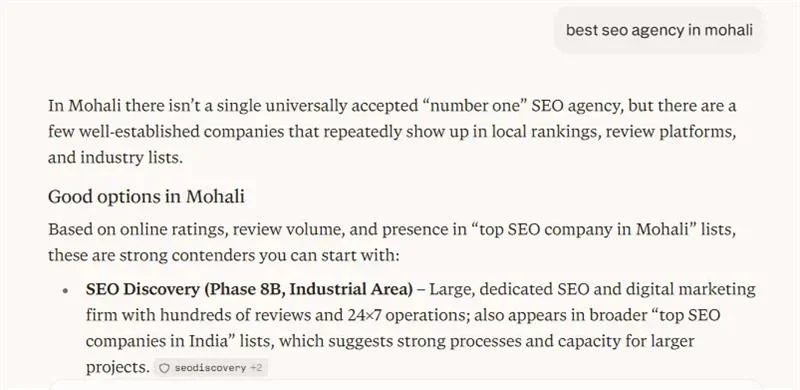
We tested our own Perplexity SEO strategy before offering it to clients. When users ask Perplexity to recommend the best SEO agency in Mohali, SEO Discovery appears in the AI-generated response. This real-world result demonstrates how the right strategy can build meaningful visibility across AI search platforms.
Our approach combined fact-first content, consistent business information across trusted platforms, and ongoing reputation building through genuine customer reviews. We strengthened topical authority through regular publishing, implemented structured schema markup, and organized important website information, so AI platforms could understand, verify, and reference our expertise, services, and credentials.
The strategy helped us appear as a recommended agency when Perplexity was asked about the best SEO agencies in Mohali. It was listed under the “Good options in Mohali” section and referenced for its customer reviews, 24×7 operations, established processes, and ability to handle larger projects, strengthening our visibility in AI search.
Ready to Clear Every Step of the Funnel?
Perplexity isn’t a smaller version of Google. It follows a six-step funnel covering crawlability, discovery, retrieval, trust, citation, and visibility. In 2026, businesses need AI SEO audits, semantic SEO, and agentic search optimization to work together, helping content become easier for AI platforms to understand, trust, retrieve, cite, and feature.
At SEO Discovery, we help businesses optimize for the full Perplexity funnel, from crawlability and content discovery to retrieval, trust, citation, and AI visibility. Our team combines technical SEO, semantic SEO, and AI search strategies to help your website become easier for AI platforms to understand, trust, and feature.
Contact us today to build a stronger AI search presence and turn Perplexity visibility into measurable growth.
This is what a high Citation Rate produces in practice: a named mention, accurate pricing, and placement in a comparison table the AI generated on its own, without anyone clicking through to a website first.
Ready to Win AI Search?
SEO Discovery helps your brand build stronger AI visibility.
FAQs About Perplexity SEO
Get indexed by allowing PerplexityBot in robots.txt, then structure content with answer-first sections so it’s extractable and citation-worthy.
Combine crawler access, answer-first structure, fresh data, and active presence on Reddit, G2, and LinkedIn, since Perplexity cites all of these directly.
Location mainly affects local query results, not core citation eligibility, which depends on crawlability, structure, and freshness everywhere.
Track which URLs get cited per region and query, since Perplexity’s citation patterns can vary by market even for the same topic.
SEO Discovery specializes in AEO and GEO, offering Perplexity-focused technical audits, content restructuring, AI search optimization, and citation tracking to help businesses improve visibility across AI search platforms.
Traditional tools measure keyword rankings. Perplexity has no ranking position, so success is measured by citation frequency instead.
Rewrite existing high-traffic pages with answer-first H2s and current-year data before creating new content from scratch.