
Objective:
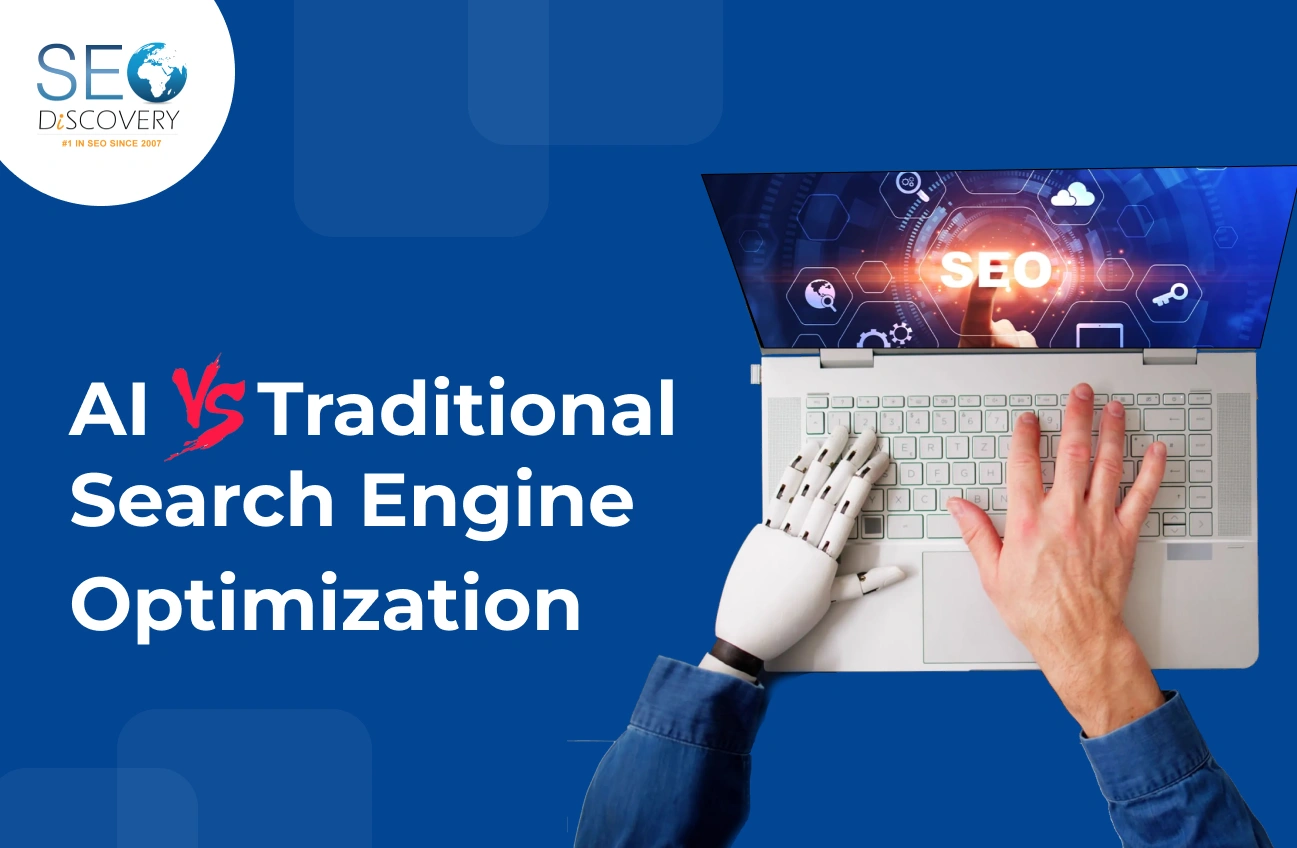
To help small businesses understand the differences between AI SEO and traditional SEO, and identify the most effective hybrid strategy.
The search space is evolving rapidly with the development of AI that is changing how the content is generated, optimized, and ranked in search results. In the case of small businesses, the issue is not the reshaping of SEO that AI will do but the speed at which they can change.
According to McKinsey & Company (October 2025), half of global consumers are now using an AI-powered search engine, and AI-based discovery is projected to shape up to $750 billion in consumer spending by 2028, emphasizing how rapidly the search space is changing toward artificial intelligence.
The secret of success lies not only in the implementation of new technology but also in the creation of a flexible strategy that will combine automation with human skills to provide sustainable visibility in search positions.
Key Takeaways
- AI SEO leverages automation and data intelligence, while traditional SEO thrives on human insight and storytelling.
- GEO boosts visibility in AI-driven searches but works best alongside traditional SEO.
- AEO optimizes structured, intent-based content for AI summaries and conversational results.
- Small businesses gain most from a hybrid SEO model combining automation with human strategy.
- Future-ready SEO blends AI analytics, core SEO principles, and agile adaptation to new search trends.
Table Of Contents
- The Shift from Manual Optimization to AI Intelligence
- AI SEO Services for Small Business and What They Bring
- Can Generative Engine Optimization Fully Replace Traditional SEO
- Comparing AEO Strategies with Traditional SEO Effectiveness
- Traditional SEO vs AI-Driven SEO Differences
- Exploring the Four Models of Hybrid SEO Strategy for 2025
- How Generative Engine Optimization Differs from Traditional SEO
- The Importance of AI SEO Services for Small Business
- Establishing a Future-Oriented SEO Strategy With SEO Discovery
- FAQs About AI vs. Traditional SEO: What’s the Best Approach for Small Businesses?
The Shift from Manual Optimization to AI Intelligence
Traditional SEO was the basis for your online visibility. It focused on important components like On Page SEO, audits, quality content, and internal linking. As Google’s algorithm advanced and began to place more importance on user intent, authority and engagement signals, the benefits then flowed to businesses that provided quality value and good optimization.
As you incorporated AI into improved digital experiences, AI and SEO for small businesses took a new turn. Tools that use generative algorithms can analyze huge data sets, understand natural language, and provide real-time predictions about search trends, and it goes beyond search. SEO is no longer just about ranking on Google, it’s about being found everywhere through search everywhere optimization.
The launch of Google AI Overviews and new platforms like Perplexity SEO and ChatGPT SEO is also proof the movement toward optimization is multi-platform and conversational visibility.
AI SEO Services for Small Business and What They Bring
SEO planning that leverages AI offers scalability, personalization, and automation to a field that has been heavily reliant on analysis by people for a long time.
AI SEO Advantage | How It Transforms Your Strategy |
Automation Efficiency | Automating the cumbersome process of tracking keywords, making audits and reporting, therefore, saving time and resources. |
Predictive Insights | Relies on machine learning to forecast upcoming search patterns and customer interest to ensure it has a competitive edge over other firms. |
Personalized Optimization | Swiftly personalizes search engine tactics according to the user behavior, demographics, and wishes to be more engaged. |
Real-Time Adaptability | Adapts to Google algorithm changes in real time, and assists in keeping rankings and visibility constant. |
Content Intelligence | With the help of NLP and AI models, it produces search intent and tone-optimized content that is SEO-optimized. |
AI SEO tools — from automated keyword research engines to AI-powered rank tracking tools vs traditional SEO software comparison — are reinventing how businesses assess performance metrics used to inform your planning or task work to do in real time.
Can Generative Engine Optimization Fully Replace Traditional SEO
Generative Engine Optimization (GEO) doesn’t replace traditional SEO — it complements it by optimizing for AI-driven platforms while traditional SEO builds authority and trust.
When to Focus on Traditional SEO | When to Focus on Generative Engine Optimization (GEO) |
You want stable long term positions on Google search engines. | You want the presence of AI-generated responses and summaries. |
Your audience searches through Google, Bing, or YouTube | Your audience is moving towards the use of AI assistants or chat search more and more. |
You stress on storytelling, brand personality, and creativity | You underline organized information, factual correctness and the ability to respond briefly. |
You rely on backlinks, authority signals, and organic traffic | You are dependent on semantic optimization and questions-based content. |
You want to create brand trust and reputation in the long run. | You would desire a quick exposure and high ranking in AI answer engines. |
Instead of wondering, can GEO replace traditional SEO, small businesses should develop a hybrid strategy that obtains the best of both worlds; design authority from traditional SEO tactics and real-time adaptability from generative AI SEO optimization for small businesses.
Comparing AEO Strategies with Traditional SEO Effectiveness
Answer Engine Optimization (AEO) is intended to enhance visibility within AI chat tools and voice assistants. AEO strategies emphasize concise, question-based content that AI engines can easily interpret and display. So, how do AEO strategies Vs traditional SEO effectiveness compare in practice?
Metric | Traditional SEO | AEO (Answer Engine Optimization) |
Search Visibility (SERPs) | High on Google result pages | Middle ground – AI-based and voice-based discovery. |
AI & Voice Search Visibility | Low | Very High — appears in conversational AI outputs |
Content Format | Long-form, keyword-rich blogs | Brief, straight, and response-oriented snippets. |
CTR (Click-Through Rate) | Stable but dependent on ranking | Declining clicks but strong brand visibility |
User Intent Focus | Transactional or informational | Conversational and intent-driven |
Best Use Case | Long-term content and link-building | Quick-answer content for AI and zero-click environments |
Traditional SEO vs AI-Driven SEO Differences
Traditional and AI-driven SEO share the same goal — visibility — but differ in automation, adaptability, and data precision. The distinctions arise in aspects of automation, data management, and adapting to algorithmic shifts.
Aspect | Traditional SEO Strength | AI SEO Strength | Hybrid Outcome (Best of Both) |
Keyword Strategy | Manual keyword mapping based on research tools | Predictive keyword clustering using AI models | Data-informed keywords that align with both intent and volume |
Content Creation | Human storytelling, tone, and creativity | NLP-based generation with SEO optimization | Authentic, high-performing AI-assisted content |
Analytics | Manual review through Google Analytics, GSC | Automated real-time dashboards and predictive insights | Comprehensive insights that combine human interpretation + AI speed |
Optimization Speed | Slower — relies on audits and manual updates | Instant — AI adjusts meta, tags, and rankings in real time | Continuous optimization loop that maintains ranking consistency |
Scalability | Limited by resources | Highly scalable automation | Fast, consistent, and data-backed growth |
Adaptability to Algorithm Changes | Requires analysis and manual fixes | AI detects and adapts instantly | Balanced response — human oversight + AI responsiveness |
The rise of AI-driven SEO strategies vs traditional SEO tactics has ushered in a new era where automation and creativity nimbly exist side by side, rather than one against the other.
For a small business, the best option isn’t to pick from one of the approach
Exploring the Four Models of Hybrid SEO Strategy for 2025
Small businesses benefit from a hybrid mix that applies each model wisely together. Here’s a look on how the four primary models can work together.
SEO Model | Core Focus | Ideal Use Case for Small Businesses | Key Advantage | Primary Challenge | Overall Impact |
Traditional SEO | On-page optimization, backlinks, and keyword ranking | Building long-term authority and trust | Sustainable, compounding traffic growth | Slower adaptability to algorithm updates | Remains essential for credibility and organic discovery |
AI SEO | Automation, data-driven insights, and predictive content | Scaling campaigns efficiently | Real-time optimization and advanced targeting | Requires technical integration | Drives efficiency and higher ROI |
AEO (Answer Engine Optimization) | Voice and AI-driven discovery | Appearing in AI chat answers and SERP snippets | Enhances visibility in conversational results | Reduced click tracking accuracy | Expands reach across AI platforms |
GEO (Generative Engine Optimization) | Optimization for AI engines (ChatGPT, Gemini, Perplexity) | Exposure in AI-generated summaries | Semantic authority and future readiness | Limited analytics and evolving guidelines | Critical for search everywhere optimization |
The combination of AI-powered SEO for small businesses, traditional methods and next-gen would be the most consistent, scalable, and future-proof method.
How Generative Engine Optimization Differs from Traditional SEO
An often-asked question — is Generative Engine Optimization equivalent to Traditional SEO?
The answer resides in the intent. Traditional SEO focuses on optimizing for search engines, while GEO focuses on optimizing for AI-driven platforms. GEO prioritizes structured, factual, and semantically rich data that AI systems can easily interpret, whereas Traditional SEO emphasizes ranking factors like keywords, backlinks, and on-page optimization to improve visibility in search results.
The Importance of AI SEO Services for Small Business

When you engage with the right AI SEO Agency, you can accelerate the adoption of AI. AI tools work faster than humans, but expert oversight ensures creativity and ethics. The best AI SEO specialists scale efficiently while preserving brand storytelling.
For businesses utilizing Local SEO Services’, AI modules, including sentiment analysis, auto-generated local FAQ’s, and a predictive review module, expands their reach significantly. A combination of regular technical SEO audit services and Strategic SEO consultancy can help small businesses develop multi-channel authority quicker than we have ever experienced.
Establishing a Future-Oriented SEO Strategy With SEO Discovery
The debate of AI vs. traditional SEO is not about who wins — it is how the two work together. Traditional SEO gives brands visibility and trust, while AI comes in to provide conditionality and relevancy.
For small businesses, the best approach is to utilize both, as AI cannot replace human creativity and an intelligent AI process cannot outrun machine efficiency. Whether optimizing for google AI overviews, ChatGPT SEO, or perplexity SEO, brands need to position themselves for potential AI-infused search landscape.
At SEO Discovery, we are experts in bridging the gap. As the best SEO company and an AI SEO Agency that our clients trust, we provide small business seo services that draw from the best SEO fundamentals and apply intelligent automation, predictive insights, and advanced AI SEO services for small business.
Looking to boost your small business visibility in 2026?
Partner with SEO Discovery, the best SEO company for small businesses. Our AI-powered SEO strategies blend innovation with proven expertise — helping your brand stand out in both search and AI-driven platforms.
FAQs About AI vs. Traditional SEO: What’s the Best Approach for Small Businesses?
Generative Engine Optimization (GEO) is focused on optimizing content for AI-enabled platforms and generative search models. Traditional SEO, on the other hand, is focused on the ranking of keywords and organic traffic coming from search engines like Google. GEO captures things like context, conversational phrasing, and semantic understanding — factors that traditional SEO employs mainly through structured keyword placement and backlink authority.
Not fully. GEO will certainly promote visibility in search results generated by AI, but the foundation for indexing and ranking in traditional search engines will always be SEO in some form. For most small businesses, the hybrid approach seems to be the best fit for visibility in AI-generated search results with GEO, while also ensuring they continue to focus on traditional SEO to promote long-term organic results.
No, they differ significantly. Traditional SEO emphasizes keyword targeting, technical audits, and backlinks, whereas Generative Engine Optimization focuses on optimizing for natural language queries and AI comprehension. GEO strategies are designed to help content surface in tools like ChatGPT or Google’s AI Overviews.
Answer Engine Optimization (AEO) aims to structure content so AI and voice assistants can deliver precise, summarized answers. Traditional SEO focuses on ranking web pages. AEO has proven more effective for conversational search and featured snippets, while traditional SEO continues to dominate long-tail keyword visibility.
Alternatives include adopting GEO strategies, AEO services, and leveraging AI-driven visibility tools like ChatGPT SEO and Perplexity SEO. These alternatives improve content discoverability in generative AI responses, enhancing reach where traditional search engines have limited influence.
Generative AI SEO Optimization for small businesses helps automate keyword research, personalize content, and enhance audience targeting. With tools powered by AI, small businesses can compete with larger firms by optimizing content for both human readers and AI-generated answer systems.
Answer Engine Optimization delivers direct, conversational answers through AI chat or voice interfaces, reducing the need for users to click through multiple sites. Traditional SEO relies on search results pages where users choose which link to explore. Both serve different user intents but can complement each other effectively.
Large Language Model Optimization (LLMO) focuses on training and optimizing content to align with how AI models interpret and generate text. Traditional SEO, in contrast, is optimized for algorithmic ranking factors like metadata, internal linking, and backlinks. LLMO is about AI interpretation; traditional SEO is about search engine visibility.
AI SEO services for small businesses offer automation, predictive analytics, and AI-powered rank tracking tools that help identify content gaps and user intent faster. They save time, improve targeting accuracy, and provide a cost-effective solution for businesses seeking growth in AI-integrated search ecosystems.
Traditional SEO focuses on keyword-based ranking, backlink building, and technical website optimization. AI-driven SEO leverages data modeling, intent prediction, and generative search adaptability. The key difference lies in automation — AI SEO learns and adapts, while traditional SEO requires ongoing manual refinement.
