
Objective
This blog highlights how SEO and social media work together in 2026 to improve brand visibility and build authority. It covers key strategies, benefits, and signs that your business needs a dedicated SEO and social media marketing agency.
- Social platforms like TikTok, YouTube, and Instagram now drive half of product discovery, making social SEO essential.
- Using SEO keyword research to guide social content improves both search rankings and social engagement.
- Social sharing accelerates content indexing and earns organic backlinks, which are two major SEO wins.
- A combined SEO and social media marketing strategy builds multi-platform brand trust and authority.
- Working with a specialized SEO and social media marketing agency can unify your strategy for faster, better results.
Improve Your Online Visibility with SEO and Social Media Services from SEO Discovery, Starting at $350/Month.
In 2026, SEO and social media are no longer separate strategies; they combine into a single “Social SEO” approach. Social platforms now function like search engines, while content shared on these channels strengthens credibility for AI-led search results. To succeed, brands must customize content for each platform’s search behavior, including TikTok, YouTube, LinkedIn, and others.
Did you know? According to a report by Forbes, 24% of respondents prefer social media platforms for searching items and topics such as restaurants, fashion, and sports updates.
This shows people no longer search only on Google. They search on TikTok for “best running shoes.” They search on YouTube for “how to fix a leaky faucet.” They browse Pinterest for home decor ideas before ever opening a browser. The customer journey now spans multiple platforms, and your strategy must follow.
This guide walks you through exactly how SEO and social media marketing work in sync. So read until the end!
Table Of Contents
- Why SEO and Social Media Synergy Matters More Than Ever in 2026
- How SEO and Social Media Work Together for Better Online Presence
- How We Improved Online Presence for Our Client Using SEO and Social Media Strategy
- Signs You Need a Dedicated SEO and Social Media Marketing Agency
- Build a Strong Digital Presence with SEO Discovery!
- FAQs About How Can SEO and Social Media Work Together in 2026
Why SEO and Social Media Synergy Matters More Than Ever in 2026
In 2026, the search ecosystem has changed drastically. TikTok has its own results that look like SERPs. YouTube is still the second-biggest search engine in the world. 95% of Pinterest’s users decide what to buy after seeing it. New search features are coming to Instagram that index captions and on-screen text.
The search is no longer Google-only. Every day, brands that don’t pay attention lose visibility. This is a big change in how users act, and your SEO and social media management strategy needs to adapt to it.
Social Signals Influence Brand Authority
Social signals like shares, comments, likes, and mentions do not directly move rankings. However, they create conditions that do influence rankings:
- Social engagement improves AI visibility: Large language models crawl trending social data to generate answers. Strong engagement ensures your seo and social media synergy impacts AI
- High-share content earns more backlinks: Viral posts attract diverse creators who link to your site.
- Shared content reaches more people: Broader visibility drives more branded searches and organic traffic growth.
- Engagement signals content quality: Meaningful interactions prove to algorithms that your information is valuable.
AI Overviews and LLMs Are Now Fed by Social Content
ChatGPT, Google AI Overviews, and Perplexity are all AI platforms that use social content to build their answers. Now, a YouTube video transcript, a LinkedIn piece, or a Reddit thread can show up in an AI-generated answer.
Your brand needs to show up in both regular search results and AI-generated answers if you want to stay visible. Good social content can help you do both. This is a core reason why the seo and social media synergy strategy has become a non-negotiable for serious brands.
The search is no longer Google-only. Every day, brands that don’t pay attention lose visibility. This is a big change in how users act, and your SEO and social media management strategy needs to adapt to it.
Confused About AI and Social Search Trends?
SEO Discovery helps you adapt fast with future-ready SEO and social strategies.
How SEO and Social Media Work Together for Better Online Presence
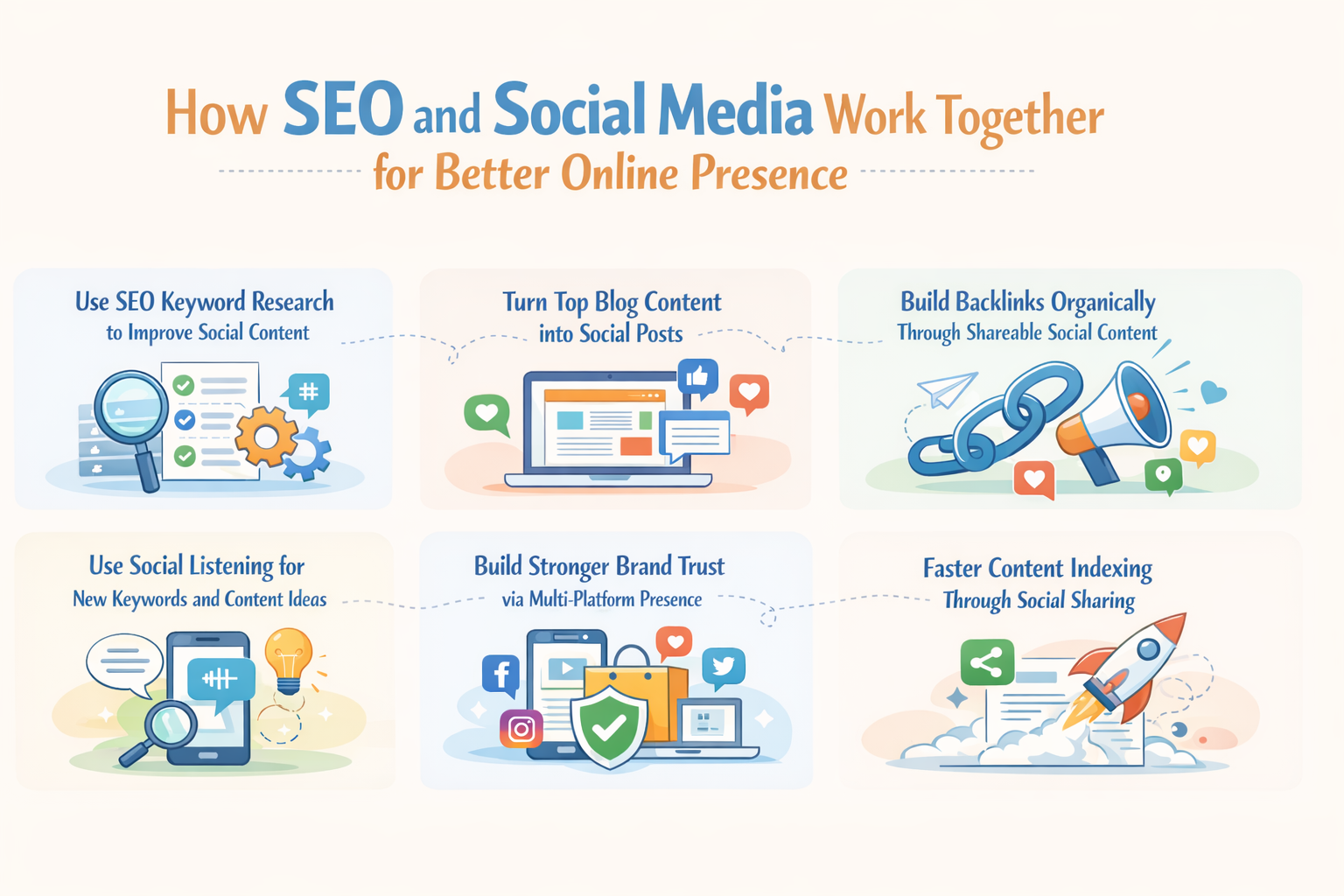
To understand how SEO and social media work together, you need to look at concrete strategies, not just theory. Here are some of the most important points that show how SEO and social media work together:
1. Use SEO Keyword Research to Improve Social Content
Keyword research is not just for web pages and blog posts. It’s a goldmine to find content for social media. If you know what keywords people are searching for, you can create a strategy that works across multiple platforms.
Here is how keyword research fuels your social media presence:
- Optimized video scripts and captions: You can use high-intent keywords in TikTok captions or video scripts to ensure your content reaches the right audience.
- Trend-based visual content: Use trending search queries to build Instagram Reels or Pinterest pins that answer specific user questions.
- Search-friendly video titles: Creating YouTube video titles that match what users type into the search bar increases the chance of your content appearing in Google results.
- Cross-platform discovery: Identifying a specific search query allows you to create one piece of content that performs well on both native social search and traditional search engines.
Example: A yoga studio uses “morning yoga for beginners” as both a YouTube title and Pinterest caption will have chances of ranking on Google while also getting discovered inside Pinterest’s native search.
2. Turn Top Blog Content into Social Posts
Your best-performing blog posts have a lot of useful information that can be used in other ways. You can make your research last longer and reach new people on more platforms by putting the same article into more than one format.
Here is how you can transform blog content into social media assets:
- Step-by-step guide to carousel posts: Convert a detailed tutorial into an Instagram or LinkedIn carousel to improve engagement and dwell time.
- Data-backed articles into infographics: Visualizing statistics from your blog for Pinterest or X makes complex information easier to digest and share.
- How-to posts into short-form videos: Use your existing SEO content writing scripts to create quick TikToks or YouTube Shorts that solve a specific problem.
- Expert opinion pieces into quote graphics: Highlighting a unique insight on LinkedIn or Facebook establishes authority and encourages community discussion.
- Case studies into threads or breakdowns: Turn a success story into an X thread to explain the process and results in a conversational way.
Example: An HR consultant repurposes their “Remote Work Policy Guide” blog into five LinkedIn carousel slides, each slide covers one section, drives more profile visits, and website clicks.
3. Build Backlinks Organically Through Shareable Social Content
Link building services are an important part of SEO, but if your content gets shared a lot on social media, you can get backlinks naturally. The first step toward getting high-quality links from all over the web is social amplification.
Here is how social sharing accelerates the link-earning process:
- Blog distribution: Publishing a research-heavy post and sharing it with compelling captions makes it more likely to be found by industry peers.
- Visual asset sharing: Creating infographics for social platforms allows journalists and bloggers to discover and embed your visuals in their own articles.
- Digital PR integration: Combining your efforts with digital PR services ensures that your best content reaches the right desks and newsfeeds.
- Niche authority building: Consistent social activity helps you get noticed by those who manage guest posting services, leading to more collaborative opportunities.
Example: A nutrition brand publishes a “Calorie Comparison Chart” infographic on Instagram. Three health bloggers discover it, embed it in their articles, and credit the brand’s website.
4. Use Social Listening for New Keywords and Content Ideas
One of the best ways to find new keywords is to monitor conversations, comments, and popular topics on social media. This is called “social listening.” You can find rising trends before they reach their peak on Google, which gives you a competitive edge in your keyword research strategy.
Here is how social listening fuels your content engine:
- Real-time audience insights: Monitoring Reddit, TikTok comments, or Facebook groups tells you exactly what questions your audience is asking.
- Early trend identification: Using tools like TikTok’s Creator Search Insights helps you find rising search trends before your competitors do.
- Direct-to-consumer feedback: Instagram polls and LinkedIn discussions act as a real-time focus group for your brand’s future topics.
- Gap analysis in content: Identifying common complaints or missing information in social discussions reveals new opportunities for your SEO content calendar.
- Natural language discovery: Social platforms show you the exact phrases and slang users use, which you can then turn into highly relevant FAQ sections or blog headers.
Example: A travel agency monitors Facebook groups where users complain, “can’t find budget trips to Bali.” They create a blog targeting that gap and start ranking within weeks.
5. Build Stronger Brand Trust via Multi-Platform Presence
People in 2026 are sceptical and do a lot of study before they buy. People are much more likely to trust a brand that shows up regularly on multiple platforms than one that only shows up in a single search result.
Here is how a multi-platform footprint establishes authority:
- Omnichannel credibility: Checking Instagram, Google reviews, and YouTube videos allows users to verify your brand’s reputation before making a decision.
- Cohesive brand experience: Maintaining consistent brand messaging across social platforms ensures users recognize and trust your expertise everywhere they go.
- Search engine rewards: Search engines favor brands with a strong multi-platform footprint, as social signals and diverse traffic sources indicate relevance.
- Unified site architecture: Strategic internal linking on your website helps guide social visitors to the most important conversion pages once they click through.
Example: A freelance photographer maintains active Instagram, Google Business, and YouTube profiles. A potential client checks all three before hiring, consistent presence across platforms closes the deal.
6. Faster Content Indexing Through Social Sharing
Sharing your new blog post on social media can help Google scan your pages a lot faster, which is a quick win that many brands miss. When search engines see a lot of activity around a new URL, they make it a priority to crawl that content.
Here is how social signals accelerate your indexing process:
- Triggering search engine crawls: When Googlebot sees a new URL being linked and discussed, it treats that engagement as a signal to crawl the page sooner.
- Rapid indexing for time-sensitive content: Social sharing is particularly useful for news articles, product launches, or trend-related posts that need immediate visibility.
- Competitive speed advantage: Getting your content into search results faster than your competitors ensures you capture the initial wave of search interest.
- Technical SEO synergy: Pairing social promotion with strong technical SEO services ensures that once the bot arrives, it can navigate your site without friction.
Example: An e-commerce store launches a new product page and immediately shares it across Facebook and LinkedIn. Google detects the link activity and indexes the page within hours.
How We Improved Online Presence for Our Client Using SEO and Social Media Strategy
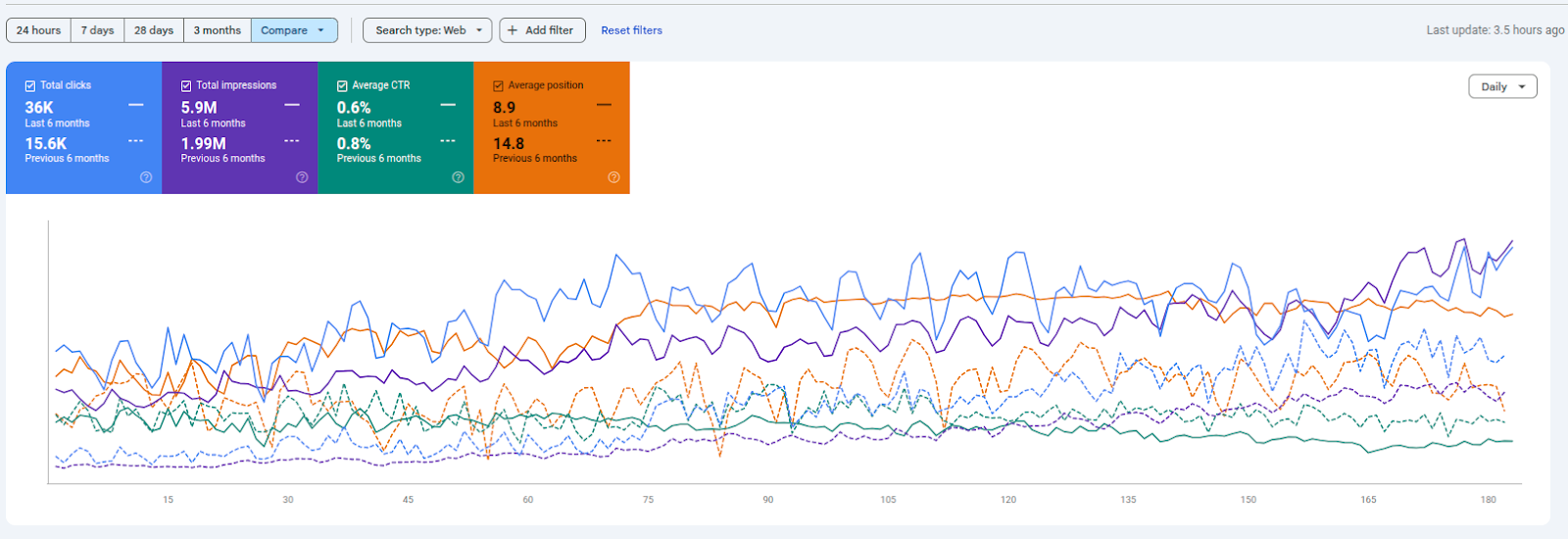
To improve organic growth for a local service-based client, we first analyzed search performance using Google Search Console. Instead of focusing on vanity metrics, we evaluated click growth, impressions, keyword expansion, ranking improvements, and how social media activity was accelerating content discovery and brand trust across platforms.
Our main objective was simple:
Build a unified SEO and social media strategy that attracts users early through social platforms, nurtures them with helpful content, and converts them through optimized service pages.
The Results (6-Month Growth)
- 36K Total Organic Clicks (Up from 15.6K in the previous 6 months)
- 5.9M Search Impressions (Up from 1.99M previously)
- Average Position improved from 14.8 to 8.9
- CTR improved from 0.8% to 0.6% (with significantly higher volume)
- 130%+ Growth in Organic Click Traffic
- Stronger multi-platform brand visibility across Google, Instagram, and YouTube
- Higher branded search volume driven directly by social media engagement
- Faster content indexing through consistent social sharing and link activity
Signs You Need a Dedicated SEO and Social Media Marketing Agency
You might be having a hard time running both channels yourself. Here are some clear signs that it’s time to work with a professional SEO and social media marketing agency.:
1. Organic traffic is declining
If your website’s traffic has gone down despite publishing new content, it could be because of technical problems or an algorithm update. A full audit and do a full audit and get things fixed quickly.
2. Social content gets no traction
If you publish without a keyword strategy, content calendar, or audience analysis, your time and effort will be wasted. An expert team offers direction based on data.
3. Not appearing in local results
You need to hurry up and work on your GMB services and local SEO if your competitors show up on Google Maps, but you don’t.
4. No clear content strategy
Random posting and blogging that doesn’t happen often won’t make a difference. You need social media marketing services packages that align with your SEO goals and are well-coordinated.
5. Unsure how to adapt to AI search
Google AI Overviews and ChatGPT are changing how users discover content; adapting your strategy requires expertise. Getting help from the right SEO and social media marketing company will help you stay on top of these shifts.
Build a Strong Digital Presence with SEO Discovery!
You can’t treat SEO and social media as two different strategies in 2026; that would have been a missed chance. Every platform that people scroll through is now a search engine. Every piece of content you put out there is a chance to rank, be found, and build authority that lasts.
Hire an SEO and social media marketing agency like SEO Discovery that specialises in both and knows how to make them work together for your business. Get in touch with us right away, and we’ll work together to make a plan that will help your brand grow on all the important platforms.
Need a SEO and Social Strategy That Actually Works?
Choose SEO Discovery for proven SEO and social media success.
FAQs About How Can SEO and Social Media Work Together in 2026
Social media helps distribute your content to a wider audience, increasing visibility and engagement. This leads to more shares, backlinks, and brand searches, which indirectly strengthen your website’s authority and improve SEO rankings.
SEO and social media marketing are different strategies. SEO focuses on ranking in search engines, while social media targets audience engagement. When combined, they create a powerful system for driving traffic and building brand awareness.
Social media does not directly influence Google rankings. However, it drives traffic, improves content visibility, and increases chances of earning backlinks, which are strong ranking factors that positively impact overall SEO performance.
SEO and social media support each other by improving content reach and performance. Social media amplifies SEO content, while SEO insights like keyword research help create optimized, discoverable social media posts that perform better.
When you share valuable content on social media, it reaches bloggers, journalists, and creators. If they find it useful, they may link back to your website, helping you earn high-quality backlinks naturally.
Social SEO involves optimizing content for discovery within platforms like TikTok, YouTube, and Pinterest. In 2026, these platforms act as search engines, making optimization crucial for visibility and audience growth.
Keyword research helps identify what your audience is searching for. You can use these keywords in captions, hashtags, titles, and descriptions to make your content more searchable and relevant across social platforms.
Combining SEO and social media increases content reach, improves brand trust, drives more traffic, speeds up indexing, enhances keyword insights, and supports a full-funnel marketing strategy for long-term digital growth.
Choose an agency with proven results, clear communication, and strong expertise in both SEO and social media. Look for case studies, transparent reporting, and a strategy that aligns with your business goals.
Posting consistently is key to success. Sharing high-quality, keyword-focused content three to five times per week helps maintain engagement, improve visibility, and support your overall SEO and social media performance.