

Objective:
This blog aims to explain what dwell time is in SEO, why it matters for rankings and user experience, and how website owners can improve dwell time to boost SEO performance and conversions.
There are numerous factors when it comes to enhancing the visibility of your website on the search engines. Dwell time is one such metric that is frequently ignored. Dwell time is defined as the time a visitor takes on your site after clicking on a link on the search results before going back to the search engine. It provides search engines with a clue of the value and the interest of your content to the users.
Did you know? Pages with higher dwell time often rank better on Google. On average, users spend 3–5 minutes longer on pages that are well-structured, engaging, and relevant to their search query, signaling higher content value to search engines.
The longer dwell time is a good sign that visitors are locating what they are seeking and take more time to browse your content. Conversely, a short dwell time may indicate that your site is not performing as per the expectations of the users. This information is utilized by search engines such as Google in their ranking algorithms and thus dwell time can indirectly affect the SEO performance of your website.
Learning about the impact of dwell time on SEO enables the owners of websites to produce more interesting content, enhance user experience, and eventually secure higher search positions.
This blog will discuss why dwell time is important and provide the strategies to improve dwell time.
Key Takeaways
- Dwell time shows how long visitors stay on your site from search results, indicating content value.
- Longer dwell times boost SEO rankings, trust, and conversions.
- Content quality, site speed, mobile usability, readability, and internal links affect dwell time.
- Avoid slow loading, thin content, poor layout, and excessive ads to improve dwell time.
- Track dwell time via session duration, bounce rate, and scroll depth for SEO optimization.
Table Of Contents
- What is Dwell Time in SEO?
- Case Studies and Success Stories
- Why is Dwell Time Important for SEO?
- Factors That Influence Dwell Time
- The Role of Dwell Time in SEO Today
- How SEO Dwell Time Boosts Your Rankings
- Dwell Time Meaning SEO: Common Mistakes to Avoid
- Measuring and Tracking Dwell Time for SEO Success
- SEO Discovery Explains Why Dwell Time Matters More Than Ever
- FAQ’s On How Dwell Time Affects Website SEO
What is Dwell Time in SEO?
Before proceeding further, it’s essential to clarify the dwell time meaning SEO professionals use. Dwell time is defined as the time interval between the moment when a user clicks a result in a search engine and his/her getting back to the search results list (SERP).
For example, if a user clicks your blog post, remains for 3 minutes, then returns to SERP, that is your dwell time.
Dwell time differs from bounce rate, which measures visits that leave without interaction, and average session duration, which tracks total site time. Dwell time specifically measures user satisfaction with content after a search click.
Case Studies and Success Stories
Case Study 1: Interactive Content Boost for LearnWell Blogs
Client: LearnWell EdTech
Service Provided: Use of interactive content strategy to improve dwell time SEO
- Strategy & Implementation:
- LearnWell’s blogs had strong search traffic but low dwell time (avg. 42 seconds).
- We added interactive quizzes, polls, and infographics to long-form guides.
- Used an SEO dwell time tracking tool to measure pre- and post-engagement metrics.
- Embedded videos from instructors to complement written lessons, keeping readers engaged longer.
Results and Key Metrics:
- Average dwell time increased from 42s to 2m 15s.
- Blog bounce rate decreased by 38%.
- Content with interactive elements earned 3× more shares across LinkedIn and Twitter.
- Improved keyword rankings, with 5 blog posts moving into Google’s Top 5 positions.
Case Study 2: Page Speed Optimization for FitFuel E-commerce
Client: FitFuel Nutrition
Service Provided: Website speed optimization for stronger dwell time in SEO
Strategy & Implementation:
- FitFuel’s product pages had high drop-offs due to slow load times (6s avg.).
- We optimized images, implemented lazy loading, and removed unused JavaScript.
- Deployed a global CDN and AMP versions for mobile shoppers.
- Used real-time dwell time SEO tools to track improvement in session duration.
Results and Key Metrics:
- Page load speed reduced from 6s to 1.8s.
- Average dwell time per visitor increased by 95%.
- Cart abandonment dropped by 27%.
- Influenced a 22% uplift in organic conversions from SEO-driven traffic.
Case Study 3: Internal Linking Strategy for GreenHome Living
Client: GreenHome Living
Service Provided: SEO internal linking optimization for better dwell time meaning SEO
Strategy & Implementation:
- GreenHome’s blogs had scattered content with poor navigation.
- We mapped a topic cluster strategy, linking cornerstone guides with supporting blogs.
- Added contextual internal links and “related posts” widgets to keep users exploring.
- Tracked engagement with SEO dwell time monitoring tools.
Results and Key Metrics:
- Average session duration increased by 78%.
- Bounce rate dropped from 62% to 41%.
- Users viewed an average of 3.4 pages per session vs. 1.6 previously.
- Organic keyword rankings improved for 10+ cluster topics within 60 days.
Make Every Second Count
Maximize your site’s dwell time and see measurable results in traffic, engagement, and conversions. Work with SEO Discovery today.
Why is Dwell Time Important for SEO?
Signal of Content Relevance
The longer a user spends on a page, the higher the probability of the search engines indicating that the page is valuable. The longer dwell time implies that the content responds to the queries of the user efficiently, and this makes the page more credible.
User Experience Indicator
Search engines want to serve results that provide a good user experience. Short dwell times mean that usability is poor, content is irrelevant or slow to load. Enhancing the dwell time SEO is simply enhancing user experience.
Indirect Ranking Factor
Google has never officially confirmed dwell time as a direct ranking factor, but behavioral signals like it are a major factor in google algorithms. The impact of dwell time on SEO performance is visible through higher rankings for content that engages users longer.
Conversion and Trust Building
Users who stick around longer are more likely to take action—subscribe, fill forms, or make purchases. Dwell time helps increase conversion, brand trust and repeat visits indirectly.
Factors That Influence Dwell Time
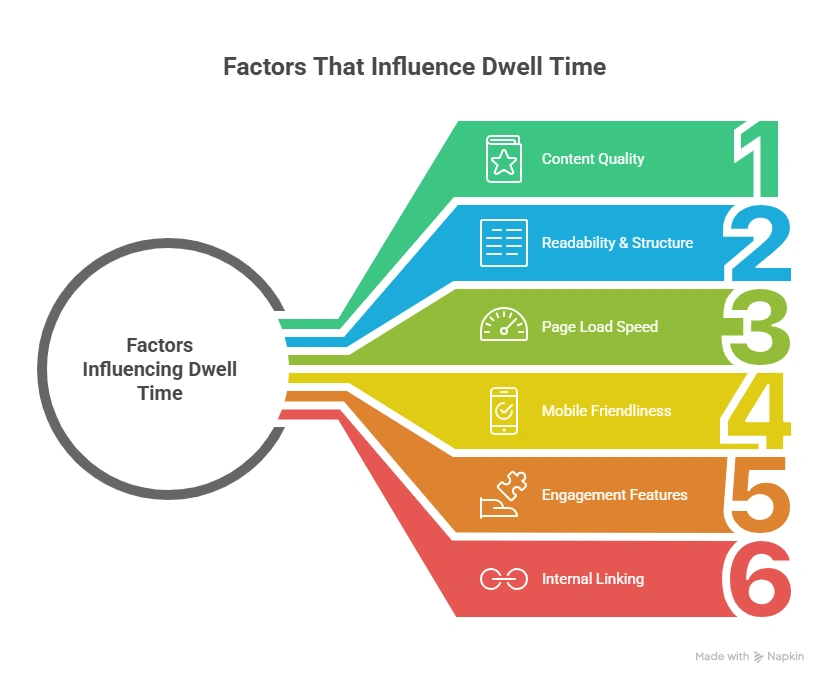
The beginning of improving SEO dwell time is by having an understanding of what influences it.
- Content Quality: Thin or irrelevant content leads to quick exits.
- Readability & Structure: Long paragraphs with no headings are not encouraging to read.
- Page Load Speed: Visitors give up on websites that take effort to load.
- Mobile Friendliness: With most searches on mobile, poor layouts reduce dwell time.
- Engagement Features: Interactive media, videos, infographics, or quizzes hold attention.
- Internal Linking: Ease of navigation encourages readers to visit multiple pages.
The Role of Dwell Time in SEO Today
Now let’s directly address how dwell time affects website SEO:
Search Rankings: Pages that have longer dwell times are preferred as they would probably answer the query of the user better.
Reduced Bounce Rates: Longer dwell times offset high bounce rates, and increase overall performance signals.
Better Crawl Prioritization: Search engines may prioritize crawling content that consistently engages users.
Competitive Edge: When your dwell time is better than your competitors, Google would be inclined to rank your content higher in the SERP.
Basically, dwell time is a quality assurance signal for search engines.
How SEO Dwell Time Boosts Your Rankings
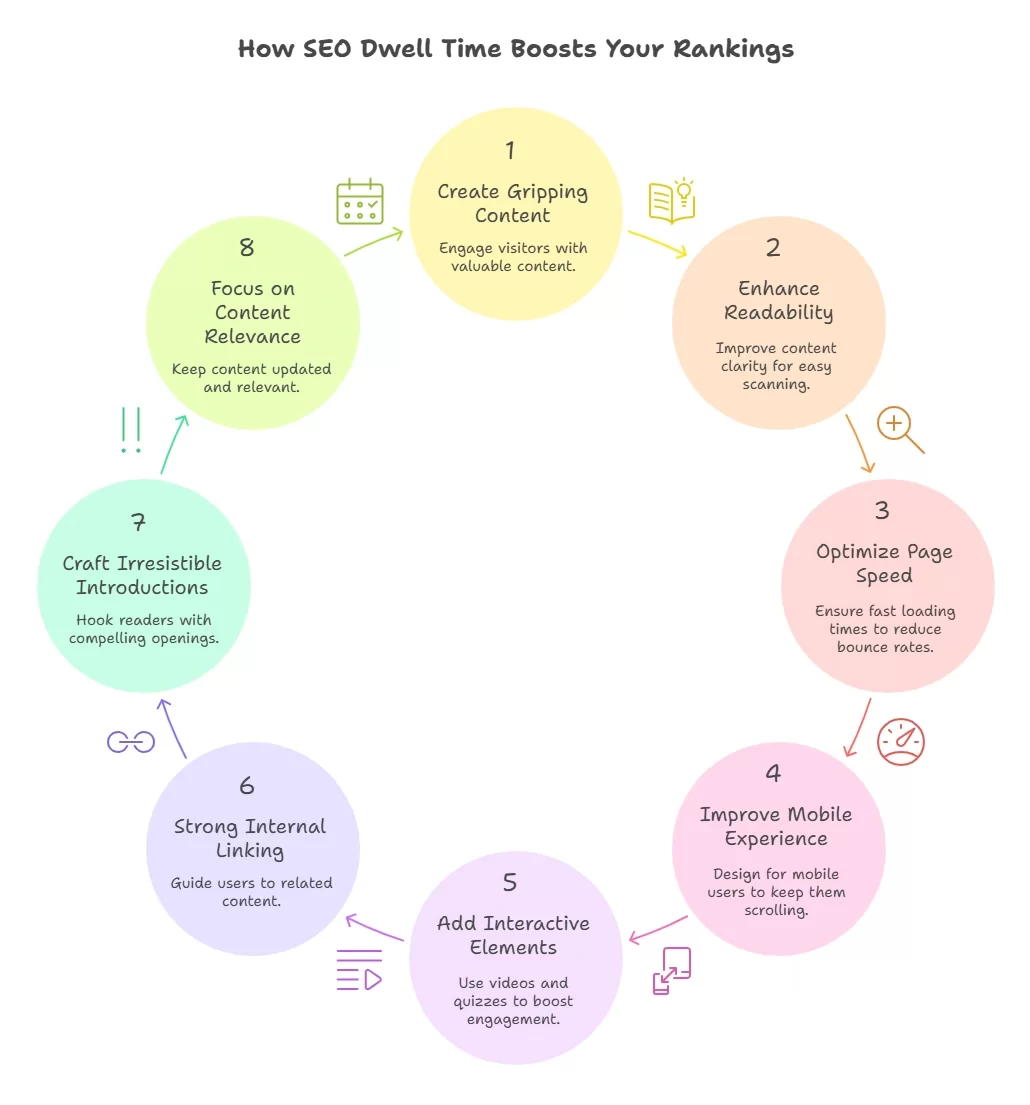
Improving dwell time in SEO is about creating value and delivering an easy user experience. Here’s how each SEO strategy improves how dwell time affects website SEO:
1. Create Gripping Content
Extensive seo-friendly content keeps visitors engaged longer. By answering user questions fully and adding stats or examples, you strengthen dwell time SEO and show search engines the value of your page.
2. Enhance Readability
Short paragraphs, clear headings, and visuals make content easy to scan. Improved readability directly improves SEO dwell time by reducing quick exits and supporting the dwell time meaning SEO.
3. Optimize Page Speed
Slow sites lead to higher bounce rates. Compress images, use CDNs, and trim heavy scripts to ensure fast loading, this directly improves the impact of dwell time on SEO performance.
4. Improve Mobile Experience
Most searches are mobile. Responsive design, simple navigation, and clear CTAs keep users scrolling, strengthening dwell time in SEO and conveying relevance to Google.
5. Add Interactive Elements
Videos, quizzes, and comment sections make pages stickier. Interactive content increases dwell time meaning SEO and encourages deeper engagement, enhancing overall SEO performance.
6. Strong Internal Linking
Guide users to related pages with smart internal links. This extends sessions, improves SEO dwell time, and shows search engines with a properly organized flow of content.
7. Craft Irresistible Introductions
A good hook in the beginning, whether it is a question, a stat, or a bold statement, gets the reader to pay attention more. Better intros mean users stay longer, improving how dwell time affects website SEO.
8. Focus on Content Relevance
Relevant content keeps the users satisfied. Periodic updates and no clickbaits are the guarantee of the better dwell time in SEO and the enhancement of the dwell time impact on the SEO performance.
Dwell Time Meaning SEO: Common Mistakes to Avoid
- Overuse of Ads/Popups: Distracts and frustrates users.
- Slow Website Speed: Major cause of immediate exits.
- Thin Content: Articles under 300 words rarely hold attention.
- Poor Formatting: No headings, walls of text, or confusing layouts.
- Ignoring Mobile Optimization: A grave omission in contemporary SEO.
Measuring and Tracking Dwell Time for SEO Success
Although Google Analytics does not provide the dwell time directly, you can deduce the same by:
- Average Session Duration (page time).
- Bounce Rate (percentage those that leave at once)
- Scroll Depth Tracking (how much content users consume)
User behavior could also be tracked with the help of such tools as Microsoft Clarity or Hotjar to gain an insight into dwell time.
SEO Discovery Explains Why Dwell Time Matters More Than Ever
SEO Discovery is a guru in dwell time SEO and has the right idea of what dwell time in SEO entails and why dwell time is vital in improving the ranking of your site. We are familiar with how dwell time affects the performance of SEO-the longer you spend with the visitor, the more relevant and quality search engines will consider you to be.
In the case of e-commerce, blogs, and business websites, our SEO dwell time plans ensure that the user stays longer and becomes more trustful, visible, and conversing. Collaborate with SEO Discovery to harness the maximum power of dwell time in the search engine optimization process and be competitive in the current competitive digital environment.
Maximize Dwell Time, Maximize Results
Don’t let visitors leave too soon. Work with SEO Discovery to improve engagement, enhance SEO, and grow your business online.
FAQ’s On How Dwell Time Affects Website SEO
Dwell time in SEO refers to how long a visitor stays on your page after clicking it from search results before returning. It shows if your content meets users’ needs effectively.
SEO dwell time signals content relevance. Longer dwell sends positive signals to search engines, boosting rankings and improving visibility.
The impact of dwell time on SEO performance is clear. Longer visits mean better engagement, higher trust, and more conversions.
Dwell time SEO measures time before returning to search results, while bounce rate tracks users leaving without interaction. Dwell time better reflects user satisfaction.
Improving dwell time SEO enhances user experience, keeping visitors engaged and encouraging more interaction on your site.
Focus on relevant, engaging content, fast loading speed, mobile-friendly design, and strong internal links to boost dwell time meaning SEO.