

Objective
This blog highlights how hotel SEO improves visibility, attracts targeted traffic, and increases direct bookings through optimization. It also outlines practical steps, including local SEO, keyword research, technical improvements, and content marketing for growth.
- SEO for hotels improves visibility, attracts targeted traffic, and increases direct bookings consistently over time.
- Local SEO helps hotels rank higher in location-based searches and drive more nearby bookings.
- Keyword research targets user intent, helping hotels attract travelers ready to research or book stays.
- Technical SEO ensures fast, mobile-friendly websites that improve rankings, user experience, and booking conversions.
- Off page SEO builds authority through backlinks, improving trust, rankings, and long-term hotel online visibility.
Get More Bookings For Your Hotel with SEO Discovery, Starting at $250/Month.
How To Do SEO For Hotels: Complete Guide to increase Booking
SEO for hotels involves optimizing your website for local searches, target keywords, and technical performance. A well-planned SEO strategy helps attract high-intent travelers and convert them into direct bookings.
Did you know? According to the International Journal of Cultural and Digital Tourism, 60% of leisure travelers and 55% of business travelers use search engines to research hotels before booking.
When guests search for “best hotels near me,” your property needs to appear at the top. That is exactly what hotel SEO achieves. It puts your hotel in front of ready-to-book travelers, without paying a commission every time. This guide walks you through every step of how to do SEO for Hotels. So, read until the end!
Table Of Contents
What Is Hotel SEO and Why Does It Matter
Hotel SEO is the process of optimizing a hotel website so that it shows up higher in search results. It targets travelers who are actively searching for accommodation online.
When someone looks for “boutique hotels in Miami,” they’re ready to make a booking. At that point, being on the first page of Google matters a lot.
How Does SEO Impact Hotel Revenue?
The impact of SEO in the hotel industry is direct and measurable. More direct traffic means your site ranks higher. With more visitors, there are more direct bookings. Direct bookings equal higher profit margins.
- Direct bookings save 15–25% in OTA commissions, significantly boosting hotel profit margins.
- SEO traffic is free and compounds over time, unlike expensive paid ads.
- Higher visibility builds strong brand authority and trust among potential hotel guests.
- Local search rankings drive more walk-ins and last-minute bookings for hotels.
A well-executed hotel SEO strategy can increase direct bookings by 30–50% over 12 months. That is a significant revenue shift for any property.
Tired of Missed Booking Opportunities?
Let our experts optimize your hotel SEO and drive consistent organic traffic.
Step-by-Step Hotel SEO Strategy for Better Online Visibility
Follow these steps to make your hotel more visible online, get more direct bookings, and attract the right kind of visitors. Hotels can make more money and grow over time by combining local SEO with content, technical optimization, and building a reputation.
Step 1: Local SEO to Capture “Near Me” Hotel Searches
Local SEO is the most important part of SEO for hotels. Most hotel searches are based on where the person is looking. You need to be at the top of local search results.
Key actions for hotel local SEO:
- Claim and optimize your Google Business Profile (GBP): Add accurate NAP (Name, Address, Phone), photos, amenities, and booking links.
- Get consistent citations: List your hotel on TripAdvisor, Yelp, Bing Places, and local directories with identical details.
- Encourage and respond to reviews: Google rewards businesses with frequent, high-quality reviews. Respond to every review, positive or negative.
- Use location-based keywords. Use keywords like “hotels near Times Square,” “beach hotels in Goa,” “pet-friendly hotels in Austin.”
Step 2: Focus on High-Intent Keywords
Keyword research is the most important part of SEO for hotels. Most tourists are very clear about what they want when they search, so you need to make sure your content matches the exact words and phrases they use. Using the right keywords will help you get more direct bookings and attract the right people.
Key actions for hotel keyword research:
- Target keywords by intent. Focus on transactional (booking-focused), informational (research-based), navigational (brand-specific), and long-tail keywords to cover the full customer journey.
- Use high-intent transactional keywords. Examples: “book hotel in [city],” “cheap hotels near [landmark].” These drive direct bookings and revenue.
- Create informational content. Examples: “best time to visit [city],” “things to do in [city].” This builds awareness early in the travel planning stage.
- Optimize for navigational searches. Include keywords like “[your hotel name] official site” or “[hotel name] booking” to capture users already searching for you.
Step 3: AI SEO to Show Up in AI Platforms
AI-powered search is reshaping how travelers find hotels. Google’s Search Generative Experience (SGE), ChatGPT, Perplexity, and Gemini now answer travel queries directly.
How to optimize your hotel for AI search platforms:
- Target conversational, question-based keywords: AI tools pull answers from content that directly answers questions. Example: “What is the best hotel in Barcelona for families?”
- Use structured data (Schema Markup): Add Hotel Schema, Review Schema, and FAQ Schema so AI engines can extract your property details accurately.
- Build authoritative content: AI platforms favor sources with demonstrated expertise. Publish detailed guides, destination blogs, and FAQs.
- Get mentioned on trusted platforms: TripAdvisor, major travel blogs, and news sites all signal authority to AI models.
- Optimize for Featured Snippets: AI tools often pull directly from featured snippet content. Use clear headers, bullet points, and concise answers.
Step 4: Create Travel Content for Bookings
Content is the foundation of hotel SEO marketing. Even the best technical optimization won’t help if you don’t have great content on your website.
Types of content that drive hotel SEO rankings:
- Destination guides: “Top 10 Things to Do in [City] in 2025” targets travelers in the research phase.
- Room and amenity pages: Describe each room type in detail. Use keywords like “ocean view suite,” “pet-friendly room,” or “executive floor.”
- Local area guides: Nearby restaurants, attractions, and transportation tips build local relevance.
- Event-based content: Create pages targeting major local events. “Hotels near [City] Music Festival” captures seasonal traffic.
- Blog posts: Consistent SEO content writing keeps your site fresh and attracts new keyword opportunities.
Step 5: On-Page SEO for Hotel Websites
When it comes to your hotel website, on-page SEO is everything that helps individual pages rank higher and turn visitors into bookings. If you optimize each page correctly, you’ll get more visitors, improve the user experience, and make direct revenue.
Key actions for hotel on-page SEO:
- Optimize titles and headings: Include target keywords in page titles, H1 tags, and meta descriptions to improve search relevance.
- Use keyword-rich image alt text: Add descriptive alt text for all images (e.g., “luxury pool suite at [Hotel Name] Miami”) to improve accessibility and SEO.
- Keep URLs clean and optimized: Use short, simple, and keyword-rich URLs (e.g., /miami-beach-hotel-rooms/) for better indexing and user experience.
- Write compelling meta descriptions: Include a clear benefit and call-to-action (e.g., “Book directly for the best rate”) to improve click-through rates.
- Implement schema markup. Use structured data for hotels, rooms, events, and reviews to enhance search visibility and rich results.
Step 6: Off-Page SEO to Build Authority
Off-page SEO builds your hotel’s authority and reputation across the web. It lets Google know that your property is trustworthy and relevant.
Effective off-page SEO strategies for hotels:
- Link building: Link building services earn backlinks from travel blogs, tourism boards, and local news sites. Quality beats quantity every time.
- Digital PR services: Get your hotel featured in travel publications, lifestyle magazines, and news outlets.
- Guest posting services: Write expert articles for travel websites with a link back to your hotel site.
- Broken backlink opportunities: Identify broken links on travel sites and suggest your hotel pages as replacements.
Step 7: Fix Technical Issues That Kill Rankings
Technical SEO covers the behind-the-scenes optimization that helps search engines crawl, index, and rank your website correctly.
Technical SEO priorities for hotel websites:
- Page speed: Google recommends a load time under 3 seconds. Use tools like PageSpeed Insights to identify issues. Compress images, use a CDN, and minimize code.
- Mobile optimization: Over 60% of hotel searches happen on mobile devices. Your site must deliver a flawless mobile experience.
- Core Web Vitals: Optimize LCP (Largest Contentful Paint), FID (First Input Delay), and CLS (Cumulative Layout Shift) to meet Google’s thresholds.
- HTTPS security: A secure site is a Google ranking factor. Always use SSL certificates.
Want to Get More Leads and Visibility Online?
Let’s build a long-term SEO strategy that delivers consistent bookings.
How We Used Hotel SEO Strategy to Increase Bookings for Our Client
To improve our hotel client’s online visibility and direct bookings, we built a complete SEO strategy focused on local search, high-intent keyword targeting, and technical optimization.
The hotel was heavily dependent on online travel agencies, which reduced profit margins due to high commissions. While they were getting impressions, their click-through rate and conversions were low, and they were not ranking strongly for high-intent booking keywords.
Our primary goal was clear: Increase visibility, improve CTR, and drive more direct bookings through organic search.
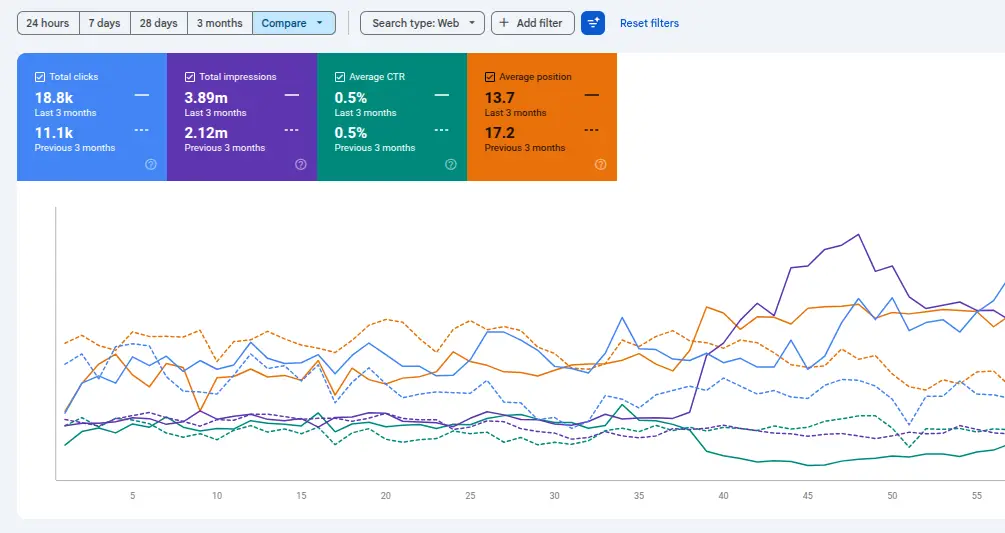
The Results (Last 3 Months vs Previous 3 Months)
- +69% increase in total clicks (18.8K vs 11.1K)
- +83% growth in total impressions (3.89M vs 2.12M)
- Average CTR maintained at 0.5% while scaling traffic significantly
- Improved average position from 17.2 to 13.7 (higher rankings across key pages)
How to Choose a Hotel SEO Agency
Choosing the right SEO agency for hotels can completely change how visible your property is online. But not every agency knows how the hotel industry works.
What to look for in a hotel SEO agency:
- Hospitality Experience: Choose agencies that have real hotel SEO success stories, not just general industry case studies.
- Transparent reporting: Make sure they give you regular reports that clearly show your rankings, traffic growth, and booking success.
- Full-services capabilities: Choose companies that offer services like technical SEO, local SEO service, content creation, and building strong links.
- Understanding of booking funnels: The agency should know how travelers act from the time they start looking for a trip until they make their final reservation.
- Customized strategies: Don’t settle for one-size-fits-all answers; instead, look for SEO firms that can make plans for your hotel that are specific to your needs.
Improve Online Presence for Your Hotel with SEO Discovery!
The best thing you can do for your hotel is to invest in a strong SEO plan. From being at the top of local searches to being visible on AI, each step in this guide brings you one step closer to filling rooms without having to pay OTA fees.
Partner with SEO Discovery, a reputable hotel SEO agency that has a history of success in the hotel business. We offer the best digital marketing services for the hospitality business. These include full-stack hotel SEO services, content marketing, digital PR services, and the best SEO services.
Get a free hotel SEO audit today by going to our website. Let us take care of your ranks while you focus on delivering exceptional guest experiences.
Want More Bookings Without Increasing Ad Spend?
Discover how SEO can bring consistent traffic to your hotel.
FAQs About How To Do SEO For Hotels
Hotel SEO is the process of optimizing a hotel website to rank higher in search engines. It drives organic traffic and increases direct bookings without paying OTA commissions.
SEO improves your hotel’s search rankings, driving more free organic traffic. Higher traffic leads to more direct bookings, saving you 15–25% in OTA commissions and boosting profit margins significantly.
The best hotel SEO keywords combine location, amenity, and traveler intent. Examples include “boutique hotel in [city],” “family hotels near [landmark],” and “pet-friendly hotels with a pool.”
Technical SEO for hotels covers page speed, mobile optimization, HTTPS security, structured data, XML sitemaps, and crawl error resolution. It ensures search engines can properly crawl and index your website.
Most hotel SEO strategies show measurable improvements in 3 to 6 months. Significant ranking gains and booking increases typically appear within 6 to 12 months of consistent effort.
Hotel local SEO optimizes your property for location-based searches. This includes Google Business Profile optimization, local citations, review management, and geo-targeted keyword strategies for nearby travellers.
Hotel SEO agencies combine keyword research, on-page optimization, link building, local SEO, and technical audits. This comprehensive approach drives sustainable ranking improvements and consistent direct booking growth.
Both have value, but SEO delivers long-term, compounding results at lower cost. Paid ads stop the moment you stop paying. SEO builds a sustainable organic traffic channel over time.
Google Business Profile is critical for hotel SEO. It directly affects your local pack rankings, map visibility, and the first impression travelers get when searching for accommodation in your area.
AI SEO for hotels means optimizing your content to appear in AI-powered search results from tools like Google SGE, ChatGPT, and Perplexity. It involves structured data, conversational content, and authority building.