

Objective: This blog explains reciprocal links in SEO in simple words—what they are, how they work, their pros and cons, and the safe ways to use them to improve visibility, traffic, and Google rankings.
There are websites everywhere on the internet and they are all trying to be noticed. A website should have more than just good content in order to appear higher in search engines such as Google; it must also have trust signals. A link is one of the largest trust signals. When a web site links to another, it is a recommendation that states, “this site is useful.”
Websites can receive links in various ways Some of them occur naturally and others are developed based on various strategies. One of the most popular is known as reciprocal linking. This is where two websites come to an agreement to link to each other and the idea is that both can share traffic and increase visibility.
Did you know? Studies show that around 73% of websites engage in some form of reciprocal linking. While it’s common, only those used naturally and sparingly bring real SEO benefits.
This can initially sound like an easy and efficient means of growth, and in certain situations, it can be. However, search engines pay much attention to the way these links are utilized. Reciprocal links are useful when done naturally. But when websites overuse them in order to deceive search engines, it may instead hurt their ranking rather than help.
This is why it is necessary to know what reciprocal links are, how they operate, and when they are to be used in an SEO strategy.
Key Takeaways
- Reciprocal links mean two websites agree to link to each other for mutual benefit.
- When used naturally and sparingly, they can help with traffic and visibility.
- Overusing or irrelevant link exchanges can harm SEO and rankings.
- The safest strategy is to balance reciprocal links with other high-quality backlinks.
Table Of Contents
- Understanding the Basics of Links in SEO
- What is a Reciprocal Link in SEO?
- Why Do Websites Use Reciprocal Linking?
- The Pros of Reciprocal Links
- The Cons of Reciprocal Links
- How Search Engines View Reciprocal Links
- Best Practices for Reciprocal Links
- The Role of Expert Link SEO Patterns
- SEO Reciprocal Links vs. Natural Links
- What Does Reciprocal Link in SEO Moz Mean?
- When Should You Use Reciprocal Linking?
- How SEO Discovery Can Help You with Reciprocal Linking and SEO
- FAQs About What is Reciprocal Link in SEO
Understanding the Basics of Links in SEO
Links are used by search engines such as Google as a trust signal. When there are numerous links to a page, this is a sign that the page is authoritative and has value. That is why backlinks are regarded as a ranking factor. The other reason is that backlinks are a ranking factor because they are a way to get a higher ranking in search engines.
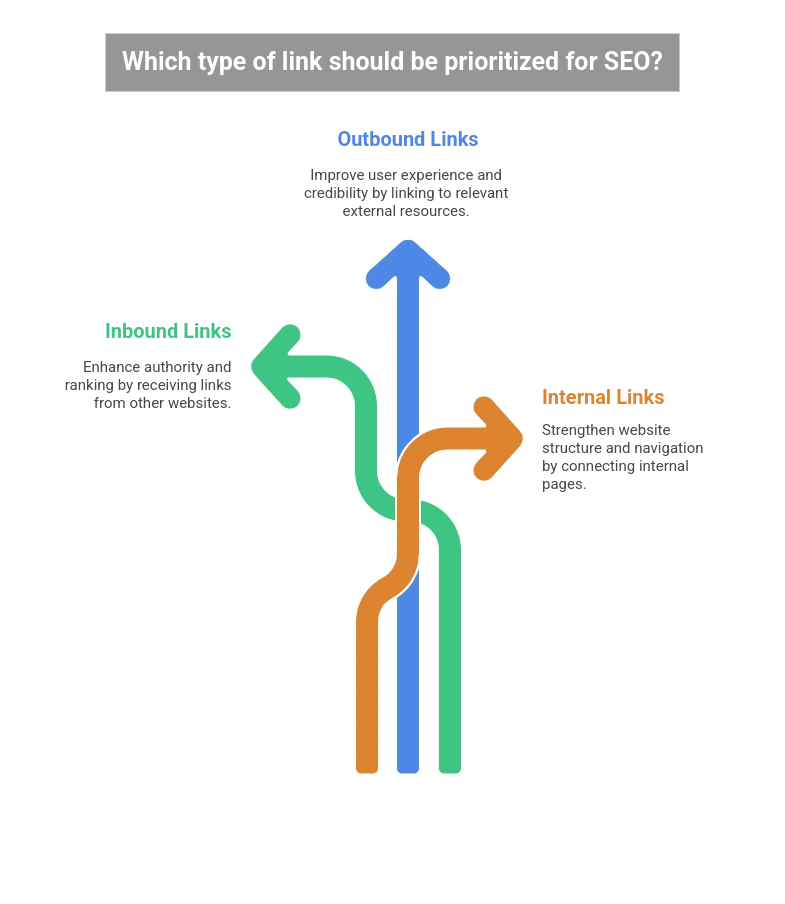
There are three main types of links:
- Inbound links (backlinks): Links that come from other websites to yours.
- Outbound links: Links you place on your website that go to other sites.
- Internal links: Internal linking within your own website that connect one page to another.
What is a Reciprocal Link in SEO?
Now let’s answer the big question: what is reciprocal link in SEO?
A reciprocal link is a link created between two websites which agree to reciprocate the links. An example of this would be that, say, Website A links to Website B and Website B links back to Website A, that would be a reciprocal link.
It is a straightforward setup and in the early days of SEO it was quite common. The exchange of links on many websites was done in order to improve their ranking within a short period. Over the years however, search engines have become more intelligent. They now verify that such link exchanges are not fake but are genuine.
When applied organically, reciprocal links can be used to enable two sites to share traffic and establish credibility. However, when overused, they can be viewed as spam and lead to punishments.
Why Do Websites Use Reciprocal Linking?
There are several reasons why websites still engage in reciprocal linking SEO:
- Traffic Sharing: Visitors are referred to each other creating mutual growth.
- Business and blogger relations: Businesses or bloggers might link to one another as a form of partnership.
- Content Support: In case there are two sites with similar content, linking to each other can be beneficial to the readers as they will get more information.
- SEO Boost: There is also a hope that the reciprocal linking will help improve search rankings but only when links are natural and relevant.
The Pros of Reciprocal Links
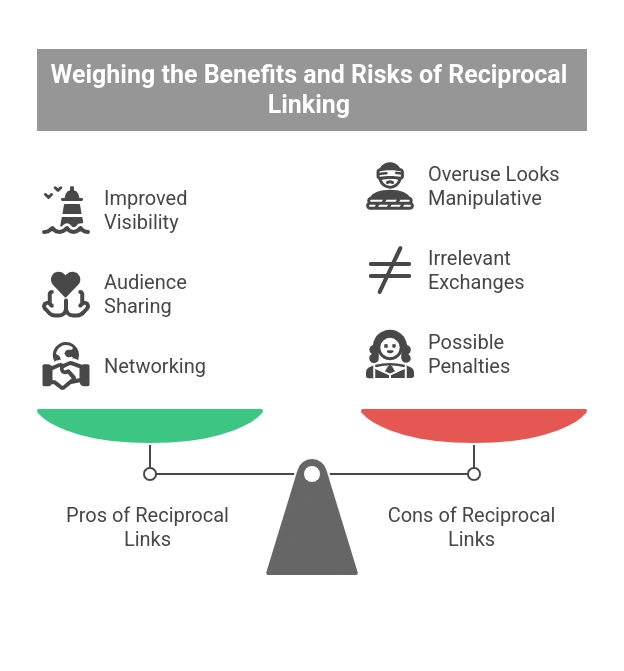
Used correctly, reciprocal links can bring several benefits:
- Improved Visibility: Helps more users discover both websites.
- Audience Sharing: Exposes websites to each other’s visitors.
- Networking: Builds professional relationships in the same industry.
- Supportive Resources: Provides readers with extra, helpful content.
The Cons of Reciprocal Links
However, there are also risks if this practice is misused:
- Overuse Looks Manipulative: Too many reciprocal links can signal to Google that the links are not genuine.
- Irrelevant Exchanges: If two unrelated websites link to each other, it looks unnatural.
- Possible Penalties: Google may reduce rankings for websites that rely heavily on artificial link exchanges.
How Search Engines View Reciprocal Links
Search engines understand that some of the reciprocal links are natural and they do not penalize them. As an example, when two specialists in the same area cite the articles of one another, it is quite natural.
However, when a site makes tens of useless link exchanges, it may be a red flag. This is the reason why SEO specialists advise to use reciprocal links sparingly.
Relevance and authenticity is the key. Links that are valuable to the readers tend to be safe.
Best Practices for Reciprocal Links
If you’re considering using reciprocal links SEO in your strategy, here are some best practices:
- Relevant Linking to Other Web Sites: The content on the link should be relevant and pertinent to your subject.
- Quality, not quantity: A single, relevant link will be better than 50 weak links.
- Avoid Link Farms: These are chains of websites that are built solely to exchange links- Google does not like them.
- Combine with Other Link Strategies: Use guest posts, high-quality content and natural backlinks as well.
- Authority: Link with other trusted and authoritative sites only.
Want Safe Link-Building Strategies that Boost Rankings? Our SEO Experts are Here to Help!
The Role of Expert Link SEO Patterns
When learning the strategy of linking, many professionals examine the pattern of expert links SEO. These trends reveal how effective websites acquire links organically, without relying too heavily on the reciprocity linking strategy.
As an example, the high-performance sites tend to gain backlinks via content marketing, guest blogging, and digital PR. Mutual links may be present, but they are only a fraction of an overall more balanced SEO strategy.
SEO Reciprocal Links vs. Natural Links
Factor | Reciprocal Links | Natural Links (One-Way Backlinks) |
Definition | Mutual agreement between two websites to link to each other. | Links given freely by other websites because they find your content valuable. |
How They’re Created | Arranged through partnerships or link exchanges. | Earned naturally when others reference your content without request. |
Google’s View | Can still have value, but often seen as less trustworthy if overused. | Highly valued since they are harder to manipulate. |
Impact on SEO | Moderate impact—good in balance but risky if relied upon heavily. | Strong impact—boosts authority, trust, and rankings. |
Best Practice | Use sparingly and ensure relevance/quality. | Focus on creating high-quality, useful content that naturally attracts links. |
What Does Reciprocal Link in SEO Moz Mean?
When you research link building, you may find a reciprocal link in SEO Moz. This is a famous SEO tool provider and they define that reciprocal links are acceptable when they occur naturally and are of benefit to users.
But Moz also cautions that excess reciprocal links, especially with irrelevant sites, can be detrimental to a site authority. Their recommendation is similar to that of Google: think user value, not manipulation.
When Should You Use Reciprocal Linking?
Here are some good situations to use reciprocal linking:
- When two businesses are in the same industry and can support each other.
- When bloggers or creators reference each other’s content.
- When you want to provide more resources to readers.
Avoid using reciprocal linking if:
- The partner website is unrelated to your niche.
- The site has low authority or looks spammy.
- You are doing it only to manipulate rankings.
How SEO Discovery Can Help You with Reciprocal Linking and SEO
Understanding reciprocal links is one thing, but applying them correctly in a larger SEO plan is another challenge. That’s where working with experts makes a difference. SEO Discovery is one of the best SEO agency trusted by businesses worldwide for building safe, effective, and long-term SEO strategies.
Our team of best SEO specialists doesn’t just focus on one aspect like reciprocal linking. Instead, they create a complete link-building plan that includes:
- High-quality backlinks from authoritative websites
- Careful use of reciprocal link SEO strategies when relevant
- Content marketing that attracts natural links
- Technical SEO to strengthen website performance
- White-hat practices that align with Google’s guidelines
With over 22 years of experience, SEO Discovery has helped startups, small businesses, and global brands improve visibility, rankings, and traffic. If you want to make sure your link-building efforts actually grow your business—and not risk penalties—partnering with SEO Discovery can give you the right balance of safety and results.
Safe, Powerful, and Proven SEO Strategies are Just One Step Away!
FAQs About What is Reciprocal Link in SEO
A reciprocal link in SEO means when two websites agree to link to each other’s content. It’s like saying, “I’ll link to your site if you link back to mine.” This is usually done to build online relationships, share audiences, and improve website authority. In simple terms, it is a mutual exchange of backlinks that can bring traffic and visibility if done naturally and with relevant websites.
A normal backlink is a one-way link where another website links to your content without expecting anything in return. A reciprocal link, on the other hand, is a two-way link exchange where both websites agree to link to each other. Backlinks that are one-way usually carry more SEO value because they appear more natural to Google. Reciprocal links can still help, but only when they are used carefully and with relevant, trustworthy websites.
Reciprocal links can affect SEO both positively and negatively. When done with relevant and high-quality websites, they can increase traffic, improve visibility, and show Google that your site is connected with other valuable resources. However, if you exchange too many links just for SEO purposes, Google may see it as manipulation and reduce your ranking. The key is balance—reciprocal links should look natural and add real value for users.
There is no fixed number of reciprocal links that is considered safe. A few natural link exchanges with relevant businesses, partners, or industry websites are perfectly fine. But if a website depends too heavily on reciprocal links, it can appear spammy and trigger Google’s penalties. The best approach is to focus on quality over quantity and use reciprocal linking as a small part of a larger SEO strategy.
SEO Discovery is a globally recognized SEO company with over 22 years of experience in digital marketing. They have worked with thousands of clients across different industries, helping them rank higher on Google and get measurable business growth. With a large team of SEO specialists, content writers, and marketing experts, SEO Discovery has built a strong reputation for delivering results through ethical and proven SEO practices.
SEO Discovery offers complete SEO services that cover everything a business needs to grow online. Their services include on-page SEO, technical SEO, link building, local SEO, eCommerce SEO, SEO content marketing, and even Amazon PPC marketing. They also provide digital marketing services like social media marketing, paid ads, and web design to give businesses an all-in-one solution.
SEO Discovery uses reciprocal linking only when it benefits the client’s website and follows Google’s guidelines. They focus on building links with relevant and high-authority websites, ensuring that every link adds value to the user and strengthens SEO performance. By avoiding spammy or excessive link exchanges, SEO Discovery protects clients from penalties and creates a long-term, sustainable SEO strategy.
Getting started with SEO Discovery is simple. You can request a free consultation where their team reviews your website, understands your business goals, and prepares a customized SEO plan. Whether you are a small business looking for local visibility or a global brand aiming for international reach, SEO Discovery provides tailored solutions to meet your needs.