

Objective
This blog focuses on how to do SEO for B2B companies with structured SEO strategies to help businesses improve rankings, attract decision-makers, and generate more qualified and conversion-ready leads.
- B2B SEO prioritizes decision-makers and uses intent-based keywords instead of generic, high-volume search terms.
- Internal linking and topic clusters are highly effective for topical authority and search engine visibility.
- Technical SEO and mobile optimization are still essential building blocks of sustainable B2B search rankings.
- AI Overview optimization helps B2B brands be seen in AI-generated answers and search results.
- Backlinks, digital PR, and case studies help B2B buyers build the trust they need to convert.
Improve Your B2B Brand Visibility with Strategic SEO Services from SEO Discovery, Starting at $250/month
B2B SEO means getting in front of business buyers with industry-specific, long-tail keywords and high-intent bottom-of-funnel searches. Rather than just increasing traffic, it helps generate qualified leads and revenue by focusing on authoritative content, detailed case studies and E-E-A-T principles to attract decision-makers.
Did You Know? According to Ahrefs, 96.98% of clicks appear in the top 10 results, making ranking essential for B2B traffic and leads.
B2B SEO is crucial because buyers do research online before selecting solutions. It helps businesses build trust, increase visibility on search engines, and engage with decision-makers at the right time, resulting in better quality leads and higher conversions.
This guide breaks down how to do SEO for B2B companies, along with more valuable insights. So, keep reading until the end.
Table Of Contents
- Understanding the concept of SEO for B2B companies
- Difference between SEO for B2B companies and B2C SEO
- How to do SEO for B2B companies?
- What are common B2B SEO mistakes to avoid?
- How do we help a B2B client increase qualified leads?
- Build strong B2B authority with SEO strategies by SEO Discovery
- FAQs for SEO for B2B companies
Understanding the concept of SEO for B2B companies
When it comes to B2B SEO, it is basically a method of optimizing a business’s website to rank higher in search engine results and improve its organic traffic. In simple terms, this strategy helps a business appear in front of other companies that are actively searching for its products or services online.
While B2B is a business-to-business relationship, as opposed to B2C, where consumers purchase goods and services from businesses, the SEO fundamentals or basics remain the same. You have to do SEO almost similarly, such as on-page, off-page, and technical SEO You may be confused thinking about the difference! We understand your curiosity. Well, check the following section, where we have clarified the difference between business-to-business SEO and business-to-consumer SEO.
Difference between SEO for B2B companies and B2C SEO
SEO strategies for B2B and B2C companies have a lot in common, but how they do it can vary a lot because of who they’re trying to reach and what they’re trying to achieve. In general, it’s the target audience.
Businesses buy services and products in a different way than consumers do, so your B2B SEO strategy should be very different from your B2C SEO strategy.
Now, targeting the audience for B2B is more challenging than that of B2C.
Want to know how? Keep reading!
Challenging sales process
Firstly, the sales process for B2B companies is a lot more complicated than it is for B2C companies. It’s a very long process that usually involves more people.
Think about how easy it is for you to buy new smartphones. Now imagine you’re part of a big company that wants to buy a payroll processing service that manages every payroll slip whenever it makes payments to its employees. It’s quite easy to see which one is more challenging. Obviously, the latter.
For this reason, B2B companies must understand their audience and customers better than B2C companies. Otherwise, they will end up without any sales.
Low keywords volume
B2B companies target a very niche audience, and so their keywords tend to have lower search volumes.
For example, if you compare “best payroll software” with “best smartphones under 15000” in tools like Ahrefs or Semrush, you will notice that the search volume is much lower for B2B keywords.
Because fewer people search these terms, there are fewer potential customers. This is why B2B companies need to be very selective about the specific keywords their target audience is using in order to get the right buyers and grow sales.
How to do SEO for B2B companies?
Here are some important B2B SEO strategies that focus on improving rankings, attracting decision-makers and generating conversions.
1. Define your ICP and map the B2B buying committee
SEO for B2B begins with knowing who actually evaluates your solution. There’s rarely a single decision-maker for B2B purchases. You have to identify every stakeholder who influences the final call.
Here are some of the best practices for ICP mapping:
- Define Ideal Customer Profile by industry, company size and role, not ambiguous titles.
- Identify all members of the buying committee, from the technical evaluators to the budget approvers.
- Map questions for each persona across awareness, consideration, and decision stages.
- Learn the exact language your buyers use by using sales call transcripts.
2. Conduct funnel-stage keyword research
Keyword research is about more than search volume and buyer intent. You need to match each keyword with the stage of the buyer’s journey.
Here are some best practices to follow when conducting keyword research:
- Group keywords into groups of informational, commercial and transactional intent.
- Target long-tail terms that indicate true buying intent and not just traffic.
- Analyze competitor rankings and identify gaps in your existing content strategy.
- You need to connect each keyword with well-structured SEO content.
3. Build topic clusters around pillar and cluster pages
Structure is important in B2B SEO marketing because it helps search engines understand your topical authority. Isolated blog posts cannot compete with a connected content structure.
Here are some of the best practices to follow in content marketing:
- Develop a pillar page for each core topic and cluster pages that link to the pillar page.
- Use consistent internal linking between pillar and cluster content to distribute authority.
- Write on all the subtopics your ICP is searching for, not just your highest-volume term.
- Regularly update cluster pages to keep the entire topic group competitive.
4. Strengthen on-page and technical SEO foundations
You need a strong enough website to support your rankings. If your site is slow, broken or difficult for search engines to crawl, good content is unlikely to rank well.
Here are some of the best practices to follow for technical SEO services:
- Check page speed, crawlability and broken links across all key landing pages.
- Prioritize mobile SEO services, as most B2B research is now performed on mobile devices.
- Add schema markup to assist search engines in understanding the content of your page.
- Submit a clean XML sitemap to Google Search Console to speed up the indexing process.
5. Optimize content for AI Overviews and AI search
Content needs to be found within answers produced by AI, not just usual search results. This is where most B2B SEO strategies fall short.
Some best practices to follow for AI SEO services are:
- Answer the core question directly within the first two to three sentences.
- Use clear headers and bullet points that AI systems can extract cleanly.
- Each statement must be supported by original data or a trustworthy, named source.
- Increase E-E-A-T signals through author bios and demonstrable company expertise.
6. Create content beyond the blog
Blog posts alone can’t cover every stage of B2B buyer research. Decision-makers even look at case studies, product pages, and competitor breakdowns before they fill out a form.
Below are some of the best practices for SEO services:
- Build landing pages around high-intent, service-related queries.
- Improve your Google Maps listing for local B2B search.
- Publish case studies with real, specific business results.
- Create comparison pages answering how buyers compare you to competitors.
7. Build authority through backlinks and digital PR
External validation establishes trust with search engines and buyers. Backlinks are still one of the most powerful authority signals for delivering B2B SEO solutions.
The following are some of the best practices to follow for link building services:
- Publish original research or proprietary data that journalists want to cite.
- Use digital PR services to secure coverage from industry-specific publications.
- Search for guest posting services on relevant high-authority B2B websites.
- Build genuine relationships, instead of pursuing high volumes of low-quality links.
8. Track SEO metrics tied to pipeline and revenue
SEO must deliver real business results. Traffic and rankings are useless without a clear path to revenue.
Below are some of the best practices to follow for the best SEO services:
- Track conversions such as demo requests, contact form fills and content downloads.
- Collaborate with sales to determine which organic channels are generating qualified pipeline.
- Expect measurable movement within four to six months of consistent effort.
- Select the best digital marketing services partners who deliver results instead of rankings.
What are common B2B SEO mistakes to avoid?
Here are the common mistakes to keep in mind when planning a successful B2B SEO strategy for better visibility and conversions.
- Targeting broad, high-volume keywords: Using generic keywords instead of specific, intent-based long-tail terms that are effective in attracting qualified B2B buyers.
- Ignoring E-E-A-T signals: Not showcasing expertise, authority, and trust through content, author profiles, and verified industry experience reduces credibility
- Poor buyer journey alignment: If your content is not mapped to TOFU, MOFU, and BOFU stages, then it will result in low engagement and conversions.
- Weak case studies and proof: Missing real client results and detailed case studies reduce trust and weaken decision-making influence
- Technical SEO issues: Slow site speed, indexing errors and mobile usability issues all impact rankings and organic search visibility
How do we help a B2B client increase qualified leads?
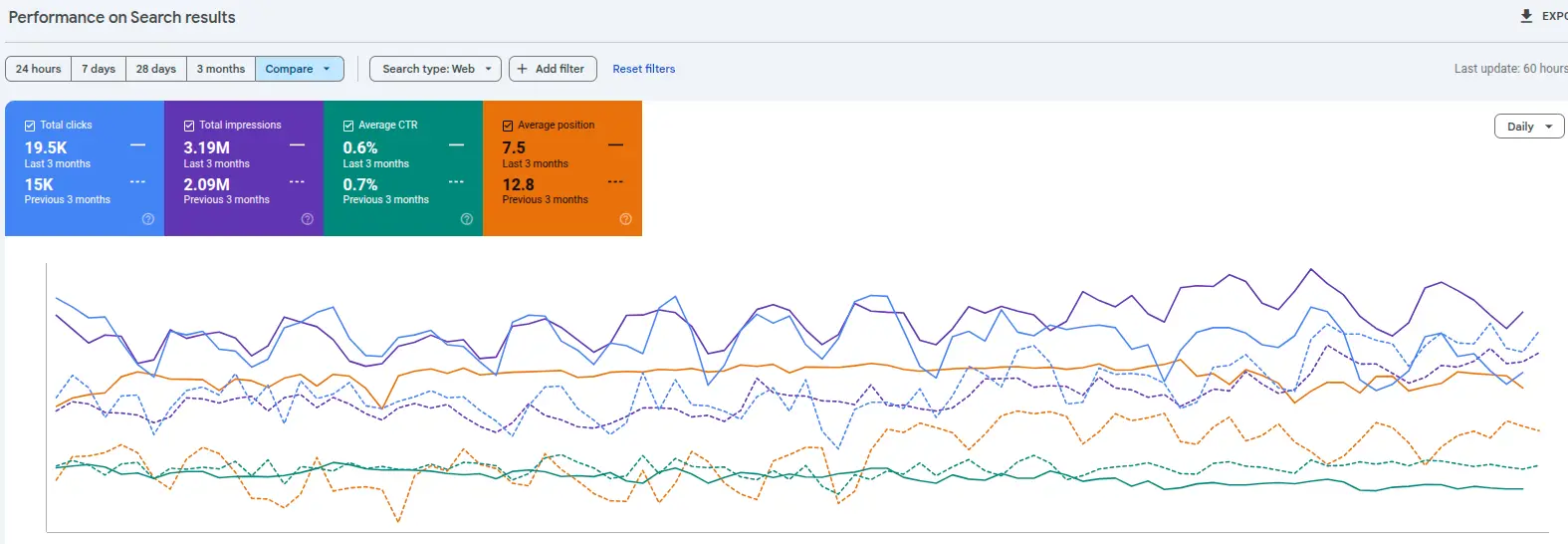
We help one of the B2B clients who was having issues with low organic visibility, low rankings for keywords, and little engagement with consistent impressions. Their website wasn’t reaching the right decision-makers, and most of the high-intent queries were underperforming in the search results, resulting in poor-quality traffic and lost lead opportunities.
We implemented a structured B2B SEO strategy focusing on technical SEO improvements, intent-based keyword mapping, and topic cluster development. We optimized landing pages, strengthened internal linking, and aligned content with the B2B buyer journey. Using Search Console insights, we identified gaps, improved underperforming pages, and enhanced overall search performance.
The Results
- Organic clicks increased from 15K to 19.5K in three months.
- Total impressions grew from 2.09M to 3.19M across search results.
- Average position improved from 12.8 to 7.5 in key search queries.
Build strong B2B authority with SEO strategies by SEO Discovery
B2B SEO helps businesses to reach the right decision-makers at the right time through high-intent search queries. It builds trust with authoritative content, increases online visibility and supports long sales cycles. It directly influences lead quality, conversions, and long-term growth of business revenue by drawing qualified traffic instead of random visitors.
SEO Discovery is a leading SEO agency offering B2B SEO strategies focused on delivering performance-based results. We are specialists in keyword research, technical SEO, AI SEO, content marketing, and link building to help businesses rank higher and attract decision-makers. We use a data-based approach to provide higher visibility, better conversions and scalable organic growth.
Connect with us today to build your B2B authority and generate consistent, quality leads.
Ready for B2B Growth?
Our experts support business growth with effective SEO methods.
FAQ for SEO for B2B Companies
B2B SEO is a method of optimizing a business’s website to rank higher in search engine results and improve organic traffic. It’s crucial for B2B companies, as it helps them connect with other businesses actively seeking their products or services online.
B2B SEO strategies are tailored to the unique needs of businesses, whereas B2C SEO targets consumers. B2B SEO often involves longer and more complex sales processes, specific target audiences, and keywords with lower search volume.
B2B SEO faces challenges like complex sales processes, low keyword search volume, and the need to understand and engage with a specific target audience in-depth. B2B SEO requires a deep understanding of the businesses it aims to reach.
For B2B companies, SEO requires an emphasis on buyer personas, high-intent keyword research, funnel-based content strategy, technical SEO, and authority building. A well-structured approach will ensure better rankings, qualified leads, and long-term organic growth.
SEO Discovery is a leading SEO agency offering the best B2B SEO practices, including keyword research, technical SEO, AI SEO, content marketing, and link building. The team focuses on data-based strategies that improve rankings, attract decision-makers, and generate consistent, qualified leads for sustainable business growth.
AI SEO improves exposure in AI-powered search results by structuring content clearly, offering direct answers and reinforcing E-E-A-T signals. It helps B2B businesses show up in AI overviews and modern search experiences.
Technical SEO is very important as it ensures websites are fast, easy to crawl and mobile-friendly. It improves indexing and user experience, helping search engines understand content properly and rank pages efficiently.
You can expect to see substantial improvements in B2B SEO in 3-6 months and solid results in 6-12 months. The timeline depends on the competition, the authority of the website, the quality of the content and the consistency of your SEO efforts.
Monitoring results in B2B SEO is important because it helps businesses understand what is working and what is not. It tracks keyword rankings, organic traffic, and conversions, allowing teams to refine strategies, improve content performance, and ensure SEO efforts consistently generate qualified leads and long-term business growth.