

Objective
AI Overviews and generative search are reshaping how visibility works in Google. This guide explains how to adapt SEO into Answer Engine Optimization, align content with conversational search, and build the signals Google’s AI models trust when generating summaries.
- AI Overviews prioritize clarity rather than length and answers rather than promotion.
- The opening line of your content is now the most significant ranking factor.
- Conversational, question-based format fits generative search behavior the best.
- Factual density, openness in the research, and being an authority raise the chances of getting cited.
- Keeping an eye on AI Overview citations is equally important as monitoring traditional rankings.
- Brands that make changes to Answer Engine Optimization today will be the ones to dominate the visibility in 2026 and beyond.
If You Want to Rank Higher on AI Overviews, Get Started with SEO Discovery from $250/Month.
Search patterns are shifting. When you use Google today, you likely notice that traditional lists of links are often preceded by an AI-generated summary. For business leaders and marketing teams, learning how to rank in AI overviews is no longer optional, its important. If the search engine is providing the answer directly on the results page, your goal is to ensure your brand is the cited source behind that information.
Projections indicate that by 2026, AI Overviews are expected to appear in 35 to 40 % of all search queries, showing how generative search summaries are becoming a dominant part of how users get answers online.
This shift is driven largely by the impact of LLMs technology on how information is retrieved. SEO is not disappearing; it is evolving into Answer Engine Optimization. To maintain visibility, content must be structured for machine extraction while remaining valuable to high-intent human readers.
Table of Contents
- Give the Answer Away in the First Sentence
- Write for the Way People Actually Talk
- Use These Ranking in AI Overviews Strategies
- Master the Google AI Overviews Ranking Factors 2026
- Proven Visibility in AI Overviews & Generative Search
- Start Monitoring AI Overviews Ranking Strategies
- Why AI Overview Rank Tracking Is the New Essential
- Claim your spot in the future of search
- Frequently Asked Questions
Answer away in the first sentence for AI Overview ranking
Earlier, the SEO strategy suggested long-form content to keep people on the page. However, AI models prioritize speed and efficiency. To be cited, you need to use the “Bottom Line Up Front” (BLUF) method, placing the most critical information at the very top of your page for AI overview ranking. This is a core pillar of modern On Page SEO, where the goal is to satisfy the user’s intent within seconds of their arrival.
- Front-load the core facts: Aim to answer the primary search query within the first 45 words of your article. This clear, fluff-free approach makes it much easier for AI crawlers to identify your text as the definitive answer for the summary they are building.
- Provide clear definitions: If a user is asking “What is SEO?”, your paragraph should start with “SEO is…” to remove any ambiguity. This direct linguistic structure signals to AI models that your content is a reliable and precise source for definitions.
- Maintain stand-alone relevance: Your opening answer must make perfect sense even if it is separated from the rest of the page. Since AI often pulls snippets in isolation, your summary needs to be a self-contained unit of high-value information.
Is your brand missing from search?
SEO Discovery fixes your technical setup to make sure Google and Gemini actually pull your business as the main answer.
Write for the way people actually talk
Keywords are dead; intent is everything. People don’t search for “best hiking boots” as much as they ask, “What are the best hiking boots for someone with wide feet who hikes in muddy terrain?” You have to mirror this conversational flow in your writing to capture the nuance that generative search engines are looking for. This approach is essential for Chatgpt seo, where the model looks for natural, helpful responses rather than robotic phrases.
- Question-based headers: Instead of using one-word titles, use your H2s to mirror the exact natural language questions found in the “People Also Ask” section. This aligns your content structure with the actual conversational prompts that trigger AI Overviews in the first place.
- Ditch the corporate robotic tone: Avoid overly formal or robotic “corporate speak” that tends to bury the actual answer in jargon. AI models are trained to prioritize helpfulness, so a direct, friendly, and human-centric tone usually wins the citation.
Focus on long-tail complexity: Targeted answers to specific, complex problems are much more likely to be featured than generic, broad overviews. By solving a very specific “messy” problem, you become the most relevant source for that high-intent niche.
Use these ranking in AI Overviews strategies
To bridge the gap between human readers and machine crawlers, you need to treat your content like a structured data set. Generative engines don’t “read” as we do; they ingest data points. If your content is vague, the AI will ignore it in favour of a competitor who provides concrete evidence and a clear hierarchy of information. This is why many businesses are now investing in professional AEO services to ensure their data is machine-readable.
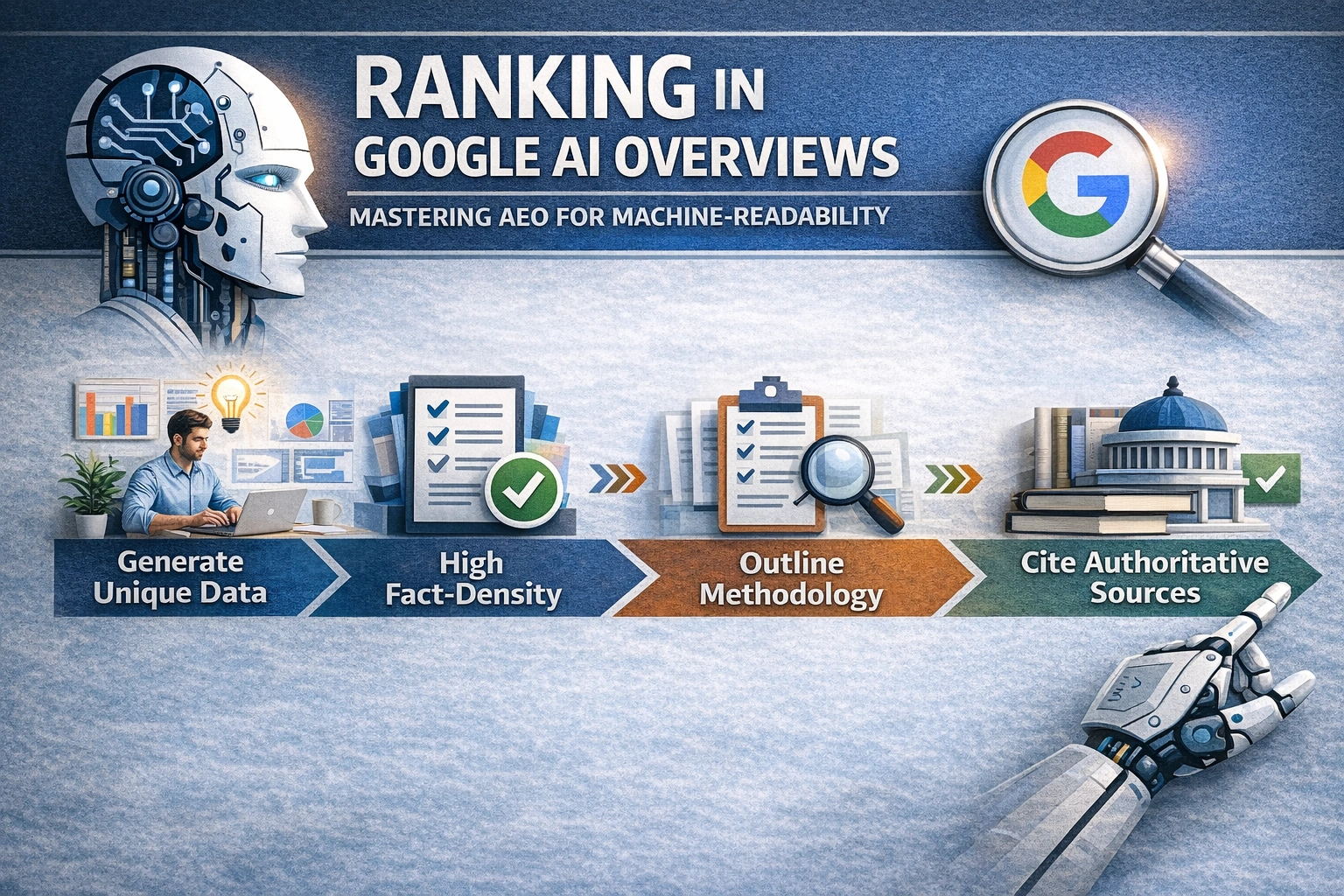
As we move further on this guide, it’s clear that knowledge of Google AI overview rankings involves building “Information Gain,” giving the user something new that doesn’t exist in the top 10 search results already. This is where SEO Discovery excels. We provide the “Information Gain” your competitors lack by leveraging our in-house research team to generate unique data, proprietary insights, and advanced content strategies that AI models find impossible to ignore.
- Focus on extreme fact-density: Ensure every paragraph adds a new, verifiable piece of information rather than just rephrasing the same point. AI rewards content that provides a high “value-per-sentence” ratio, making it a more efficient source for a summary.
- Implement “Methodology” sections: For reviews or comparisons, explain exactly how you arrived at your conclusion. AI models love citing the “why” behind a recommendation because it allows them to provide more transparent and trustworthy answers to the end user.
- Ground your claims in authority: Link to authoritative external sources like government reports, academic journals, or official whitepapers to prove your content is based on reality. This “grounding” makes your site a safer bet for an AI that wants to avoid hallucinating incorrect facts. Using the Best AI SEO Specialists ensures that your citations are technically sound and strategically placed.
Ready to win more search traffic?
Our team at SEO Discovery uses real-world data to help you capture those valuable citations before your competitors do.
Master the Google AI Overviews ranking factors 2026
To truly win, you need to look at Google AI overviews ranking factors. Research shows that semantic completeness is now a huge deal. It’s not just about one page; it’s about having a network of related facts that the AI can cross-reference to ensure you aren’t just guessing. Effective internal linking is the key here, as it guides the AI through your topical authority. Understanding these AI overviews ranking factors is the difference between being a primary source and being buried.
- Optimize for multimodal signals: Include charts, original images, and video transcripts to provide the AI with multiple ways to “understand” your content. If an AI can’t parse your text perfectly, it might still find the answer in your table or image captions.
- Increase semantic richness: Use “vocabulary neighbors” terms that are logically and technically related to your main topic to help the AI understand the full context. If you’re writing about “baking,” you should naturally mention “leavening,” “hydration,” and “gluten development” to prove expertise.
- Deploy advanced schema markup: Use technical code behind the scenes to tell the search engine exactly what your content is, whether it’s a “HowTo,” a “Review,” or an “FAQ.” Even the Best SEO Tools cannot replace the precision of well-implemented schema in a modern search environment.
Proven Visibility in AI Overviews & Generative Search
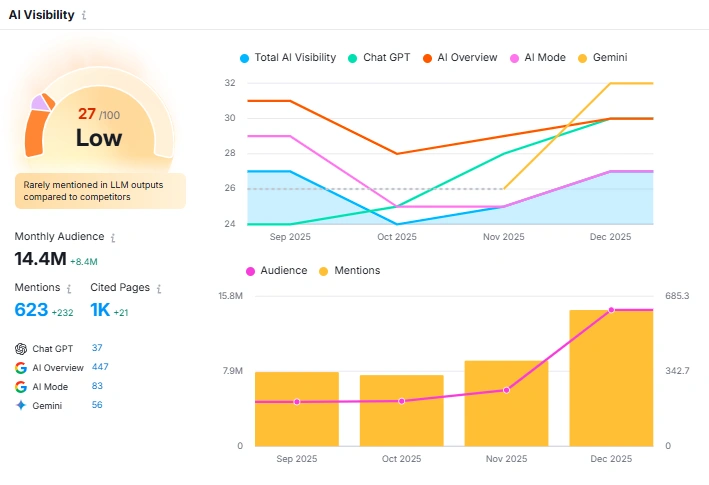
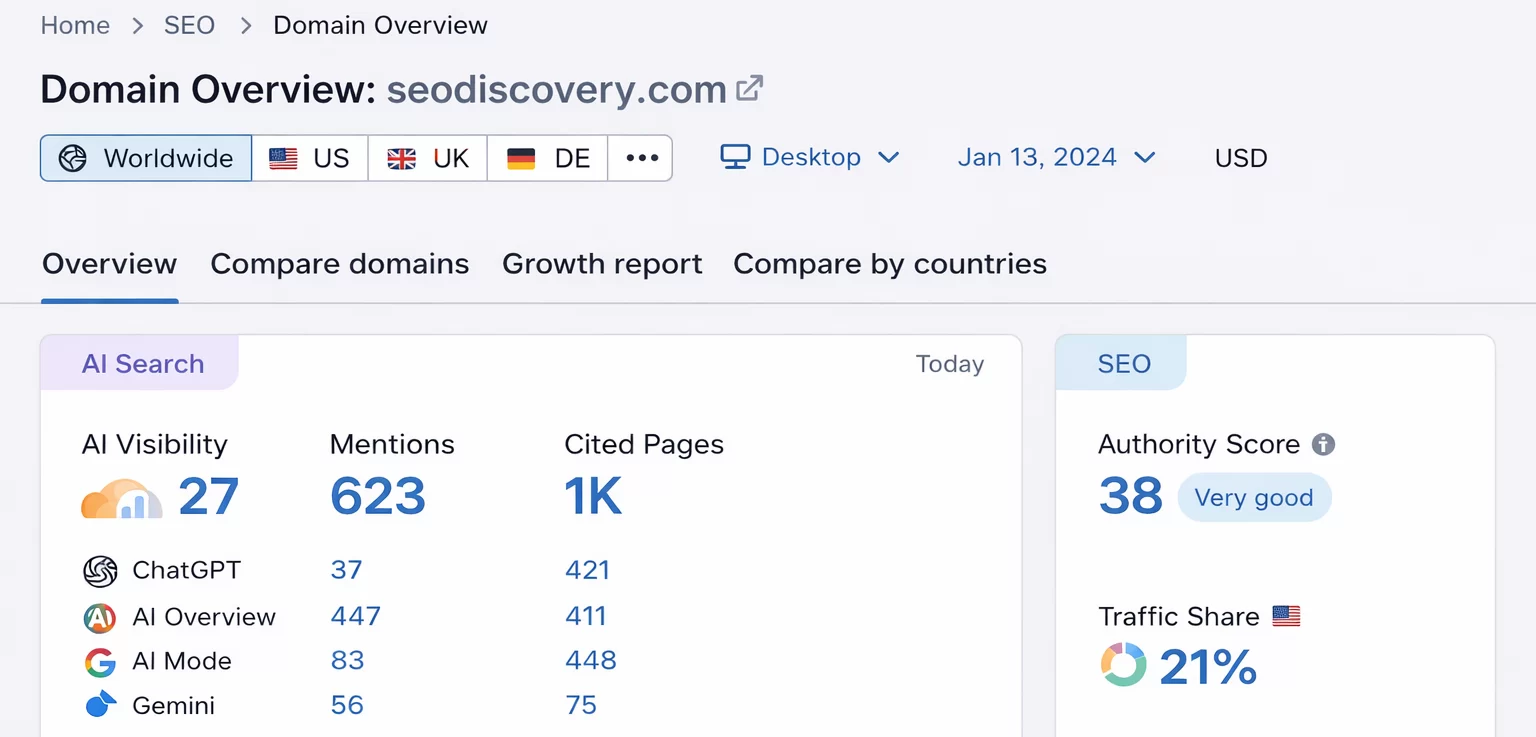
SEO Discovery’s domain performance shows clear, measurable signals that search engines rely on when selecting sources for AI Overviews and generative answers.
Demonstrated AI Overview Presence
- AI Visibility Score: 27
Confirms consistent inclusion across AI-driven search environments where summaries and direct answers are generated.
- 623 Total AI Mentions
Indicates that SEO Discovery content is repeatedly referenced when search engines assemble AI-generated explanations and comparisons.
- 1,000+ Cited Pages
Shows depth of coverage and topical authority—key factors AI systems use to validate accuracy before selecting sources.
Strong Coverage Across Generative Platforms
SEO Discovery maintains visibility across multiple AI-driven search experiences:
- Google AI Overviews: 447 mentions, 411 cited pages
- ChatGPT: 37 mentions, 421 cited pages
- AI Mode: 83 mentions, 448 cited pages
- Gemini: 56 mentions, 75 cited pages
AI Overviews favor sources that appear consistently across platforms, not just high-ranking blue links. This cross-platform presence reinforces trust and selection probability.
Start monitoring AI Overviews rankings strategies
You can’t fix what you don’t measure. You need to start monitoring AI overviews rankings strategies to see which of your pages are being picked up and which are being ignored. The search results are volatile, and what works today might be summarized differently tomorrow as the models update their training data. For brands looking for perplexity seo success, staying updated on these changes is vital. By monitoring AI overviews rankings strategies, you can pivot quickly when algorithms shift.
- Track your specific citations: Keep a close watch on which exact sentences or lists from your site are being pulled into the AI box. This tells you exactly what “style” of writing is working, so you can replicate that success of AI overviews brand ranking across your entire website.
- Analyze your “AI neighbors”: Look at which other websites are being cited alongside yours in the same overview. By studying their content structure, you can identify “information gaps” that you might have missed in your own articles during your initial keywords research phase.
- Iterate based on citation performance: If you notice a high-traffic page isn’t getting an AI citation, try making your introduction more direct or adding a clear summary box. Small formatting tweaks often make the difference between being a “blue link” and being a “top source.”
Want to fix your search visibility?
Trust SEO Discovery to turn your expertise into the clear, cited answers that modern search engines are looking for today.
Why AI overview rank tracking is the new essential
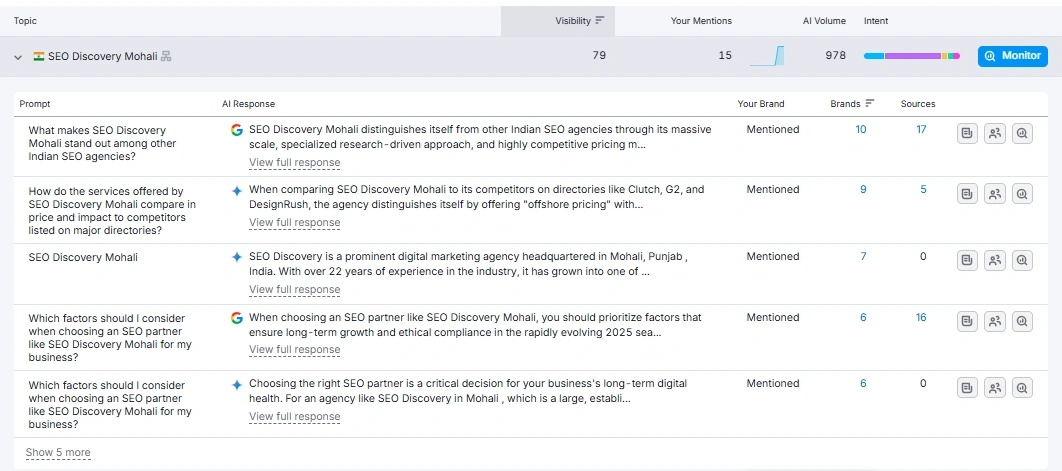
You’re missing the whole picture if you’re just looking at “Position 1.” AI overview rank monitoring provides you with the real estate that people really click on. In the world of search everywhere optimization, appearing in these summaries is the ultimate goal. When you keep track of them, be sure to check the AI overview sources ranking. The AI often gets its information from sites that aren’t even in the top three organic places. This is because it values clarity above “backlink power.” Using AI overview rank tracking makes sure you’re optimizing for the places where visitors really look.
- Check the visual placement: Is your brand being called the “primary” solution, or is it hidden away in the “more to explore” links? This helps you figure out whether people consider your information as the main source or merely a supplementary one.
- Watch how people click through: Check your Search Console statistics to observe how your traffic changes when a site gets a citation rank in AI overviews. High-quality AI SEO services focus on this data to refine your strategy continually.
- Make sure your brand is consistent: Use tracking to make sure that the AI is giving your brand the right credit for your information. If the AI is summarizing your thoughts but not saying your name, you need to change the “Entity” signals on your site to get credit for them.
Claim your spot in the future of search
The shift toward AI-driven search is the biggest opportunity for content creators since the birth of Google. If you want to stop trailing behind and start dominating your niche, you need a strategy built for 2026 that prioritizes how to rank in AI overviews. Partnering with the best SEO company, such as SEO Discovery ensures you stay ahead of the curve. As an award-winning agency recognized by Forbes and Semrush, we provide the technical precision and creative authority needed to win in the era of Generative Search. Don’t wait for your traffic to drop. Click below to secure your visibility now!
Why is your competition ranking higher?
SEO Discovery audits your pages to find the exact gaps keeping you out of the top generative search response boxes.
FAQs About How do I rank in AI Overviews and Generative Search
An AI Overview is an automated summary generated by a computer that is shown at the top of the search results. It takes pieces of information from various sources to answer a user’s query directly.
The main aim of traditional SEO is to get a better position for links, while AI Overviews focus on deciding the content that is most clear, factually correct, and can be easily extracted and summarized by Google Ai mode.
That is right. AI Overviews are not limited to the top three organic results only. They cite the sources that provide clearer definitions, better structure, or more accurate answers.
It definitely matters, but it has to be structured well. AI prefers those web pages that give a direct answer to the question and then offer supporting, dense, well-organized information.
The use of schema helps the search engines to figure out the goal and layout of the content. This way, the content is likely to be correctly interpreted and cited by AI systems.
Consistently. AI-generated content keeps changing, so it is necessary to keep a check on citations, formatting effectiveness, and visibility trends in order to stay competitive.