

Objective:
This blog describes how the development of Large Language Models (LLMs) is changing the search engine optimization domain, the importance of optimizing search engines to be more AI-friendly, and how brands can optimize content, technical SEO, and authority-building strategies to be the most visible, engaging, and ranking in the search engines powered by Large Language Models.
The discovery of brands online is changing drastically because of the emergence of LLMs in the search ranking system. Big AI engines like ChatGPT, Perplexity, and Google AI Mode are changing the search behavior, interaction with users and content access. Recent studies have also indicated that more than two-thirds of searches today include AI-assisted search or conversational search, which shows that brands are urgently required to optimize search to the LLM search engine. Understanding the impact of LLMs on SEO cease to be an optional matter to marketers, as they are crucial to staying relevant, active, and authoritative within the digital space.
Did you know? LLM-optimized content is 35% more likely to appear in AI-generated answers across platforms like ChatGPT and Perplexity, signaling higher brand visibility and user engagement in search.
Brands that adapt their SEO for LLMs not only improve visibility in AI-driven search but also enhance user experience by providing structured, relevant, and extractable content.
This blog explains why ignoring LLMs leads to lost zero-click opportunities, fewer brand mentions, and reduced referral traffic.
Key Takeaways
- LLMs drive zero-click searches and conversational queries.
- Optimizing for AI-driven SEO boosts visibility in AI-powered search.
- Structured data, SEO LLMs.txt, and pillar pages enhance discoverability.
- Brand authority and White Label SEO Services ensure long-term AI-driven success.
Table Of Contents
- The Impact of LLMs on SEO and User Search Behavior
- Case Studies and Success Stories
- Technical Implications of SEO for LLMs on Your Website
- Building Content Concepts with SEO and LLMs
- Authority Signals and Brand Presence in LLM SEO
- Measuring SEO for LLMS Impact and Avoiding Risks
- Stepwise SEO llms.txt Strategy for Ranking
- Ecommerce & Product-Focused Strategies for SEO for LLMs
- SEO Discovery Shows How llms.txt File SEO Can Transform Your Visibility
- FAQs About Impact Of LLMS On SEO
The Impact of LLMs on SEO and User Search Behavior
Large Language Models (LLMs) are advanced AI systems trained to understand, generate, and interact with human language at scale. They are able to read, respond to questions, generate, and even help in decision-making by forecasting contextually applicable data.
“SEO for LLMs” refers to the process of optimizing digital content so that it is easily discoverable, understandable, and favored by AI-driven search tools and language models.
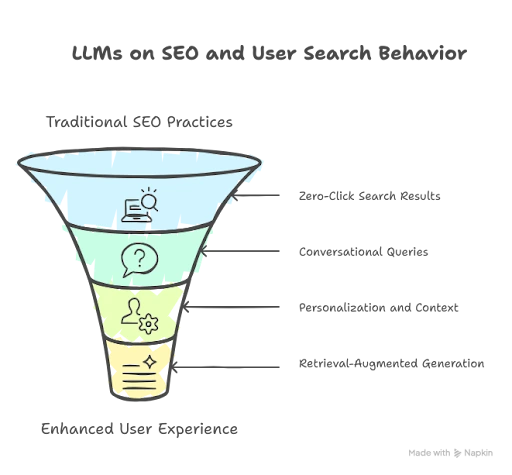
Traditional SEO was too keen on keywords, back links, and in-page optimization. The introduction of LLM and SEO however creates a paradigm shift:
- Zero-Click Search Results: LLMs can provide direct answers in the search interface, reducing clicks to websites. Users may no longer navigate through multiple pages to get the information they need, which changes traffic patterns and referral metrics.
- Conversational Queries: Unlike traditional search engines, LLMs handle natural language queries. Full-sentence queries are now posed by users such as the best SEO practices when using AI to create content. and they demand correct, brief replies.
- Personalization and Context: Modern LLMs learn user preferences over time, surfacing content customized to specific contexts. It translates to the fact that the usefulness of your site is becoming more and more determined by its ability to meet sophisticated, purpose-based searches.
- Retrieval-Augmented Generation (RAG): LLMs are not only based on training data, but they can also access new information on indexed websites, i.e., structured and authoritative content has higher chances of being quoted or surfaced.
The transition to the direct, AI-based response demands that brands reconsider the format of their content and its readability and interpretation by LLMs.
Case Studies and Success Stories
Case Study 1: Cloudsential
Service Provided: Implementation of llms.txt SEO rules, structured data for FAQ and TechArticles, and publication of original research.
- Strategy & Implementation:
- Applied llms.txt SEO guidelines across the website.
- Structured data markup added for FAQs and technical articles.
- Published original research to increase authority and references.
- Results and Key Metrics:
- Significantly increased AI visibility.
- Cloudsential now appears as a top reference for ChatGPT SEO queries.
Case Study 2: Flashtrends
Service Provided: Optimization of product detail pages (PDPs) with schema, citation building, and AI mention monitoring.
- Strategy & Implementation:
- Enhanced PDPs with relevant schema markup.
- Engaged in citation building across authoritative sources.
- Monitored AI-driven mentions for brand presence.
- Results and Key Metrics:
- Increased traffic from Perplexity SEO-driven searches.
- Flashtrends featured in direct answers for zero-click queries.
Case Study 3: Insight Nest
Service Provided: Use of topic clustering, intent-rich content creation, and structured FAQs and How-Tos.
- Strategy & Implementation:
- Developed topic clusters targeting user intent.
- Added structured FAQ and How-To schema markup.
- Created high-quality content to enhance authority.
- Results and Key Metrics:
- Gained increased authority in Search Everywhere Optimization.
- AI summarizations frequently cite Insight Nest’s pages.
Technical Implications of SEO for LLMs on Your Website
Adapting SEO and LLMs involves not only content strategy but also technical optimization:
- LLMs.txt File SEO: Similar to robots.txt, the llms.txt file seo approach allows websites to communicate directly with AI crawlers. By controlling which pages can be ingested by LLMs, brands can protect sensitive content while promoting high-value pages.
- Server-Side Rendering (SSR) & Static Site Generation (SSG): Many LLM crawlers do not execute JavaScript effectively. Platforms like Next.js can deliver SSR content, ensuring LLMs index the raw HTML instead of waiting for client-side rendering.
- Structured Data & Schema Markup: JSON-LD, FAQ schema, and TechArticle markup make it easier for LLMs to extract accurate information. Implementing structured data signals quality and enhances the chances of your content being cited.
- Yoast SEO LLMs.txt Integration: Popular SEO tools like Yoast now support generating llms.txt files, streamlining LLM-specific indexing strategies. By combining Yoast SEO LLMs.txt guidance with traditional SEO checks, brands can control their AI visibility efficiently.
- Content Hierarchy: Clear H1-H2-H3 structures and semantic HTML ensure LLMs can parse and understand content topics, subtopics, and key takeaways.
These technical interventions are important for SEO LLMS.txt optimization and guaranteeing your content is discoverable, readable, and actionable for AI-driven search engines.
Master the technical foundation for LLM-driven search
Ensure your site’s architecture, from llms.txt to structured data, is optimized for AI discovery and citation.
Building Content Concepts with SEO and LLMs
LLMs value clear, useful, and original content. Traditional keyword stuffed pages are no longer enough. Here’s how to adjust your content strategy for LLMs SEO:
- Use Topic Clusters & Pillar Pages
Instead of focusing on one keyword per page, create a main “pillar” page covering a big topic and support it with smaller pages on related subtopics. This shows LLMs your expertise on the whole concept, not just a single keyword. - Add Clear, Quick Answers
Start sections with short, direct answers, bullet points, or numbered lists. For example:
“LLMs favor content that’s structured and easy to read, like tables, FAQs, or step-by-step lists.” - Include Original Data & Insights
Share unique research, case studies, or actionable tips. Original content is more likely to be recognized and cited by LLMs, establishing your brand as a trusted source. - Write Conversationally & Clearly
Use natural, easy-to-read language. Include FAQs, How-To guides, and clear explanations to match how people ask questions and how LLMs process them.
By following these tips, you align SEO and LLMs with both human readers and AI models, maximizing reach and authority.
Authority Signals and Brand Presence in LLM SEO
In the case of LLMs, the brand SEO visibility is not only assigned based on backlinks but also mentions, citation, and cross-web authority. Brands need to focus on:
- Digital PR & Citation Building: Earn mentions in reputable publications, research articles, and niche blogs. These citations are usually brought up on the surface by LLMs.
- UGC & Community Engagement: Community-generated content, reviews, and forums enhance brand signals and contribute to AI-driven search relevance.
- Ecommerce-Specific Considerations: Product pages (PDP) now outrank category pages in the search results generated by the LLC-motivated shopping search. Structured product data optimization, reviews, and descriptions are significant in SEO for brands in LLMs.
With brand authority, you can be sure your content will be visible when AI-driven search is reshaping click patterns.
Measuring SEO for LLMS Impact and Avoiding Risks
Measuring the impact of LLMs in SEO is not as straightforward as traditional metrics. Standard analytics may miss AI-driven visibility, so a mix of strategies works best.
Check AI Responses Directly
Ask LLMs questions like, “What is [brand/topic]?” and note which sources they cite. This helps you see how your content is being recognized by AI.
Track Traffic Shifts
Use tools like GA4 to monitor referral spikes or drops. Zero-click search results can change how visitors reach your site.
Monitor Brand Mentions
Track mentions across the web and within AI-generated answers. This gives insight into your brand’s visibility in the AI ecosystem.
Watch Out for Risks
LLMs come with challenges. AI can produce “hallucinations,” meaning plausible but incorrect information. Always fact-check content.
Over-optimizing content just for AI can hurt readability and brand trust. Low-quality automated content without human oversight also undermines credibility and E-E-A-T signals principles.
Balance Human and AI Input
The key is maintaining a balance between AI and human input. When done right, your content stays accurate, engaging, and trustworthy, while benefiting from the advantages of LLM-driven SEO.
Stepwise SEO llms.txt Strategy for Ranking

To succeed in the evolving AI-driven search landscape, follow this condensed checklist for LLM SEO execution:
- Keyword Research with Intent and Entities
Keyword Research focus on queries that align with user intent and include entity-rich terms. This forms the foundation for effective SearchGPT SEO, ChatGPT SEO, and Perplexity SEO strategies. - Audit Existing Content
Review current pages for structured data, semantic clarity, and AI readability to ensure LLMs interpret your content correctly. - Implement llms.txt for AI Indexing
Manage how AI models crawl and reference your site by creating and optimizing an llms.txt file. - Integrate AI-Aware SEO Tools
Use features like Yoast SEO’s LLMs.txt integration to organize AI-focused content management. - Build Pillar Pages and Topic Clusters
Develop inclusive pillar pages supported by cluster content to establish authority over full concepts rather than individual keywords. - Publish Original Research and Insights
Share unique studies, tables, and case studies. This strengthens your credibility for SearchGPT SEO, ChatGPT SEO, and Perplexity SEO. - Add FAQs, How-Tos, and Snippets
Include short, extractable answers that LLMs can easily reference. Structured snippets improve AI-driven visibility. - Optimize Technical SEO
Ensure server-side rendering, fast page load, and semantic HTML to enhance AI indexing and ranking. - Engage in Digital PR and UGC Campaigns
Increase mentions and authority through digital PR initiatives and user-generated content, enhancing AI trust signals. - Monitor AI Visibility and Iterate Quarterly
Regularly track how your content performs in SearchGPT SEO, ChatGPT SEO, and Perplexity SEO contexts, refining your strategy each quarter.
Ecommerce & Product-Focused Strategies for SEO for LLMs
For ecommerce brands, LLM SEO offers powerful ways to boost product visibility across AI-driven platforms.
- Prioritize Product Detail Pages (PDPs): Focus on PDPs rather than category pages for direct exposure in AI-first search environments, enhancing your performance in SearchGPT SEO, ChatGPT SEO, and Perplexity SEO.
- Use Structured Product Data: Implement schema for price, availability, reviews, and specifications to support Google AI Mode indexing and AEO Services.
- Citations & Reviews: Ensure testimonials, user reviews, and press mentions are easily indexable by LLMs, strengthening authority signals for AI SEO Services.
- Cross-Linking for Semantic Networks: Link related PDPs and blog content to create strong semantic connections, improving discoverability in Search Everywhere Optimization campaigns.
- Utilize Keyword Research & White Label SEO Services: Target AI-relevant keywords and consider white label solutions to scale AI-focused SEO strategies efficiently.
SEO Discovery Shows How LLMS.txt File SEO Can Transform Your Visibility
SEO Discovery leads the way in LLM-driven SEO, understanding how AI-powered search is reshaping digital marketing. From zero-click searches and conversational queries to brand citations and structured data requirements, LLMs are redefining content and technical SEO strategies.
For e-commerce, blogs, and business websites, our custom LLM SEO strategies make your content structured, authoritative, and highly discoverable by AI models. Partner with SEO Discovery to leverage AI SEO Services, implement SEO LLMs.txt, build topic clusters, and publish original content that boosts visibility, authority, and engagement.
We also provide White Label SEO Services, enabling agencies to scale LLM-focused strategies for their clients efficiently and effectively.
Unlock the Power of LLMs
Elevate Your SEO Performance by connecting with SEO Discovery now.
FAQs About Impact Of LLMS On SEO
LLMs (Large Language Models) such as ChatGPT and Perplexity are able to read and write like humans. Instead, they value concise, systematized, and authoritative pieces of information altering the operation of search engine optimization.
Traditional SEO focuses on keywords and backlinks. SEO for LLMs focuses on semantic relevance, topic authority, and structured data in the search results of an AI.
Key LLM SEO strategies involve creating topic clusters and pillar pages, publishing original research and case studies, adding FAQs, How-Tos, and short snippets, and using structured data (schema) to help AI models understand and index your content effectively.
Track AI visibility by querying models directly, monitoring referral traffic, and checking brand mentions. Combine these with traditional analytics for a full view.
Look out for AI hallucinations (inaccurate info), over-optimized content that hurts readability, and low-quality automated content that undermines E-E-A-T principles.
A best SEO agency or SEO consultancy like SEO Discovery can implement AI SEO Services, manage SEO LLMs.txt, and optimize content for SearchGPT SEO, ChatGPT SEO, and Perplexity SEO. White Label SEO Services are also available for agencies.
No. It complements traditional SEO by improving AI visibility while keeping content readable and authoritative for human users.