

Objective
This blog describes the step-by-step process of creating a brief outline for SEO content. It empowers content writers, SEO teams, and digital marketers to create structured, rankable, and conversion-focused content every time.
- Keyword research is the foundation of every great SEO content outline.
- Content structure should not be built until you confirm the search intent.
- Looking at your competitors is a great way to find topics to write about and to spot ranking gaps.
- Every H1 must contain the primary keyword within the first five words.
- Weak content comes from vague briefs and rarely ranks or converts well.
Improve Ranking with Expert SEO Content Strategy from SEO Discovery, Starting at $250/Month.
To create a strong SEO content outline, you must choose the right keyword, analyze top-ranking pages, and organize headings according to user intent. A well-planned outline will make your article easier to read, more detailed, and better optimized for search engine optimization and genuine readers.
Did You Know? According to Ahrefs, 87% of respondents use AI to assist in content creation.
Think of an SEO content outline as the roadmap to your blog. Without it, your content can look disorganized or incomplete. A good outline helps you stay organized, makes your content more readable, and naturally inserts important keywords while also helping you to fulfill the user’s needs.
In this guide, we’ll instruct you on what an SEO content outline is, how to create it step-by-step, how to build structures for different content formats, and what tools make this process faster, so keep reading till the end.
Table Of Contents
- What is a Content Outline in SEO and Why is it Important
- How to Write a Brief Outline for SEO Content
- How to Design SEO Content Outline Templates for Multiple Content Types
- What Are the Key Mistakes in Creating a Content Outline for SEO?
- What Are the Best Tools to Build an SEO Content Outline Faster
- How We Helped a Client Recover Rankings With Proper SEO Content Strategy
- Start Your SEO Content Journey with SEO Discovery
- FAQs About How to Write a Brief Outline SEO Content
What is a Content Outline in SEO and Why is it Important
A content outline for SEO is an organized structure that arranges your headings, subheadings, keywords, and key discussion points before writing begins. It helps produce well-structured content that aligns with user intent, improves readability, covers topics in-depth, and makes it simpler for the search engines to understand your page.
Why it matters for your SEO strategy:
- It fits the content with the user search intent from the start.
- It cuts down on revisions by providing writers with clear, actionable direction.
- Proper heading signals help Google understand your content structure.
- It guarantees complete topic coverage for better content quality and readability.
- Increases publishing timelines across large content marketing programs.
- It provides consistency for every writer on your team.
How to Write a Brief Outline for SEO Content
Following the right process step by step makes it much easier to create a strong SEO content outline. Every step from keyword research to heading structure helps you create organized, user-focused, and search-optimized content. These are the basic steps you should take.
1. Start With Keyword Research and Intent Mapping
It helps you find the right topics, identify user intent, and generate content that matches what people are actively searching for on the internet.
Key Points to focus on during keyword research:
- Find The Right Primary Keyword: Use tools like Ahrefs, SEMrush, or Google Search to find keywords with a high search volume and a decent level of competition.
- Understand Search Intent Properly: Before you structure your content, know if the keyword intent is informational, commercial, navigational, or transactional.
- Analyze Top SERP Results: Review the highest-ranking pages to determine the types of content that Google prefers for your keyword focus.
Pro Tip: Type your keyword into Google and look at the “People Also Ask” section. Those questions show precisely what your audience is looking for, so write your H3 and H4 subheadings accordingly. |
2. Analyze the Top Competing Pages
Competitor evaluation allows you to see what is ranking on Google, find content gaps, and improve your SEO content writing strategy more efficiently.
Here’s what you need to analyze:
- Analyze Heading Structures Carefully: Look at the top-ranking pages and compare their H1S, H2S, and H3S to learn how content is structured.
- Evaluate Content Depth and Coverage: Review average word count, quality of explanations, and key topics regularly included in competitors’ content.
- Identify Missing Questions and Gaps: Find unaddressed “People Also Ask” questions and content gaps your competitors didn’t explain well.
Pro Tip: Paste competitor H2 and H3 headings into a simple spreadsheet. The topics that must appear in 3 or more competitors must cover headings. The gaps that no one else is covering are your most significant ranking opportunities. |
3. Define the Target Audience and Funnel Stage
Set up your target audience and funnel stage specifically in the SEO content outline so you can create more targeted, relevant content.
Here’s what you should define:
- Create A Clear Reader Persona: Within the brief, write a short reader persona that details the type of audience, their goals, challenges, and expectations of the content.
- Define Knowledge Level and Funnel Stage: Determine if your readers are beginners or experts, and what stage of the buying journey they are currently in.
- Highlight Goals And Pain Points: Clearly define what action you want the reader to take, what concerns they might have, and what questions the content should answer.
Pro Tip: Write the persona like a real person. Instead of “marketers,” write “a freelance content writer with two years of experience who wants to rank their first blog post.” The more specific the persona, the sharper the content. |
4. Write Your H1 and Meta Title
Create a compelling meta title and simple H1 that encourages clicks, justifies page importance, and improves your digital PR services’ visibility.
How to write an effective H1 and meta title:
- Keyword Placement in H1: Place the primary keyword in the first three to five words of the H1 so that search results can quickly see relevance and enhance your search visibility.
- Title Formula and Length Control: Apply the formula of the main keyword with a benefit or format signal and maintain the title length between 50 and 60 characters.
- CTR Promoting with Power Words: Use power words like “complete,” “proven,” “step-by-step,” or “ultimate.” Make two or three variations and choose the strongest hook.
Pro Tip: Use a free headline analyzer tool like CoSchedule Headline analyzer to run your final H1. Aim for a score above 70. High-scoring headlines always get more clicks from the same SERP position. |
5. Build the Heading Outline
Build a structured heading flow (H2 to H4) that serves as a content blueprint, clearly structuring topics and enhancing SEO with the natural placement of technical SEO strategies throughout the content.
Here are the main points below:
- Plan H2 Sections First: Plan five to eight H2 sections as the main structure, covering the entire topic in a logical way from introduction to final conclusion.
- Add Supporting H3 and H4 Levels: Use 2-4 H3S under each H2, and only use H4 when further explanation or additional clarity is required.
- Use Keywords and Logical Flow: Incorporate LSI keywords in at least half of the H2 headings and organize the structure to lead the reader from question to solution.
Pro Tip: Read the heading outline from top to bottom without any body text. If it looks like an orderly table of contents that step by step answers the reader’s main question, your structure is solid. Rebuild if it seems disorganized before you start writing. |
6. Add Section-Level Notes for the Writer
Put clear section notes for the writer under every heading to determine the angle, information required, and final reader takeaway clearly.
Here’s how to apply it effectively:
- Include Direction Under Each Heading: Write 2–4 bullet points under each H2 and H3, giving angle, structure, and clear content direction for writers.
- Define Content Angle and Evidence: Clarify if the section is problem, solution, comparison, or data-based and include needed stats, studies, or real-world examples.
- Guide Keywords and Visual Needs: Include secondary keywords, questions, and recommend visuals such as tables, images, or infographics to enhance clarity and engagement.
Pro Tip: Don’t list “explain this topic” as a section note. explain why ignoring search intent is the single most common reason well-written content fails to rank. ” Specific direction always results in specific, high-quality writing. |
7. Complete the Full Brief Details
Finish the complete brief with final details, ensuring SEO consistency and a smooth workflow, and avoid delays or additional revisions in your content outline for the SEO process.
Here’s how to finalize everything properly below:
- Define Content Length and URL Structure: Determine the desired word count based on competitor averages and develop a concise URL slug with keywords, avoiding dates for SEO clarity.
- Add Meta, Links, and References: Create a 150-160 character meta description and insert 2-4 internal links and 1-2 authoritative external sources.
- Set CTA and Brand Tone: Decide CTA placement in the article and define tone as conversational, formal, or authoritative for a consistent brand voice.
Pro Tip: Always include the suggested anchor text for every internal link inside the brief. When writers choose their anchor text, it is often too generic. Pre-defined anchors protect your internal linking strategy and keep your site architecture clean and consistent. |
8. Review the Brief Before Sending
Review the brief before sending it for final approval to catch any errors, improve clarity, and ensure a smooth workflow for local search optimization.
Here’s how to review the brief effectively:
- Check Keyword Placement and Structure: Make sure that the primary keyword is in H1 and H2, and that secondary keywords are naturally placed throughout the heading structure.
- Ensure Section Notes and Intent Match: Make sure each H2 and H3 has 2-3 notes and content matches the search intent from Step 1.
- Review Overall Flow and Readability: Read through the outline from top to bottom to ensure that there is a clear logical reader journey and that the content flows smoothly.
Pro Tip: Before sending any brief to a writer, ask yourself: “Could someone write a complete, accurate, and well-structured draft using only this document?” If the answer is no, the brief needs more detail. |
Want to Improve Your SEO Writing Process?
Get structured briefs that guide every piece of content.
How to Design SEO Content Outline Templates for Multiple Content Types
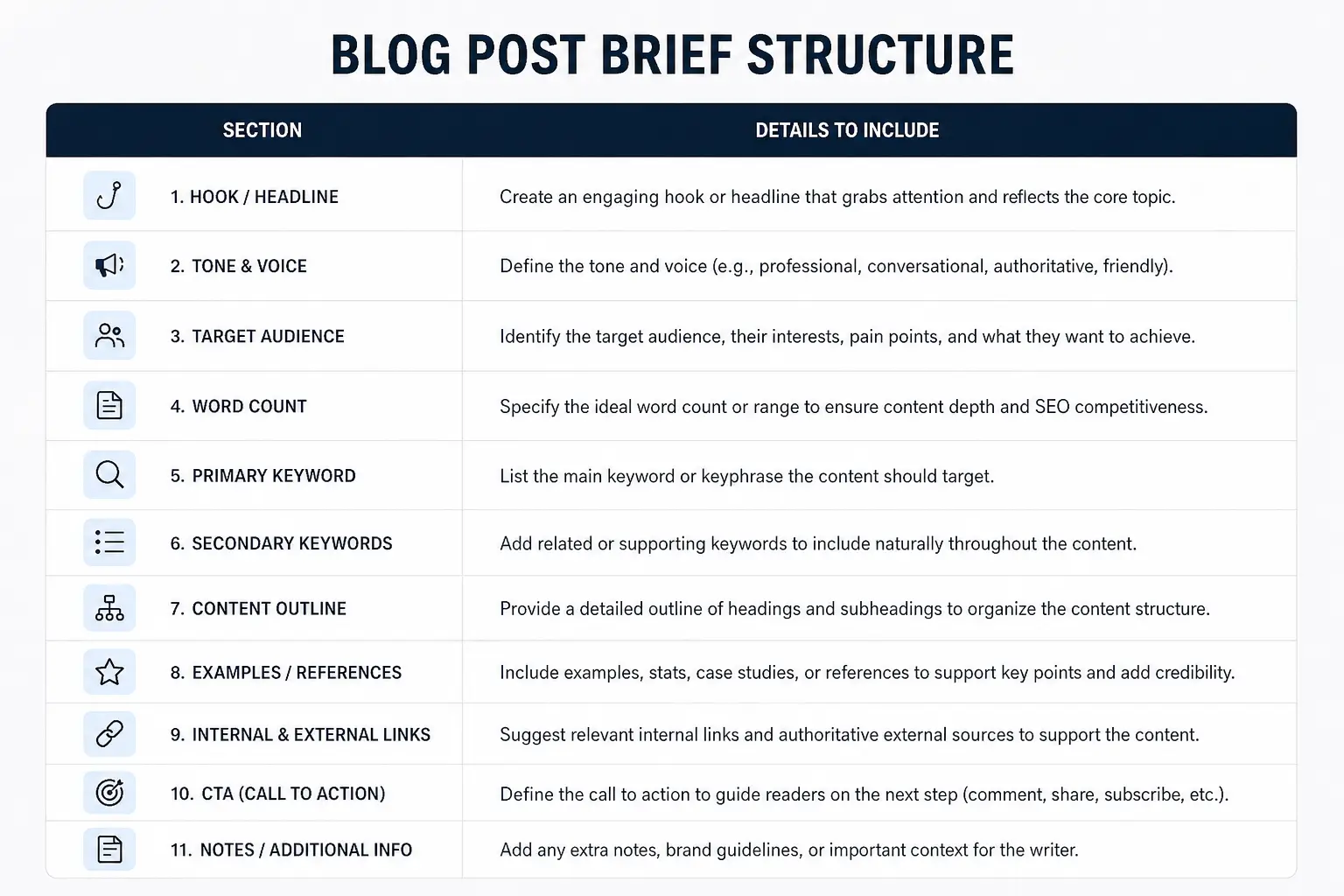
- Blog Post Brief Structure: Establish hook, tone, word count, examples, and keyword placement upfront so the writer knows the story, reader pain, and SEO direction clearly.
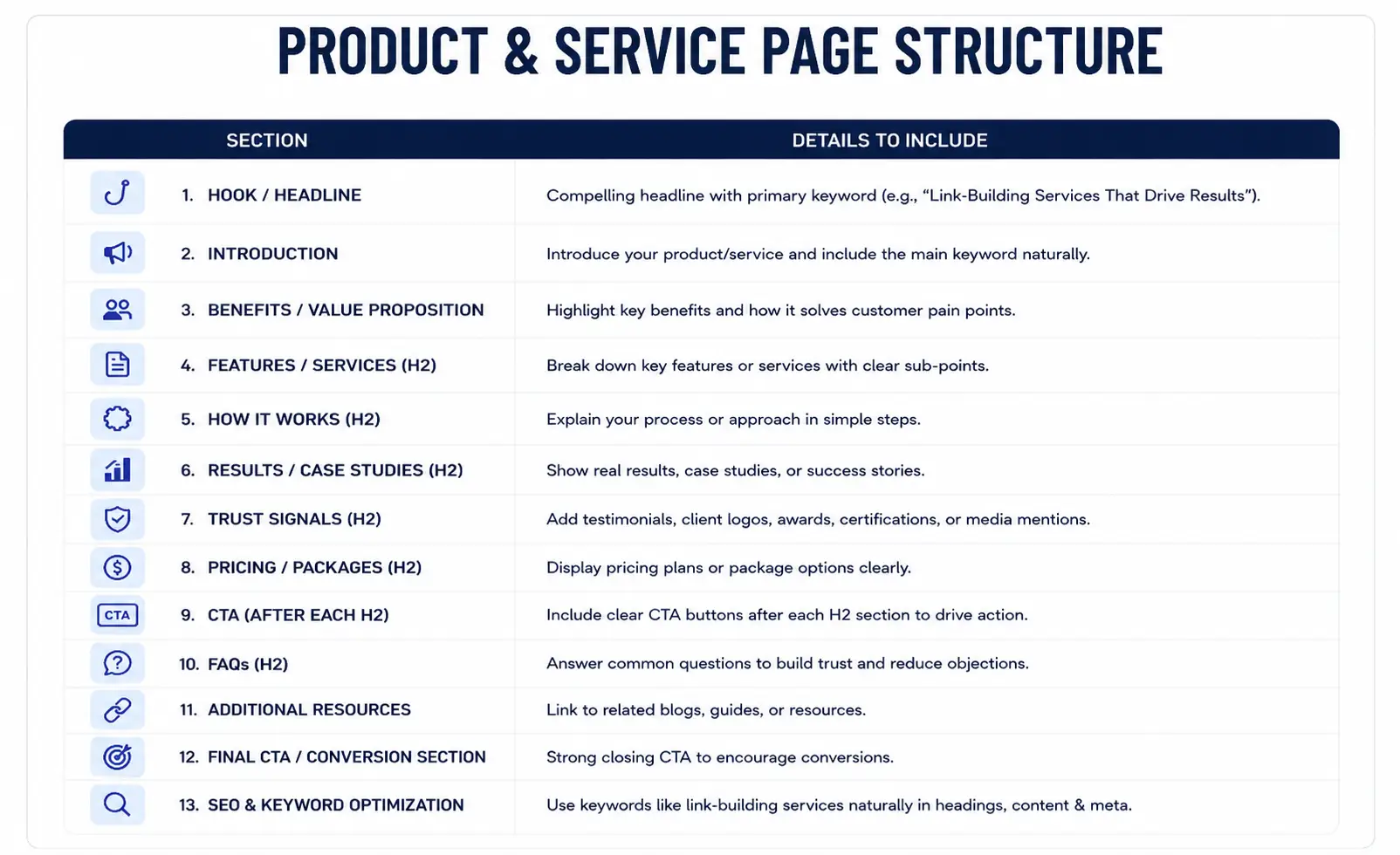
- Product and Service Page Structure: Focus on conversions with CTAs after H2S, add trust signals, pricing info, and place keywords through link building services naturally in headings and the introduction.
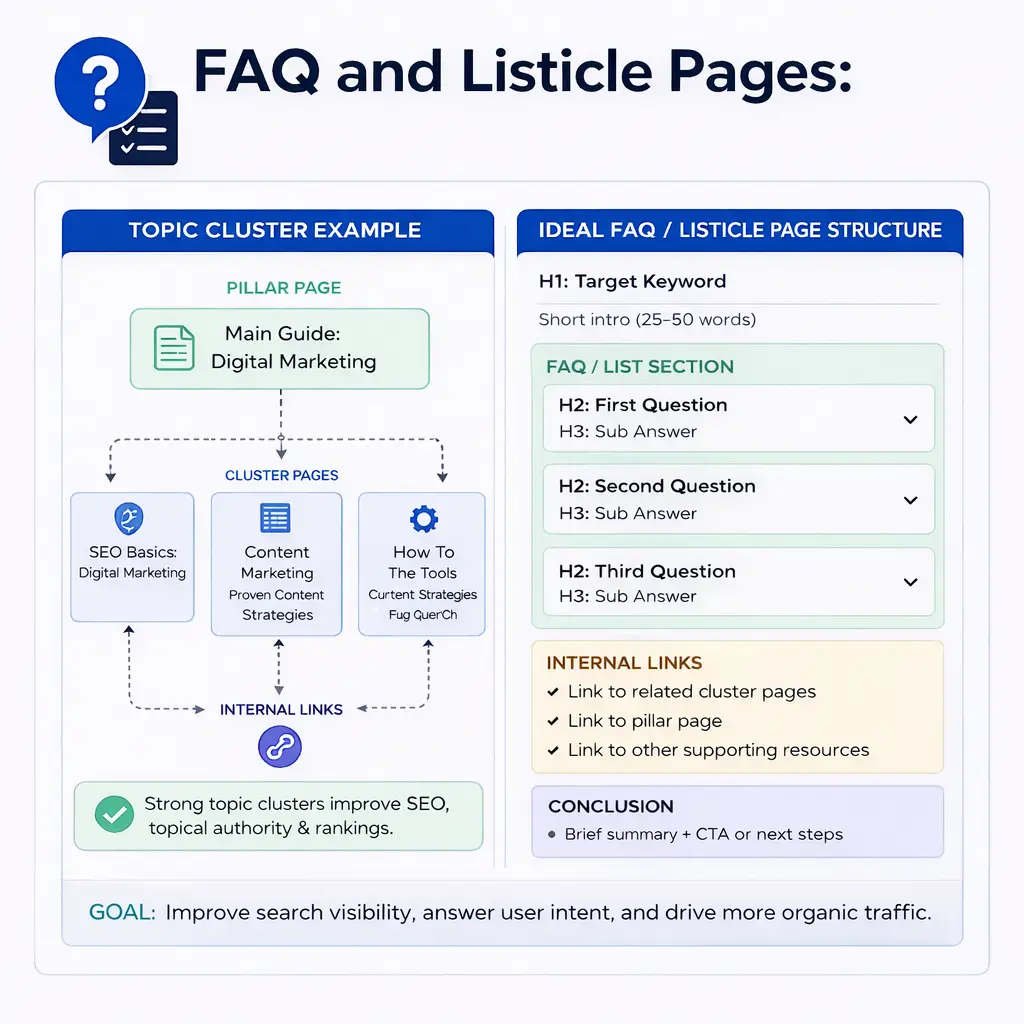
- FAQ and Listicle Pages: Create topic clusters, internal links, and a clear structure with short answers to help content rank well and get search visibility.
Struggling to Organize Your Content Ideas?
We help you plan SEO content with clear and simple briefs.
What Are the Key Mistakes in Creating a Content Outline for SEO?
Even seasoned content teams can make short mistakes. These are the top 5 most common SEO content outline mistakes that kill rankings before the article is even published.
- Ignoring Search Intent Alignment: If you ignore search intent, transactional pages will fail. Always structure your page according to what the SERP is actually showing.
- Keyword Stuffing in Headings: Overstuffing keywords in each heading makes content difficult to read and signals bad quality to users and Google.
- Skipping Competitor Analysis: When you don’t check competitors, you miss out on essential topics, questions, and gaps that help your content rank better in search.
- Vague Section Notes: When section notes are not clear, writers get confused. So always add a clear angle, data, and detailed questions.
- Not Refreshing Briefs: Old briefs affect performance, so always update your keywords, SERP insights, and approach before rewriting any content.
What Are the Best Tools to Build an SEO Content Outline Faster
The right tool saves hours and improves the quality of the brief. Here’s a simple breakdown of the best tools that you can use while creating a content outline for SEO.
Tool | Best For | Cost |
Google Search | SERP analysis, PAA, related searches | Free |
AnswerThePublic | Question and topic mapping | Free and Paid |
Google Search Console | Existing content performance data | Free |
Ahrefs | Keyword data and competitor gap analysis | Paid |
SEMrush | Full content brief, automation and SERP data | Paid |
Frase.io | SERP-based brief generation | Paid |
Surfer SEO | NLP-based content scoring | Paid |
How We Helped a Client Recover Rankings With Proper SEO Content Strategy
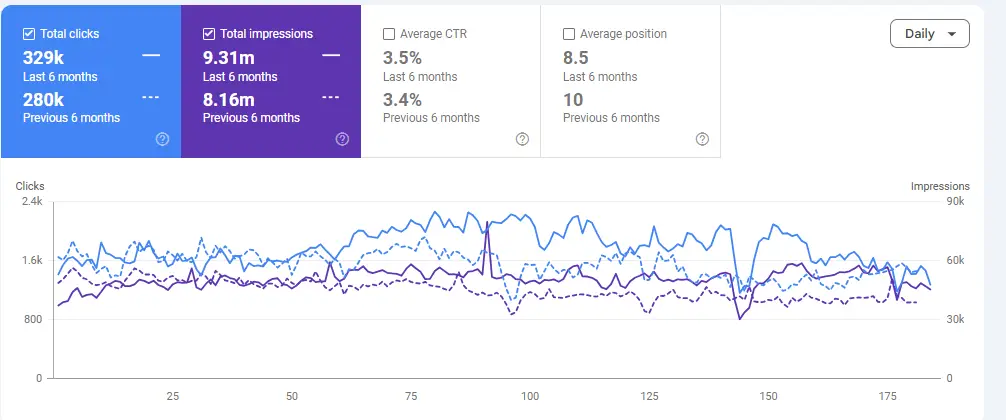
We helped one of our clients who had almost no organic visibility across traditional and AI-powered search platforms. Their website was fully live and functional, but they did not have a proper SEO content outline, keyword strategy, heading structure, or search intent alignment. Google wasn’t indexing their pages, and real users weren’t finding their brand online.
We performed a full content audit and rebuilt their entire website content using structured SEO content outlines. Our focus was on proper keyword targeting, headings inspired by top-ranking pages, intent-matched content formats, and clean internal linking throughout every page.
The Results (Last 6 Months vs. Previous 6 Months)
- Total clicks grew from 280K to 329K in just six months
- Total impressions increased from 8.16M to 9.31M across the same period
- Average position improved from 10 to 8.5, moving content closer to page one
- Average CTR improved from 3.4% to 3.5% with stronger H1S and meta titles
- Content rewrites reduced bounce rates and improved time-on-page across key landing pages
Start Your SEO Content Journey with SEO Discovery
To understand how to write a brief outline for SEO content, start with a clear structure that defines keywords, intent, and headings before writing begins. It helps keep content organized, improves rankings, and ensures every section has a clear purpose and SEO direction from the start.
At SEO Discovery, we support your content outline for SEO and online growth with end-to-end digital marketing solutions. We not only provide content services but also offer Google Maps SEO, guest posting services, and GMB services under one roof to help your business build visibility, attract traffic, and grow consistently online.
Contact us today and let’s build content that actually ranks and brings real results for your business.
Looking for Smarter Content Planning?
We turn keywords into powerful SEO content outlines.
FAQs About How to Write a Brief Outline SEO Content
A content outline in SEO is a structured document that maps headings, keywords, and key points before writing. It aligns content with search intent and helps writers produce first-draft-ready, rankable articles efficiently.
A content outline ensures topical coverage, proper placement of keywords, and logical structure. It also reduces revisions and helps Google understand the page’s full relevance for a specific search query.
An SEO outline length depends on the article type. A standard 1,500-word blog needs five to eight H2S with supporting H3S, section notes, and keyword targets mapped to each individual heading.
A content brief covers strategy: audience, tone, keywords, and links. A content outline covers structure: H1, H2s, H3S, and section notes. Together, they form one complete, actionable brief outline.
Use tools like Ahrefs, SEMrush, or Google Search Console to identify keywords with strong search volume and clear intent. Study the top SERP results to confirm the format Google rewards for that query.
Yes. An SEO AI agent content outline tool like Frase or Surfer SEO can generate SERP-based outlines in minutes. Always review and customize the output to match your audience and brand voice precisely.
An SEO content brief should include the primary keyword, search intent, target audience, heading structure, word count, meta title, meta description, internal link targets, and CTA placement instructions.
Update SEO content briefs every six to twelve months or whenever you plan a content refresh. Re-run keyword and SERP research each time to ensure the brief reflects current search behavior accurately.
SEO Discovery not only creates structured SEO content outlines but also delivers complete content writing support, including keyword research, intent mapping, and optimized articles that improve rankings and drive consistent organic growth.