

Objective
This blog highlights the top citation analysis services for AI SEO, comparing features, use cases, and proven strategies. It helps marketers and SEO teams choose the right tool to win more AI citations in 2026.
- Brands can use citation analysis to enhance their visibility in AI search engines.
- Citations, mentions, and recommendations are distinct AI visibility signals.
- Blocking GPTBot can stop your website from earning AI citations.
- URL-level citation tracking provides deeper insights than domain-level monitoring.
- The right citation tool transforms data into actionable AI SEO strategies.
Maximize Your AI Search Performance with Advanced Citation Tracking from SEO Discovery, Starting at $250/month
The best citation analysis options for optimizing AI search will depend on your goals, budget, and reporting needs. Some platforms offer enterprise-level AI visibility and competitive intelligence, while others offer lightweight monitoring of brand mentions and citations across AI-powered search engines.
Did you know? According to Search Engine Journal, AI Overviews appear in 47% of Google searches and occupy nearly half the screen space.
Citation analysis is becoming increasingly important as AI search platforms rely on trusted sources, mentions, and references to generate answers. Keeping track of where your brand is mentioned and how frequently it appears in reputable sources can increase visibility, credibility, and discoverability in AI search results.
In this guide, we cover what citation analysis actually means for AI search, the three metrics most teams confuse, the eight criteria to evaluate any tool, and the best platforms available. So, keep reading until the end.
Table Of Contents
- What is citation analysis for AI SEO, and how do AI search engines use citations?
- How do mentions, citations, and recommendations differ in AI SEO?
- What is the future of citation analysis in AI SEO?
- How do you evaluate the best citation analysis options for optimizing AI search?
- Which citation analysis services are best for AI SEO?
- How to use a citation analysis service to actually improve AI SEO?
- Common mistakes businesses make with citation analysis for AI SEO
- How did we help a brand gain more AI search citations?
- Enhance your brand visibility in AI search with SEO Discovery
- FAQs about citation analysis
What is citation analysis for AI SEO, and how do AI search engines use citations?
Citation analysis is the process of tracking which URLs and domains AI models reference when producing answers. It’s different from tracking keyword rankings and building backlinks.
How AI search engines use citations
- Verify information accuracy: AI search engines use citations from trusted sources to confirm the accuracy and reliability of information before presenting it in responses.
- Measure content authority: A brand or content that is regularly mentioned by reputable websites is a sign of authority and trustworthiness.
- Generate AI answers: AI systems often use cited sources to respond to users directly and conversationally.
- Determine brand visibility: Brands that are mentioned frequently in multiple sources are more likely to be included in the AI-generated search results.
- Identify topic relevance: Citations help AI models understand which websites, brands, and content are closely associated with specific topics through effective content marketing efforts.
- Build user trust: AI platforms often reference credible sources to provide users with more reliable and trustworthy answers.
How do mentions, citations, and recommendations differ in AI SEO?
Many AI SEO tools combine mentions, citations, and recommendations together. Understanding the differences can be crucial when choosing the best AI citation analysis software to measure AI search visibility. Here’s the difference:
|
Metric |
Definition |
Primary Benefit |
|
Mention |
Your brand appears in AI-generated content without source attribution. |
Creates brand awareness and visibility. |
|
Citation |
The AI references or links to your website as a source. |
Builds authority and trust and supports stronger internal linking opportunities. |
|
Recommendation |
The AI actively suggests your product or service as a solution. |
Generates leads, conversions, and revenue opportunities. |
What is the future of citation analysis in AI SEO?
AI search is quickly transforming the way users search for information online. With AI search citation gap analysis, AEO strategy is becoming a core part of modern SEO; companies can no longer rely on just the traditional rankings. As AI-generated answers become more prevalent, the visibility of your citations can directly impact brand awareness, trust, and opportunities to convert.
Key trends shaping the future of citation analysis
- AI Overviews are expanding rapidly: The summary generated by AI now features in a significant share of informational and commercial queries, making it all the more important to win citations from trusted sources.
- AI search platforms are processing massive query volumes: Search volumes on platforms like Perplexity and Chatbot run into hundreds of millions each month, making AI SEO services increasingly important for brands that want to be visible in AI-generated answers.
- Zero-click searches continue to grow: More users are getting complete answers without clicking through to websites. Brands that don’t appear in AI answers risk losing visibility, trust, and conversions to competitors.
How do you evaluate the best citation analysis options for optimizing AI search?
Choosing the right platform is essential if you are wondering which citation analysis service is best for AI SEO. Use these 8 criteria to select a tool that will provide actionable insights and support long-term AI search visibility.
- Methodology transparency: An effective instrument will be transparent about how often it reruns prompts, collects data, and updates citation reports so you know precisely what you’re measuring.
- Citation depth: The best platforms are tracking citations at the URL level, so you can see what pages are getting the most visibility.
- AI engine coverage: Look for tools that monitor citations across ChatGPT, Perplexity, Gemini, and Google AI Overviews instead of focusing on a single platform.
- Geographic Tracking: Regional insights can reveal how your citation performance differs by country, language, or market.
- Competitor benchmarking: Comparing your citation share of voice with competitors can uncover gaps and support stronger digital PR services strategies.
- Actionable recommendations: Data is useful, but recommendations result in results. The platform should have clear next steps, content opportunities and optimization suggestions.
- Export flexibility: Easy access to CSV exports or API integrations makes reporting and analysis much more efficient.
- Pricing transparency: Clear pricing helps you understand costs upfront and avoid lengthy sales conversations before evaluating the tool.
Ready to Improve Citations?
Our experts uncover opportunities to strengthen authority.
Which citation analysis services are best for AI SEO?
Below are some of the best citation analysis tools for AI search optimization, along with their key features.
|
Tool |
Best For |
AI Engines Covered |
|
Profound |
Enterprise teams |
10+ |
|
Peec AI |
Granular data teams |
7 |
|
Semrush AI Toolkit |
Businesses Expanding Into AI Search |
6 |
|
SE Ranking |
Agencies and SMBs |
4 |
|
Otterly.ai |
Brand monitoring |
5 |
|
Dageno AI |
Prompt-level tracking |
4 |
|
Indexly |
Index and citation overlap |
4 |
|
LLMrefs |
LLM referral traffic |
5 |
|
Ahrefs |
Established SEO Teams |
6 |
1. Profound: enterprise-grade AI citation intelligence at scale
Profound has 10+ AI engines, with citation classification at the URL level, making it one of the leading citation analysis tools for AI search. It clearly outlines citations, recommendations, and mentions in one dashboard. Its main feature is the action layer that offers strategic recommendations instead of simple data reporting. Brands that combine Profound with technical SEO services to address crawler access problems and structured data gaps usually see more robust, quicker improvements in citation visibility than brands that employ the platform on its own.
2. Peec AI: granular and filterable citation data for technical teams
Peec AI lets you filter AI citation analysis results by model, region, prompt tag, and time period. Its strength is the URL-level segmentation for technical SEO teams that need precise cuts of data. There is no content recommendation layer, so you must build your own response strategy from the numbers it provides. Pairing Peec AI data with a structured SEO content writing process helps teams act on citation gaps without losing time interpreting raw outputs.
3. Semrush: integrated citation tracking for existing users
Semrush now tracks Google AI citation analysis, including AI Overview mentions and cited pages. It integrates directly with GA4 AI traffic data, which is useful for connecting citation visibility to actual revenue impact. Businesses running local SEO service campaigns benefit particularly from Semrush’s geographic filtering, which shows how AI citation presence varies by region and city-level query behavior. The main limitation is that the standard plan does not include AI citation tracking features, which require an additional paid upgrade.
4. SE Ranking: reliable daily citation monitoring for agencies and SMBs
SE Ranking provides daily citation logs with historical tracking for ChatGPT, Gemini, Perplexity, and Google AI Overview. It’s one of the best citation analysis options for optimizing AI search, especially for agencies managing many clients. Teams running link building service campaigns alongside SE Ranking’s citation monitoring can directly measure whether new editorial placements are improving AI citation frequency. The only downside is that its AI search engine citation analysis methods and reporting features are scattered across multiple interfaces, which can result in less streamlined workflows.
5. Otterly.ai: lightweight brand monitoring across AI platforms
Otterly.ai focuses on tracking brand mentions and ChatGPT citation analysis at a surface level. It is fast to set up and works well for teams that need basic AI visibility without heavy configuration or technical overhead. Businesses that rely primarily on Google Maps and local discovery channels will find Otterly.ai useful for monitoring whether AI assistants are surfacing their business name in local-intent responses. But it is not built for deep competitive citation gap work or URL-level analysis.
6. Dageno AI: prompt-level citation tracking with strong customization
Dageno AI tracks citations for specific prompts, helping businesses understand how different search queries affect which sources AI platforms reference. This makes it useful for testing content visibility across various AI-generated answers. Brands using digital PR services can check whether new media mentions and publications are being recognized as citation sources by AI search engines. While it covers fewer AI platforms than some competitors, its detailed prompt tracking and customization features make it a valuable option for businesses focused on AI search visibility.
7. Indexly: bridging indexation gaps and AI citation visibility
Indexly helps businesses check whether their pages are being indexed and recognised by AI search engines. This makes it easier to understand why some pages are not earning citations, even when the content is high quality. Businesses using GMB services can also verify that their location and service pages are visible to AI platforms for local search queries. It is a useful tool for identifying visibility issues before working on citation improvements.
8. LLMrefs: referral traffic measurement from AI platforms
LLMrefs focuses on measuring actual referral clicks arriving from AI platforms like ChatGPT and Perplexity to your site. It answers a sharper business question than most citation tools. Instead of asking, “Are we cited?”, it asks, “Is that citation actually sending traffic?” Teams offering mobile SEO services can use LLMrefs to understand how AI-generated traffic behaves across mobile and desktop devices. Its freemium plan also makes it a good option for businesses that want to start monitoring AI visibility without a large investment.
9. Ahrefs: AI citation insights for established SEO teams
Ahrefs provides AI citation tracking and visibility insights through its growing AI search features. It helps businesses monitor brand mentions, cited URLs, and competitor presence across AI-generated search results. As one of the leading AI citation analysis software in the AI optimization industry, Ahrefs is particularly useful for teams already relying on its SEO toolkit for research and competitive analysis. Businesses that combine Ahrefs data with content marketing strategies can identify content gaps, strengthen topical authority, and improve their chances of earning AI citations. The main limitation is that some AI visibility features are only available on higher-tier plans.
How to use a citation analysis service to actually improve AI SEO?
Owning a subscription to the most reliable citation analysis for AI search engines is not a strategy by itself. Here is how to turn citation data into measurable results.
Step 1: Building a reliable citation baseline
Select 25 to 50 prompts that reflect real queries across your category and funnel stages. Run them across ChatGPT, Perplexity, and Google AI Overviews. Record which URLs appear in citations, which competitors dominate which topic clusters, and which areas your brand is completely absent from. This baseline is your starting point for everything that follows.
Step 2: Fixing citation eligibility blockers before outreach
Confirm that AI crawlers like GPTBot and PerplexityBot can access your pages through your robots.txt file. Add structured data, clear authorship signals, and updated author bios across key pages. Brands that use guest posting services to earn mentions on trusted websites can improve their website authority and increase their chances of getting cited by AI search engines at the same time. Outdated content will not earn citations through outreach alone. Your content must be eligible before it can become visible in AI search results.
Step 3: Running a citation gap analysis and building a source seeding plan
Use AI search citation gap analysis data to identify which domains AI engines already trust and cite in your niche. Prioritize editorial outreach to those specific domains. Brands that combine outreach, content creation, and citation tracking often improve their AI visibility faster. Getting cited by a few trusted websites that AI already recognizes can be more effective than publishing many new blog posts.
Step 4: Weekly monitoring and iterative measurement
Review your target prompts every two weeks and compare your citation performance with competitors. Monitor any major drops in visibility and make improvements when needed. The best citation analysis for AI comes from regular tracking and optimization because AI search results can change as platforms and content evolve.
Common mistakes businesses make with citation analysis for AI SEO
Even teams using the best-reviewed citation analysis for AI tools make these mistakes consistently. Avoiding them saves months of wasted effort.
- Tracking mentions instead of citations: Mentions help people become aware of your brand, while citations help build trust and authority. Treating them as the same can lead to inaccurate insights and poor SEO decisions.
- Choosing a tool with no action layer: Data without recommendations is an expensive dashboard. You still need a human or agency to build the execution plan from raw citation numbers.
- Ignoring geographic citation differences: US citations do not reflect UK or APAC AI responses. If you serve global markets, localized ChatGPT citation methods and regional prompt testing matter enormously.
- Treating citation analysis as a one-time audit: Checking citation data only once a month can cause you to miss important changes in AI search results and competitor visibility.
- Skipping AI crawler access checks. If GPTBot cannot access your website, improving content or doing outreach will not help you earn consistent AI citations.
How did we help a brand gain more AI search citations?
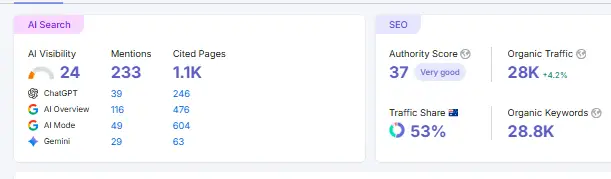
We helped one of our clients improve their visibility in AI-generated search results. Although they had quality content and steady organic traffic, their brand was rarely cited by AI platforms. This limited their exposure, authority, and ability to compete with more visible competitors in AI search.
We focused on strengthening topical authority, improving content quality, optimizing internal linking, and ensuring AI crawlers could access important pages. Our team also identified citation gaps, targeted trusted industry sources, enhanced entity signals, and continuously monitored AI visibility to improve citation opportunities across multiple AI platforms.
Results achieved
- Achieved a 24 AI visibility score across leading AI search platforms.
- Increased total brand mentions to 233 AI-generated references.
- Earned more than 1.1K cited pages across monitored AI engines.
- Secured 116 citations from Google AI Overviews alone.
- Generated 604 cited pages through Google AI Mode visibility.
- Maintained 28K organic traffic while expanding AI search presence.
Enhance your brand visibility in AI search with SEO Discovery
As AI search continues to evolve, citation analysis is becoming an essential part of a successful SEO strategy. The right tools and processes help businesses track citations, uncover visibility gaps, measure competitor performance, and improve their chances of being referenced by AI search engines. Brands that prioritize citation optimization are better positioned to build authority, trust, and long-term AI visibility.
SEO Discovery helps businesses improve AI search performance through strategic AI SEO, technical optimization, content creation, citation tracking, and competitive analysis. Our team focuses on strengthening your presence across AI-powered search platforms, helping your brand earn more citations, establish greater authority, and attract qualified customers through sustainable growth.
Contact us today to strengthen your AI search presence and maximize citation visibility.
Want Higher AI Visibility?
SEO Discovery strengthens authority across AI search engines.
FAQs about citation analysis
Citation analysis for AI SEO tracks which URLs and domains AI engines reference when generating answers. It helps brands identify visibility gaps and improve their presence across ChatGPT, Perplexity, and Google AI Overviews. This type of AI citation analysis helps businesses understand their visibility in AI-generated search results.
Backlink analysis tracks links between webpages for Google ranking signals. AI citation analysis monitors which sources answer engines actively pull from when generating responses. These are two completely different signals that require separate optimization strategies.
Co-citation analysis examines which sources AI models cite together within the same response. Appearing consistently alongside authoritative sources can strengthen entity authority and improve your chances of earning future citations. This is the foundation of co-citation analysis in AI search.
Yes. AI models evaluate entity authority, source trust, and relevance rather than relying solely on keyword rankings. A page ranking lower on Google can still receive more AI citations than a top-ranking page.
To perform citation analysis, create a list of relevant prompts and test them across AI platforms like ChatGPT, Perplexity, and Google AI Overviews. Track cited sources, identify visibility gaps, compare competitor citations, and optimize content to improve your chances of earning future AI citations.
LLMrefs and SE Ranking offer affordable options for smaller teams that need citation tracking and visibility monitoring. Businesses seeking a hands-off approach may also benefit from managed AI SEO services that include citation analysis and optimization. Both platforms are considered among the best AI citation analysis software options for smaller organizations.
Running citation analysis at least twice per month is recommended. AI citation patterns can change quickly as models update and competitors publish new content, making regular monitoring essential.
A citation occurs when an AI engine references your website as a source. A recommendation happens when the AI actively suggests your product or service as a solution. Citations build authority, while recommendations often contribute directly to conversions.
Ahrefs provides AI citation tracking through its Brand Radar tool, which monitors domain-level and URL-level citations across selected AI platforms. Access to broader AI visibility features may require higher-tier subscription plans. These Ahrefs AI citation analysis features help businesses monitor their AI search presence.
SE Ranking and Profound are popular options for agencies managing multiple client accounts. They offer scalable reporting, competitor tracking, and citation monitoring features that support larger AI SEO campaigns. They are widely recognized as citation analysis services for AI SEO at scale.