


Objective
This blog highlights what is a content roadmap, its key elements, the step-by-step creation process, useful tools, AI search strategies, and common mistakes to avoid.
- A content roadmap turns strategy into structured actions, timelines, and measurable objectives.
- Clear goals and KPIs help measure content performance and business outcomes.
- Audience research keeps content relevant, useful, and valuable for readers.
- Content pillars organize topics and strengthen search visibility over time.
- Suitable formats and channels help content reach the right audience.
- Clear ownership and timelines keep content projects organized and accountable.
- Frequent updates contribute to better successful content and changing needs.
Get Expert Content Marketing Support from SEO Discovery at just $250/month
Table Of Contents
- What is a content marketing roadmap?
- Why you need a content marketing roadmap
- Key elements of a content marketing roadmap
- How to build a content marketing roadmap (step-by-step)
- What tools can help you create a content marketing roadmap?
- How do you build a content roadmap for AI and search visibility?
- Common mistakes to avoid in a content marketing roadmap
- How SEO Discovery helped a client turn around their content performance
- Turn your content plan into growth with SEO Discovery
- FAQs about content roadmap
A content roadmap is a simple plan that turns a content strategy into a clear timeline. It shows what content to create, publish, and share, along with key milestones. It connects the overall strategy with daily content work and helps teams organize important content tasks before setting specific publishing dates.
Did You Know?
Google says SEO works best when your content roadmap prioritizes helpful, people-first content rather than content created mainly for rankings.
To create a content roadmap, start by setting clear goals and understanding your audience. Then, identify content topics, choose suitable formats and channels, set priorities, and timelines, assign responsibilities, and decide how results will be measured. This gives the team a clear direction and makes content planning easier.
In this guide, we will explain what is a content roadmap, the key elements, easy steps to build one, useful tools, and mistakes to avoid. Keep reading till the end.
What is a content marketing roadmap?
A content roadmap is a simple plan. It outlines what content you’ll create, when you’ll publish it, and how it serves your business goals, such as improving visibility or helping with reputation management.
A roadmap is not a replacement for your content calendar or strategy. Rather, it connects them. Your strategy provides a direction. Your roadmap converts direction into actual steps. Your calendar takes care of the daily content work. Here’s how they differ:
Element | Content Strategy | Content Roadmap | Content Calendar |
Purpose | Sets direction and goals | Plans steps and timelines | Schedules daily posts |
Timeframe | Long-term (1-3 years) | Mid-term (quarterly/yearly) | Short-term (weekly/monthly) |
Detail level | Big-picture vision | Clear checkpoints | Detailed task list |
Owned by | Leadership/marketing head | Content/marketing manager | Content team/writers |
Why you need a content marketing roadmap
Content without a plan doesn’t usually work. A content marketing roadmap provides a reason for your team behind each piece you publish. Here are a few reasons why a content marketing roadmap can help you make your content marketing even more effective.
- Aligns teams: Everyone knows what needs to be done, when it needs to be done, and what goals they are working toward.
- Links content results: A roadmap connects your content to measurable results, such as more traffic, leads, and sales.
- Improves SEO over time: Providing consistent, useful content increases search visibility and demonstrates how SEO and content marketing work together for sustained growth.
Need a Smarter Content Strategy?
Get expert guidance to plan content that performs.
Key elements of a content marketing roadmap
Knowing the key components of an effective content roadmap will help you develop a clear plan that is consistent with your content goals. Some of the essential components are
- Goals and KPIs: Establish specific goals like increasing traffic to your website, generating more leads, boosting engagement, or improving your search rankings.
- Audience personas: Know your audience, such as what their needs, interests, questions, and problems are.
- Content pillars: Grouping related topics collectively can keep your content organized and can also help enhance your SEO efforts.
- Distribution channels: Decide where you will distribute your content, such as your website, email, social media, or other forms of media.
- Timeline and milestones: Establish deadlines and key checkpoints to move content projects forward and get them done on time.
- Clear ownership: Assign each task to one person so they know which tasks they are responsible for.
- Budget and Resources: Organize the money, tools, writers, designers, and other assets you need to make high-quality content.
- Measure Results: Watch how your content is performing, and if something isn’t giving you the results you want, make changes.
How to build a content marketing roadmap (step-by-step)
Once you are familiar with the key features of a marketing roadmap, building a valuable content roadmap will be less complicated. Follow these simple eight steps.
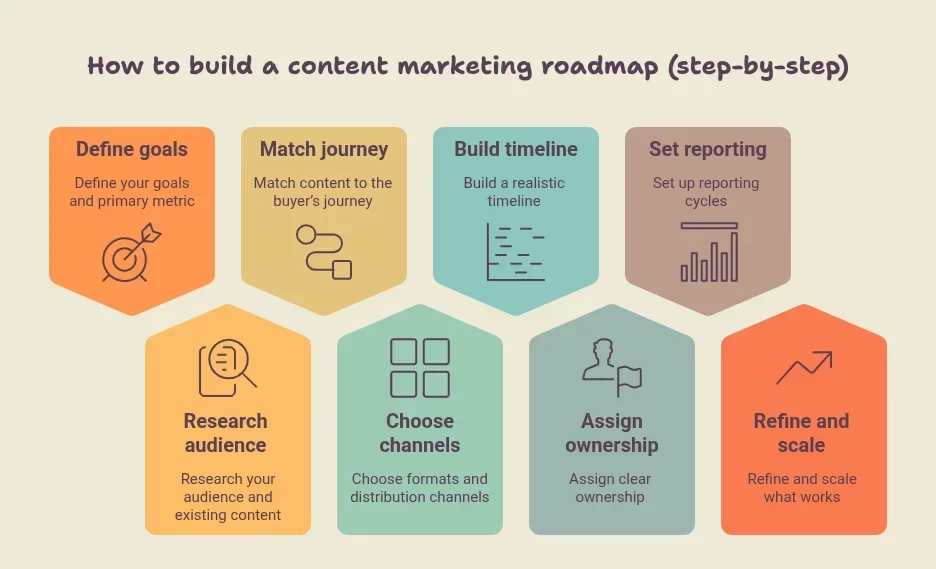
Step 1: Define your goals and primary metric
First, decide what you expect your content to accomplish. Your goal might be to increase traffic to your site, produce more leads, boost your search rankings, or develop brand awareness. Choose one primary metric that aligns with your goal. This gives you a simple way to assess if your content is going in the right direction.
Pro tip: Choose a realistic goal, such as improving organic traffic by 30% in 6 months. |
Step 2: Research your audience and existing content
Before you start creating new content, determine who you want to target along with what you already have. Think about your audience’s needs, questions, interests, and problems. Audit your existing content to identify what’s working, what could be improved, and where you can implement useful content marketing tips.
Pro tip: Start with your best-performing pages. They can tell you what your audience considers useful and what topics deserve more attention. |
Step 3: Match content to the buyer’s journey
Consider what your audience requires at each step of the buying process. Develop useful information for those researching an issue, evaluating options, or ready to choose. One of the key components of an effective content roadmap is mapping content to these stages, as it ensures that your content is relevant and useful.
Pro tip: Tailor your content to each stage so your audience receives relevant information at the right time. |
Step 4: Choose formats and distribution channels
Find the content formats that are best for your audience and goals. You could use blog posts, videos, case studies, guides, or social media posts. Then select the appropriate channels for sharing, such as your website, email, search engines, or social media.
Pro tip: Pair each content format with the channel where it’s most likely to find your target audience. |
Step 5: Build a realistic timeline
Create a clear timeline for each responsibility in content creation, such as research, writing, editing, publishing, and advertising. Allocate enough time to each task according to its size and importance. For instance, conversion-focused landing pages might need more time to write, design, review, and test before they can be published.
Pro tip: Leave some extra time between tasks to handle revisions or unexpected delays without affecting your schedule. |
Step 6: Assign clear ownership
Decide who will be responsible for each content activity, like research, writing, editing, design, publishing, and promotion. A clear content roadmap makes it easier to manage responsibilities and helps every person know what they are supposed to do. This reduces confusion and missed deadlines.
Pro tip: Assign one person to oversee each major content project and keep the work moving. |
Step 7: Set up reporting cycles
Choose how often to review your content results. Examine important metrics like traffic, ranking, leads, and engagement to determine what is working. Regular reporting enables you to identify problems early, refine your plan, and make better decisions about your content.
Pro tip: Review your results every month and focus on the numbers that directly support your main content goals. |
Step 8: Refine and scale what works
Review your content results and focus more on what performs well. Update weak content, repeat successful topics, and adjust your approach when needed. Your content marketing roadmap should grow and change as you learn what works best for your audience and business.
Pro tip: Double down on content that brings steady traffic, leads, or engagement instead of starting from scratch every time. |
Need a Clear Content Roadmap?
We help you plan, organize, and manage content effectively.
What tools can help you create a content marketing roadmap?
You don’t need costly software to build a content roadmap. Most teams will do well with a simple spreadsheet or task board. Here’s a table of some simple tools and templates you can utilize to organize and oversee your content.
Format | Best For | Key Benefit |
Timeline view | Seeing quarterly milestones | Shows progress at a glance |
Kanban board | Tracking daily task status | Keeps teams accountable in real time |
Swimlane chart | Managing multiple content types | Separates work by team or format |
Spreadsheet | Small teams and solo marketers | Free, flexible, and easy to update |
How do you build a content roadmap for AI and search visibility?
The way people search is changing rapidly. AI Overviews and answer engines now shape how people seek information online. Your content roadmap needs to be prepared for these modifications and make your content easy for search engines and AI tools to recognize, find, and use.
- Build topic clusters: Group related content around main topics and connect it to pillar pages. This helps show your knowledge and build stronger topic coverage.
- Answer questions directly: Give clear answers to common questions early in each section. This makes your content easier for readers and AI tools to understand.
- Use structured formatting: Use clear headings, bullet points, tables, and short paragraphs. Simple formatting helps search engines and AI tools find important information quickly.
- Keep content fresh: Review and update important pages regularly. Add new information, remove outdated details, and make sure your content stays accurate and useful.
“Keep your content roadmap flexible. Review search trends, audience needs, and performance regularly to update priorities and create content that remains relevant across search and AI platforms.”
Shweta Gupta, Content Marketing Specialist, SEO Discovery
Common mistakes to avoid in a content marketing roadmap
Even the best teams make basic errors when planning their content. Here are a few common mistakes to avoid when building a content marketing roadmap:
Skip clear goals: Without a clear target, it becomes difficult to know what your content should achieve or how to measure success.
Ignore distribution: Even great content may not perform if you do not share it on the right channels.
- Lack of one owner: When everyone is responsible for a task, it can become unclear who should actually get it done.
Never update plans: Your audience and business needs can change, so an old roadmap may stop being useful.
Overload your timeline: Trying to do too much at once can put pressure on your team and lead to missed deadlines.
How SEO Discovery helped a client turn around their content performance
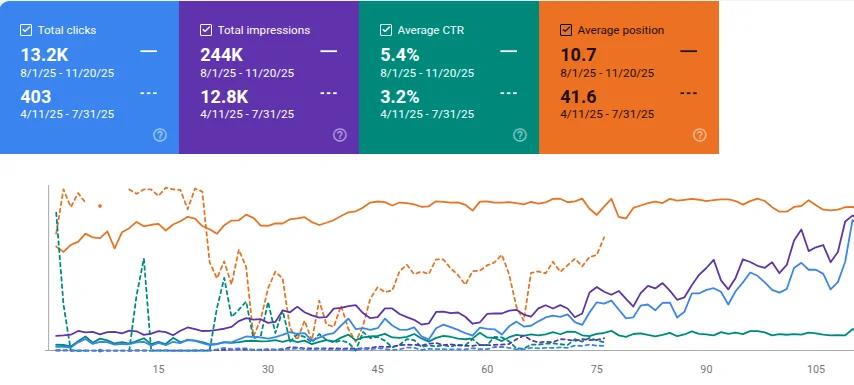
One of our clients was struggling with a lack of search visibility. Their website was not ranking well, had extremely low click-through rates, and had no organic traffic. The average position was below page 4, and impressions barely reached a few thousand each month, limiting real business growth.
We built a full content marketing roadmap based on topic clusters and search intent. We modified existing content, filled in technical SEO gaps, and published new keyword-targeted pages regularly. We also optimized meta titles and descriptions to increase click-through rates on every ranking page.
Results within a few months:
- Total clicks jumped from 403 to over 13,200 clicks.
- Impressions grew from 12.8K to nearly 244,000 total.
- Average CTR improved from 3.2% to 5.4%.
- Average position climbed from 41.6 to 10.7 overall.
Turn your content plan into growth with SEO Discovery
A well-planned content roadmap turns your content strategy into actionable steps. Every step, from setting goals and knowing your audience to choosing channels, delegating tasks, monitoring results, and adjusting your plan, helps your team create useful content that generates traffic, leads, visibility, and business growth.
SEO Discovery helps businesses grow with content through strategic planning, SEO, content, and digital marketing expertise. Our SEO consultancy, with experienced professionals and a results-oriented approach, helps companies boost their search visibility, target the right audience, and establish a stronger online presence through effective content methods.
Turn your content strategy into measurable results with SEO Discovery and start planning smarter content today.
Ready to Grow With SEO Discovery?
Get tailored content and SEO strategies for stronger online growth.
FAQs about content roadmap
A content roadmap is a plan that outlines what content to create, when to publish it, who handles each task, and how it supports business goals. It helps teams organize topics, timelines, channels, responsibilities, and performance tracking in one clear plan.
Start by setting clear goals and understanding your audience. Identify important topics, organize them into content pillars, choose suitable formats and channels, set realistic timelines, assign responsibilities, and review performance regularly. Update the plan as business goals, trends, and audience needs change.
Connect content plans with product launches, customer needs, and marketing priorities. Create useful content such as guides, comparisons, case studies, and product-focused resources around important milestones. This keeps content relevant while supporting product awareness, consideration, and conversions throughout the buyer journey.
Analyze competitor topics, formats, rankings, and content gaps to identify opportunities. Use these findings to create more useful and original content instead of copying competitors. Competitor research can help prioritize topics, improve content quality, and address questions that existing content does not answer well.
SEO Discovery helps businesses develop content strategies that support search visibility, audience engagement, and business growth. Its team combines SEO, content, and digital marketing expertise to create practical strategies focused on attracting the right audience and generating measurable results.
The key components of an effective content roadmap include goals, KPIs, audience personas, content pillars, distribution channels, timelines, ownership, resources, and reporting. These elements help teams organize their work, maintain consistency, track progress, and improve content based on performance.
Teams can use spreadsheets, project management tools, Kanban boards, and timeline templates to create and manage a roadmap. The right option depends on team size and workflow. Simple tools can be effective for organizing topics, deadlines, responsibilities, milestones, and content status.
A content roadmap can improve visibility by helping teams consistently create useful, well-structured, and relevant content. Planning topic clusters, answering audience questions, using clear formatting, adding internal links, and updating older content can support both search engine and AI search visibility.