


Objective
This guide explains what a content roadmap is, how it differs from a content strategy, content plan and editorial calendar, what it should include, and how to build one step by step. It also includes a filled-in quarterly template and shows how to plan content for AI search in 2026.
- A content roadmap is a time-bound, high-level plan that sequences content initiatives against business goals. It sits between your content strategy and your editorial calendar.
- Strategy answers why and for whom, the roadmap answers what and in what order, and the calendar answers when, where and who.
- Every good roadmap includes goals and KPIs, a timeline with milestones, audiences, pillars, formats, owners, capacity and a review cadence.
- Only 12% of B2B marketers rate their marketing as highly effective, according to CMI, which makes prioritisation the roadmap’s most important job.
- AI search changes the roadmap: plan by topic cluster, invest in original data, and track AI citations alongside rankings.
- Review KPIs monthly, adjust the roadmap quarterly and rebuild it once a year.
What is a content roadmap? A content roadmap is a time-bound, high-level plan that shows what content you will create, for whom, in what order and why, and how each initiative supports your business goals. It turns your content strategy into a prioritised sequence of work and feeds your day-to-day editorial calendar.
Teams often confuse roadmaps with strategies, plans and calendars, and many roadmaps fail because they try to do everything at once. This guide clears up the terms, lists what a roadmap should include, and walks through a 10-step process with a template you can copy. If you are new to the wider topic, see how SEO and content marketing work together.
Did You Know?
Only 12% of B2B marketers rate their marketing as highly effective, even though 88% use AI content tools. Source: Content Marketing Institute
More content is not the answer. A roadmap helps you choose fewer, better pieces that move your goals, and decide what not to make.
Need a Content Roadmap That Drives Traffic and Leads? Talk to SEO Discovery’s Content Strategists
Table Of Contents
- What is a content roadmap?
- Content roadmap vs content strategy vs content plan vs editorial calendar
- Why you need a content roadmap
- Key components of a content roadmap
- How to create a content roadmap in 10 steps
- Content roadmap template (with a filled-in example)
- Content roadmap formats and when to use each
- Best tools for building a content roadmap
- How to plan a content roadmap for AI search
- How to measure a content roadmap
- Common content roadmap mistakes
- Case study: how a content roadmap turned results around
- Turn your content plan into growth with SEO Discovery
- FAQs about content roadmaps
What is a content roadmap?
A content roadmap is a time-bound, high-level plan that sequences your content initiatives (what you will create, for whom, why and roughly when) against business goals. It usually covers a quarter to a year and sits between your content strategy and your editorial calendar.
You will see two definitions in use, and knowing both prevents confusion:
- The strategic roadmap: a quarter-by-quarter plan of themes, pillars and initiatives tied to goals. Stackmatix describes it as the plan that defines what content you will create, for whom and why, leaving publish dates to the calendar.
- The project roadmap: a dated production plan with milestones, dependencies and owners. CoSchedule describes it as breaking a campaign into step-by-step timelines.
Most teams get the best results by keeping the roadmap strategic and pushing day-level dates and assignments into the editorial calendar. That is the definition this guide uses.
“If your content calendar is full but results are flat, you probably have a calendar without a roadmap. The roadmap is where you decide which topics matter this quarter, and which good ideas wait.”
Content roadmap vs content strategy vs content plan vs editorial calendar
These terms overlap, and sources use them differently. This working hierarchy keeps them clear:
| Layer | Question it answers | Time horizon | What it contains | Typical owner |
|---|---|---|---|---|
| Content strategy | Why, and for whom? | A year or more | Business goals, audiences, positioning, content pillars | Leadership, head of content |
| Content roadmap | What will we build, in what order, and why? | A quarter to a year | Prioritised initiatives and themes with goals and KPIs | Content lead with stakeholders |
| Content plan | How will we execute? | A quarter to a year (often merged with the roadmap) | Channels, budget, team and resources | Marketing managers |
| Editorial calendar | When, where and who? | Days to weeks | Dated pieces with owners and status | Writers, editors, producers |
Put simply: strategy comes first, the roadmap turns it into a sequence of initiatives, and the calendar schedules the individual pieces. A roadmap without a strategy is a list of ideas, and a calendar without a roadmap is busywork.
Why you need a content roadmap
Most teams already produce plenty of content. The problem is impact. In CMI’s B2B research for 2027, only 12% of marketers rated their marketing as highly effective, and those who succeeded credited relevance and quality (47%) and team skills (43%) far more than AI tools (14%). HubSpot’s 2026 State of Marketing found 83.5% of marketers expect to produce more content, while measuring ROI is their top challenge (33%).
- Focus: it ties every piece to a goal, so you stop producing content that nobody needs.
- Alignment: sales, product and leadership can see what is coming and why.
- Capacity planning: it shows whether your team can actually deliver what is planned.
- Better SEO and AI visibility: planned topic clusters build authority faster than random posts. See how to improve SEO visibility.
- Measurable results: clear KPIs make it easier to prove what worked.
Key components of a content roadmap
| Component | What to include |
|---|---|
| Goals and KPIs | One primary goal per quarter, such as leads or organic sign-ups, with a measurable target |
| Audience and funnel stage | Which persona each initiative serves and whether it is awareness, consideration or decision content |
| Content pillars | 3 to 5 core themes your brand wants to own |
| Initiatives and formats | Pillar pages, clusters, guides, videos, case studies, original research |
| Channels | Website, email, social, partners and paid amplification |
| Timeline and milestones | A quarterly or monthly sequence with key launch dates |
| Owners and capacity | Who leads each initiative and how much team time it needs |
| Budget | Writers, design, video, tools and promotion |
| Dependencies | Product launches, events, seasonal peaks and approvals |
| Review cadence | When you check KPIs and adjust priorities |
Every source we reviewed lists goals and a timeline, but few mention budget or dependencies. Including them is what makes a roadmap realistic.
How to create a content roadmap in 10 steps
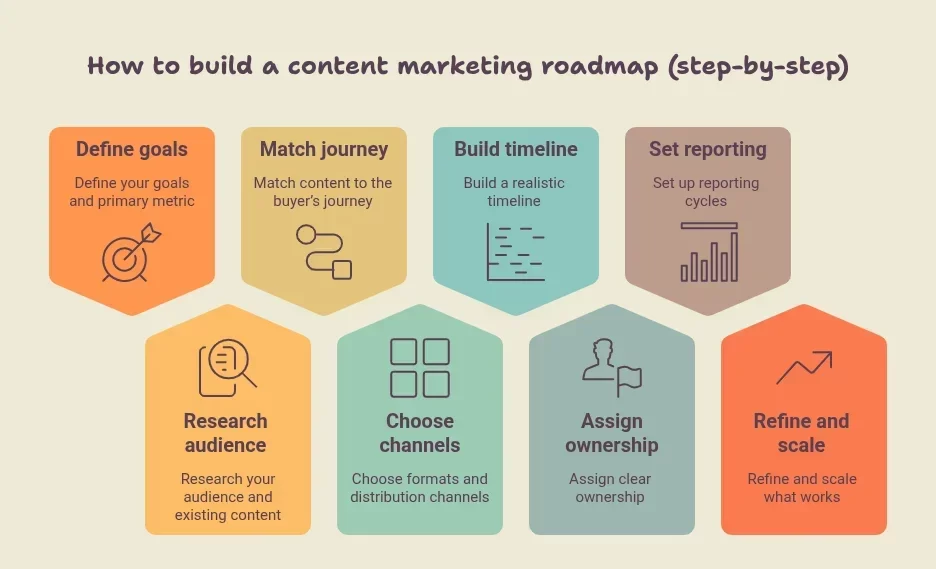
1. Set goals and one primary metric
Start from business goals, not content ideas. Pick one primary metric per quarter, such as demo requests or organic sign-ups, and two or three supporting metrics.
2. Define your audience and funnel stages
Document who you are trying to reach, the problems they have, and the questions they ask at each stage of the buying journey.
3. Audit your existing content
List what you already have and decide for each page whether to keep, update, consolidate or remove it. Updating strong pages is often faster than writing new ones.
What to do: Export your top 50 pages from Google Search Console and flag any that lost clicks over the last six months.
4. Research topics and keywords
Use keyword research, customer questions, sales calls and competitor gaps to build a long list of topics.
5. Group topics into pillars and clusters
Organise topics into 3 to 5 pillars, each with supporting cluster articles that answer related questions. This structure helps both Google and AI tools see your authority on a topic.
6. Prioritise with a simple scoring model
Ahrefs scores topics on traffic potential, business potential and ranking potential. Score each topic from 1 to 3 on all three and start with the highest totals. Frameworks such as ICE or RICE, adapted from product management, also work.
7. Plan capacity and budget
Estimate the hours each initiative needs and compare it with your team’s real capacity. Reserve part of your capacity for refreshing existing content, not just new pieces. Stackmatix, for example, suggests a split such as 50% new content, 20% experiments and 30% refreshes.
What to do: Ask each contributor how long their step takes instead of assuming. Assumed timelines are the most common reason roadmaps slip.
8. Sequence initiatives and map dependencies
Place initiatives in the order that supports your goals, launches and seasonal peaks. Note which items depend on design, product or legal approval.
9. Hand off to the editorial calendar
Break each initiative into individual pieces with dates, owners and status in your editorial calendar. HubSpot recommends planning the calendar at least four to six weeks ahead.
10. Measure, review and adjust
Review KPIs monthly, adjust priorities quarterly and rebuild the roadmap once a year, as HubSpot recommends. Keep a “parking lot” of good ideas you chose not to do yet.
Need a Clear Content Roadmap?
Our strategists build prioritised roadmaps around your goals, audience and search data.
Content roadmap template (with a filled-in example)
Copy this structure into a spreadsheet, Notion or your project tool. Here is an example quarter for a B2B software company whose goal is more demo requests from organic search.
| Initiative | Pillar | Audience and stage | Format | Goal and KPI | Owner | Month | Priority score |
|---|---|---|---|---|---|---|---|
| Pillar page: complete guide to the core topic | Pillar 1 | Managers, awareness | Long-form guide | Rank top 10; 500 organic visits/month | Content lead | Month 1 | 9/9 |
| 5 cluster articles answering top questions | Pillar 1 | Managers, consideration | Blog posts | Internal clicks to pillar; 2% to demo page | Writer A | Months 1 to 2 | 8/9 |
| Original survey report | Pillar 2 | Leaders, awareness | Research report | Earn 15 referring domains; AI citations | Head of content | Months 2 to 3 | 8/9 |
| Refresh 10 declining posts | All | Mixed | Updates | Recover lost clicks | Writer B | Ongoing | 7/9 |
| Customer case study | Pillar 1 | Buyers, decision | Case study | Demo requests from page | Product marketing | Month 3 | 7/9 |
Parking lot: podcast series, glossary hub, webinar programme. These are good ideas held back until capacity allows.
Content roadmap formats and when to use each
| Format | Best for |
|---|---|
| Theme or pillar-based (quarterly) | Most teams; one pillar focus per quarter, as HubSpot suggests |
| Now / Next / Later | Sharing priorities with leadership when dates are uncertain |
| Timeline or Gantt | Launches with hard dates and dependencies |
| Swimlane | Showing work by team, channel or pillar |
| Kanban board | Tracking production status day to day |
| Spreadsheet | Small teams starting out, though harder to collaborate on |
Aha! notes that Now/Next/Later roadmaps work well for shifting priorities but can turn into wish lists if items are never scored. See Aha!’s guide.
Best tools for building a content roadmap
| Tool | Type | Best for |
|---|---|---|
| Google Sheets or Excel | Spreadsheet | Simple roadmaps and templates for small teams |
| Notion or Airtable | Database | Flexible roadmaps linked to briefs and calendars |
| Asana, Trello, monday.com or ClickUp | Work management | Timelines, kanban boards, owners and dependencies |
| CoSchedule | Marketing calendar | Connecting the roadmap to a publishing calendar |
| HubSpot Content Hub | CMS and CRM | Tying content to leads and revenue |
| Semrush or Ahrefs | SEO research | Keyword, topic and competitor gap research |
| Google Search Console | Free analytics | Queries, clicks and refresh opportunities |
Most of these tools have free or low-cost entry plans, but pricing changes often, so check each vendor’s current plans. For more options, see our guide to the best SEO tools.
How to plan a content roadmap for AI search
AI search now shapes how people find content. Google says AI Mode has passed one billion monthly users, with queries about three times longer than traditional searches. Pew Research found people clicked a result in 8% of visits with an AI summary, versus 15% without one. Seer Interactive saw organic click-through fall 61% on queries with AI Overviews, but brands cited in those Overviews earned 35% more organic clicks.
Google’s own guide to generative AI features says optimising for AI is still SEO, and names unique, first-hand content as the most important long-term factor. Build that into your roadmap:
- Plan by topic cluster, not single keywords. AI answers break one question into several related searches, so cover the follow-up questions too.
- Schedule original data, such as surveys or benchmarks. CMI found 27% of B2B marketers cite original research as a trust builder.
- Reserve capacity for refreshes, so key pages stay accurate and current.
- Write clear, answer-first sections for readers, with a direct answer under each question heading.
- Track AI visibility, including AI citations and Search Console’s generative AI reporting.
- Skip the myths. Google says llms.txt files, special AI markup and chunking content for AI are not needed.
Learn more in our guides to ranking in AI Overviews and appearing on Google Search, or explore our answer engine optimization services.
How to measure a content roadmap
A roadmap needs two scorecards. One shows whether you delivered what you planned. The other shows whether it worked. A roadmap can ship everything on time and still fail its goals.
| Scorecard | Metrics | Review |
|---|---|---|
| Delivery | Planned items shipped, time from idea to publish, cost per piece, first-pass approval rate | Monthly |
| Audience and SEO | Organic traffic, rankings, click-through rate, engagement, AI Overview citations | Monthly |
| Business outcomes | Conversions, leads, pipeline and revenue influenced by content | Monthly and quarterly |
Review KPIs monthly, adjust the roadmap quarterly and run a full refresh once a year. Strong internal linking between pillars and clusters helps new pages get found and measured faster.
Common content roadmap mistakes
- Building without a strategy. Without clear goals and audiences, the roadmap becomes a list of ideas.
- Unrealistic timelines. Assumed durations and missing dependencies derail even good plans.
- Treating publishing as distribution. Plan promotion through email, social media and partners, not just publishing.
- Measuring traffic only. Track conversions and pipeline as well as visits.
- Ignoring existing content. Refreshing strong pages often beats writing new ones.
- Chasing volume over relevance. More content does not fix weak strategy. CMI found only 58% of AI content users saw quality improve, even though 87% saw productivity gains.
- Never updating the roadmap. Search, products and priorities change, so review it every quarter.
Case study: how a content roadmap turned results around
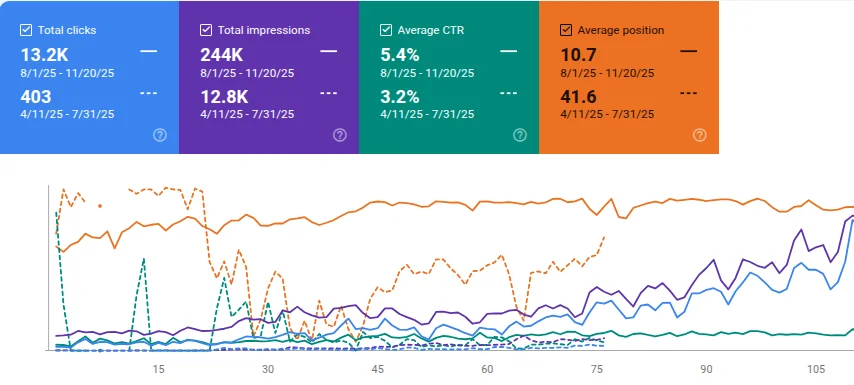
One of our clients was struggling with search visibility. Their website ranked poorly, had a low click-through rate and earned very little organic traffic. Their average position was below page four, and impressions reached only a few thousand a month.
We built a content marketing roadmap based on topic clusters and search intent. We updated existing content, fixed technical SEO gaps, published new keyword-targeted pages on a regular schedule, and rewrote meta titles and descriptions to lift click-through rates.
| Metric | Before | After |
|---|---|---|
| Total clicks | 403 | 13,200+ |
| Impressions | 12.8K | About 244K |
| Average CTR | 3.2% | 5.4% |
| Average position | 41.6 | 10.7 |
Turn Your Content Plan into Growth
Get a prioritised content roadmap built on your search data and goals.
Turn your content plan into growth with SEO Discovery
A well-planned content roadmap turns your content strategy into actionable steps. Every step, from setting goals and knowing your audience to choosing channels, delegating tasks, monitoring results, and adjusting your plan, helps your team create useful content that generates traffic, leads, visibility, and business growth.
SEO Discovery helps businesses grow with content through strategic planning, SEO, content, and digital marketing expertise. Our SEO consultancy, with experienced professionals and a results-oriented approach, helps companies boost their search visibility, target the right audience, and establish a stronger online presence through effective content methods.
Turn your content strategy into measurable results with SEO Discovery and start planning smarter content today.
Ready to Build Your Content Roadmap?
Tell us your goals, and our strategists will show you what to prioritise first.
FAQs about content roadmaps
A content roadmap is a time-bound, high-level plan that shows what content you will create, for whom, in what order and why, and how each initiative supports your business goals. It sits between your content strategy and your editorial calendar.
A roadmap plans initiatives and priorities across quarters, answering what and why. A calendar schedules individual pieces over days or weeks, answering when, where and who.
A content strategy defines your goals, audiences and positioning. The roadmap turns that strategy into a prioritised sequence of content initiatives over a set period.
Goals and KPIs, audiences and funnel stages, content pillars, initiatives and formats, channels, a timeline, owners and capacity, budget, dependencies and a review cadence.
Most roadmaps cover one quarter in detail and the rest of the year at a higher level. Review them quarterly and rebuild them once a year.
Usually the head of content or content marketing lead, with input from SEO, product, sales and leadership.
Three to five pillars is a practical range for most teams. Fewer pillars make it easier to build real authority on each topic.
Score each topic on traffic potential, business value and ranking potential, then start with the highest scores that fit your team’s capacity.
A B2B software company might plan a pillar guide, five cluster articles, an original survey, ten content refreshes and a case study for one quarter, all tied to demo requests.
Spreadsheets, Notion, Airtable, Asana, Trello, monday.com, ClickUp and CoSchedule work well, with Semrush, Ahrefs and Google Search Console for research.
Planning topic clusters, original data and regular refreshes makes your content more complete and trustworthy, which helps it appear in Google AI Overviews and AI assistants.
Yes. A simple one-page roadmap helps small teams focus limited time on the content most likely to bring customers.