

Did your website traffic suddenly drop?
Is your site no longer showing up on Google like it used to?
If so, you might be dealing with a Google penalty. It’s a nightmare for any website owner. One day you’re ranking well, getting steady traffic and leads—and the next, it all disappears. This sudden drop can feel like your online business is falling apart, and it often happens without warning. But don’t panic. There is a way back.
Over 95% of websites that suddenly lose their rankings are hit by a Google penalty—either from an algorithm update or a manual action by Google’s team.
These penalties can happen for many reasons, like low-quality content, spammy backlinks, or breaking Google’s rules. That’s why many businesses turn to the best search engine optimization agency to help diagnose the issue and create a recovery plan.
In this blog, we’ll explain what Google penalties are, how to find out if you’ve been hit, and most importantly—how to recover and get your website back on track.
Table of Contents
- What Is a Google Penalty?
- Why Does Google Penalize Websites?
- How to Check for a Google Penalty
- Common Google Algorithm Updates That Cause Penalties
- Steps for Google Penalty Recovery
- Can Rapid URL Indexer Help With Google Penalty Recovery?
- Hiring a Google Penalty Recovery Consultant
- Choosing the Right Google Penalty Removal Expert
- How to Prevent Future Penalties
- Recover from Google Penalties Fast with SEO Discovery: Your Trusted SEO Optimization Company
- FAQs About Recovering from a Google Penalty
What Is a Google Penalty?
A Google penalty is a consequence imposed on a website for violating Google’s Webmaster Guidelines, which are designed to ensure that websites provide a high-quality, user-friendly experience. When a website is penalized, its visibility in Google search results can be severely impacted, often resulting in a significant drop in rankings. In some extreme cases, the website may even be removed from search results entirely, causing a dramatic loss of organic traffic.
Penalties generally fall into two categories:
1. Manual Penalty:
A manual penalty is imposed by a Google team member (a human reviewer) after they discover that a website is engaging in practices that violate Google’s guidelines. This could include activities like using manipulative link building services, keyword stuffing, or hosting thin or duplicate content. If your site is hit with a manual penalty, you will be notified through the Google Search Console under the Manual Actions section. The notification typically outlines the reason for the penalty, and you will need to address the issues before submitting a reconsideration request to have the penalty lifted.
Signs of a Manual Penalty:
- A sudden drop in traffic that corresponds to a manual action.
- A notification in Google Search Console.
- A specific guideline violation indicated by Google, such as unnatural links or spammy content.
2. Algorithmic Penalty:
An algorithmic penalty is not triggered by a manual review but instead occurs automatically as a result of changes in Google’s algorithms. Updates like Google Panda (which targets low-quality content) and Google Penguin (which targets manipulative link-building practices) can cause an algorithmic penalty. These penalties often result in a gradual decline in rankings, making them harder to identify compared to manual penalties.
Signs of an Algorithmic Penalty:
- A slow, steady decline in search rankings over time.
- Correlation with a major Google algorithm update (you can track updates through SEO news sites or the Google Search Console).
- Changes in traffic patterns that align with algorithmic shifts.
If you’re unsure where to start, working with a trusted digital marketing agency can help you identify the root cause of the penalty and implement effective recovery strategies.
Suspect Your Site Has Been Penalized? Get a Free SEO Audit
Why Does Google Penalize Websites?
Google’s primary goal is to provide the best possible search experience for its users. To achieve this, Google’s search algorithms are designed to prioritize high-quality, relevant, and trustworthy content. Websites that attempt to manipulate search rankings through dishonest or unethical practices are penalized to ensure that search results remain fair, helpful, and valuable.
When a site engages in tactics that violate Google’s Webmaster Guidelines, it risks being penalized, which can result in a significant drop in search rankings or even complete removal from search results.
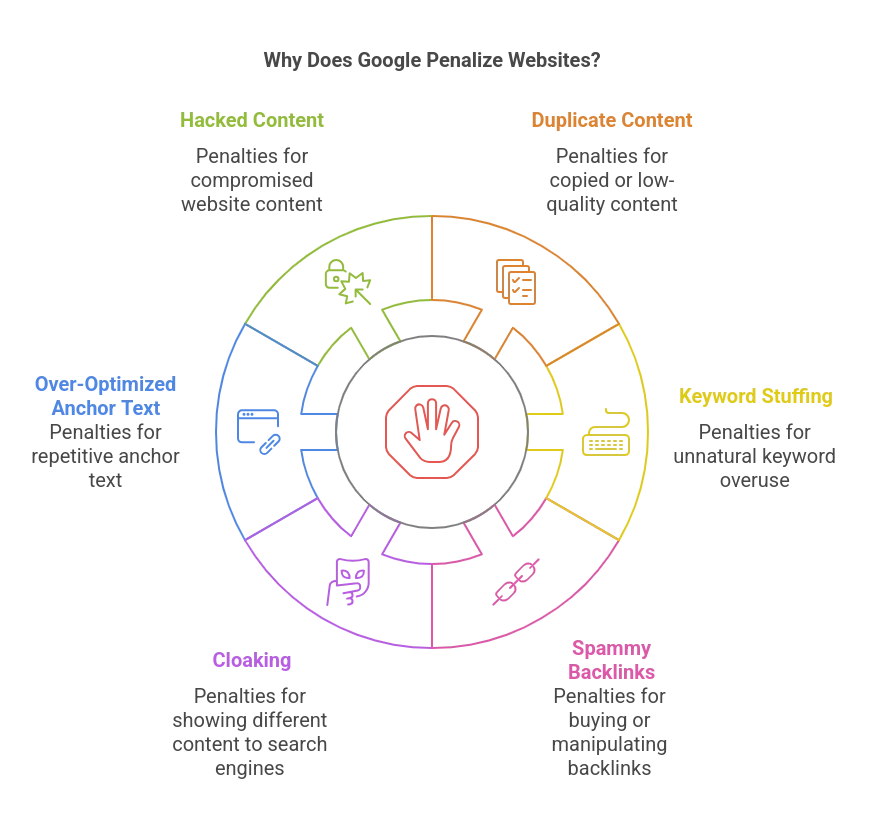
Here are some of the most common reasons why Google might penalize a website:
1. Duplicate or Low-Quality Content
Google values originality and quality in the content it ranks. When a website publishes duplicate content (i.e., content that’s copied from other sources) or thin content (content that provides little value or is poorly written), it harms the user experience. Google penalizes websites that fail to offer unique, well-researched, and high-quality content that satisfies user intent.
If you’re investing in content marketing, ensure that every page on your site delivers unique, relevant insights tailored to your audience.
2. Keyword Stuffing
Keyword stuffing refers to the practice of overloading a webpage with a specific keyword or phrase in an unnatural way in order to manipulate search engine rankings. While keywords are an important part of SEO, Google has become sophisticated enough to recognize when a page is unnaturally stuffed with them.
3. Spammy or Paid Backlinks
Backlinks (links from other websites to yours) are one of the most important ranking factors in Google’s algorithm. However, when a website engages in the practice of buying links, participating in link farms, or manipulating backlinks through spammy techniques, it can trigger a penalty. Google strives to ensure that links are earned naturally based on the quality of the content.
4. Cloaking or Hidden Text
Cloaking involves showing different content to search engines than what is visible to users. This is a deceptive tactic used to improve rankings by hiding content on a page (e.g., using white text on a white background or placing keywords in hidden HTML elements). Google penalizes cloaking because it provides a misleading experience for users.
5. Over-Optimized Anchor Text
Anchor text is the clickable text in a hyperlink. When it is over-optimized (i.e., when the same keyword is repeatedly used in anchor text across numerous backlinks), it can appear manipulative. Overuse of exact match anchor text signals to Google that the link profile may be unnatural or spammy.
To build a natural backlink profile, incorporate a mix of branded terms, generic phrases, and relevant keywords, combined with on page optimisation for a balanced SEO strategy
6. Hacked Content
If a website is compromised and its content is altered without the site owner’s knowledge (often to include spam or malware), Google will penalize the website. Hacked content can often be difficult to detect, but Google treats it as a violation of its guidelines because it can harm users who visit the site and may distribute malicious content.
If you’ve experienced a sudden drop in rankings and suspect your site has been compromised, it’s essential to hire an SEO specialist to perform a technical audit and implement recovery measures.
Avoid Penalties Before They Happen. Our SEO Experts Can Help You Stay Compliant.
How to Check Google Penalty
Before you can start working on recovering from a Google penalty, it’s essential to first identify whether your site has been penalized and understand the type of penalty. Penalties can affect a website in different ways, and pinpointing the cause of the issue is a crucial first step toward resolution.
Steps to Check for a Google Penalty:
1. Check Google Search Console:
One of the first places to check is Google Search Console (GSC). If your site has been hit with a manual penalty, Google will notify you in the Manual Actions section.
- Where to find it: Go to Search Console > Security & Manual Actions > Manual Actions.
- What to look for: If there’s an issue, Google will list the reason for the penalty (e.g., “unnatural links to your site,” “thin content,” etc.). Google provides details on what went wrong and what you need to fix. If there’s no notification, you likely haven’t received a manual penalty.
Why this is important:
Manual penalties are actionable—you can directly fix the problem and submit a reconsideration request after addressing the issue. Many times, issues arise due to tactics like over-optimized anchor text or irrelevant SEO Guest Posting Services, which need immediate cleanup.
2. Analyze Traffic with Analytics Tools:
Another sign of a penalty is a sudden drop in traffic. If you notice a significant decline in your website’s organic traffic, it could indicate that your site has been hit by an algorithmic penalty rather than a manual one. These penalties don’t come with notifications, so tracking your traffic closely is vital.
- Use Google Analytics: Look for sudden drops or patterns that coincide with Google algorithm updates.
- Compare with known algorithm updates: After noticing a traffic drop, check if it coincides with Google’s algorithm updates (like Panda, Penguin, or core updates).
Why this is important:
A traffic drop without a manual penalty notification could point to an algorithmic issue. Knowing the timeline of your traffic drop can help you pinpoint whether a recent Google algorithm update may have impacted your site.
3. Use Penalty Checker Tools:
Several penalty checker tools can help you confirm whether your traffic drop aligns with a specific algorithm update. These tools are particularly useful for detecting algorithmic penalties.
- Panguin Tool: This tool overlays your website’s traffic data with a timeline of Google updates, helping you match traffic drops with algorithmic changes.
- SEMrush (or other SEO tools): SEMrush offers a penalty checker that correlates your site’s traffic changes with algorithm updates.
Why this is important:
These tools can provide additional clarity, especially when my website ranking dropped suddenly and you’re unsure if it was due to a penalty or a natural fluctuation.
4. Consult a Google Penalty Expert:
If you’ve gone through the above steps and still can’t identify the cause of the issue, or if you’re struggling to interpret the data, it may be time to consult a Google penalty expert. These professionals specialize in diagnosing penalties, identifying the cause, and helping websites recover.
Why it’s useful:
A penalty expert can help you analyze your backlink profile, content quality, on-page SEO, and other factors that might have triggered the penalty. They can also assist in fixing the problem and guiding you through the reconsideration process.
Don’t Navigate Penalty Recovery Alone. Let Our 22+ Years of Experience Guide You.
Common Google Algorithm Updates That Cause Penalties
Google’s algorithms are constantly evolving to provide users with the most relevant, high-quality content. As part of these updates, Google targets websites that violate their quality guidelines or attempt to manipulate rankings through unnatural tactics. Some of the most significant updates have had a direct impact on rankings, with websites suffering penalties for not adhering to Google’s best practices. Here’s an overview of some of the most notable Google algorithm updates that could cause penalties:
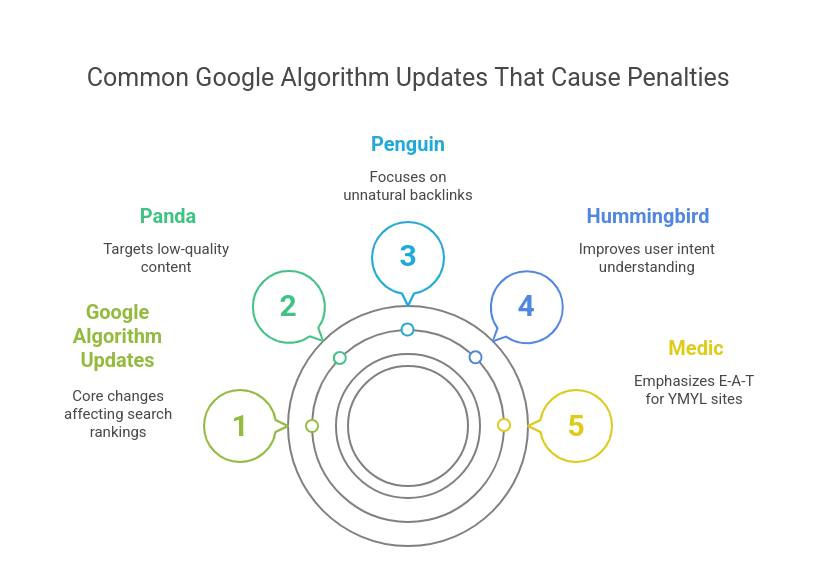
1. Google Panda
Focus: Low-Quality or Thin Content
Launched: February 2011
What it targets: Google Panda was designed to address the issue of low-quality content in search results. It particularly targets websites with thin content (content that provides little value), duplicate content, or poorly written pages that don’t meet the needs of users. The update aims to reward websites that offer original, valuable, and user-focused content.
How to Recover:
- Focus on creating high-quality, informative, and original content. If you’re targeting a local audience, combining this strategy with local SEO services can improve both relevance and visibility in regional search results.
- Remove or improve thin content pages and fix any duplicate issues across the site.
2. Google Penguin
Focus: Unnatural Backlinks
Launched: April 2012
What it targets: Penguin specifically focuses on unnatural or manipulative link-building practices. Websites that had engaged in black-hat SEO tactics, like purchasing backlinks, participating in link schemes, or using link farms, were particularly vulnerable to penalties. Penguin also penalized sites with over-optimized anchor text.
How to Recover:
- Disavow bad backlinks using Google’s disavow tool.
- Focus on earning natural, high-quality backlinks from authoritative and relevant sources.
- Diversify anchor text to make your link profile appear more organic.
3. Google Hummingbird
Focus: User Intent and Relevance
Launched: August 2013
What it targets: Google Hummingbird was a major overhaul in Google’s search algorithm, designed to improve the way Google understands user intent and delivers relevant search results. Unlike previous updates, Hummingbird wasn’t specifically aimed at penalizing websites. Instead, it changed how search queries were interpreted, focusing on delivering contextual relevance over simple keyword matching.
How to Recover:
- Shift your focus to topic-based content and semantic search by understanding the context and intent behind search queries.
- Optimize your site for natural language and provide thorough, relevant content that answers user questions comprehensively.
4. Google Medic
Focus: YMYL (Your Money or Your Life) Sites
Launched: August 2018
What it targets: The Google Medic Update primarily affected YMYL (Your Money or Your Life) websites, which are sites that deal with topics related to health, finances, and other critical subjects that can significantly impact a person’s well-being. Google began to place greater emphasis on E-A-T (Expertise, Authoritativeness, Trustworthiness) for these types of sites. Websites that lacked clear expertise, authority, or trustworthiness in these fields were heavily penalized.
How to Recover:
- Focus on building authority by ensuring content is written or reviewed by credible experts in the field.
- Add clear author bios, link to authoritative sources, and make your site’s trustworthiness clear (e.g., security features, privacy policies).
- Improve overall site quality by ensuring it meets E-A-T standards.
5. Helpful Content Update
Focus: Content Written for Users vs. Search Engines
Launched: August 2022
What it targets: The Helpful Content Update was introduced to target websites that publish content primarily for ranking purposes rather than to genuinely help users. This update reflects broader SEO trends where Google continues to favor user-first content over keyword-driven content.
How to Recover:
- Focus on creating original, valuable, and user-centered content that addresses the real needs of your audience.
- Remove or improve content that is seen as low-value or keyword-stuffed.
- Engage with your audience by offering solutions and in-depth information, rather than creating content merely for search rankings.
Steps for Google Penalty Recovery
Now that you’ve confirmed a penalty, here are actionable steps for Google penalty recovery:
1. Identify the Cause
Go through your website and backlink profile. Look for thin content, keyword stuffing, duplicate pages, and low-quality backlinks.
2. Fix On-Site Issues
- Improve low-quality content
- Remove duplicate or thin pages
- Enhance user experience and site speed
- Fix mobile usability issues
3. Clean Up Your Backlinks
Use tools like Ahrefs or SEMrush to audit your backlinks. Disavow spammy links and request removal from webmasters if possible.
4. Submit a Reconsideration Request
If it’s a manual penalty, submit a detailed explanation of what was fixed. Include links, screenshots, and timelines.
5. Wait and Monitor
Recovery takes time. Keep monitoring your traffic and keyword rankings. Recovery from algorithm penalties might take longer and usually requires continuous improvements.
Can Rapid URL Indexer Help With Google Penalty Recovery?
Can Rapid URL Indexer help with Google penalty recovery? This is a common question. The answer is: it depends. If the issue lies in unindexed or deindexed pages due to thin content or crawl issues, then tools like Rapid URL Indexer can help by speeding up reindexing.
However, for manual or algorithmic penalties related to spammy practices, simply reindexing URLs won’t be enough. Fixing the root causes is essential.
Hiring a Google Penalty Recovery Consultant
If you’re overwhelmed, a Google penalty recovery consultant can take over the process for you. They understand the latest algorithm changes, know how to analyze backlinks, and can craft a proper reconsideration request.
Benefits of Working with a Google Penalty Expert:
- Deep analysis of site issues
- Access to professional tools
- Tailored recovery strategies
- Ongoing monitoring and support
Many companies offer Google penalty recovery services that include full audits, disavow files, content clean-up, and recovery tracking.
Choosing the Right Google Penalty Removal Expert
Not all consultants are equal. When hiring a Google penalty removal expert, look for these:
- Proven case studies
- Client testimonials
- Transparency in methods
- Up-to-date SEO knowledge
Avoid any consultant who promises quick fixes or guarantees #1 rankings. Google penalty removal consultants should focus on long-term solutions.
How to Prevent Future Penalties
Recovery is great, but prevention is better. Here’s how to keep your site safe:
- Follow Google’s Webmaster Guidelines
- Create valuable, original content
- Build backlinks naturally
- Avoid black-hat SEO tricks
- Keep your website secure and updated
Hiring a Google penalty service can also include preventive SEO audits and strategies.
Recover from Google Penalties Fast with SEO Discovery: Your Trusted SEO Optimization Company
Has your website been hit by a Google penalty? Whether it’s a sudden traffic drop or a sharp decline in rankings, you’re not alone—and you’re not out of options. SEO Discovery, the best search engine optimization company in India, specializes in diagnosing and recovering websites from both manual and algorithmic penalties.
With over 22+ years of SEO experience, we have helped thousands of businesses bounce back stronger after being penalized by Google. Our certified SEO experts use proven, white-hat strategies to restore your rankings, clean up spammy backlinks, improve content quality, and regain your domain’s credibility in the eyes of search engines.
What makes SEO Discovery stand out?
- In-depth Google Penalty Audits
- Expert Manual Action Recovery
- SafeLink Cleanup & Disavow Services
- Algorithm Update Recovery (Panda, Penguin, Helpful Content, and more)
- Transparent Reporting & Ongoing Monitoring
Customized SEO Strategies Aligned with Google’s Guidelines
Still Have Questions? Our SEO Specialists Are Here to Help You Recover Quickly and Effectively.
FAQs About Recovering from a Google Penalty
A Google penalty is a punishment that Google imposes on websites that violate its Webmaster Guidelines. Penalties can result from low-quality content, unnatural backlinks, or other practices that violate Google’s rules, leading to a significant drop in search rankings and organic traffic.
If your website has been penalized, you may notice a sudden drop in traffic or rankings. For manual penalties, you will receive a notification in Google Search Console. For algorithmic penalties, you might see a gradual decline in rankings that coincides with a Google algorithm update. You can also use tools like the Panguin Tool or SEMrush to check for correlation with algorithm updates.
- Duplicate or low-quality content
- Keyword stuffing
- Spammy or paid backlinks
- Cloaking or hidden text
- Over-optimized anchor text
- Hacked content
Manual penalty: Imposed by a Google team member after reviewing your site and identifying violations of Google’s guidelines. You’ll be notified in Google Search Console.
Algorithmic penalty: Happens automatically when Google’s algorithms (like Panda or Penguin) detect violations. There is no direct notification, so you need to track your traffic and correlate drops with algorithm updates.
To recover, you need to:
- Identify the cause of the penalty (manual or algorithmic).
- Fix the issue (e.g., remove bad backlinks, improve content quality).
- If it’s a manual penalty, submit a reconsideration request after fixing the issues.
- If it’s an algorithmic penalty, focus on improving your content, backlinks, and overall SEO to align with Google’s guidelines.
Recovery time varies. For manual penalties, once you fix the issues, you can submit a reconsideration request, and recovery may take a few weeks. Algorithmic penalties can take longer, and your recovery depends on the effectiveness of your efforts and future algorithm updates.