


Objective
This blog explains why SEO for therapists is essential for growing any therapy practice. It also highlights some strategies to attract more patients online across all therapy specialties.
- SEO for therapists generates consistent, high-intent organic traffic to your practice website regardless of your speciality.
- Local SEO helps you appear in Google Maps and local search results where patients are actively looking for help.
- E-E-A-T content builds trust and credibility with both Google and potential patients across all therapy niches.
- Technical SEO and site speed directly impact your search rankings and overall user experience.
- Hiring professional SEO services for therapists saves time and accelerates sustainable practice growth.
Get More Patients with SEO for Therapists by SEO Discovery, starting at $250/month.
Yes, SEO for therapists is absolutely important, and ignoring it means losing potential patients to competitors every single day. If you want to grow your practice, you need to show up where people are searching for help.
Did you know? According to a report by the International Journal for Community Medicine and Public Health, among 400 participants, 78.75% use the internet to obtain health information.
Now, if someone needs help, they pick up their phone and search “therapist near me” or “physical therapist for back pain” or “speech therapist for my child.” If your website does not appear on that first page, you simply do not exist for them.
This guide breaks down why SEO is important for therapy practices of all kinds and exactly how to implement it. So, read until the end!.
Table Of Contents
- Why SEO for Therapists Is No Longer Optional
- Key SEO Strategies Every Therapist Should Implement
- How We Helped a Therapy Practice Grow Its Organic Search Performance
- Why You Should Hire SEO Services for Therapists
- Grow Your Therapy Practice with SEO Discovery!
- FAQs About Is SEO Important for Therapists in 2026
Why SEO for Therapists Is No Longer Optional
Over the past ten years, there has been a significant shift in the healthcare and wellness sector. Before calling, patients in all therapeutic specialties look for providers online. Your next patient is currently looking for you on the web, regardless of whether you work as a physical therapist, occupational therapist, speech therapist, or any other type of counsellor.
The question is whether they can find you. This is where Google SEO for therapists becomes non-negotiable. Your practice remains invisible on the internet without it. With it, you draw in clients who are actively looking for precisely what you provide, right when they need it most.
The Real Cost of Ignoring SEO
- You lose patients to local competitors who invest in therapist SEO services.
- Paid advertisements are a waste of money, whereas organic traffic has no long-term expenditures.
- New patients cannot find you, even when they search your exact speciality
- Compared to competitors, your internet authority and credibility remain low.
- Your practice’s expansion is solely dependent on word-of-mouth, which is unpredictable.
The reality is simple. Is SEO worth it for therapists? Absolutely. A well-optimized website works 24/7 to bring new clients without ongoing ad spend.
Key SEO Strategies Every Therapist Should Implement
Here are the most effective SEO strategies therapists should follow to improve online visibility and attract more patients.
1. Master Local SEO for Therapists to Get Found Nearby
When someone searches for “therapist near me,” Google shows a map pack with three nearby clinics. You want to be one of them. Whether you work as a chiropractor, speech therapist, physical therapist, or any other wellness provider, this holds true.
Here are the essential local SEO strategies for therapists to implement right away:
- Claim and optimize your Google Business Profile: Best GMB services add accurate name, address, phone number, business hours, services, and photos.
- Use location-based keywords: Add phrases like “physical therapist in [City]” or “speech therapist in [Neighborhood]” throughout your website pages.
- Build local citations: List your practice on relevant directories like Healthgrades, Zocdoc, and Yelp with consistent and accurate information.
- Collect and respond to client reviews: Google reviews directly impact your local search ranking and build social trust.Optimize for mobile: The majority of local searches happen on smartphones, so a fast mobile experience is essential.
2. Shift from Keywords to Search Intent
Traditional SEO was about using keywords in each paragraph and hoping for the best. Modern SEO marketing for therapists is about deeply understanding what your ideal patient is actually trying to find when they type into Google.
There are four types of search intent and keywords research strategies you need to understand:
- Informational: The user seeks knowledge or answers to specific health questions to understand their current symptoms, e.g., “What does an occupational therapist do?”
- Navigational: The user is looking for your specific practice or clinic name to find your website, e.g.,” Dr. Sarah Lee’s physical therapy Portland.”
- Commercial: The user is investigating various providers and comparing different therapy options before making a decision, e.g., “best speech therapist for toddlers near me.”
- Transactional: The user is ready to take immediate action, such as scheduling a consultation or booking, e.g., “book a physical therapy appointment online.”
When your content aligns with these intents, it signals Google that your page is precisely what the searcher is looking for. Commercial and transactional intent should be the focus of your service pages. The purpose of your blog posts and educational content should be to provide information.
3. Implement E-E-A-T and Patient-Focused Content
Google uses the E-E-A-T quality structure, which stands for Experience, Expertise, Authoritativeness, and Trustworthiness. This paradigm is essential for all types of therapists. Because they deal with subjects that directly affect people’s well-being, health, and wellness, websites are subject to further scrutiny from Google.
Here is how to demonstrate strong E-E-A-T signals on your therapy website:
- Detailed author and provider bios: Include credentials, certifications, licenses, years of experience, and areas of speciality.
- Educational blog content written by real practitioners: Share genuinely useful information relevant to your speciality and your patients’ concerns.
- Patient testimonials and case outcomes: Real social proof builds credibility and trust with prospective patients.
- Links to authoritative sources: Reference peer-reviewed research, government health bodies, and respected professional associations.
For example: A speech therapist who writes a blog post titled “5 Early Signs Your Child May Benefit from Speech Therapy” establishes credibility, provides a genuine response to a query parents have, and organically draws in relevant traffic.
Is Your Therapy Practice Missing from Search Results?
Improve visibility and attract more therapy clients through smart SEO.
4. Focus on AI Visibility as Part of Modern SEO
Millions of people now use AI-powered platforms like ChatGPT, Google Gemini, and Perplexity to locate health and wellness services. People use these platforms to ask questions like “What should I look for in a speech therapist?” or “Who is a good physical therapist near me?” These AI platforms won’t highlight your practice if your website isn’t organized in an authoritative and transparent manner.
Here is how to optimize your therapy website for AI visibility:
- Use structured data and schema markup on your service pages: Schema markup helps AI tools and search engines understand who you are, what services you offer, and where you practice.
- Add FAQ sections that address the most common patient questions: FAQ content mirrors the conversational queries people type into AI tools, making your site more likely to be cited as a source.
- Write answers in concise, plain-language paragraphs: AI tools favor content that directly answers questions without unnecessary filler.
- Keep your practice name, services, and contact details consistent across every online platform: Consistency across your website, Google Business Profile, directories, and social media signals credibility to both AI tools and search engines.
5. Technical SEO and AI Readiness
If your website is slow, difficult to use, or tough for search engines to crawl, even the most captivating content will perform poorly. Technical SEO services improve your website’s basis so that all other SEO efforts work more effectively.
Key technical areas every therapist’s website should address:
- Page speed: Google’s Core Web Vitals are a confirmed ranking factor. Aim for a load time under 2.5 seconds on all devices.
- Mobile optimization: Over 60% of all searches happen on mobile. Your site must look and perform flawlessly on a small screen.
- HTTPS and SSL security: Google marks non-secure sites as untrustworthy. Clients need to feel safe on your website before they ever contact you.
- Clean site architecture: Use logical URLs, descriptive page titles, breadcrumbs, and smart internal linking to help Google understand and crawl your site efficiently.
- Schema markup: Mark up your business type, location, services, reviews, and FAQ content so search engines and AI tools can read your site accurately.
6. Build Authority and Backlinks
Backlinks are links from other websites that point to your site. They are viewed by Google as indicators of credibility and trust. Your website will appear more authoritative in search results if it receives more high-quality backlinks.
Key link-building opportunities for therapists include:
- Healthcare and therapy directories: Listing your practice in trusted therapy directories helps people find your services while strengthening your website authority.
- Local news and community websites: Many local publications cover mental health topics and wellness resources. Being featured in these outlets can bring both credibility and valuable backlinks.
- Guest articles on wellness blogs: Writing helpful articles for respected health or wellness blogs allows you to share expertise while linking back to your website.
- Partnerships with complementary healthcare providers: Collaborating with professionals such as nutritionists, physiotherapists, or life coaches often leads to natural cross-referrals and backlinks.
Grow Your Therapy Practice with SEO!
Reach more patients online and build a consistently growing therapy practice.
How We Helped a Therapy Practice Grow Its Organic Search Performance
To increase organic visibility and attract more patients, we focused on building a comprehensive SEO foundation for the therapy practice instead of relying solely on paid advertising or word-of-mouth referrals.
Our strategy included thorough keyword research aligned to patient search intent, on-page content improvements, technical SEO fixes, Google Business Profile optimization, and a targeted link-building campaign to build domain authority in the mental health space.
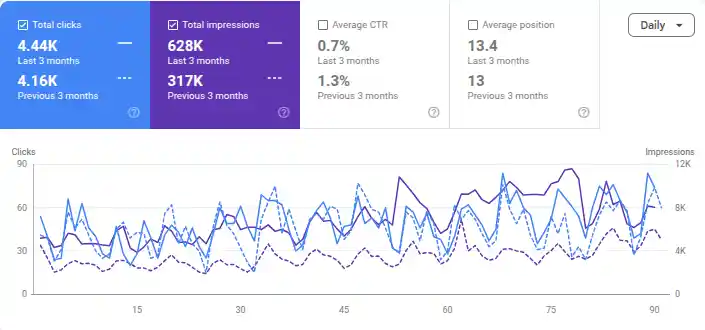
The Results (3-Month SEO Growth)
| Metric | Previous Period | Current Period | Change |
| Total Clicks | 4.16K | 4.44K | +280 clicks (+6.7%) |
| Total Impressions | 317K | 628K | +311K (+97.8%) |
| Average CTR | 1.3% | 0.7% | Normalised across broader keyword set |
| Average Position | 13 | 13.4 | Stable while expanding keyword footprint |
Why You Should Hire SEO Services for Therapists
As a therapist, you devote your knowledge, time, and effort to assisting your patients. It takes hours of constant work each week to research, execute, and manage SEO. That’s precisely why there are SEO services for professional therapists and why so many prosperous clinics depend on them.
Here is what the best SEO services for therapists typically include:
- Increased Visibility to Local Patients: By strategically optimising your practice, you can stand out when locals look for mental health services in your area.
- Attracting the “Right” Patients: Targeted keyword research links patients looking for assistance with those particular issues with your specialised therapeutic knowledge.
- Building Credibility, Authority, and Trust: Reputable backlinks and excellent content position your clinic as a top, trustworthy healthcare resource.
- Saving Time and Reducing Stress: You may focus all of your concentration on patient sessions because experts take care of complicated technological duties.
- Long-Term Growth and Cost-Effectiveness: Without the high recurring expenses of conventional paid advertising, organic search rankings offer long-term patient leads.
Grow Your Therapy Practice with SEO Discovery!
The question is not really whether SEO matters for therapists. It is whether you will be the practice they find. Every therapy service across every speciality is growing. People are actively searching online for therapy providers. Your skills and abilities have the power to truly change lives. But only if you are truly accessible to those in need.
Are you prepared to expand your therapy practice using a proven SEO strategy?SEO Discovery specializes in local SEO services for therapists across every speciality, offering content strategy, technical optimization, and full-scale digital marketing built for healthcare professionals. Visit our website right now, and we’ll help you improve your ranking, draw in more patients, and create a practice that continually expands.
Help Patients Find Your Practice!
Make your therapy services easy to discover through effective SEO.
FAQs About Is SEO Important for Therapists in 2026
Yes. SEO complements referrals by bringing in new patients who search online, expanding your reach beyond personal networks, and increasing consistent practice revenue.
Most therapy practices see meaningful improvements within 3 to 6 months. Local SEO can produce faster results, sometimes within a few weeks of proper setup and optimization.
Local SEO targets patients in your geographic area using maps, local keywords, and GMB optimization. General SEO focuses on broader keyword rankings and wider topic-based or national visibility.
Costs vary from $500 to $3,000 per month, depending on scope, competition level, and the agency. Local SEO packages for individual practices tend to be on the more affordable end.
Basic local SEO tasks can be handled yourself. For faster, more reliable, and more comprehensive results, hiring a professional therapist SEO service is highly recommended.
Speech therapists rely on local searches from parents, caregivers, and patients. SEO helps them appear prominently when people search for pediatric or adult speech therapy services in their area.
Target location-based terms like “therapist in [city]”, speciality-specific terms like “occupational therapist for children”, and intent-driven phrases like “how to find a physical therapist near me.”
Absolutely. Consistent, well-written blog posts targeting real questions in your specialty improve rankings, demonstrate genuine expertise, and attract patients at the research stage of their decision.
Online therapists can target state-wide or national keywords since they are not bound by geography, making strong content strategy and broad topic authority especially important for their growth.
Start with a technical SEO audit and a fully optimized Google Business Profile. These two foundational steps quickly reveal existing problems and establish your local visibility from day one.