

Objective
This blog offers recovery actions for websites that were impacted by Google’s Core Update. You’ll learn how to spot traffic drops, increase your E-E-A-T indicators, improve content, and make your webpages visible in 2026 and beyond.
- Google Core Update in December 2025 hurt the rankings of 40–60% of sites, with affiliate sites being the hardest hit at 71%.
- E-E-A-T no longer deals with YMYL alone, but with any type of content.
- Sites that had LCP greater than 3s lost 23% of the traffic as compared to their competitor who had faster sites.
- Theoretical research is now trumped by first-hand experience.
- One does not have to wait till the next update to recover.
Hit by Google’s Core Update? Recover Your Rankings with SEO Discovery from $250/Month.
If your site suddenly dropped by 40-60% of its traffic in late December, you are not alone, and it was not your fault. However, recovery is surely possible, and some websites are already seeing results.
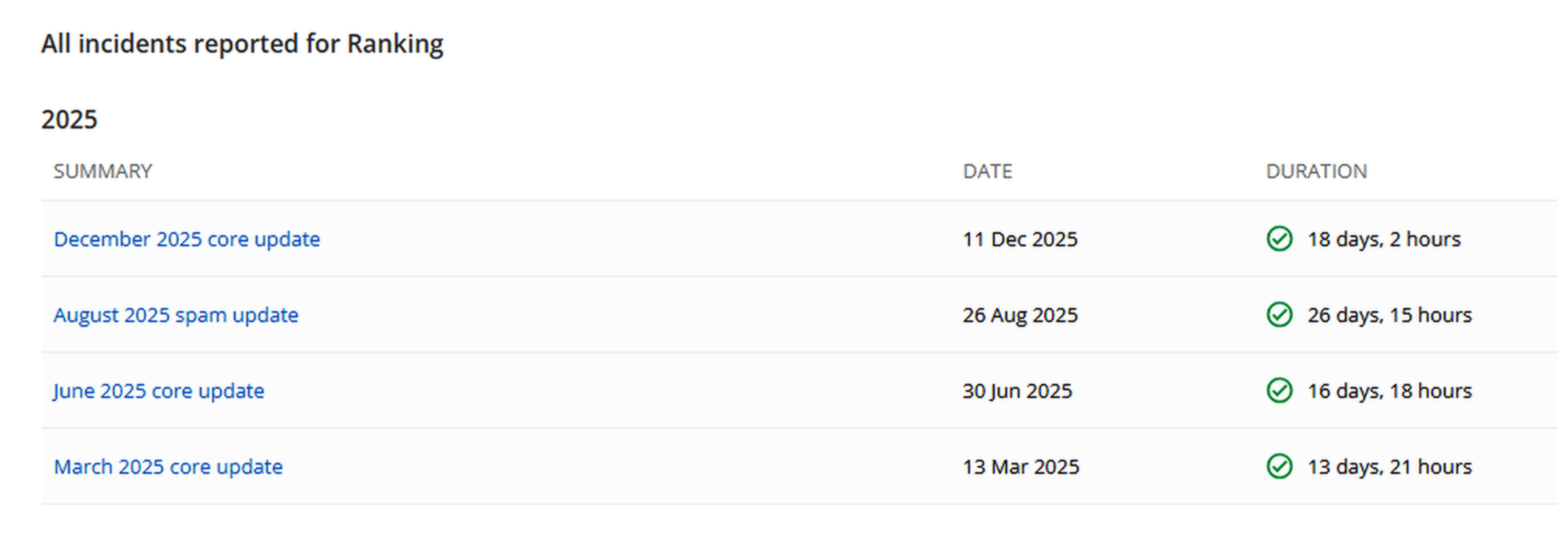
On December 29, Google completed its December 2025 Google Search Core Update, and thousands of site owners lost their rankings. It was the third significant update of 2025, launched over 18 days beginning on December 11.
According to SEMrush Sensor data, Google Core Update triggered a volatility spike that peaked on December 20 with a score of 8.7 out of 10, marking the highest single-day value recorded in 2025. During this period, affiliate sites experienced the most significant impact at 71%, followed by YMYL sectors at 67% and e-commerce sites at 52%.
This was not a penalty; it was a shift in the quality, trust, and user value criteria used by Google. Here is your full recovery plan.
Table Of Contents
- What Is a Google Core Update and How Google Broad Core Algorithm Updates Changed in 2025
- How to Check If Affected by Google Core Update Using Performance Data
- Google Core Update SEO Recovery Strategy for 2026 and Beyond
- How Do Google Core Updates Work to Restore Your Rankings Over Time
- Avoid These Mistakes After Being Hit by Google Core Update
- Tracking Google Core Updates, Quality Improvements, and Recovery Metrics
- How SEO Discovery Helped a Client Regain Rankings After the Google Core Algorithm Update in December 2025
- Don't Wait for the Next Update to Devastate Your Rankings
- Frequently Asked Questions
What Is a Google Core Update and How Google Broad Core Algorithm Updates Changed in 2025
Google Core Update is a general overhaul in terms of its algorithm, which re-assesses the ranking of the content, which emphasizes relevance, quality, user experience, and trust signals across search results significantly.
The December 2025 update was a serious change of priorities. Compared to the previous updates, which featured incremental changes, this Google Broad Core Algorithm Update provided structural changes and redefined the relationship between experience, content quality, and user engagement and their role in rankings, which brought about four significant changes that restructured the visibility of search.
1. Experience Now Dominates Over Theory
Google has now started to lay more emphasis on the first-hand experience rather than well-researched content. There should be original photos as opposed to stock photos in product reviews. The service pages should have case studies with the real client results. Tutorial content requires step-by-step documentation of personal testing.
2. AI Content Detection Gets Smarter
How do Google Core Updates work to identify AI-generated content? According to Google’s John Mueller, “Our systems don’t care if content is created by AI or humans. What matters is whether it’s helpful for users.” Now, Google can differentiate between good and bad AI-assisted content versus fully AI-generated content. AI SEO services can overlay human input, proprietary information, and experience onto AI drafts to achieve superior performance.
3. E-E-A-T Is Now Extended To All
E-E-A-T (Experience, Expertise, Authoritativeness, Trust) used to mainly affect health and finance content. These requirements were expanded in December 2025 to practically all comparative searches, including e-commerce reviews, SaaS reviews, and how-to guides.
4. Behavioral Signals Given More Importance
User engagement metrics, such as dwell time, scroll depth, and return visits, now carry greater weight. Sites with low user experience metrics, like intrusive ads, slow loading times, or content pushed below the fold, suffered disproportionate ranking losses. Google measures pogo-sticking (visitors immediately returning to search results), internal link clicks, and return visitor percentages.
Google Search Core Update News for January 2026 and What to Expect
Remaining updated on the Google Search Core Update News is essential to ensuring that you keep your rankings. As we enter 2026, the industry analysts believe the next core update will be released around Q1 or Q2, which is the trend of Google over the past few years. Contrary to the other views, the volatility trends of Google Search News Core Update tracking on SEMrush Sensor and SISTRIX estimate the possibility that an update will be released as early as March 2026.
The difference with 2026 is that Google has assured that there will be incremental updates, done frequently, between large rollouts. This implies that the rankings are allowed to be varied on a weekly basis depending on the improvement of quality rather than only on major announcements.
How to Check If Affected by Google Core Update Using Performance Data
Do not panic, but prepare to concentrate on facts. To determine whether Google Core Update has impacted your site, there has to be a systematic analysis of various platforms, and not conjectures on the basis of temporary ranking changes.
To begin with, the December Core Update ended approximately on December 29, 2:05 PM ET, and the residual volatility lasted until the beginning of 2026. Give a minimum of one week analysis time after completion of rollout. Compare performance benchmarks before December 11 and the data collected after December 29, and confirm the rollout status with the Google Search Status Dashboard.
Then assess the degree of impact. Position drops of minor level do not necessarily demand urgent response, whereas the major declines are normally signs of more substantial content, relevancy, or technical problems, which need audits and competitive analysis.
Finally, identify behavioral patterns. Stable impressions with falling clicks suggest messaging or intent mismatch, while sharp ranking losses point to quality or trust issues. Category-level drops usually signal topical weaknesses. Use tools like Google Search Console, Google Analytics, SEMrush Sensor, SISTRIX Visibility Index, Ahrefs / SEMrush, Screaming Frog, Core Web Vitals Report, and Google Disavow Tool.
Struggling to Recover from the December 2025 Core Update?
SEO Discovery is an expert in quick recovery plans that include full technical audits, E-E-A-T improvements, and content optimization to get you back on page 1.
Google Core Update SEO Recovery Strategy for 2026 and Beyond
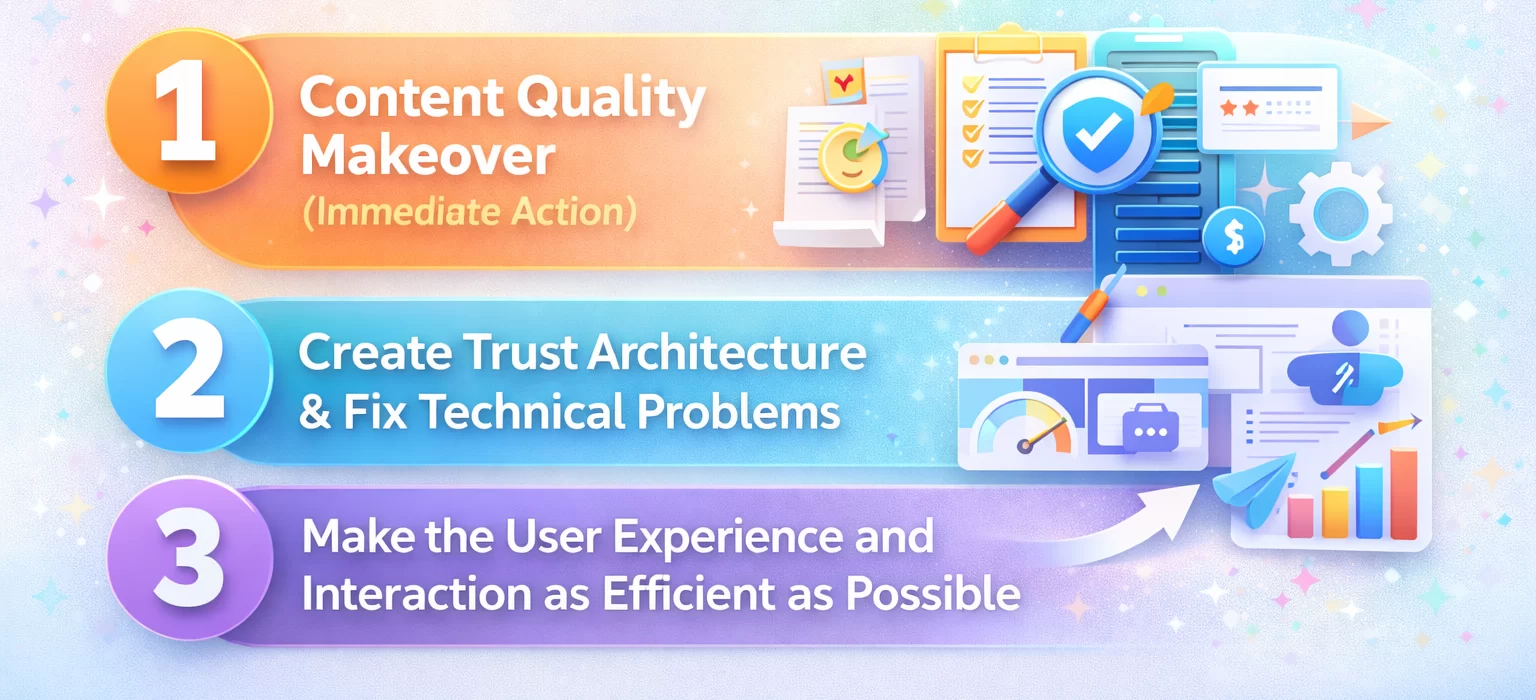
1. Content Quality Makeover (Immediate Action)
Inject Signals of Real Experience
Add “Our Experience,” “What We Tested,” or “In My Testing” sections with detailed information. Insert original photographs, screenshots, or video demonstrations- never stock photographs. Use real-life examples, such as “Our 18-month testing showed…”. Apply language patterns that show firsthand experience.
Demonstrate Expertise
Include detailed author bios, credentials, and verifiable backgrounds. Connect to reputable accounts on LinkedIn, industry certifications, and published work. Incorporate the professional quotes or interviews of trusted persons. In case of YMYL content, show medical qualifications, financial certifications, or verifiable expertise.
Update Pre-Existing Content
The initial step is to prioritize the top 20–30 organic landing pages to achieve maximum ROI. Update all dates, statistics, and outdated information with current 2026 data. Expand content to between 500 and 1,500+ words following SEO best practices. Consolidate redundant or duplicate content into hub pages and include FAQ sections to address user intent gaps. Strengthen internal linking using descriptive anchor text.
Focus on substantive rather than cosmetic changes. Note that changing a publication date without a substantial content update can lead to penalties. Ensure all changes are recorded transparently.
2. Create Trust Architecture & Fix Technical Problems
Technical Trust Signals
Make sure that you have active HTTPS throughout your site. Display prominent privacy policies and disclaimers, particularly on “Your Money or Your Life” (YMYL) content. Create a clear “About Us” page that includes team photos and verifiable company information. Provide full contact details, including email, phone number, and a physical address.
Critical Performance Metrics: Sites with Largest Contentful Paint (LCP) exceeding 3 seconds experienced 23% more traffic loss compared to faster competitors. A poor Interaction to Next Paint (INP) score above 300ms resulted in a 31% drop, particularly on mobile devices.
Fix Core Web Vitals:
- LCP: Less than 2.5s
- INP: Less than 200ms
- CLS: Less than 0.1
Social Proof Elements
Display actual reviews of customers with their names and dates. Include testimonials with photos and company attribution. In the case of a Local SEO Services business, make sure to optimize your GMB Service listing by updating information, photos, and customer reviews.
Backlink Health
Check your backlink profile using Ahrefs or SEMrush. Identify and remove harmful backlinks via the Google Disavow Tool, or consider professional Google penalty services in case you have been severely impacted. Emphasize quality rather than quantity by using strategic link building services that focus on authoritative sources. Conduct thorough keyword research to make your backlink strategy in line with the high-value search terms.
3. Make the User Experience and Interaction as Efficient as Possible
Enhance behavioral indicators that are increasingly important to Google:
- Decrease pogo-sticking by responding to questions instantly and clearly.
- Increase dwell time with interesting and well-organized content.
- Include relevant internal links to promote in-depth site exploration.
- Format information for easy scanning using clear headings and bullet points.
- Add structured data, such as HowTo and FAQ schemas, to improve search visibility.
- Remove intrusive ads and slow-loading elements that push primary content below the fold.
How Do Google Core Updates Work To Restore Your Rankings Over Time
Realistic recovery durations are generally 2–4 weeks for quick technical victories, 2–6 months for standard sites with normal effort, and 6–12 months for YMYL (Your Money or Your Life) sites. The next Google Core Update, today or in the coming months, is likely to coincide with full recovery- Google Core Update Q1-Q2 2026.
Critical Update: Google releases continuous, minor, unannounced updates between significant updates. As Google puts it: “We’re continually making updates to our search algorithms, including smaller core updates. These updates are not announced because they aren’t widely noticeable, but they are another way that your content can see a rise in position.” You may not even need to wait for the next major update to experience recovery. Following Google Core Update news helps you stay informed.
What you will see in the course of recovery: 1st ranking changes (not a cause for alarm), slow movements between core updates, and most significant changes following core updates.
Avoid These Mistakes After Being Hit By Google Core Update
Modifying Dates with no content changes: Google can identify when content has been altered, and not only in displayed dates. Any modification to a “2026” date with no material enhancement is penalized.
Panic-Deleting Content: Prioritize updating and improving over deletion. Consolidation is typically more effective than removing pages entirely. Only eliminate material that is truly irrelevant to your audience.
Over-Optimization: Do not overload content with keywords in an attempt to optimize rankings. Avoid excessive internal linking that appears to be manipulative. Always write for human readers first.
Pursuing Band-Aid solutions: Core updates are not punishments, and there is no “one-size-fits-all” fix. Increasing backlinks will not help, as recent updates focus heavily on on-page quality. Similarly, it is not effective to use AI to rewrite the material without human oversight. Consider collaborating with the best digital marketing service providers that are aware of long-term strategies.
Tracking Google Core Updates, Quality Improvements, And Recovery Metrics
Don’t be preoccupied with rankings only. Monitor these indicators in Google Analytics and Search Console:
Traffic quality indicators:
- Pages per session
- Average session duration
- Bounce rate
- Conversion rate
Engagement signals:
- Scroll depth (reading range of the users)
- Internal link click-through rate
- Return visitor percentage
In some instances, low traffic but better conversion rates can mean that it is being targeted better. You are getting more qualified visitors even when the overall numbers are low.
Is Your Content Missing the E-E-A-T Signals Google Demands?
SEO Discovery turns thin content into pages that are full of information and demonstrate real expertise. This helps you earn Google’s trust in the 2026 algorithm.
How SEO Discovery Helped a Client Regain Rankings After the Google Core Algorithm Update in December 2025
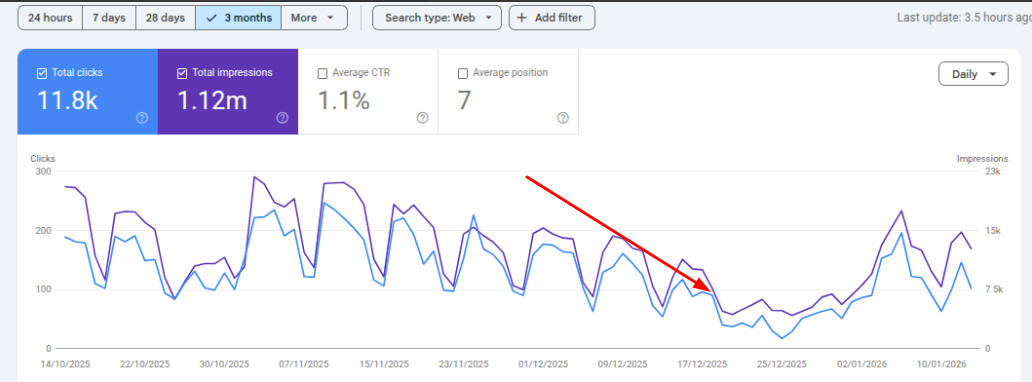
When the December 2025 Google Core Algorithm Update hit, a mid-sized online retailer experienced a devastating 40% traffic drop overnight. Key product pages fell from positions 3-5 to 15-20, and monthly organic sessions collapsed from 12,000 to 7,200.
Our Recovery Strategy:
SEO Discovery conducted a comprehensive analysis identifying critical issues: Core Web Vitals failures, thin content lacking E-E-A-T signals, and poor site architecture. We implemented targeted fixes across technical performance, content quality, and trust signals.
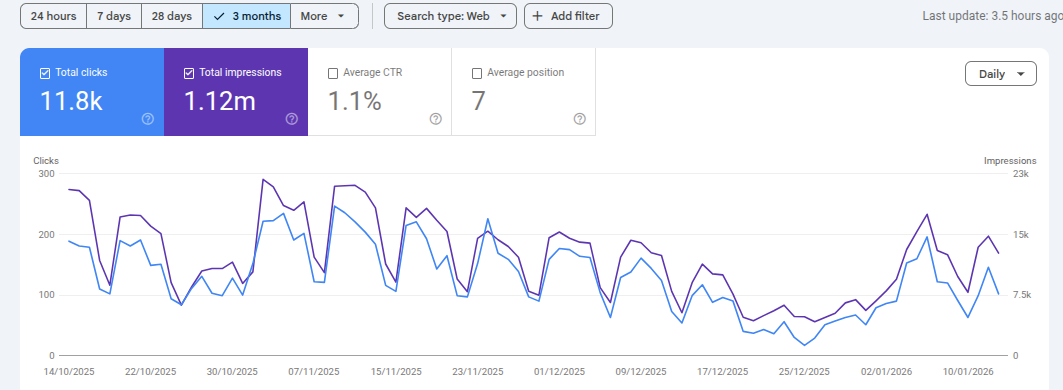
Complete Recovery in 3 Months:
- 11,800 monthly clicks (+64% recovery from December low)
- 1.12M impressions (+65% visibility growth)
- Position 7 average (11-position climb to page 1)
- 1.1% CTR (+37.5% engagement improvement)
Don't Wait for the Next Update to Devastate Your Rankings
The December 2025 Google Core Update raised expectations regarding content quality, technical performance, and practical expertise. Recovery is about continuously providing value that merits ranking, not about taking shortcuts.
With another major update likely in early 2026, delaying action risks further visibility and revenue loss to competitors who’ve already adapted. The good news is that you don’t have to wait for the next rollout to recover. Performance can be gradually restored by making strategic changes in content, technical SEO, and E-E-A-T.
Partnering with experienced teams like SEO Discovery can help speed up this process with an organized, data-driven recovery approach.
Can’t Wait 6 Months for Organic Recovery to Happen Naturally?
Get started with a free consultation from SEO Discovery.
Email: sales@seodiscovery.com | contact us at +91 74287 99334.
FAQs About How to Overcome Declining Traffic After Google's Core Update
A Core Google Update is a key revolver to the search algorithm of Google that recalibrates the ratings of the websites. These updates evaluate the content quality and E-E-A-T. The algorithm is constantly improving its capacity to recognize truly useful pieces of content that show real experience and knowledge.
Keep an eye on several sources to detect updates in real time: Check Google Search Central Blog for official Google Core Update SEO announcements, track SEMrush Sensor for volatility spikes (scores above 7/10 indicate significant changes), use SISTRIX Visibility Index for market-wide ranking movements, monitor Google’s @searchliaison Twitter/X account for updates, and check Google Search Console for sudden traffic pattern changes.
Yes. Unannounced updates can be issued continuously in a year by Google. Gradual ranking recovery can be achieved by making substantial quality improvements, such as adding first-hand experience signals, refreshing outdated statistics, repairing technical problems, and creating real E-E-A-T. You do not have to wait until the next large update to see the results.
No. According to Google’s John Mueller, “Our systems don’t care if content is created by AI or humans. What matters is whether it’s helpful for users.”Nonetheless, AI content generated in bulk tends to be less experienced, less innovative, and less valuable than positioning a piece of content efficiently after updating it. Google Broad Core Updates recognizes the content that reflects human knowledge, irrespective of how it is made.
Google Broad Core Updates are significant, verified algorithmic transformations that influence the way Google evaluates all the material on the web. This is publicly announced on Google Search Central blog and usually needs 6-18 days to fully roll out, resulting in high volatility of rankings. The smaller regular updates are called daily refinements, which are not publicly announced but still provide an opportunity to rank the improvements in case quality changes.
Compare the Check Google Search Core Update timing with declining traffic in Google Search Console. Compare metrics on one week before December 11 th and after December 29 th. Rollout will produce sudden drops by more than 30%, which reflect Core Update Google impact.
No. Google Core Updates do not correct themselves. Healing will need substantial quality enhancement, i.e., better E-E-A-T indicators, patching, and content conversion. Nevertheless, gradual recovery through continuous minor updates between major Google Core Algorithm Update cycles can take place without having to wait until the next rollout.
Yes, if you lack in-house expertise. Professional agencies understand how do Google Core Updates work and implement proven recovery frameworks. They solve technical problems, E-E-A-T shortfalls, and content gaps more quickly than DIY solutions, and in most cases, recover in 90 days or less.
Altering the publication dates without any modification of content provokes sanctions. Topical authority is killed through panic-deleting pages. Google Core Updates quality tests are aggravated by over-optimization and stuffing keywords. Disregard of Core Web Vitals and the blockage of AI crawlers only increase the losses in the rankings after being hit by the Google Core Update.
Almost everything is better in recovery. New sites have no advantages since they do not have existing domain authority and backlinks, and the content is not indexed. Google Broad Core Updates are rewards that recognize quality on older sites. Fresh implies starting all over again, rebuilding a zero-based recovery is usually successful in 3-6 months with an appropriate strategy.