

Objective
This blog highlights pain point SEO and how it is different from traditional keyword strategies. It provides a clear step-by-step guide, with common mistakes and ways to measure results that help your business grow.
- Pain point SEO targeting buyer intent, not just search volume.
- It is a mix of three keyword types: category, comparison, and JTBD.
- High-intent content converts better, and there is a lot less competition.
- AI overviews prefer clear, problem-solving content over generic pages.
- Track conversions, not traffic, to measure real pain point success.
Turn Customer Problems into Leads with Proven SEO Strategies from SEO Discovery, Starting at $250/Month.
Pain Point SEO is a high-intent marketing strategy that focuses on specific customer problems and solution-oriented keywords instead of general search terms. It creates content that solves the user’s problems directly, attracting qualified and conversion-ready visitors and helping businesses generate leads, increase signups, and improve overall conversion rates.
Did You Know? According to SEMRUSH, long-tail keywords account for most Google search queries, showing the importance of intent-based targeting in SEO.
Pain Point SEO connects businesses with the right audience at the right stage of the customer journey. By focusing on real user needs and search intent, it improves content relevance, builds trust, increases engagement, and generates more valuable leads, making SEO efforts more effective and results-oriented.
This guide explains what pain point SEO is, how it differs from traditional SEO, the types of keywords to target, steps to build a strategy, and how to measure success. Keep reading to learn more.
Table Of Contents
- What is pain point SEO, and how does it differ from traditional SEO?
- What are the three types of pain point keywords?
- How does pain point SEO help grow your business?
- How to build a pain point SEO strategy (step-by-step)?
- How to prioritize which pain points to target first?
- How does pain point SEO help you appear in Google's AI Overviews?
- How to measure the success of SEO pain points?
- Common pain point SEO mistakes to avoid
- How we used pain point SEO to generate more qualified leads
- Turn high-intent searches into revenue with SEO Discovery
- FAQs about pain point SEO
What is pain point SEO, and how does it differ from traditional SEO?
Pain point SEO moves away from high-volume keywords to understanding real user intent and specific problems. It ensures that content is focused on what users are struggling with and offers precise solutions that increase engagement, build trust, and attract more qualified traffic that is more likely to convert and grow the business.
What sets pain point SEO apart from traditional SEO
Aspect | Traditional SEO | Pain Point SEO |
Main Goal | Improve Traffic | Increase Conversions |
Keyword Focus | High search volume | High buying intent |
Funnel Stage | Top of funnel | Middle to bottom of funnel |
Competition Level | High | Lower |
Typical Conversion Rate | Lower | Higher |
What are the three types of pain point keywords?
To effectively target users’ problems, solutions, and purchase-based searches, pain point keywords are classified into three main groups based on the user intent. These are the three types of SEO pain point categories:
- Category keywords: These refer to the words/phrases people use when searching for products/services that they are already interested in.
Example: best accounting software
- Comparison and alternative keywords: These queries involve people comparing different options to find the best one before making a final decision.
Example: Shopify vs WooCommerce
- Jobs-to-be-done (JTBD) keywords: These are about situations where users want to solve a problem or complete a task without thinking of a particular product.
Example: how to track sales leads
What is the best keyword strategy for national SEO?
Search intent links to a major change in tactics. Keyword research that really works needs to ditch the “service + city” approach and focus on queries that are about solving problems. This is one of the key differences between local SEO and national SEO strategies since national users are mostly searching for information.
- Move Beyond Geo-Modifiers: Transition to broad intent terms.
- Target Problem-Awareness: Use SEO content writing to solve industry challenges.
- Focus on Long-Tail: Capture lower-difficulty, high-intent traffic first.
The biggest strategic shift between planning a local vs. national SEO campaign is the keyword swap.
How does pain point SEO help grow your business?
Pain Point SEO mainly helps businesses grow by creating content that relates to the user’s actual pain points, thereby increasing the relevancy, engagement, and conversion quality. Here are the benefits of how it helps to grow.
- Higher conversion rates: Visitors who use high-intent search terms are more inclined to convert more quickly than those who use generic terms.
- Lower competition: Fewer brands target specific pain points, which makes ranking easier.
- Stronger trust and authority: Solving real problems builds credibility, and pairing that with the best digital marketing services strengthens your brand’s overall positioning.
- Better content ROI: When you concentrate on genuine customer issues instead of general topics people are not really searching for, you will get more out of your budget.
- Improved local visibility: When pain point content is combined with effective local SEO services, it makes it easier for your nearby customers to find you instead of your competitor.
How to build a pain point SEO strategy (step-by-step)?
Below are the ways to generate a pain point SEO strategy through focusing on user problems, intent keywords, content optimization, and performance tracking.
Step 1: Identify pain points
Your primary focus should be on finding genuine customer issues and then aligning these findings with effective keyword research services when preparing a blog content plan. Here are the main ways to discover the pain points:
- Ask your sales team: They get objections and complaints straight from potential clients almost every day.
- Check out online reviews: Reviews highlight the frustrations that customers have with products or services already on the market.
- Look at support tickets: Recurring tickets are a direct indication of the pain points your audience experiences most.
Step 2: Map pain points to the buyer's journey
Dividing the pain points by buyer stages will help ensure that your content meets the readers’ search intent at each stage of the journey. Below is a breakdown of the stages of the buyer journey.
- Awareness stage: At this point, readers understand they have a problem but have not decided on any solution yet.
- Consideration stage: Readers evaluate various solutions before making a choice for which one is the best fit.
- Decision stage: Potential buyers have made up their minds and are only looking for that final push to convert.
Step 3: Create content that solves the problem
Converting research into effective SEO content means answering the exact question that users search for and then adding useful supporting details. Here’s how to create useful SEO content.
- Reply right away: Give the solution first and then offer the background or additional context.
- Use very simple language: Avoid jargon to make it easier for the readers to grasp the answer.
- Provide evidence: Back it up with data, examples, or case studies that support your point.
Step 4: Optimize and internally link your content
Improving your content with technical SEO and internal links can help pages rank better and make your website easier to use. Below are some important steps to improve your results.
- Improve page speed: Pages that load quickly tend to retain visitors for a longer duration, thereby reducing bounce rates.
- Include internal links: Internal linking can be used to connect pages dealing with pain points and related service pages.
- Resolve technical issues: It is a good practice to check for broken links, duplicate content, and crawl issues on a regular basis.
Step 5: Promote and build authority
Consistent outreach builds credibility and visibility, and as your authority grows naturally over time, search engines will start to trust your content more. This is how outreach builds trust and authority.
- Develop quality backlinks: Link building services should be used to get links from relevant and authoritative sites.
- Engage in digital PR: Digital PR services get your brand featured in news articles or industry publications.
- Guest post strategically: Guest posting services put your name on respected sites and expand your reach.
How to prioritize which pain points to target first?
Not all pain points deserve the same level of attention, so before creating any new content, score each one using the three simple factors explained below.
- Buying intent: Check whether this pain point leads directly to an actual purchase decision, rather than to casual browsing behavior.
- Ranking feasibility: Based on the current competition, determine whether you can realistically rank for this keyword within a reasonable, manageable time frame.
- Business impact: Before you invest valuable time and content team resources, make sure this pain point aligns with your highest-margin services.
How does pain point SEO help you appear in Google's AI Overviews?
Pain Point SEO gives you a higher chance of appearing in Google AI Overviews by providing clear, direct, and structured responses matching user intent.
How AI SEO improves structured visibility
- Answers specific questions quickly with clear, focused content.
- Uses a structured format that is easily readable by AI systems.
- Improves visibility by matching intent-based search queries accurately.
How to measure the success of SEO pain points?
To measure SEO pain points’ success, you need to track the right metrics, not just overall website traffic numbers every single month. Here’s how to evaluate SEO success properly.
Metric | Description |
Conversion Rate Per Page | Measures how many visitors complete desired actions on each page, showing content effectiveness clearly. |
Lead Quality & Sales Readiness | Evaluates how many leads become qualified sales conversations and eventually convert into paying customers consistently. |
Local Visibility Growth | Tracks improvements in Google Maps and GMB performance for better local search discovery and reach. |
Mobile Performance & Engagement | Analyzes user behavior on mobile devices to ensure a smooth experience and higher engagement rates overall. |
Keyword Ranking Progress | Monitors improvement in targeted keywords over time to confirm steady organic growth and visibility. |
Common pain point SEO mistakes to avoid
Many businesses make mistakes they could easily avoid when running SEO pain point campaigns, and these mistakes significantly limit rankings and overall conversions. Below are the most common mistakes that you should avoid.
- Chasing zero-intent long-tail keywords: Sometimes, a long-tail keyword may get a decent search volume, but it brings zero buying intent for your actual business.
- Ignoring search intent: Generic answers, instead of solving the real problem, confuse readers and impact rankings.
- Skipping clear calls to action: Content without a clear next step leaves interested readers confused, so conversions drop even when traffic stays strong.
- Replacing traditional SEO completely: Pain point SEO works best when combined with traditional SEO, not replacing it completely for more visibility.
How we used pain point SEO to generate more qualified leads
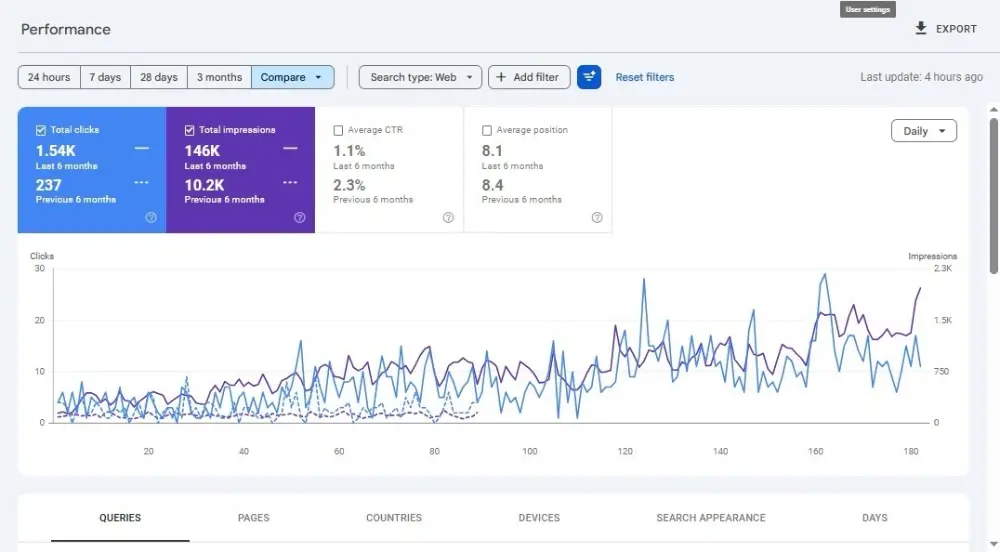
One of our clients was struggling with organic visibility, low website traffic, and low search engagement. The content they had was targeting broad keywords and didn’t solve the exact problems potential customers were looking for. As a result, they attracted fewer qualified visitors and missed valuable opportunities to generate leads and grow their business.
To address these challenges, we implemented a pain point SEO strategy that focuses on recognizing customer pain points and targeting high-intent keywords. We created and optimized content around real user concerns, improved on page SEO, strengthened internal linking, and resolved technical issues. This approach made the website more relevant to the search intent and attracted users who are actively looking for solutions.
The results
- Total clicks increased from 237 to 1.54K within six months.
- Search impressions grew significantly from 10.2K to 146K.
- Average search position improved from 8.4 to 8.1 across target keywords.
- Pain point-focused content attracted more qualified organic traffic and visibility.
Turn high-intent searches into revenue with SEO Discovery
Mastering pain point SEO moves your strategy from chasing empty traffic to capturing high-intent buyers. By solving targeted customer problems at each step of the buyer’s journey, your company can greatly improve conversion rates, build stronger brand trust, and get a much better return on your content marketing investment.
As one of the best digital marketing agencies, SEO Discovery will guide you to find and target these high-value opportunities. Our team uses the best SEO services along with an intent-focused strategy to optimize your content, improve your rankings, and convert qualified searchers into paying customers.
Contact us today to transform your organic search traffic into measurable business growth.
FAQs about pain point SEO
Pain point SEO is about creating content around the issues your customers face. It focuses on high-intent keywords rather than broad ones, which means it attracts visitors closer to the purchase decision.
Generally, keyword research is about finding keywords that people search for the most. Pain point SEO is more about first identifying customer problems and then discovering keywords related to those problems, so you create content that converts better.
SEO Discovery allows businesses to grow with pain point SEO by targeting high-intent keywords that solve customer issues. Using strategic SEO services that focus on conversions, user intent, and measurable organic growth, we create optimised content, improve rankings, and generate qualified leads.
Not necessarily. In fact, some pain point keywords have a relatively good volume, but the primary focus is always on the buying intent. This means even zero-volume keywords are capable of bringing in extremely valuable, ready-to-buy visitors.
Most businesses see early conversion improvements within 3-6 months. Full ranking results may take longer depending on competition and content consistency.
Definitely. Because small businesses usually lack the resources to compete with large companies for the top volume keywords, pain point SEO enables them to focus on specific, less competitive searches that generate qualified leads.
Category keywords, comparison and alternative keywords, and jobs-to-be-done keywords are the three types of pain point keywords. Each type is focused on a different phase of the buyer’s journey.
Yes. Some specialize in local visibility, while others focus on content, authority, and scalability. Understanding local and national seo requirements helps identify the right partner for your goals.
Yes. Content that directly answers a specific problem performs well in AI Overviews, as AI systems can more easily summarise clear, structured answers.
Consult your sales department, read customer reviews, and examine help desk tickets. Also, you can use tools like AnswerThePublic and AlsoAsked to uncover frequently asked questions.
Pain point SEO is not a substitute. It’s most effective when paired with traditional SEO, giving you both broad reach and targeted, high-converting content.
Don’t just track traffic, track conversions. Monitor leads, signups, and sales from specific pages, then compare conversion rates to wide traffic content.