

Objective
This blog explains the expected timeline for SEO medical marketing results and the main factors that affect the speed at which a practice ranks. It assists doctors and providers in defining realistic expectations and taking appropriate action.
- Medical SEO requires 4-12 months to notice organic growth.
- Local SEO can bring faster results with Google Business Profile optimization efforts.
- E-E-A-T ensures that only knowledgeable medical content ranks in health searches.
- Common mistakes such as poor content, weak technical SEO and ignoring reviews can delay results.
- AI is changing SEO with a focus on structured and knowledgeable medical content.
Get More Visibility and Patients with Proven Medical SEO Services from SEO Discovery, Starting At $250/Month.
Medical SEO services usually require 4 to 12 months to achieve significant outcomes, with early improvements visible in 3 to 6 months. The timeline will depend on the competition, the authority of the website, and the quality of the content. Highly competitive markets will take 12-18 months, but local areas with less competition often see improvements more rapidly.
Did you know? According to Google, customers are 2.7 times more likely to consider a business reputable when it has a completed Business Profile on Google Search and Maps.
Medical SEO is a long journey. Trust is an essential factor in healthcare, and search engines require time to determine the trustworthiness of your website. This is why regular activity like publishing helpful content, improving your website, and enhancing your local presence is so important to getting consistent and long-term results.
This guide outlines the SEO timeline, key factors, common mistakes, and how AI impacts SEO medical marketing, so continue reading until the end.
Table Of Contents
- What is SEO for Medical Websites, and Why is It Challenging for Doctors?
- How does SEO for Medical Practices Improve Over Time?
- Which Factors Impact Your Medical SEO Services Timeline?
- How is AI Changing SEO for Medical Practices?
- What Common Mistakes are Slowing Down Your SEO Medical Marketing Results?
- How We Optimize SEO for Medical Practices for Our Client
- Improve Your SEO for Medical Websites with SEO Discovery
- FAQs About Medical SEO Services
What is SEO for Medical Websites, and Why is It Challenging for Doctors?
Medical website SEO is the procedure of improving your healthcare website to be more accessible on search engines like Google. It makes it easy for patients to find your practice when they search for services you offer in their area.
So why are so many doctors so frustrated by it? Here are the real problems:
- Google has stricter standards for medical sites: Google has more stringent ranking rules for medical sites because they can impact users’ health decisions.
- E-E-A-T is strict: If you want your medical content to rank consistently well online, it needs to show real experience, expertise, authority, and trustworthiness.
- Competition is tough on all sides: Doctors are competing against local clinics, hospitals, and big-name health websites that lead search results with authority.
- HIPAA compliance adds more complexity: Medical SEO monitoring and analytics fall under HIPAA regulation and require specialised, compliant configurations.
How does SEO for Medical Practices Improve Over Time?
Here’s a structured phase-specific description of SEO medical marketing results and what to monitor.
Months 1 to 2: Foundation and Audit Phase
This phase is the foundation stage where your service provider reviews your site, resolves crawl issues, implements schema, enhances your Google Business Profile, and does keyword research focusing on targeted patient search queries.
What to measure: Crawl coverage in Google Search Console and correct page indexation.
Months 3 to 4: Early Signals Phase
Your content pages start indexing. Branded and long-tail queries start to rank. You may start showing up in the local map pack for less competitive keywords. Phone inquiries can increase by 10-20%, but patient attribution may not be clear at this point.
What to measure: Google Search Console impressions, map pack appearances, and observed keyword rankings.
Months 5 to 6: Momentum Phase
Mid-competition keywords start to move higher. You’ll start to see results from your local SEO for medical professionals, especially in the map pack. Your review generation campaigns now continuously enhance your local ranking signals and establish trustworthiness with new patients.
What to measure: Organic sessions, contact form submissions, and tracked inbound calls.
Months 7 to 12: Growth and Attribution Phase
Here is where the real results come out. Competitive keywords start ranking higher. You can track new patient appointments because of organic search. Your medical marketing SEO investment begins to return a measurable return on every dollar spent.
What to measure: Organic new patient volume and cost-per-acquisition.
12+ Months: Compound Authority Phase
Your site is now a topical authority. Your content marketing compounds; older content still attracts traffic while new content gets ranked faster. Local visibility prevails. You’re probably beating out competitors who have been in the competition longer but haven’t invested as diligently in SEO.
What to measure: Voice market share, referral domain growth, and review velocity.
Which Factors Impact Your Medical SEO Services Timeline?
The results of medical SEO services depend on a number of variables. These six factors directly determine how fast or slow your results come.
1. Industry Competition
Addressing high-volume keywords (think “dentist NYC”) takes much longer than targeting niche, local terms. In major metro areas, competitive specialties like dermatology, orthopedics, and plastic surgery can take 12 to 18 months. You can see ranking change in 30 to 60 days with a reliable medical practice local SEO company that focuses on hyperlocal, intent-rich terms like “urgent care [neighborhood].”
Pro Tip: Begin with hyperlocal and low-competition keywords, and as your domain authority slowly builds, then move into broader terms.
2. Site Credibility
New sites have no trust signals, so it takes Google time to gain confidence in them. Established sites with a good backlink profile and crawl history are likely to rank faster. Use trusted platforms to link with the new websites to borrow authority and speed up trust building.
Pro Tip: Link your doctor bio pages to Healthgrades and Doximity profiles to steal authority and improve Google trust signals.
3. Regular Content Publishing
Regularly publishing great SEO content helps your website build trust with search engines. If a practice gets 10 to 15 optimized pages published in the first month, they can start to see early outcomes by the third or fourth month. By consistently posting blogs every month, you build authority with Google over time, but also show that your website is active and reliable in the medical field.
Pro Tip: Build topical authority with Google consistently by publishing at least two medically accurate, expert-reviewed blog posts each month.
4. Local Search Signals
Medical local SEO, particularly Google Maps, usually provides results faster than ranking for national keywords. Consistent Name, Address, and Phone (NAP) information on Healthgrades, Vitals, and Doximity is critical. Google dislikes inconsistent citations, and it can cost you months in the rankings.
Pro Tip: Review your NAP consistency across all medical directories each month, as even a tiny mismatch can quietly kill your local rankings.
5 Technical SEO Performance
Technical SEO services address issues such as crawl errors, missing schema, and slow page speed that may hinder the growth of your website. Most medical websites will resolve these problems in 30 to 60 days. If you don’t fix them early on, they can affect your SEO performance and delay your rankings and patient growth.
Pro Tip: Perform a free Google PageSpeed Insights test on your homepage today and fix any critical issues before you publish any new content.
6. Google Algorithm Updates and Industry Changes
Google updates its algorithm regularly, and healthcare websites are the most affected. Staying up-to-date with AI SEO services trends and structured data requirements helps you to maintain your rankings through future updates. Helpful Content updates from 2022 till now have impacted medical sites that published shallow or non-expert content.
Pro Tip: Subscribe to Google Search Central updates and check your GSC traffic after every major algorithm update to identify ranking shifts early.
Struggling to Rank?
Fix issues slowing your growth with expert SEO support from SEO Discovery.
How is AI Changing SEO for Medical Practices?
AI is changing the way patients find doctors and the way Google ranks medical websites right now. SEO for medical practices has to adapt to these changes.
This is exactly how AI is changing medical website SEO:
AI overviews impact: Google AI Overviews now appear above the traditional results, dragging the listings down, so it’s essential to have structured, specialised medical content to stay visible.
Content quality standards: AI focuses on accurate, detailed, and expert-backed medical content, so thin or generic pages will not work, particularly for SEO for medical websites that want to rank in healthcare search results.
- Smarter local search: AI enhances local search with reviews, relevance, and business data, resulting in more viable local SEO for medical professionals and a greater dependency on comprehensive optimization.
What Common Mistakes are Slowing Down Your SEO Medical Marketing Results?
You can have a great strategy, but these mistakes will set you back months. Keep an eye out for all of them:
- Ignoring the technical SEO foundation: If you start content without fixing technical issues, you’ll be facing indexing problems and poor search performance from the start.
- Publishing thin or low-quality content: Content without depth doesn’t meet Google’s E-E-A-T standards, which diminishes trust and limits rankings for healthcare searches.
- No internal linking strategy: Without internal linking, your pages are isolated, meaning crawl efficiency is reduced, and SEO value is limited within your site.
- Ignoring patient reviews: Not actively seeking reviews negatively impacts local rankings. Reviews are a powerful trust and ranking factor for medical SEO.
- Choosing a non-specialized SEO agency: Often, working with a general agency without healthcare expertise leads to poor strategies and slower, weaker results in SEO for medical professionals.
Ready to Beat Competitors?
Use proven SEO methods to outrank other clinics in your area.
How We Optimize SEO for Medical Practices for Our Client
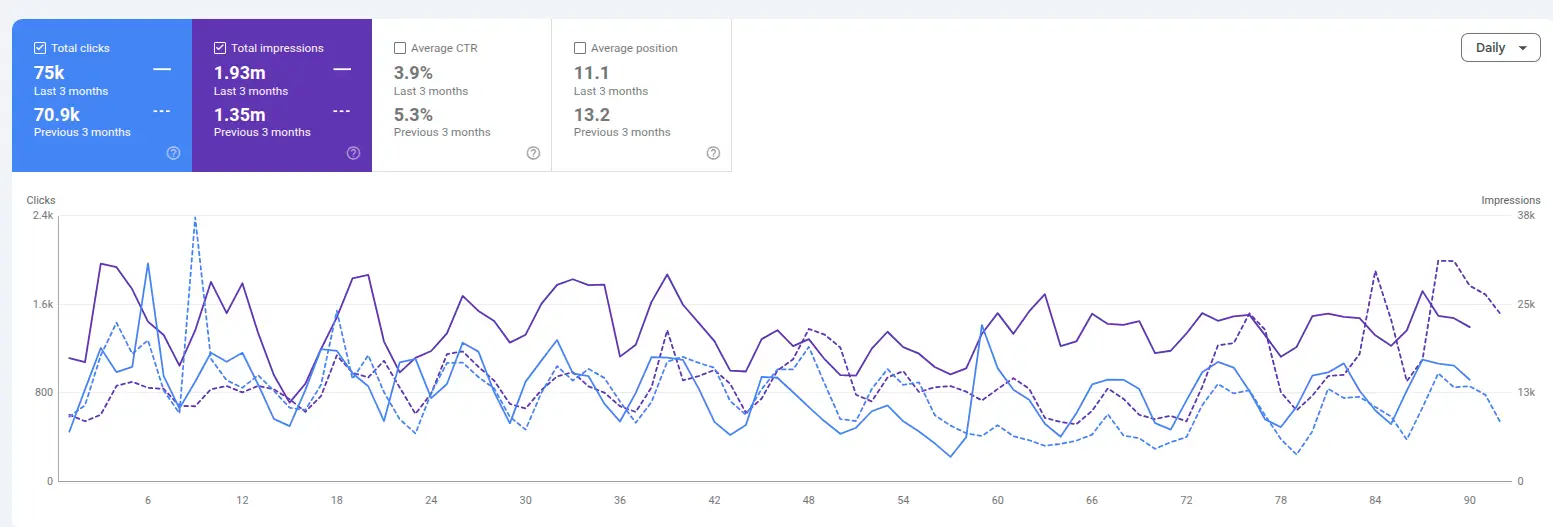
We performed a targeted medical SEO marketing campaign for a medical practice focusing on local visibility, high-intent keywords, and technical improvements using SEO for medical practices. The client used to rely heavily on referrals and paid ads, with low organic visibility and inconsistent growth in traffic.
Instead of relying on ads, we centered our SEO services for medical practices around Google Business Profile optimization, local content creation, citation development, and fixing critical technical SEO issues under SEO for medical practices.
Our goal was clear: increase organic traffic, improve keyword rankings, and generate qualified local patient leads through targeted medical SEO solutions.
The Results (Last 3 Months vs Previous 3 Months)
- Total clicks increased from 11.1K to 18.8K, an increase of nearly 70% in one quarter
- Total impressions grew from 2.12 million to 3.89 million, representing a huge increase in visibility
- The average position improved from 17.2 to 13.7, moving the practice closer to Page 1
- Consistent upward trend in daily clicks and impressions, confirming stable organic growth
Improve Your SEO for Medical Websites with SEO Discovery
SEO medical marketing is a long-term plan that creates steady visibility, stronger rankings, and consistent patient inquiries over time. When done right, it helps healthcare providers own local search results and ensures long-term growth.
SEO Discovery stands out as a trusted provider of the best SEO services for healthcare businesses, delivering tailored strategies including technical SEO, local optimization, schema implementation, and E-E-A-T-focused content to help medical practices surpass competitors.
Contact us today to learn more about proven result-focused SEO solutions built specifically for doctors and healthcare practices.
Want Expert SEO Help?
Let specialists handle your medical SEO for faster and safer results.
FAQs About Medical SEO Services
Medical SEO is the practice of optimizing your healthcare website for higher rankings on Google. It helps more patients find your practice online when they search for SEO for medical professionals in their area.
Most practices observe early signs in 3 to 6 months. If you’re doing regular, professional optimization work on your medical website, you can usually expect to see big results within 6 to 12 months.
Here are the 3 fastest ways to improve your medical practice’s local SEO search rankings right now: optimizing your Google Business Profile, building consistent citations, and generating patient reviews.
Most practices make investments based on competitiveness in the market, the number of locations, and the full spectrum of medical SEO services provided by the agency.
E-E-A-T is the abbreviation for Experience, Expertise, Authoritativeness, and Trustworthiness. Google uses these signals to assess content quality for SEO on medical websites and to identify which pages should rank highly in healthcare searches.
Google considers volume, longevity, and star rating to be the most important medical local SEO ranking factors. A practice with 200+ reviews and a 4.5 star rating will often beat out competitors with weaker review profiles.
SEO Discovery is the best platform for SEO for medical websites, as they provide healthcare-centric strategies, technical expertise, and proven results that enhance visibility, rankings, and patient acquisition consistently.