


Objective
This blog outlines the precise steps for executing a website redesign SEO process without losing rankings or organic traffic. It includes initial redesign audits, URL mapping, staging tests, and post-launch tracking.
- Always run a full SEO audit before any redesign work starts to protect top-performing pages.
- The most important technical steps are a 1-to-1 URL mapping document and proper 301 redirects.
- Block staging sites with noindex tags to avoid getting penalized for duplicate content while developing.
- Submit a new XML sitemap immediately on launch day and check GSC each day for 30 days.
- Do not rewrite ranking content or delete ranking pages without a clear, documented SEO plan.
Redesign your Website without Losing SEO Traffic with Website Redesign Services by SEO Discovery, Starting at $250/month.
A smart website redesign SEO plan is not just about appearances; it’s about redesigning your site without affecting rankings. This involves auditing your current site, mapping URLs with 301 redirects, preserving high-value content, saving metadata, testing on staging, and improving speed and mobile experience.
Did you know? According to Forbes, 88 percent of users will not return to a website after a bad user experience.
A proper redesign lets you upgrade your website without risking your rankings. It makes the user experience better, improves performance, and makes sure that search engines can still read and trust your site.
In this guide, we will walk you through every step of the process, the benefits of SEO-friendly website redesign, and mistakes to avoid, so read on to the end.
Table Of Contents
- Does SEO Website Redesign Affect Traffic and Rankings?
- Key Benefits of SEO for Website Redesign
- What are the Steps for Website Redesign for SEO Success?
- What to Check After an SEO Website Redesign?
- What are the Common Mistakes in Website Redesign for SEO?
- How We Helped Our Client Redesign Their Website Without Losing SEO
- Trust SEO Discovery for Secure Website Redesign SEO Results
- FAQs About Website Redesign SEO
Does SEO Website Redesign Affect Traffic and Rankings?
Yes, website redesign and SEO are directly related. Any changes you make to your URL structure, content, or page speed transmit fresh signals to Google. Those signals can fall in ranking fast with no proper planning.
There are three main risks that can cause SEO loss during a redesign:
- URL changes tell Google that the old page has vanished, taking out its ranking history.
- Content rewrites change the relevance of keywords on pages that were already ranking.
- New themes or code can slow down loading speed and block search engine crawlers.
Key Benefits of SEO for Website Redesign
Getting good results in search isn’t about luck, it’s about strategy. SEO for website redesign means not just protecting rankings but achieving stronger performance and growth.
The following are the top advantages of an SEO-friendly website redesign:
- Achieve higher rankings because the redesign solves SEO problems and improves keyword visibility.
- A better experience maintains users engaged and reduces bounce rate naturally.
- Long-term authority improves proper redirects and link-building services.
Faster speed improves rankings and gets better conversions consistently.
What are the Steps for Website Redesign for SEO Success?
An SEO website redesign isn’t guesswork, it’s putting things in the right order. If you take the right steps, you can protect rankings and keep the traffic consistent.
Phase 1: Pre-Redesign Preparation
The best results come from the work done before any design work begins. Most website owners neglect this step altogether. If you ignore it, you are risking your rankings.
So here’s what to do in Phase 1:
1. Run a Full SEO Audit
- Do an SEO audit to export all your URLs with traffic, rankings, and backlink data prior to redesign.
- Find out the top pages that are getting the most traffic, so you don’t mistakenly lose them.
- Review pagespeed and performance now so you can compare after launch.
- Check backlinks to find pages with great backlinks and make sure you do not delete them.
- Keyword research helps you to find new content ideas to include in your new structure.
2. Back Up Your Current Site
- Full backup to secure your database, files, and plugins before starting the redesign process.
- Redirect chains to fix existing redirects and avoid problems after the redesign of the website.
3. Map and Protect Top-Performing Pages
- Sorts pages to keep, improve, or merge in the redesign process.
- Review internal linking to connect key pages strategically to distribute authority across your site.
4. Identify Thin or Duplicate Pages
- Find duplicate or overlapping content before redesign and combine it into stronger, single optimized pages.
- Use 301 redirects to forward old pages to new ones and protect rankings and traffic.
- Fix duplicate tags before starting your website redesign for SEO.
Phase 2: SEO-First Redesign Process
Most SEO and website redesign projects fail at this point. Most traffic drops during this phase happen because people execute without keeping SEO as the main focus. Every decision here has to be made with rankings in mind.
Here is what to do in Phase 2:
1. Maintain URL Structure Wherever Possible
- Don’t change URLs unless absolutely necessary for redesign, as it may cause harm to your rankings
- URL Mapping is crucial to match each old URL to a new one using an SEO website migration service.
2. Build and Test on a Staging Site
- Use a staging site to build and test your website redesign SEO instead of making changes on your live website.
- Apply Noindex Tags to ensure you block staging pages so Google doesn’t index duplicate content.
- Run a full crawl to find errors, broken links, and performance problems before you launch.
3. Maintain and Enhance On-Page SEO Elements
- Transfer meta tags, ensuring you move all titles and descriptions exactly as they were before.
- Add schema markup and validate it to maintain your extensive outcomes.
- Compress and convert images to improve speed and performance with AI SEO services.
4. Keep Site Architecture Flat and Crawlable
- Keep your important pages within three clicks during site redesign SEO, so Google can find them easily.
- Link your high-performing pages to key pages to increase internal linking and promote content marketing campaigns
- Don’t place important pages in menus, as it can quietly harm your rankings
Phase 3: Launch and Post-Launch SEO
The work doesn’t end at launch. The first 30 to 60 days after going live are critical for protecting and recovering your rankings in SEO for a website redesign.
Here is what to do in Phase 3:
1. Implement 301 Redirects Before Going Live
- Redirect testing prior to launch and fix any 302s to proper 301s.
- Create an entire redirect map to ensure that no important pages are lost, and maintain your rankings with link building services.
2. Submit a Fresh XML Sitemap
- Submit a clean XML sitemap to Google Search Console within a few hours of going live.
- Delete the old staging sitemaps so that Googlebot doesn’t get confused.
- Manually submit your top pages in GSC to speed up the discovery of important pages for faster re-indexing
- Ensure your new sitemap is accepted in GSC without errors with the best digital marketing services
What to Check After an SEO Website Redesign?
A few positions decreasing in the first two weeks is normal in SEO and website redesign, and sometimes it can take 30 to 60 days. The difference between a successful launch and a traffic disaster in the long run is knowing when to act.
- Set up GSC alerts immediately: Allow alerts for coverage errors, crawl errors, and manual actions. Check GSC daily for the first two weeks after launch.
- Compare rankings against your baseline weekly: Track keyword positions with Ahrefs or Semrush against your pre-launch spreadsheet. A drop of 10 or more positions on the top page needs quick investigation.
- Validate UX improvements with GA4: Run A/B tests on redesigned high-traffic pages to ensure the new design enhances engagement, using Google Maps optimization.
What are the Common Mistakes in Website Redesign for SEO?
These are mistakes even experienced teams make. Watch out for all of them:
- Don’t remove old posts with backlinks, simply redirect to relevant pages with digital pr services.
- Make sure Google doesn’t crawl your staging site, or it can create duplicate content problems.
- Always do mobile testing, as Google uses mobile-first indexing.
- Check PageSpeed on staging and fix LCP and CLS issues before launch
How We Helped Our Client Redesign Their Website Without Losing SEO
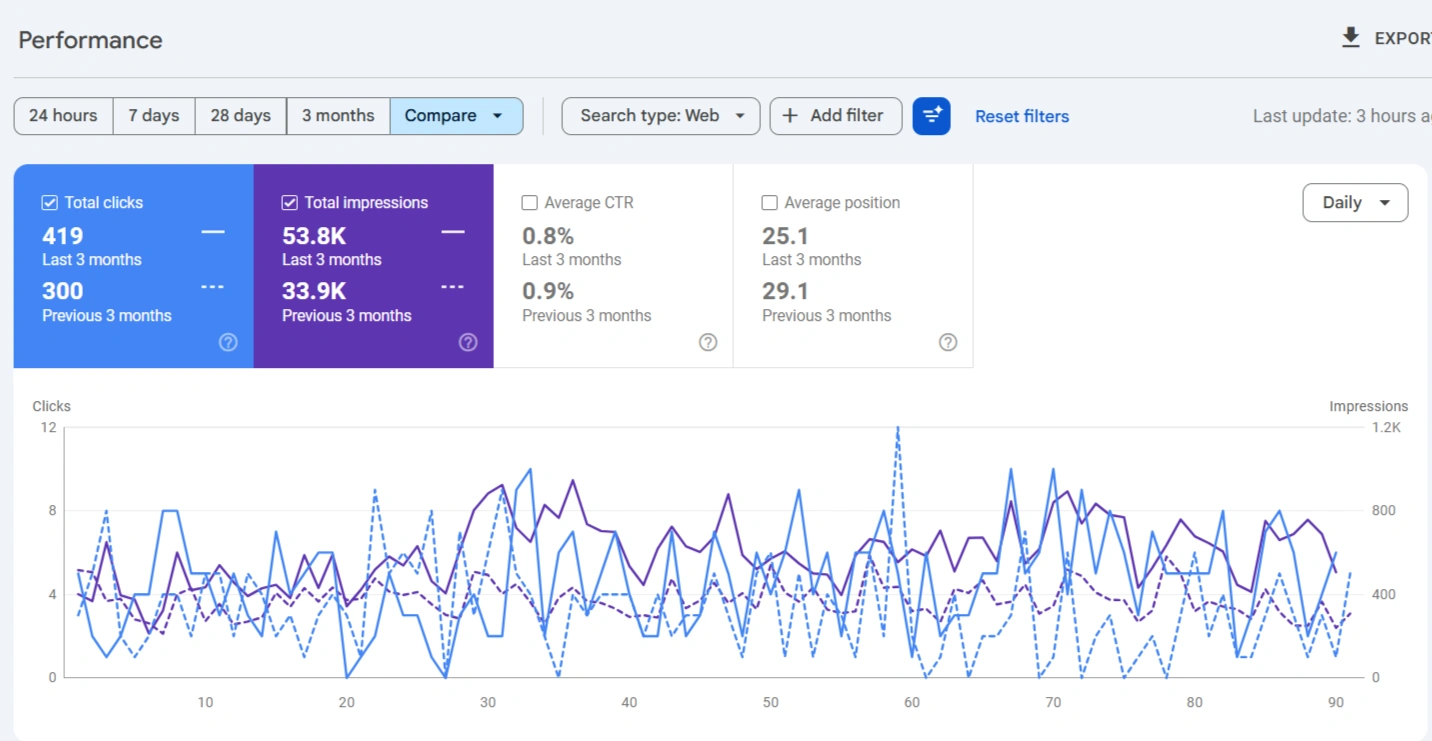
We helped our client, who already had a website but was struggling with bad performance. They had a high bounce rate, meaning visitors were leaving the site quickly, without exploring other pages. This was affecting their overall results and the generation of leads.
To resolve these issues, we redesigned their website, carefully preserving their SEO. The primary objective was to improve the site structure, decrease the bounce rate, and make the website more engaging so that more visitors stayed longer and converted into real inquiries.
The Results (Last 3 Months vs Previous 3 Months)
- +39% increase in total clicks (300 vs 419)
- +59% growth in total impressions (33.9K vs 53.8K)
- Average position improved from 29.1 to 25.1 (higher rankings across key service pages)
Trust SEO Discovery for Secure Website Redesign SEO Results
Website redesign SEO is not just about an updated appearance for your site, it’s about enhancing your performance, maintaining your search rankings, and making sure your content is still visible to the right audience. With a well-planned approach, you won’t lose traffic during the transition. Instead, you’ll gain better speed, structure, and user experience.
At SEO Discovery, we handle website redesign with a strong SEO-first strategy, using digital pr services, guest posting services, and GMB services to protect rankings, enhance visibility, maintain traffic, and ensure your website performs better post-redesign.
Planning a redesign? Contact us today to avoid ranking drops and make your website redesign SEO-safe and growth-focused.
FAQs About Website Redesign SEO
Not always. By following a well-planned SEO process during your website redesign, including proper redirects and content preservation, you can maintain or improve your rankings after the launch.
Small dips will recover in 2-6 weeks. Big drops from missing redirects or deleted content can take 3-6 months to recover fully.
Run a full audit, map URLs, set proper 301 redirects, preserve content, test on staging, and monitor performance after launch.
Auditing all URLs and creating a redirect map, backing up your metadata, testing on staging, and submitting a new sitemap at launch are all ways you can migrate a website without losing SEO.
Only change URLs for an exceptionally well-strategic reason. Every URL change is a risk to ranking equity, even if you have a proper 301 redirect in place.
The most reliable tools for a thorough SEO for website redesign audit are Google Search Console, Ahrefs, Screaming Frog and Semrush.
A staging site is a private copy of your website for development. It needs to be blocked from Google in order to avoid duplicate content penalties while building.
Yes. SEO Discovery provides a full SEO website migration service, including audits, redirect mapping, technical checks, and post-launch monitoring for businesses of all sizes.