

Objective
This blog explains how AI for healthcare is transforming lead generation and SEO by improving visibility, targeting patient intent, and sharing seven actionable strategies, metrics, and insights for generating qualified healthcare leads.
- AI improves healthcare SEO by analyzing patient search intent with accuracy.
- Local SEO automation improves Google Maps ranking for clinics.
- AI-powered content optimization enhances relevance and search performance.
- Use predictive analytics to identify high-value patients who are likely to convert.
- Chatbots automatically capture and convert patient leads 24/7.
Get More Qualified Healthcare Leads with AI-Powered SEO Solutions from SEO Discovery, Starting at $250/Month
AI for healthcare lead generation and SEO helps healthcare providers convert their online visibility into qualified patient leads. AI helps practices attract the right audience and generate more healthcare leads by understanding patient intent, optimizing content for AI-powered search, improving local search presence, and strengthening E-E-A-T signals.
Did You Know? According to SE Ranking, nearly 30% of users rely on AI responses as a second opinion for healthcare-related queries.
People often begin their search for healthcare services online when they are in need. They check for symptoms, compare doctors, and read reviews and treatment options before deciding who to contact. If your practice doesn’t come up in that process, potential patients may opt to see another provider instead. AI-powered healthcare SEO makes your practice discoverable when patients are actively looking for answers and care.
In this guide, we will cover what AI-powered SEO means for healthcare, how it’s different from traditional SEO, 7 strategies that generate real leads, and how to measure results. Continue reading until the end.
- What is AI in healthcare SEO, and why is it critical for lead generation?
- How AI differs from traditional SEO for healthcare
- How is AI used in healthcare SEO? 7 strategies that generate leads
- How to analyze AI for healthcare SEO results
- Turn online searches into patient appointments with SEO Discovery
- How we helped a healthcare business grow with AI-powered SEO
- FAQs about AI for healthcare SEO
What is AI in healthcare SEO, and why is it critical for lead generation?
AI for healthcare applies machine learning and natural language processing to increase the visibility of healthcare websites in search results. It studies complex patient search behavior, determines intent, and optimizes content accordingly, helping providers deliver more relevant information and achieve results that go far beyond traditional manual SEO efforts.
Key benefits of AI in healthcare SEO:
- Understanding patient intent: AI goes beyond keywords to understand the intent of searches and match patient questions with the most relevant health care content.
- Strengthening E-E-A-T signals: AI helps identify weak or outdated content, making it easier to maintain expertise, authority, and trust across healthcare websites.
- Identifying high-value searches: AI analyses thousands of search queries to identify search terms that result in patient inquiries and appointment bookings.
- Supporting YMYL compliance: AI helps healthcare websites maintain content quality standards required for sensitive health-related topics and medical information.
- Focusing on lead generation: The leading SEO firm for healthcare companies uses AI to create strategies that attract patients with genuine treatment intent, not just website traffic.
How AI differs from traditional SEO for healthcare
Traditional SEO is based on manual research, periodic updates, and keyword density. AI SEO constantly monitors, adapts, and optimizes, giving healthcare providers a real competitive edge in a crowded search landscape.
Factor | Traditional SEO | AI-Powered SEO |
Keyword Research | Manual, slow | Automated, intent-clustered |
Content Optimization | Keyword density | NLP-based, semantic |
Technical Audits | Periodic checks | Continuous monitoring |
Local SEO | Manual updates | Automated NAP and GBP services |
Lead Quality | Mixed traffic | High-intent patients |
How is AI used in healthcare SEO? 7 strategies that generate leads
Understanding AI use in healthcare is more than automation. It helps healthcare providers increase search visibility, reach the right audience, and generate qualified patient leads. Here are seven ways that make it possible.
1. AI-powered keyword research that matches patient intent
Patients don’t search as marketers write. AI-powered keyword research charts the entire patient journey from initial symptom to ultimate booking decision, revealing high-converting queries that manual research consistently misses.
This occurs in three ways:
- Target every patient stage: AI figures out keywords for the awareness and decision stage, helping healthcare providers to connect with patients as they go through their search journey.
- Prioritize high-intent keywords: AI tools evaluate thousands of keyword variations to identify the searches most likely to generate patient inquiries.
- Build full-funnel visibility: AI clusters keywords by patient intent and helps mobile, local, and healthcare SEO efforts achieve better visibility.
Pro tip: Group keywords by patient journey phase. Focus on decision-stage keywords, as these patients are typically ready to book.
2. AI content optimization for medical pages
Another challenge is publishing content that ranks, builds trust, and converts patients. AI-powered content marketing and content optimization is the process of finding out exactly what Google rewards on top-ranking medical pages, helping healthcare providers fill content gaps and build pages that perform better in search results.
This is how it works:
- Improve content relevance: AI detects missing medical topics and related terms, helping healthcare content better align with search intent and patient needs.
- Strengthen trust signals: AI identifies missing credentials, author information, and clinical references that enhance higher E-E-A-T and content credibility.
- Optimize content performance: Before you publish, AI spots thin content, assesses page quality, and compares your content to the top competing pages.
Pro tip: Add a real doctor’s name and credentials as the author on each medical page. It creates trust and can help with rankings.
3. Local SEO automation for clinics and hospitals
More than patients searching locally, rely on local healthcare options. AI-powered local SEO services ensure your clinic shows up consistently in those searches and increase your visibility, generating medical healthcare SEO leads across every location automatically.
Here are some important local SEO insights:
- Google Maps optimization control: AI-powered optimization keeps your Google Business Profile fresh, keyword-focused, and optimized for local intent to help you get more visibility and leads.
- Competitor and reputation tracking: AI-powered GMB services analyze competitor profiles, monitor patient reviews in real time, and suggest compliant responses to improve rankings and trust.
- Technical local SEO accuracy: NAP consistency across directories is automatically checked and fixed, while mobile SEO ensures fast-loading pages for stronger local healthcare performance.
Pro tip: Regular Google Business Profile updates, such as health tips or offers, keep your clinic active, enhance visibility, and increase local rankings.
4. AI-powered technical SEO audits
In healthcare, a slow, broken, or badly built website loses patients before they’ve read a single word. AI-powered technical SEO services monitor your whole site 24/7, such as catching issues that kill rankings and conversions before they escalate.
Here are the main technical healthcare SEO highlights:
- Core web performance optimization: Using AI for healthcare, AI is constantly monitoring Core Web Vitals for fast loading speed, stable visuals, and smooth interactivity for better rankings and user experience.
- Structured data and content integrity: Medical schema markup is automatically implemented, while duplicate content is resolved across locations to avoid SEO conflicts and improve relevance.
- Site health and navigation strength: Technical audits identify crawl errors, broken links, and gaps in internal linking, resulting in a better site structure and improved patient navigation experience.
Pro tip: Run a Core Web Vitals check on your booking page first. Even a one-second delay can cut conversions by 7%, so fix it quickly.
5. AI-assisted healthcare content gap analysis
Leading SEO firms for healthcare companies don’t simply guess at the next content to create. They conduct AI-powered gap analysis to identify every topic your competitors are ranking for. They then create content clusters that own entire symptom and condition categories.
Below are competitor gap analysis insights
- Topic authority clustering strategy: AI establishes authority by creating strong topic clusters around a central condition like knee pain, including causes, treatments, surgery options, and recovery.
- Competitor gap and SERP insights: AI rapidly scans competitor content and keyword combinations to identify high-value gaps, such as featured snippets and People Also Ask opportunities.
- Structured healthcare content hubs: Condition-specific content hubs strengthen topical expertise signals, improve rankings, and make sure every piece of content aligns with clear SEO objectives and visibility.
Pro tip: Begin with your highest-earning service, then create supporting pages around it, and finally publish them all together to earn structured topical authority from Google.
6. Predictive analytics for high-converting patients
Not everyone who visits your website is the same. AI-powered predictive analytics analyzes behavioral data to identify which patient types, devices, and content paths lead directly to appointment bookings. It enhances AI for healthcare lead generation and SEO by prioritizing high-intent users.
Here are the key predictive SEO insights:
Patient conversion behavior insights: AI analyzes demographic data and identifies which age groups, conditions, and patient types generate the highest lifetime value for healthcare practices.
Device and funnel performance analysis: AI tracks mobile vs. desktop behavior and maps funnel drop-offs. It shows exactly where patients leave before appointment bookings are completed.
Data-based SEO strategy: AI links keyword research to actual appointment data from CRM to help optimize content, CTAs, and layouts for maximum healthcare lead generation.
Pro tip: Filter your GA4 data by organic traffic and check which service pages get the most form submissions, then focus more on them.
7. AI chatbots and conversational SEO for lead capture
A patient finds your page at 11 PM. No staff is available. They leave without booking. With conversational AI in healthcare, AI chatbots step in to capture leads 24/7 and turn real patient questions into valuable SEO content.
Below are essential chatbot SEO strategies
AI chatbot lead capture system: With AI chatbots, you can book appointments 24/7, capture leads after hours, and qualify patients by specialty, location, and insurance, thus increasing conversions.
Structured data and search visibility: FAQ schema from chatbot conversations increases presence in voice search, conversational queries, and Google AI Overview results.
Authority building and SEO amplification: Digital PR, guest posting, and link building can help you to get backlinks to your chatbot-supported pages and improve rankings and healthcare SEO authority overall.
Pro tip: Export your chatbot questions monthly and turn them into FAQ pages or blogs. They quickly rank for long-tail patient searches.
How to analyze AI for healthcare SEO results
Being visible on Google is not enough; what matters is patient bookings. Clear KPI tracking helps healthcare providers to understand the real SEO impact. Leading SEO services for the healthcare industry track the entire patient journey to deliver improved results.
Below is a simple breakdown of the key performance metrics.
KPI | What to Track |
Organic appointment requests | Form submissions from organic traffic |
Call tracking | Calls attributed to organic (not paid) |
Cost-per-lead | SEO lead cost vs. PPC lead cost |
Local pack rankings | Position in Google Maps for target cities |
Organic patient segment traffic | Visits from high-intent healthcare queries |
Tools to use: Google Analytics 4, Google Search Console, CallRail for organic call tracking, BrightLocal for local SEO, and CRM integration to connect leads back to their SEO source
How we helped a healthcare business grow with AI-powered SEO
Our healthcare client had a completely functional website but was struggling to attract new patients online. They were invisible on Google Search and Google Maps. Visits were only through word of mouth, with no digital presence or lead generation.
We performed a thorough SEO for healthcare audit and built a custom strategy from the ground up. Our focus was on local SEO, dedicated service page creation, Google Business Profile management, citation cleanup, and a consistent review generation process.
The results:
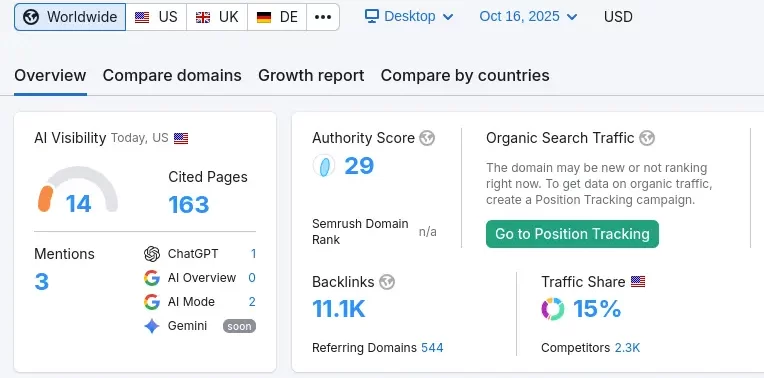
- AI Visibility reached 14, with 163 cited pages now live online.
- Authority score climbed to 29, improving domain strength against healthcare competitors.
- Backlinks grew to 11.1K, supported by 544 strong referring domains.
- ChatGPT cited the client earning direct mentions inside AI-generated search responses.
- Google AI Mode delivered 2 mentions, placing the brand inside AI-powered answers.
- Traffic share reached 15%, competing confidently against 2,300 active domain competitors.
Turn online searches into patient appointments with SEO Discovery
AI in Healthcare SEO enables medical practices to attract qualified patients by improving search engine visibility, targeting high-intent keywords, and optimizing content for AI-powered search. It focuses on increasing appointment bookings, growing your local presence, and ensuring your healthcare website is found by patients looking for treatment and medical services online.
At SEO Discovery, we provide the best SEO services designed specifically for healthcare businesses that want measurable growth. We use AI-driven strategies, including keyword research, content optimization, technical SEO, and local search enhancement to improve rankings and convert traffic into real patient leads. We specialize in consistent leads, more robust online authority, and long-term digital success for healthcare providers.
Contact us today to grow your healthcare practice with proven SEO strategies that bring real patient appointments.
FAQs about AI for healthcare SEO
It’s using machine learning tools to help healthcare websites rank higher, get found by patients searching online, and turn organic traffic into actual appointment bookings without relying solely on paid advertising.
They use AI-powered keyword research, local SEO automation, and E-E-A-T content strategies to improve search visibility and produce a continuous flow of qualified patient leads.
Most healthcare websites see measurable local ranking improvements within 60 to 90 days. Significant lead volume growth typically builds between three and six months of consistent effort.
It ensures that your clinic appears on Google Maps and in local search results when nearby patients search for your specialty. It helps make calls, get directions, and book appointments right from those searches.
Yes. AI SEO is scalable. Even single-location practices with a small marketing budget can achieve great ROI by focusing on local SEO and content cluster strategy.
They answer patient questions, qualify leads by specialty and location, and allow appointment scheduling when office staff is not available, capturing leads 24/7.
They track organic appointment requests, call volume from organic traffic, cost-per-lead versus PPC, and local pack rankings, not just website session counts or keyword positions.
It shows you which symptom and condition topics competitors rank for that you don’t, so you can create targeted content clusters that snag high-intent patient searches before your competition does.