

Objective
This blog highlights the best keywords to use for SEO and explains how to find, evaluate, and use them effectively. It delivers marketers and business owners a clear, actionable keyword strategy to achieve real organic growth.
- Best keywords balance search volume, difficulty, intent, and business relevance.
- Long-tail keywords are easier to rank and convert higher for growing sites.
- Different businesses need niche keyword sets, not generic high-volume terms.
- AI search favors semantic, conversational, and entity-based keyword targeting today.
- Keyword placement, density, and linking directly impact overall SEO performance.
Get a Revenue-Focused Keyword Strategy Built for Business Growth from SEO Discovery, Starting at $250/month
The process of how to find the best keywords for SEO is not about targeting generic, high-traffic words like “shoes” or “marketing”. Instead, it targets long-tail, niche-specific keywords that fit the user intent, attract the right audience, have moderate search volume, less competition, and higher conversion potential.
Did You Know? According to Semrush, long-tail keywords represent the majority of Google searches.
Finding the right keywords is important because it helps you understand what your audience is really searching for. It helps you to focus your SEO on keywords that bring meaningful traffic, improve visibility and contribute to real business growth, not just random clicks.
In this guide, we will cover keyword types, selection signals, research steps, tools, business-specific keyword tips, and common mistakes to avoid, so continue reading till the end.
Table Of Contents
- What are SEO keywords, and why do they still matter in 2026?
- What makes a keyword the best keyword to use for SEO?
- What are the different types of SEO keywords?
- How do you find the best keywords for an SEO strategy?
- Which is the best keyword research tool for SEO?
- What are the best keywords to use for SEO by business type?
- How is AI search changing keyword strategy?
- How do you use keywords effectively in your content?
- Common mistakes to avoid when finding the best keywords for SEO
- How we helped a client increase organic visibility
- Build a high-converting keyword strategy with SEO Discovery
- FAQs about how to find the best keywords for SEO
What are SEO keywords, and why do they still matter in 2026?
SEO keywords are the words and phrases that people type into search engines when they are searching for information, products or services. They help link your content to the exact search phrases your audience uses.
Why do they still matter in 2026?
- Relevance signals: Keywords signal relevance to Google and help search engines understand the topics of pages and better match search intent.
- Buyer intent match: Keywords connect content to buyer intent, so you can be sure your page answers exactly what users are actively searching for.
- Targeted traffic: Keywords are a significant part of bringing in high-converting traffic, as they draw in users who are more likely to engage with your website, especially when you focus on the best keywords to use for SEO.
- SEO strategy foundation: Keywords are the core of your SEO strategy, guiding content, internal linking, and landing pages for better search performance.
What makes a keyword the best keyword to use for SEO?
Not all keywords deserve a place in your strategy. The best keywords to use for SEO share four measurable qualities.
The 4 keyword quality signals every SEO should check
- Search volume: The search volume is the number of times a keyword is searched for in a month. More volume can raise awareness, but relevance and intent matter equally.
- Keyword difficulty (KD): Keyword Difficulty tells you how difficult it is to rank for a keyword.” Avoid highly competitive terms for new websites, as the best SEO service providers hold the top positions.
- Search intent: Search intent shows us what people want when they search online. Aligning intent with quality SEO content writing results in better rankings, engagement and conversions.
- Business relevance: A keyword can generate traffic, but it needs to bring in potential customers. Always focus on words that are relevant to your products, services and goals.
|
Pro tip Assess all keywords for search volume, difficulty, intent, and relevance. Often, the best results are achieved with balanced keywords, not high-competition keywords. |
What are the different types of SEO keywords?
Knowing the types of keywords will help you create a well-balanced, high-performing strategy. Here is a breakdown of the different types of SEO keywords:
- Short-tail keywords: These are general keywords with one or two words, such as “SEO” or “shoes”. These keywords have a high search volume but are very competitive to rank for.
- Long-tail keywords: These are longer phrases, consisting of three or more words, such as “how to find the best keywords for SEO”. They target specific searches and generally provide higher conversion rates.
- Mid-tail keywords: These keywords contain two or three words and balance search volume with competition. Examples include “keyword research tools” and “local SEO strategy”.
- Informational keywords: These keywords often include words like “what”, “how”, “why”, or “guide”. They help bring in people who are looking for information and learning about a subject.
- Navigational keywords: These are the keywords that people search for when they want to visit a particular website or brand. For example, “Ahrefs login” or “SEO Discovery services.”
- Transactional keywords: These keywords have high purchase intent. Phrases like “hire an SEO agency” or “buy SEO services” indicate that users are ready to take action.
- Commercial investigation keywords: These are the keywords people use when they compare products or services before they make a decision. Examples are “Best keyword research tool for SEO” and “Ahrefs vs. Semrush”.
- Local keywords: These keywords combine a service with a location, such as “SEO agency in New York” or “local SEO services near me. ” They help businesses attract nearby customers.
How do you find the best keywords for an SEO strategy?
Finding the right keywords involves understanding search intent, competition and audience needs. Using best practices for keyword strategies in SEO can help you to increase your rankings, traffic and conversions.
Step 1: Start with seed keywords
Begin by brainstorming the essential words that describe your business, services, or subject matter. Build a strong starting keyword list by looking at your website navigation, customer language and competitor menus. This process helps to uncover relevant search terms that align with user intent and create a solid foundation for SEO strategy development.
|
Pro tip: Ask your sales or support team what words customers actually use to describe their problem. The best seed keywords are real customer language. |
Step 2: Use keyword research tools
Enter your seed keywords into the best keyword research tool for SEO to expand your list. Tools such as Google Keyword Planner, Ahrefs, Semrush and Google Search Console will show volume, difficulty and related terms. Google autocomplete and People Also Ask are free but often overlooked.
|
Pro tip: Don’t export the entire list and then forget about it. Sort by keyword difficulty and then filter by intent. The best opportunities are in the areas of low difficulty and clear commercial or informational intent. |
Step 3: Analyze competitor keywords
Find keywords that your competitors rank for, but you do not. Study these gaps and identify real opportunities to compete effectively. Focus on their low-difficulty, high-intent keywords first because they are easier to rank for and deliver faster results than going after the more competitive and high-value search terms later on.
|
Pro tip: Don’t aim for all the keywords your competitor ranks for. Focus only on phrases where the ranking page is thin, out of date or poorly written. Those are your best opportunities. |
Step 4: Filter by intent, not just volume
See which pages rank highest for any keyword you want to target. Google is showing product pages, but your content is a blog post, so the intent is not the same. Always match your content type to what Google is already rewarding for that keyword. It also helps you determine the best number of keywords for SEO without keyword stuffing your content.
|
Pro tip: Search your target keyword in an incognito browser and study the first three results. If they all follow the same format, match it. If they differ, you have the opportunity to improve your approach. |
Step 5: Prioritize With a Keyword Gap Analysis
Separate keywords into three buckets: quick wins (low KD, clear intent), medium-term targets (moderate KD, high relevance), and long-term goals (high KD, high value). Build toward the hardest terms while ranking for the easiest ones first. As you create content, maintain the best keyword density for SEO to keep your pages optimized without keyword stuffing.
|
Pro tip: Start publishing content for your quick-win keywords immediately. Early rankings build domain authority faster, which makes it easier to compete for tougher terms later. |
Which is the best keyword research tool for SEO?
The right tool can save you hours of research and expose opportunities your competitors miss. Here are the top choices:
|
Tool |
Best For |
Cost |
|
Google Keyword Planner |
Volume and CPC data |
Free |
|
Ahrefs |
Competitor research, KD scores |
Paid |
|
Semrush |
Full keyword audit and gap analysis |
Paid |
|
Google Search Console |
Actual queries driving your traffic |
Free |
|
Ubersuggest |
Beginner-friendly keyword ideas |
Free/Paid |
|
AnswerThePublic |
Question-based keyword discovery |
Free/Paid |
The best keyword research tool for SEO depends on your goals and budget. For agencies and growing businesses, Ahrefs and Semrush provide the most complete picture. If you are a beginner, Google’s free tools are a good, reliable place to start.
What are the best keywords to use for SEO by business type?
Depending on the industry, some keywords perform better than others. Understanding the best number of keywords for SEO helps improve relevance and target the right audience. Here are the keywords for different industries.
Best keywords for a small business
Small businesses often see better results if they target local and long-tail keywords rather than broad keywords. Combining services with locations draws in local customers and creates qualified leads. For example, property sector businesses can improve visibility by focusing on the best SEO keywords for real estate.
Best keywords for ecommerce
Ecommerce sites should target product-specific, category and buyer-intent keywords that match what shoppers are searching for on the web. Pricing, reviews and comparison keywords convert much better. The best keyword research tool for SEO can help you discover valuable opportunities.
Best keywords for B2B
B2B companies should target keywords that reflect their industry expertise, business challenges and buying decisions. These searches are generally lower volume but higher intent. Focusing on solution-focused, comparison, and ROI-based terms can help bring in decision-makers actively considering products or services.
Best keywords for service-based businesses
Local and transactional keywords are well-suited for service businesses that match customer needs and search intent. Industry-specific keywords can help with visibility and lead generation. For example, photographers can attract more relevant traffic by targeting the best SEO keywords for photographers.
How is AI search changing keyword strategy?
AI-based search is changing the way Google understands content. Now it’s not enough to repeat the same keywords. Intent, context and structure are important for AI search.
- Semantic search growth: Google understands topics and related terms better than before, reducing the importance of exact-match keyword optimization.
- Conversational search rise: Now, more users are searching with natural language questions like how do I find the best keywords for SEO, especially through AI assistants and voice search.
- AI overview visibility: AI-generated search results are more likely to feature structured content, with clear answers and organized sections.
- Topic authority matters: Covering a topic over multiple pages is a way to show your expertise and makes it easier to rank for more keywords than focusing on individual keywords.
This is where AI SEO services play a growing role. To optimize for AI-powered SERPs, you need to use a combination of semantic keywords, structured content and robust E-E-A-T signals.
How do you use keywords effectively in your content?
Knowing how to pick the best SEO keywords is half the work. Selection is important, but so is placement. Here are some best practices for keyword placement:
- Strategic keyword placement: Use your main keyword in your H1, first paragraph, at least one H2, and conclusion. Naturally, use secondary keywords throughout the content.
- Avoid keyword stuffing: Do not force multiple keywords into the same sentence or section. The best keyword density for SEO is generally between 1% and 2%.
- Optimize meta elements: Use your main keyword in the meta title and description. The best meta keywords for an SEO approach are those that attract clicks rather than keyword stuffing.
- Natural content structure: Effective SEO content writing and internal linking help search engines to understand your content, and also improve the user experience and engagement.
Common mistakes to avoid when finding the best keywords for SEO
Avoiding common mistakes in keyword research improves rankings, traffic, and overall SEO performance. Here are the mistakes to avoid when finding the best practices for keyword strategies in SEO.
- Chasing the wrong keywords: Targeting just high-volume keywords can be hard to rank for. Also, don’t forget long-tail keywords, which can bring in more targeted traffic and conversions.
- Ignoring user intent: If you rank for keywords that don’t match your content, it can increase your bounce rates and decrease engagement. Always choose keywords relevant to what users expect to find.
- Poor keyword optimization: Keyword stuffing and having the same keyword on many pages can hurt performance. Use keywords naturally and assign a primary keyword to each page.
- Failing to update strategy: Search trends are ever-changing. Analyze keyword performance regularly, find gaps in competitor keywords and don’t attract the wrong audiences with badly targeted keywords.
How we helped a client increase organic visibility
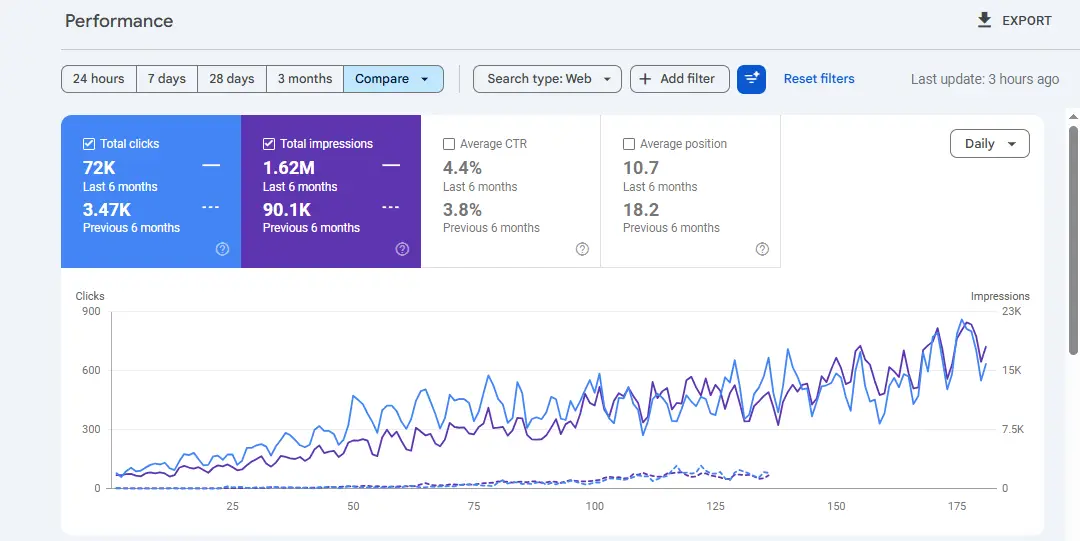
One of our clients was struggling with low search visibility and little organic reach. They had no keyword targeting on their content, and their pages weren’t receiving consistent traffic. Impressions were low, and clicks were negligible. Their average position was below the first page of search results.
We conducted a full audit of their keyword research and rebuilt their content marketing strategy around high-opportunity, intent-matched keywords. We improved on-page elements, enhanced internal linking and published structured SEO content writing targeting both informational and transactional queries on their core service pages.
The results:
- Total clicks grew to 72K in the last 6 months.
- Total impressions reached 1.62M over the past 6 months.
- Average CTR improved from 3.8% to 4.4% across the site.
- Average position strengthened from 18.2 to 10.7 in search results.
Build a high-converting keyword strategy with SEO Discovery
The right keywords do not just bring traffic. They bring the right traffic. Every ranking you earn, every click you get, and every lead you convert starts with choosing keywords that match what your audience actually wants at that exact moment.
SEO Discovery has helped hundreds of businesses build keyword research strategies that go beyond rankings and drive real revenue. Whether you need to identify the best SEO keywords for jewellery, find the best SEO keywords for architects, or build a full commercial keyword map for a B2B brand, our team builds strategies around your goals, not vanity metrics.
Contact us today to build a keyword strategy that generates traffic, leads, and real business growth.
FAQs about how to find the best keywords for SEO
If you’re just getting started, you should be targeting long-tail keywords with low difficulty and clear intent. They have less competition, rank faster and attract audiences who are already ready to make a purchase or inquiry decision.
Target one keyword per page and add three to five semantically related secondary keywords. If you try to target too many primary terms on just one page, your ranking signals get decreased a lot.
The best keyword density for SEO is between 1% and 2%. Anything higher risks over-optimization penalties. Focus on natural placement within helpful, well-structured content rather than hitting a fixed number.
Short-tail keywords are broad terms, such as “SEO.” Long-tail keywords are search phrases like “how to pick the best keywords for SEO” that bring more targeted, conversion-ready traffic and have less competition.
Assess four signals: monthly search volume, keyword difficulty, search intent match, and business relevance. Sometimes, a low-volume keyword with a perfect intent match can beat a high-traffic mismatched term.
The most comprehensive paid tools are Ahrefs and Semrush. Google Keyword Planner and Google Search Console are two powerful free options. The best keyword research tool for SEO depends on your budget and how deep you want to go.
Review your keyword strategy at least every quarter. Algorithm updates, competitor movements, and shifting search trends all affect rankings. Consistent optimization separates top performers from sites that plateau after initial gains.
SEO Discovery uses competitor gap analysis, intent mapping and a custom scoring framework to build keyword strategies. Each recommendation matches rankings with real business revenue goals, not just traffic volume numbers.
Ahrefs provides AI citation tracking through its Brand Radar tool, which monitors domain-level and URL-level citations across selected AI platforms. Access to broader AI visibility features may require higher-tier subscription plans. These Ahrefs AI citation analysis features help businesses monitor their AI search presence.
SE Ranking and Profound are popular options for agencies managing multiple client accounts. They offer scalable reporting, competitor tracking, and citation monitoring features that support larger AI SEO campaigns. They are widely recognized as citation analysis services for AI SEO at scale.