


Objective
This guide explains how to create a Google Ads for Doctors SEO outline: a step-by-step plan for your campaign goals, keywords, landing pages, compliance, budget, and tracking, so your medical practice can turn clicks into booked patient appointments.
- A Google Ads for Doctors SEO outline is a structured plan that covers goals, keywords, ad copy, landing pages, compliance, budget, and tracking.
- Start with clear patient acquisition goals and a target cost per appointment before launching campaigns.
- High-intent, location-based keywords and negative keywords keep your budget focused on patients ready to book.
- Landing pages that match the ad, load fast on mobile, and show trust signals convert more clicks into appointments.
- Google restricts some healthcare ads, and Google Ads is not HIPAA compliant by default, so keep patient health data out of ads and tracking.
- LocaliQ’s 2026 benchmarks show physicians and surgeons average a 12.43% conversion rate and a $40.04 cost per lead on search ads.
- Aligning your Google Ads outline with SEO gives your practice both paid and organic visibility.
When patients need a doctor, most of them start with a Google search. Google Ads helps your practice appear at the top of those results, right when patients are ready to book. But without a clear plan, ad spend can disappear quickly with few appointments to show for it. That is why every practice needs a Google Ads for Doctors SEO outline.
Short answer: A Google Ads for Doctors SEO outline is a structured roadmap for your medical practice’s paid search campaigns. It defines your patient acquisition goals, high-intent local keywords, compliant ad copy, landing pages, budget, bidding strategy, and conversion tracking, and aligns them with your SEO so you rank in both paid and organic results.
Did You Know?
According to LocaliQ’s 2026 search advertising benchmarks, physicians and surgeons average a 6.61% click-through rate, a $4.76 cost per click, a 12.43% conversion rate, and a $40.04 cost per lead on search ads.
In this guide, we break down every part of a Google Ads for Doctors SEO outline, including strategy planning, healthcare ad policies, budget, bidding, common mistakes, and how to choose an agency, with a real case study from SEO Discovery.
Grow Your Medical Practice with Google Ads by SEO Discovery, Starting at $250/Month
Table Of Contents
- What Is a Google Ads for Doctors SEO Outline?
- How to Build a Google Ads for Doctors SEO Outline: 6 Steps
- Healthcare Ad Policies and HIPAA: What Doctors Must Know
- Case Study: 120+ Patient Conversions at $6.91 Per Lead
- Budget Planning: How Much Should Doctors Spend on Google Ads?
- Common Google Ads Mistakes Doctors Make
- Google Ads vs SEO for Doctors
- How to Choose a Google Ads Agency for Doctors
- Final Note
- FAQs
What Is a Google Ads for Doctors SEO Outline?
A Google Ads for Doctors SEO outline is a written plan that maps out every part of your medical practice’s Google Ads campaigns before you launch them. It also makes sure your ads and your SEO target the same patient searches, so both work together.
Google Ads itself is pay-per-click (PPC) advertising that shows your practice at the top of Google Search and Maps when patients search for services such as “pediatrician near me” or “same-day dermatologist.” You pay only when someone clicks.
A complete outline includes:
Outline Section | What It Covers |
Goals | New patients per month and target cost per appointment |
Keywords | High-intent, location-based, and negative keywords |
Ad copy | Compliant headlines, descriptions, and ad assets |
Landing pages | Message match, booking forms, trust signals, mobile speed |
Compliance | Google healthcare policies and HIPAA-safe tracking |
Budget and bidding | Monthly spend and smart bidding strategy |
Tracking | Calls, forms, bookings, and monthly reporting |
SEO alignment | Matching pages and keywords for organic visibility |
Why Your Google Ads Outline Should Align with SEO
Many practices run ads separately from their website SEO. When your paid ad services and organic SEO work together, your practice can appear in both paid and organic results for the same search. This increases visibility and builds patient trust faster.
For example, a concierge clinic running Google Ads for “concierge doctor near me” should also optimize its website for that phrase. Dedicated SEO for doctors helps your ads and organic listings support each other.
How to Build a Google Ads for Doctors SEO Outline: 6 Steps
Use these six steps as the core of your Google Ads for Doctors SEO outline. Each one builds on the last to bring in booked appointments, not just clicks:
1. Define Your Patient Acquisition Goals
Before launching ads, decide what success looks like for your practice.
Key steps:
- Set booking targets: Decide how many new patients you want each month, for example 50 new appointments.
- Set a target cost per appointment: Choose a realistic cost per booking based on the value of a new patient.
- Align ads with revenue goals: Focus spend on the services that matter most to your practice.
- Review monthly: Adjust goals based on conversion data and seasonal demand.

2. Conduct Thorough Keyword Research
Strong keyword research ensures your ads reach patients who are ready to book.
Key steps:
- Target high-intent keywords: Use phrases such as “cardiologist near me accepting new patients.”
- Use location-based terms: Include your city or neighborhood, such as “family doctor in [City].”
- Add specialty keywords: For example, naturopathic doctors can target “holistic health doctor near me.”
- Add negative keywords: Exclude irrelevant searches such as “jobs,” “salary,” “free,” or “veterinary.”
3. Build High-Converting Landing Pages
Your ads are only as good as the page they lead to. Professional landing page optimization turns more clicks into appointment requests.
Key steps:
- Match the ad message: Use a headline that matches the service in your ad.
- Keep booking simple: Use a short appointment form and a click-to-call button.
- Show trust signals: Add patient reviews, board certifications, and insurance information. Strong online reputation management supports this.
- Load fast on mobile: Aim for a page that loads in under three seconds. Learn more about page speed optimization.
4. Write Compelling, Compliant Ad Copy
Good ad copy speaks to patient needs while following Google’s healthcare policies.
Key steps:
- Address patient needs: For example, “Same-Day Appointments Available. Book Online Today.”
- Use credible language: Words such as “board-certified,” “trusted,” and “same-day” build confidence.
- Avoid misleading claims: Do not promise cures or guaranteed results.
- Use ad assets: Add call, location, sitelink, and callout assets to make your ad more useful and visible.
5. Set Up Conversion Tracking
Tracking shows which keywords and ads actually bring in patients.
Key steps:
- Track form submissions: Record completed appointment requests.
- Track phone calls: Use call assets and call tracking to measure calls from ads.
- Track chat and booking tools: Include online booking and live chat leads.
- Optimize with data: Use results to refine keywords, bids, and your wider PPC strategy.
6. Target the Right Location and Schedule
Most patients choose a doctor close to home or work. Target a set radius or ZIP codes around your practice, and schedule ads for the hours your team can answer calls and confirm bookings.
Struggling to Get Patients From Your Google Ads?
Fix your targeting, sharpen your budget, and start converting clicks into real appointments.
Healthcare Ad Policies and HIPAA: What Doctors Must Know
Short answer: Doctors can advertise on Google Ads, but healthcare ads must follow Google’s healthcare and medicines policies, and Google Ads is not HIPAA compliant by default. Never collect or share patient health information through ads, tracking tags, or remarketing lists.
- Restricted content: Some healthcare topics, such as prescription drugs and certain treatments, are restricted or require certification.
- No misleading claims: Ads must not promise cures or make unproven medical claims.
- Limited remarketing: Google limits personalized advertising based on health conditions, so avoid building audiences from visitors to condition-specific pages.
- Protect patient data: Do not send protected health information to Google Ads or analytics tools. Use HIPAA-compliant forms and booking systems.
- Review ad approvals: If an ad is disapproved, fix the policy issue and request a review.
This section is general guidance, not legal advice. Check Google’s current policies and consult a compliance expert for your practice.
Case Study: How We Helped a Medical Practice Generate 120+ Patient Conversions at $6.91 Per Lead

A medical practitioner approached SEO Discovery because their Google Ads campaigns were running but producing very few bookings, with a high cost per conversion and low visibility in local search.
We restructured the account with high-intent keyword targeting, optimized landing pages, negative keyword refinement, and smart bidding. Results improved within a single month.
Results (December 2025):
Metric | Result |
Clicks | 2,510 from targeted, high-intent medical keywords |
Conversions | 120+ |
Cost per lead | $6.91 |
Impressions | 128,000+ across local search results |
Wasted spend | Significantly reduced through negative keywords |
Budget Planning: How Much Should Doctors Spend on Google Ads?
Short answer: There is no single right budget. Your spend depends on your specialty, location, competition, and how many new patients you want. A simple way to plan is: monthly budget = target new leads × cost per lead. See our guide to Google Ads costs for more detail.
As a starting reference, LocaliQ’s 2026 benchmarks put the average cost per lead at $40.04 for physicians and surgeons and $72.97 for dentists and dental services.
Target New Leads per Month | Cost per Lead (2026 Benchmark) | Estimated Monthly Budget |
25 | $40 (physicians and surgeons) | $1,000 |
50 | $40 (physicians and surgeons) | $2,000 |
50 | $73 (dentists) | $3,650 |
Estimates are based on industry averages. Your actual costs will vary by specialty, location, and competition.
Start with a focused budget on your highest-value services, then scale what converts. Our PPC services for startups start from $250 per month.
Smart Bidding Strategies for Medical Ads
Smart bidding uses Google’s AI to set bids for each auction based on the likelihood of a conversion.
Bidding Strategy | How It Works | Best For |
Maximize Conversions | Gets as many conversions as possible within your daily budget | New campaigns with conversion tracking in place |
Target CPA | Aims for a set average cost per conversion | Practices with steady conversion data and a clear cost goal |
Maximize Conversion Value / Target ROAS | Focuses on higher-value conversions | Practices that assign different values to services |
Manual CPC | Gives you full control over bids | Very small budgets or testing |
Note: Google retired Enhanced CPC for Search and Display campaigns in March 2025, so most practices now use the strategies above. A Google Ads management services team can help you choose the right one.
Want More Patients Booking Through Google Ads?
Partner with SEO Discovery for a data-driven ad strategy with real results.
Common Google Ads Mistakes Doctors Make
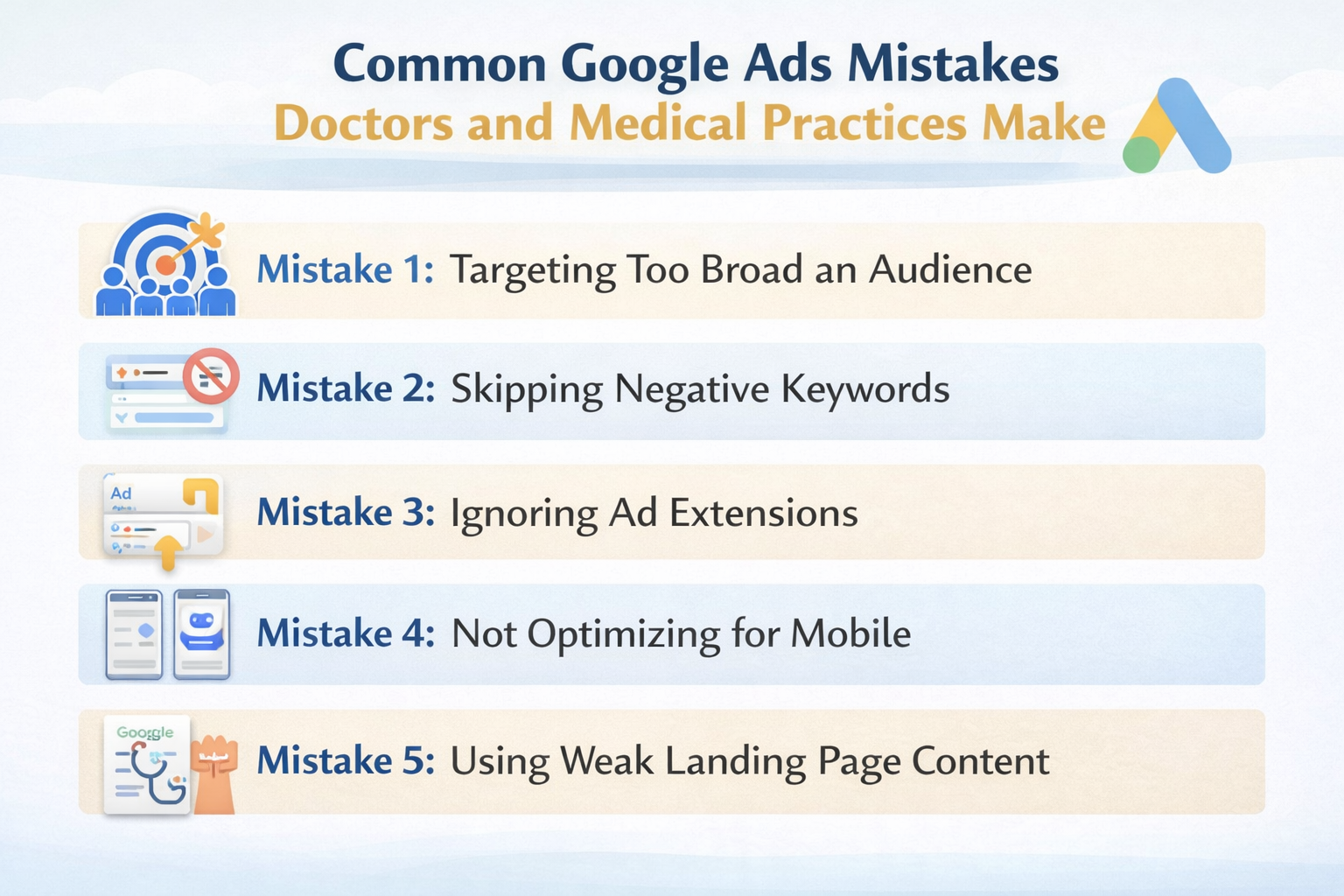
Mistake 1: Targeting Too Broad an Area
Showing ads far outside your service area wastes budget. Target a radius, city, or ZIP codes near your practice.
Mistake 2: Skipping Negative Keywords
Without negative keywords, ads can appear for irrelevant searches. A cardiologist, for example, may want to exclude “pet,” “veterinary,” “jobs,” and “salary.”
Mistake 3: Ignoring Ad Assets
Call, location, sitelink, and callout assets make your ad larger and more useful at no extra cost. Skipping them lowers visibility and clicks.
Mistake 4: Not Optimizing for Mobile
Many patients search for doctors on their phones. Make sure your landing pages load fast, display well on small screens, and have an easy click-to-call button.
Mistake 5: Weak Landing Page Content
Generic or thin content hurts conversions. Use clear, patient-focused SEO content writing that answers common questions and builds trust.
Mistake 6: Ignoring Compliance
Collecting health details through ad forms or using health-based remarketing can create policy and privacy risks. Keep ad tracking free of patient health information.
Google Ads vs SEO for Doctors
Both channels help patients find you, but they work differently:
Factor | Google Ads | SEO |
Speed | Results can start within days | Usually takes several months |
Cost | Pay for each click | No cost per click, but needs ongoing investment |
Placement | Top of search results and Maps | Organic results and Google Maps listings |
Longevity | Stops when spending stops | Can keep bringing traffic long term |
Best use | Fast appointments and new services | Long-term visibility and trust |
The best results usually come from using both. Combine paid campaigns with SEO optimization strategies, local SEO, and an optimized Google Business Profile to cover every stage of the patient journey.
How to Choose a Google Ads Agency for Doctors
Not every advertising agency understands healthcare. Look for a partner with these qualities:
What to Look for in a Medical Google Ads Agency
- Healthcare experience: Case studies from medical clients with clear results.
- Compliance knowledge: Understanding of Google’s healthcare policies and HIPAA-safe tracking.
- Transparent reporting: Clear monthly reports on spend, leads, and cost per appointment.
- Full-service support: PPC, landing pages, content, and technical SEO under one roof.
- Google Partner status: A sign the agency meets Google’s performance standards.
Questions to Ask Before Hiring
- Have you managed Google Ads for doctors or medical practices before?
- How do you keep campaigns compliant with Google’s healthcare policies and HIPAA?
- How do you measure and improve cost per appointment?
- Do you offer white label Google Ads services for multi-location practices?
- How do you handle smaller budgets for new or growing practices?
Stop Running Google Ads Without a Strategy
Plan smarter campaigns, control your budget, and turn clicks into confirmed appointments.
Final Note
A clear Google Ads for Doctors SEO outline turns guesswork into a repeatable system. Set measurable goals, target high-intent local keywords, build fast and trustworthy landing pages, follow healthcare ad policies, and track every conversion.
Review your outline every month, scale the services that convert, and keep your ads aligned with SEO for long-term visibility.
If you want expert support, SEO Discovery is a digital marketing company that helps medical practices plan, launch, and optimize Google Ads campaigns. Explore our Google Ads management services to see how we can help you book more patients.
Ready to Book More Patients with Google Ads?
Get expert digital marketing support tailored to your medical practice.
FAQs About Google Ads for Doctors SEO Outline
It is a structured plan for a medical practice’s Google Ads campaigns. It covers goals, keywords, ad copy, landing pages, compliance, budget, bidding, tracking, and how the campaigns align with SEO.
Include patient acquisition goals, high-intent and negative keywords, compliant ad copy and assets, optimized landing pages, HIPAA-safe tracking, a monthly budget, a bidding strategy, and matching SEO pages.
According to LocaliQ’s 2026 benchmarks, physicians and surgeons pay an average of $4.76 per click and $40.04 per lead on search ads. Your actual costs depend on specialty, location, and competition.
Yes. Doctors and medical practices can advertise on Google Ads, but ads must follow Google’s healthcare and medicines policies. Some topics, such as prescription drugs, are restricted.
Google Ads is not HIPAA compliant by default. Do not collect or send protected health information through ads, tracking tags, or remarketing lists, and use HIPAA-compliant forms and booking tools.
Combine high-intent local keywords, negative keywords, compliant ad copy, fast mobile landing pages, conversion tracking, and smart bidding such as Maximize Conversions or Target CPA.
Use specialty and location keywords with booking intent, such as “pediatrician near me,” “dermatologist in [City],” or “same-day doctor appointment,” and add negative keywords to block irrelevant searches.
Use location targeting by radius, city, or ZIP code, add location and call assets, and connect your Google Business Profile so your ads show your address and directions.
Yes. Naturopathic doctors can advertise, but ad claims must be accurate and follow Google’s healthcare policies. Focus on services, credentials, and local keywords.
Ads can start generating clicks within days. Most campaigns need a few weeks of data to optimize bids and keywords for consistent, cost-effective appointments.
Google Ads delivers fast, paid visibility at the top of search results, while SEO builds long-term organic rankings. Using both gives your practice the strongest overall visibility.
Not always, but an experienced healthcare agency can save time, avoid policy issues, and improve cost per appointment through better targeting, tracking, and landing pages.