

Objective
This blog highlights how long SEO typically takes to show results and why patience is essential for long-term success. It also covers the key factors, realistic timelines, and applicable strategies to speed up your SEO growth without compromising quality.
- Most websites start seeing SEO results within 3 to 6 months with consistent optimization efforts.
- New domains take longer to rank due to limited authority and the Google Sandbox effect.
- Technical SEO health, content quality, and strong backlinks significantly influence how fast your rankings improve.
- Consistent long-term SEO efforts build momentum, leading to exponential traffic and ranking growth after twelve months.
- Targeting long-tail keywords and fixing technical issues early helps accelerate SEO progress and improve rankings faster.
Get Faster SEO Results Without Compromising Quality with SEO Discovery, Starting at $250/Month.
Most websites begin seeing SEO results within 3 to 6 months, while highly competitive industries can push that timeline to 12 months or more. SEO speed depends on several factors, such as current technical health, content quality, niche competition, and more.
Did you know? According to a report by Research And Markets, the search engine optimization services market size is expected to grow to $203.83 billion in 2030.
This shows the growing importance of SEO for businesses. Yet many of them wonder how long it takes for SEO to work. The timeline isn’t always instant, whether you’re a small business trying to reach customers in your neighborhood or a brand competing on a national level.
This guide breaks down exactly how long does it take for SEO to work, what slows it down, and what you can do to move faster without risking your rankings. So, read until the end.
Table Of Contents
- How Long Does SEO Take to Work?
- Why Does SEO Take Time?
- Key Factors That Decide How Long SEO Takes for Your Site
- How We Improved SEO Speed and Online Visibility for Our Client
- Month-by-Month SEO Timeline: What to Expect
- How to Speed Up SEO Without Compromising Quality
- Start Your SEO Journey with SEO Discovery Today!
- FAQs About How Long Does It Take For SEO To Work
How Long Does SEO Take to Work?
Here is a quick breakdown of how long does SEO takes for different types of websites:
Website Type | Expected Timeline |
New domain (no authority) | 6 to 12 months |
Established site (some backlinks) | 3 to 6 months |
Competitive niche (finance, legal, health) | 12 to 24 months |
Local business with Local SEO services | 3 to 4 months |
Low-competition niche | 2 to 4 months |
Trust is the main thing that sets a new domain apart from an old one. Before putting you on page one, Google needs time to crawl your site, assess your content, and evaluate your backlink profile.
New websites often face a delay in gaining visibility, known as the Google Sandbox effect. This is an undefined period of time, usually 1 to 3 months, during which new websites may not rank well in search results.
On the other hand, a well-known domain with a history of good content might start seeing results 30 to 90 days after fresh optimization.
Why Does SEO Take Time?
Google’s algorithm uses more than 200 factors to decide whether to rank a website or not. These include technical SEO, content quality, backlinks, and user experience. SEO is an incremental process. Before new pages can move up in the search results, they need to be found, crawled, and indexed.
Beyond that, here is why SEO takes time:
- Building trust: Google treats your domain like a new employee. It needs months of consistent, quality work before giving you bigger responsibilities (better rankings).
- Backlinks take time to build: It takes time to get links from trustworthy websites. Content marketing, guest posting, digital PR, and building relationships are all parts of it.
- Algorithm updates: Google makes hundreds of changes to Google’s ranking algorithms every year. Your rankings can shift, requiring fresh adjustments.
- Competition: Your competitors are also investing in SEO content writing, building links, and fixing bugs.
Understanding why SEO takes time helps you stop chasing shortcuts and start building something that lasts.
Struggling with Slow SEO Growth?
Improve crawlability, content performance, and rankings with expert SEO.
Key Factors That Decide How Long SEO Takes for Your Site
It takes time for SEO to work, but not all websites need the same amount of time. The following factors directly affect your timeline.
1. Domain Age and Website Authority
Domain age isn’t just a number. For search engines, it shows a history of trust. Sites that regularly offer value, keep their reputations clean, and get high-quality backlinks have a significant advantage in search rankings.
Here is how established authority impacts your growth:
- Faster Ranking Results: Websites with years of organic history and traffic can often see significant SEO improvements in about 3 months.
- Trust-Based Growth: Google tends to reward older domains that have avoided penalties, allowing them to rank for competitive terms more easily.
- The “Sandbox” Period: Brand-new domains often face a waiting period of 6 to 12 months before they can fully compete for top-tier search results.
2. Competition Level in Your Niche
The crowdedness of your industry directly dictates the timeline for seeing significant SEO results. In some industries, you can grow quickly, but in others, you need to commit to the long term if you want to stand out from the established players.
Here is how market competition influences your search engine performance:
- Geographic Advantage: Local service providers often experience quicker wins because their competition is naturally limited to a specific physical area.
- Sector Difficulty: Industries like finance or healthcare face intense global competition, requiring much more time to establish the necessary authority to rank.
- Click-Through Reality: The top organic result captures approximately 27.6% of all clicks, whereas the second page receives less than 1% of user attention.
- Resource Requirements: High-competition niches demand more sophisticated link-building strategies and the development of extensive, authoritative content clusters.
3. Technical SEO Health
Technical SEO is the foundation for your website’s visibility. It includes important things like fast site speed, mobile optimization, structured data, and secure protocols. Even the highest quality content will struggle to gain traction in search rankings.
Here is how technical performance dictates your ranking timeline:
- Speed and Performance: Slow page load times directly hinder your ability to rank, as search engines prioritize a seamless user experience.
- Crawlability and Indexing: Unresolved crawl errors and broken internal links act as roadblocks, preventing search bots from correctly mapping your site.
- Mobile-First Indexing: A poor mobile experience can significantly delay your progress, as Google primarily uses the mobile version of content for indexing.
- Security and Trust: Implementing secure protocols like HTTPS is a non-negotiable standard that builds immediate trust with both users and search engines.
4. Content Quality and Strategy
Content is the main thing that makes people find you in search results. Publishing content without a plan makes it difficult to gain better rankings. However, generating a high quality of content without thinking about what’s valuable usually leads to digital noise instead of actual results.
Here is how a focused content strategy improves your SEO performance:
- Strategic Consistency: Publishing one high-quality, well-researched post per week consistently outperforms a rushed schedule of mediocre content.
- Topical Authority: Search engines reward websites that cover subjects in great depth, establishing them as a go-to resource in their niche.
- User-Centric Results: Clear and complete answers to specific user questions ensure higher engagement and lower bounce rates.
- Structural Optimization: Using a robust internal linking strategy helps both readers and search crawlers navigate your site more effectively.
5. Backlink Profile
Backlinks are still one of the best ways for search engines to figure out how trustworthy a website is. When it comes to search engine competition, a domain with a wide range of high-quality referring links will always do better than sites that don’t have external validation.
Here is how a strategic backlink profile improves your rankings:
- Signal of Credibility: Each high-quality link acts as a “vote of confidence” from another site, telling search engines that your content is trustworthy.
- Faster Authority Gains: Earning links from established, high-traffic domains can significantly reduce the time it takes for new pages to reach the first page.
- Referral Traffic Growth: Beyond SEO, well-placed links on niche-relevant sites drive direct, qualified traffic to your business.
- Equity Reclamation: Identifying and fixing broken links allows you to recover lost authority and ensure your “link juice” flows correctly to active pages.
6. Budget and Resources
How quickly you can see clear search engine growth depends on how much you spend. A limited budget often results in slower content creation, fewer high-impact link building services, and delayed technical improvements, all of which extend your waiting period.
Here is how resource allocation influences your SEO speed:
- Specialized Expertise: Access to dedicated SEO teams ensures that technical audits, keyword research, and strategy execution happen simultaneously rather than in stages.
- Content Scaling: Higher investment allows for the consistent production of high-quality, long-form content that builds topical authority at a faster pace.
Aggressive Link Acquisition: Greater resources enable more extensive outreach and digital PR campaigns, which are essential for competing in high-difficulty niches.
How We Improved SEO Speed and Online Visibility for Our Client
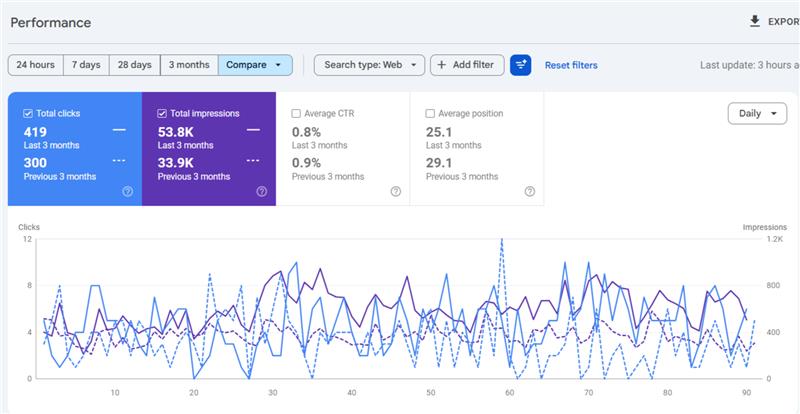
To help our client achieve faster SEO results, we focused on removing the key bottlenecks that were slowing down their growth. We began with a complete technical audit to fix crawl errors, improve site speed, and enhance mobile performance. This ensured search engines could efficiently access and index their pages.
Next, we optimized existing content and targeted long-tail, low-competition keywords to generate quicker ranking wins. At the same time, we built a strong internal linking structure and published consistent, high-quality content to improve topical authority.
Our main objective was simple:
Build a fast, scalable SEO strategy that improves rankings, increases organic traffic, and generates consistent growth.
The Results (Last 3 Months)
- 419 Total Clicks (Up from 300 in the previous 3 months)
- 53.8K Total Impressions (Up from 33.9K previously)
- Average Position Improved from 29.1 to 25.1
- Faster keyword ranking movement across multiple pages
- Consistent upward trend in clicks and impressions
- Improved crawlability and indexing speed through technical fixes
Don’t Let Slow SEO Hold Your Business Back!
Partner with SEO Dioscovery and let’s fix performance gaps that slow your progress.
Month-by-Month SEO Timeline: What to Expect
Here is a realistic roadmap for how long SEO takes to start working across a 12-month campaign.
Month 1: Audit, Research, and Setup
This is the foundation phase. In this phase Your SEO team should:
- Run a full technical audit to uncover crawl issues, speed problems, and structural errors
- Complete in-depth keyword research to identify high-value, low-competition targets
- Analyze competitor backlink profiles and content gaps
Set up Google Search Console, Google Analytics, and tracking benchmarks
Months 2 to 3: Content Publishing and On-Page Fixes
At this stage, Google starts crawling your updated and new pages. Impressions in Search Console begin ticking upward. Rankings for long-tail, low-competition keywords may start appearing. In this phase, your SEO team should:
- Publish optimized content targeting prioritized keywords
- Fix all technical issues identified in Month 1
- Optimize existing pages for on page SEO (titles, meta descriptions, headers)
- Begin early link-building services outreach
Months 3 to 6: Rankings Begin Stabilizing
This is the most important window. Traffic starts building. Keyword rankings begin moving onto page 2 and then page 1 for targeted terms. In this stage:
- Content marketing campaigns gain early traction
- Internal linking between related pages starts passing authority
- Your topical clusters begin signaling authority to Google
Months 6 to 12: Authority Compounds
By now, your content library is growing. Your backlinks are accumulating. Harder, more competitive keywords start coming within range. In this stage:
- Traffic from earlier content begins doubling or tripling
- Off-page SEO services amplify your brand signals
- You start appearing for branded searches and related queries
12+ Months: The SEO Snowball Effect
This is where early investment pays off exponentially. The SEO takes time to get results, and the narrative finally flips into compounding returns. In this phase, you will notice:
- Pages ranked at positions 5 through 10 begin climbing into the top 3
- Your domain authority strengthens, making new content rank faster
Best digital marketing services in combination with SEO deliver a full-funnel impact
How to Speed Up SEO Without Compromising Quality
While SEO takes time, there are legitimate strategies to improve your progress. Here are a few of them:
Fix Technical Issues First
Technical problems make everything move more slowly. Do a full site audit before you add any information or build any links. To find crawl mistakes, duplicate pages, and URLs that take a long time to load, use tools like Screaming Frog, Ahrefs, or Google Search Console.
Target Long-Tail, Low-Competition Keywords Early
It takes a long time to rank for broad, high-volume keywords as a new site. Instead, you should focus on clear, specific phrases. For example, targeting “best HVAC contractor in Denver for small apartments” will rank faster than “HVAC services.”
Build Topical Clusters
Create content hubs around a core topic. For example, if your main topic is content marketing, write posts about content strategy, content formats, and how to measure the success of your content. Google rewards topical depth.
Use Internal Links Strategically
Internal linking is one of the most underused elements to reduce speed. Link from your high-authority pages to your newly published content. This passes authority and signals to Google which pages matter most.
Amplify Content Across Channels
Use email, social media, and digital PR services to share your content out there. Google will recognize your authority faster if your content gets shared, mentioned, and visited a lot.
Invest in Off-Page SEO
Earned backlinks are still one of the best ways to improve rankings. For the most effect, use blogger outreach services, guest posting services, and broken backlink reclamation for maximum impact.
Start Your SEO Journey with SEO Discovery Today!
SEO is a long-term commitment that rewards consistency rather than a one-time project. The majority of sites start to show effects in three to six months, and the greatest improvements come after 12 months of consistent effort.
SEO Discovery can assist you if you’re prepared to improve your online visibility. In order to grow your results, our team provides the best SEO services, including technical SEO, local SEO, link building, and SEO content writing.
Get your free SEO audit from SEO Discovery right now to learn exactly what is causing your website to lag and how quickly we can resolve it.
Speed Up Your Organic Growth Starting Today!
Let’s fix technical gaps and improve your keyword performance efficiently.
FAQs About How Long Does It Take For SEO To Work
A new website typically takes 6 to 12 months to rank. Google needs time to crawl, index, and trust your domain through the Google Sandbox period before displaying your pages prominently.
Rarely. While technical fixes can improve crawlability quickly, measurable traffic and ranking changes usually take at least 3 months. Consistent effort is key to meaningful SEO results.
Paid ads generate instant visibility through a budget. SEO builds authority organically, which takes time but delivers sustainable, long-term traffic at a far lower cost per click.
Monitor organic impressions, keyword ranking movement, and organic traffic in Google Search Console and Google Analytics. Steady upward trends across 2 to 3 months confirm your SEO is working.
Yes. Older domains with existing content and backlinks often see faster results. New domains face the Google Sandbox and typically need 6 to 12 months to gain strong visibility.
Local SEO services generally show results within 3 to 4 months. Local competition is lower than in national markets, and Google My Business optimization can produce visibility gains even faster.
Absolutely. Technical issues like slow page speed, broken backlinks, and crawl errors prevent Google from properly indexing your site, significantly delaying how long SEO takes to work.
Yes. Fix technical issues early, target long-tail keywords, build internal links, publish topical content clusters, and earn quality backlinks through guest posting and blogger outreach services.
After 12 months, SEO results compound significantly. Early rankings improve, new content ranks faster, domain authority grows, and organic traffic can increase by 200% to 500% or more.
SEO budgets vary widely, but small to mid-size companies typically invest $500 to $1,000 per month. Higher budgets allow faster content production and more backlink building, accelerating your overall timeline.