


Objective
This blog highlights how competitor analysis strengthens SEO strategy with actionable insights. It explains tools, AI advancements, and practical steps to improve rankings and outperform competitors effectively.
- Competitor analysis reveals keyword gaps, backlink opportunities, and content strategy improvements.
- Studying competitors helps refine SEO efforts and improve search engine rankings faster.
- A structured checklist ensures consistent, scalable, and effective SEO competitor research.
- AI tools speed up competitor analysis with predictive insights and real-time monitoring.
- Professional services provide deeper insights, saving time and improving SEO performance.
Get an Effective SEO Strategy by Analyzing Competitors with SEO Discovery, Starting at $250/Month
How Competitor Analysis Improves SEO Strategy
Analyzing your competitors allows you to pinpoint missing keywords, discover new backlink prospects, and identify technical vulnerabilities in their websites. Evaluating where competitors excel or fall short helps you strengthen your content approach, improve search rankings, and adapt to shifting market trends
Did you know? According to a report by HubSpot, 88% of marketers do SEO work to increase or maintain their investments.
Yet most brands still don’t know how to plan their content and keywords. Brands use competitor analysis in SEO strategy to get rid of all the guesswork. You won’t waste time once you know which keywords your competitors rank for, which backlinks they get, and what kind of content they publish. You start investing in things that really work.
This guide highlights how competitor analysis improves SEO strategy, the rise of AI-backed research, and when to hire professional SEO competitor analysis services. So, read until the end!
Table Of Contents
- How Competitor Analysis Improves SEO Strategy
- What Is Competitor Analysis in SEO Strategy and Why It Matters
- A Practical SEO Competitor Analysis Checklist
- The Best SEO Tools for Competitor Analysis
- How AI SEO Strategy Platforms Are Reshaping Competitor Analysis in 2026
- How We Used Competitor Analysis for Our B2B Client’s Growth
- When to Use Professional SEO Competitor Analysis Services
- Stay Ahead of Your Competitors with SEO Discovery!
- FAQs About How Competitor Analysis Improves SEO Strategy
What Is Competitor Analysis in SEO Strategy and Why It Matters
Competitor analysis in SEO strategy means studying your competitors’ digital presence to find ranking opportunities. Before you spend time or money, it helps you figure out what works in your niche.
Think of it as knowing how to beat your competitors. You are not copying competitors. You are learning from their success and their mistakes.
Why the Role of Competitor Analysis in SEO Strategy Is Critical
An in-depth SEO audit of your competitors’ websites reveals insights that most teams ignore. Here is what you can discover:
- Gaps in organic keywords: Identify missed chances where competitors rank, which will help you effectively cover more targeted keywords.
- Top-performing content: Analyze competitor pages generating maximum traffic to replicate and improve successful content strategies.
- Backlink sources: Discover high-quality websites that link to your competitors’ websites to get similar or better authoritative backlinks.
- SEO share of voice: Check how visible your competitors are in search results to see where you stand in the market and how much room you have to grow.
- On-page signals: Look at the titles and headings of rival pages to improve your own on page SEO.
- Technical weaknesses: Find gaps in competitor site performance to outperform them with better speed and technical SEO.
Not Getting Results from Your SEO Efforts?
Let us identify what your competitors are doing better and fix it fast.
A Practical SEO Competitor Analysis Checklist
Follow this SEO competitor analysis checklist to build a repeatable, scalable research process. Cover these 10 key areas every time.
Step 1: Identify Your Search Competitors
Your search competitors are not always the people who rank high in search results. Run a Google search for your top 5 keywords. Take note of the brands that always show up on page one. Those are your SEO competitors.
Use Semrush or Ahrefs to pull a competitor overlap report. This shows which domains compete for the same keyword set as yours.
Step 2: Keyword Gap and Intent Analysis
Keyword research is the most important part of any competitor audit. You can use keyword gap tools to find terms that your competitors rank for, but you don’t.
Focus on high-intent, medium-competition keywords. These give you the best chances to rank quickly and often align closely with buyer journeys.
Step 3: Content Gap Discovery
Identify topics where competitors publish content, but your site stays silent. This is where SEO content writing helps you grow the most.
Look at competitor blog clusters, pillar pages, and FAQ sections. These reveal the search topics your audience is hungry for right now.
Step 4: On-Page SEO Review
Examine how your competitors structure titles, meta descriptions, header tags, and internal links. Look for patterns in the length and depth of the content on all of their ranking pages.
Patterns of internal linking are especially revealing. Strong internal links help search engines understand the hierarchy of content and give each page more authority.
Step 5: Backlink Profile Analysis
Use link building service tools like Ahrefs or Majestic to analyze your competitors’ backlinks. Find their top referring domains and note patterns in anchor text.
Look for broken backlinks pointing to competitor pages. These are golden link reclamation opportunities. Reach out with better content using blogger outreach services or guest posting services.
Step 6: Technical SEO Benchmarking
Technical SEO services benchmarking lets you see how Core Web Vitals, crawl errors, site design, and structured data usage compare to those of your competitors.
Even if their content isn’t as good, competitors whose sites load faster and are better often rank higher. Close the technical gap, and your rankings will improve faster.
Step 7: Site Structure Comparison
Map out how the websites of your websites are set up. Take a look at their URL layout, category depth, and how they handle navigation. Search engines can crawl and rank content much more quickly for sites that are well-organized.
Step 8: Social Signals Review
Even though social signals aren’t directly used to rank sites, they reveal the audience engagement levels. Content that gets a lot of shares usually gets more backlinks and visitors. Write down which of your competitors’ posts gets the most shares and analyze why.
Step 9: UX Benchmarking
Look at the page layouts, CTAs, clarity, and mobile experience of your competitors. People stay on sites longer and leave them less often when the UX is better. These behavioral signals indirectly but consistently impact rankings.
Step 10: SERP Feature Monitoring
Track which SERP features your competitors are currently using. These include featured snippets, People Also Ask boxes, image carousels, and local packs. Each feature is a high-visibility traffic opportunity waiting to be claimed.
Best SEO Tools for Competitor Analysis
It’s important to find the right tools. The best all-in-one SEO tools with competitor analysis make audits faster and far more accurate. In 2026, this area is dominated by a number of platforms. Here is a breakdown of the most trusted options:
- Semrush: The most comprehensive platform for keyword gaps, backlink audits, traffic analytics, and content benchmarking.
- Ahrefs: Industry gold standard for backlink analysis and organic search competitor tracking.
- Moz Pro: Excellent for domain authority comparisons and on-page optimization insights.
- SE Ranking: A budget-friendly option with strong competitor tracking and white label reporting features.
How AI Is Reshaping Competitor Analysis in 2026
The rise of AI for competitor SEO analysis has fundamentally changed how teams research and plan. Once it took weeks to do an audit manually; now it only takes hours. In 2026, AI-based SEO software competitor research strategy planning platforms can now predict keywords, find content gaps automatically, and perform real-time SERP monitoring at scale. Here is what AI tools can do:
- Automated keyword clustering based on search intent, not just volume.
- Predictive content scoring that forecasts how new content will perform before publishing.
- Real-time competitor alerts when rivals gain or lose significant rankings overnight.
- AI-led content briefs that incorporate competitor insights automatically.
- Natural language processing to audit competitor content quality at scale.
These advances mean smaller teams can now compete with enterprise brands that have much larger budgets.
Want to Turn Competitor Insights into Revenue?
We help you convert search opportunities into real business growth.
How We Used Competitor Analysis for Our B2B Client’s Growth
We started with a detailed competitor analysis to identify gaps that were limiting performance. This included uncovering high-intent keywords competitors were ranking for, analyzing their top-performing pages, and identifying backlink opportunities.
Our primary goal was clear: build a scalable SEO system that increases visibility, captures high-intent traffic, and consistently drives conversions.
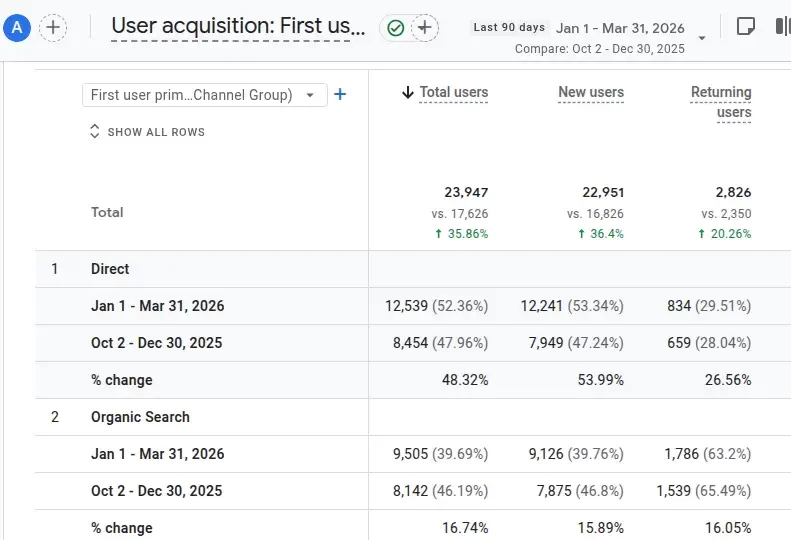
The Results (Last 90 Days vs Previous Period)
- +35.86% increase in total users (23,947 vs 17,626)
- +36.4% growth in new users (22,951 vs 16,826)
- +20.26% increase in returning users (2,826 vs 2,350)
- Organic Search grew by 16.74%, reaching 9,505 users
- New organic users increased by 15.89%, showing stronger keyword targeting
- Returning users from organic search grew by 16.05%, indicating better engagement
When to Use Professional SEO Competitor Analysis Services
Even with great tools, many businesses benefit from hiring expert SEO competitor analysis services. Here is when it makes strong business sense:
- You lack in-house expertise: Interpreting large data sets requires experience. An expert provides practical insights, not just numbers.
- You are entering a new market: A fresh competitor analysis by professionals prevents costly early strategic mistakes.
- You have limited time: Running a complete audit takes 20 to 40 hours. Outsourcing frees your team for execution.
- Your rankings have stagnated: Expert analysis from an external team often spot blind spots that internal teams consistently miss.
Professional competitor analysis SEO services offered by agencies typically bundle the best SEO services, local SEO services, off-page SEO services, digital PR services, and content marketing into a single managed engagement.
Stay Ahead of Your Competitors with SEO Discovery!
It is no longer optional to have a strong competitor analysis SEO plan. It is the foundation of every successful search strategy. Brands that monitor competitors, study how they use data to make decisions, grow faster than brands that don’t. You can use a trusted SEO competitor analysis plan, all-in-one SEO tools, or AI-powered platforms to do the audit yourself. The important thing is to be consistent and adapt quickly.
Partner with SEO Discovery, a trusted name in digital marketing. The experts on our team offer full SEO competitor analysis services along with tested keyword research, the best digital marketing services, and SEO content writing that gets actual rankings. Call us right now and get your free competitor analysis.
Take Over Your Niche Before Others Do!
Use competitor analysis to capture high-intent traffic.
FAQs About How Competitor Analysis Improves SEO Strategy
Competitor analysis in SEO strategy means evaluating rival websites to find keyword gaps, content opportunities, and backlink strategies. It helps you rank faster with data-backed decisions.
Start by identifying search competitors, then analyze keywords, content gaps, backlinks, technical SEO services benchmarks, site structure, UX, and SERP features systematically every quarter.
The best SEO tool for competitor site analysis in 2026 is Semrush or Ahrefs for most teams. SE Ranking suits smaller budgets with strong competitor tracking and reporting features built in.
AI for competitor SEO analysis automates keyword clustering, content scoring, and SERP monitoring. It significantly reduces manual research time while improving the depth and accuracy of competitive insights.
A competitor analysis report sample SEO audit covers organic traffic, top keywords, backlink profiles, content gaps, technical scores, and SERP feature performance for rival domains in your niche.
SEO share of voice competitor analysis measures what percentage of total search visibility your brand owns versus rivals. A low share of voice signals strong room for ranking growth and content investment.
Hire professional SEO competitor analysis services when you lack expertise, enter new markets, face stagnant rankings, or need polished reports for stakeholders, clients, or board-level presentations.
Run a full competitor analysis SEO audit every quarter. Monitor ranking shifts and new competitor content monthly. Daily SERP alerts help catch major competitive moves and respond early.
Yes. Combining local SEO services with competitor analysis helps you discover local citation sources, map pack ranking factors, and content topics driving strong local traffic for rivals in your area.
The best all-in-one SEO tools with competitor analysis combine keyword tracking, backlink auditing, content analysis, and site audits in one platform. This saves time and keeps competitive data consistent across reports.