


Objective
This guide breaks down the five most damaging brand SEO mistakes hurting business reputations in 2026, backed by the latest Google policy and algorithm updates, with clear fixes for each.
- Consistent brand data improves trust across search engines and AI platforms.
- Authentic reviews build credibility. Manipulated reviews destroy it.
- Helpful content earns visibility. Misleading content loses it.
- Natural writing beats keyword stuffing every time.
- Mobile experience shapes your reputation before customers even engage.
Protect Your Brand Reputation With SEO Discovery, starting at $250/month.
Your Brand's Reputation Is Now an SEO Metric
The days when search engines rewarded brands based on gimmicks such as proper keyword density, anchor text, and even backlinking are over. The current age involves search ranking by algorithms and even AI tools like ChatGPT, Gemini, Perplexity, and AI Overviews that judge not on the gimmicks but rather on whether the brand keeps its promises. The process of search engine optimization has merged seamlessly into brand reputation management without any businesses realizing it yet.
Did You Know?
Google blocked or removed 292 million policy-violating reviews in 2025, highlighting the growing crackdown on fake and manipulated reviews.
That number is important because it helps us see how much of what businesses call an “SEO strategy” is really just reputation manipulation with a search engine on top of it. Fake reviews, gated feedback, keyword-stuffed pages, and outdated directory listings all do the same thing: they create a gap between what your brand is saying and what is factually true. Search engines look for that gap now, and so do the customers reading your reviews, even before they visit your website.
Mistakes like that do happen. They’re prevalent in nearly every industry, from local service companies to enterprise brands. The cost of production is the difference. 2026 meant real policy enforcement, real fines, real algorithm updates targeting these exact behaviors.
Traditional SEO | Brand SEO | |
Focus | Rankings | Trust and reputation |
Optimizes | Keywords | Brand perception |
Measures | Traffic | Authority and credibility |
Evaluated by | Google, AI assistants, review platforms, and branded search | |
Scope | Technical optimization | Technical, content, reputation, and entity optimization |
Table Of Contents
- What Is NAP Consistency and Why Is It Important for Brand SEO?
- What Is Review Gating and Why Does Ignoring Negative Reviews Damage Rankings?
- What Is Search Intent Mismatch and Why Does It Hurt Your Content?
- What Is Keyword Stuffing and Why Does It Still Hurt Brands in 2026?
- Why Does a Slow Mobile Experience Cost You Customers?
- How Do Brand SEO Mistakes Show Up in Branded Search?
- What Does Strong Brand SEO Actually Look Like in Practice?
- Is Your Brand SEO Strategy Protecting Your Reputation or Quietly Damaging It?
- FAQs About Brand SEO Mistakes
What Is NAP Consistency and Why Is It Important for Brand SEO?
If your business changes phone numbers or moves, but old listings, social profiles, and review sites still have your old information, it can confuse both Google and potential customers.
The Impact: Imagine a customer walking into your old office or calling a disconnected phone number. That bad experience can quickly morph into a negative review and eroded trust.
2026 Update: NAP consistency is no longer just a local SEO factor. AI search tools like ChatGPT, Google AI Overviews, and Microsoft Copilot also rely on business information from trusted directories. If your listings are outdated, AI may provide incorrect answers about your business, making it harder for customers to find or trust you.
The Fix:
- Run a Google Business Profile optimization pass across every listing you control at least quarterly.
- Use one consistent format for your business name, address, and phone number across every platform.
- Update outdated information on directories, review sites, and social media as soon as changes happen.
- Whenever your business name, address, or phone number changes, perform a full listing audit immediately instead of delaying it.
Search your business name in quotes on Google today. Anything that surfaces with old information goes on this week’s fix list.
What Is Review Gating and Why Does Ignoring Negative Reviews Damage Rankings?
Some brands try to manipulate their star rating by only soliciting reviews from happy customers and quietly funneling complaints to a private form. It’s called review gating, and it used to be a soft violation and mostly unenforced.
That changed on April 16–17, 2026, when Google launched its biggest review policy change in years. Now, review gating is explicitly banned and actively policed. This includes staff review quotas (“We need ten reviews this week”), asking customers to mention a specific employee in their review, review kiosks or shared devices at checkout, and pressuring customers to leave a review while still on your premises. Google now uses GPS, IP, and device fingerprinting to enforce this, automatically catching violations.
The Impact: A perfect 5-star rating built by filtering reviews can reduce trust instead of building it. Customers recognize unnatural review patterns, search engines value authentic feedback, and deceptive review practices may even result in significant financial penalties under consumer protection laws.
The Fix:
- Send the same review request to every customer, gated only by the fact that they were a customer.
- Respond to every negative review in a professional way. Make an apology, explain the solution, and make sure that the future customers see how you deal with the problem.
- Avoid asking customers to leave only positive reviews or providing scripts for what they should write
- Build this into your broader brand reputation management process, not a one-time review request template.
Worried Your Review Process Isn’t Compliant?
Our team checks your reviews against Google’s 2026 policy before it becomes a bigger problem.
Mistake | Business Impact | Quick Fix |
Inconsistent NAP data | Confuses customers, search engines, and AI platforms | Audit and update all business listings quarterly |
Review gating | Damages trust and may violate review policies | Request honest reviews from every customer |
Misleading search intent | Increases bounce rates and reduces credibility | Create content that matches user intent |
Keyword stuffing | Hurts readability and can trigger spam signals | Write naturally and prioritize user value |
Slow mobile experience | Loses visitors, leads, and conversions | Improve page speed and Core Web Vitals |
What Is Search Intent Mismatch and Why Does It Hurt Your Content?
People visit your content expecting answers. If your page promises to solve a problem but immediately pushes a product or service without providing useful information, they are likely to leave within seconds.
The Impact: When users quickly return to the search results, it signals that your content didn’t meet their expectations. Over time, this can reduce trust, increase bounce rates, and make your brand appear unhelpful or overly promotional.
2026 Update: This is no longer just a user experience issue. In May 2026, Google strengthened its spam policies to target content created primarily to manipulate AI-generated search results instead of helping users. Whether your content appears in Google Search, AI Overviews, or AI assistants, it should provide clear, accurate, and useful answers first. This shift makes Search Everywhere Optimization more important than ever. Helpful content builds trust across every search experience.
The Fix:
- Search your target keyword before you start writing. Review the top-ranking pages to understand what users expect.
- Create content that answers the user’s question clearly and provides more value than competing pages.
- Place a clear, direct answer near the beginning of the article so it is easier for search engines, AI Overviews, and generative search Platforms can easily understand and cite it.
- Introduce your product or service only after you’ve provided useful information and addressed the reader’s needs.
What Is Keyword Stuffing and Why Does It Still Hurt Brands in 2026?
Keyword stuffing means adding the same keywords repeatedly in your content, meta descriptions, or image alt text just to improve rankings. This outdated practice no longer works and can hurt both your SEO and your brand reputation.
The Impact: Stuffed copy makes a brand sound robotic and desperate rather than authoritative. It reduces trust, creates a poor user experience, and makes your brand appear less credible.
2026 update: Google’s June 2026 spam update continued its efforts to target keyword stuffing and other spammy SEO tactics. Instead of focusing on keyword repetition, prioritize content optimization that is helpful, natural, and written for people first. High-quality content is more likely to perform well in traditional search, AI Overviews, and other AI-powered search experiences.
The Fix:
- Write for your readers first, not search engines. Use keywords naturally where they fit.
- Focus on covering the topic completely instead of repeating the same keyword. This helps build topical authority.
- Use Entity-Based SEO and natural language so your content is easy for both people and search engines to understand.
- Prioritize website content optimization and E-E-A-T optimization by sharing accurate, helpful, and experience-based information.
- Strengthen authority building with expert quotes, original insights, trusted sources, and real examples instead of stuffing keywords.
“Create content primarily for people, not to manipulate search rankings.” — Google Search Central |
That guidance predates 2026, but it is more timely than it has ever been. AI systems are increasingly rewarding content that demonstrates real expertise and usefulness, not content based on a target keyword density.
Why Does a Slow Mobile Experience Cost You Customers?
A website that takes more than a few seconds to load, or doesn’t display properly on a phone, drives visitors away before they’ve read a single word.
The Impact: Mobile now accounts for more than 60% of all web traffic. If your website is slow or difficult to navigate, visitors are more likely to lose trust in your business and leave without taking action.
2026 Update: Fast, mobile-friendly websites remain essential for both traditional search and AI-powered search experiences. As Google continues to refine its ranking systems, websites that deliver a smooth user experience are more likely to keep visitors engaged and build trust. Improving Core Web Vitals is no longer just a technical task. It’s part of creating a better experience for both users and search engines.
The Fix:
- Test your website regularly using Google PageSpeed Insights and fix any performance issues.
- Remove or optimize unnecessary scripts, plugins, and third-party tools that slow down your pages.
- Make website conversion optimization part of your performance strategy by improving speed, usability, and user experience together.
- Make sure your website is 100% responsive and works perfectly on different screen sizes and devices.
How Do Brand SEO Mistakes Show Up in Branded Search?
Every brand SEO mistake eventually shows up in the most important place: your own search results.
Branded search happens when someone searches for your company or product name, such as “[Your Brand] reviews,” “[Your Brand] pricing,” or “[Your Brand] locations.” This branded search traffic shows that people already know your business and are actively looking for more information.
The problem is that your branded search results reflect your overall online reputation. If your business has outdated listings, unanswered negative reviews, slow-loading pages, or misleading content, those issues become visible the moment someone searches for your brand.
A potential customer researching your business may see incorrect contact details, poor reviews, or an outdated website before they even visit your homepage. Those first impressions can influence whether they choose your business or move to a competitor.
This is why brand marketing SEO and branding SEO are much more than technical SEO. They help build trust, improve online brand authority, and create a positive impression wherever customers find your business.
Investing in SEO for brand awareness also strengthens your branded search presence. Consistent business information, helpful content, and active review management help create search results that build confidence instead of raising doubts. That is how branding helps drive SEO success.
Today’s search experience goes beyond Google. AI platforms like ChatGPT, Google AI Overviews, Gemini, and Microsoft Copilot also use reviews, business listings, and trusted online content to answer questions about brands. This makes AI search optimization, AI assistant optimization, AEO, GEO, and strong AI visibility increasingly important. The more accurate and consistent your brand information is across the web, the more likely AI systems are to present your business as a trusted choice.
What Does Strong Brand SEO Actually Look Like in Practice?
Every mistake we’ve covered has a better alternative. When a brand consistently builds trust through accurate information, helpful content, positive reviews, and strong authority signals, search engines and AI platforms are more likely to recommend it.
The example below shows how a well-optimized brand can appear in Google AI Mode for a relevant search query.
Example: Google AI Mode results for “SEO company for small businesses”
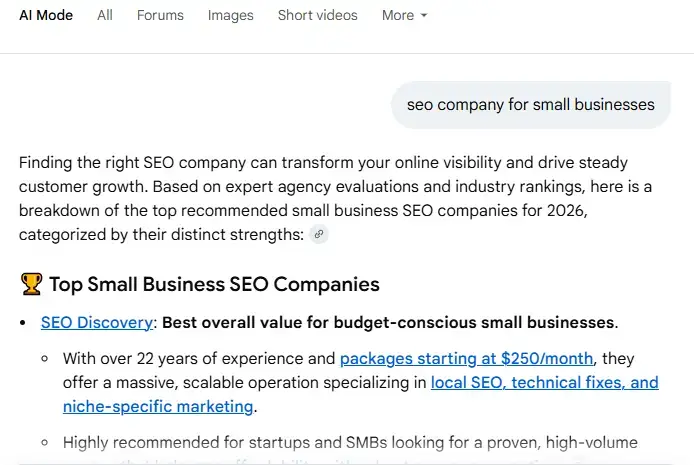
In this example, SEO Discovery appears as the top recommendation, with Google AI Mode highlighting key details such as the company’s experience, starting pricing, and service specialization. This demonstrates how consistent brand information, helpful content, strong reviews, and clear expertise can make it easier for AI-powered search experiences to understand and present your business with confidence.
Businesses with inconsistent listings, weak content, poor reviews, or outdated information are less likely to earn this level of visibility. Instead, AI systems may provide limited, incomplete, or less confident summaries, making it harder for potential customers to trust your brand
Is Your Brand SEO Strategy Protecting Your Reputation or Quietly Damaging It?
Every mistake in this guide creates a gap between what your business promises and what customers actually experience. At SEO Discovery, we help businesses close those gaps with brand SEO, reputation management, technical SEO, and enterprise SEO services so your online presence builds trust instead of losing it.
Ready to Protect Your Brand’s Reputation?
Let’s audit what’s actually showing up when people search your brand.
FAQs About Brand SEO Mistakes
Branded search is any query that includes your company or product name, like “[Brand] reviews” or “[Brand] near me,” rather than a generic industry term.
Branded traffic is the visits and clicks your site earns specifically from people searching your brand name, rather than a general keyword.
A branded query names your business directly, while a generic keyword describes the product or service category without naming any specific brand.
It’s an approach that combines technical SEO with consistent brand messaging, so search results and AI answers reflect your business accurately.
Branded SEO focuses on protecting and optimizing how your specific company name performs in search, while regular SEO targets broader topic and keyword visibility.
Run a full audit quarterly, and trigger an immediate check any time your address, phone number, or business name changes.
Yes. Google explicitly banned review gating in its April 2026 policy update, and enforcement is automated and active.
No, not simply for being AI-assisted. Google penalizes thin, manipulative, or keyword-stuffed content regardless of how it was produced.
Aim for a Largest Contentful Paint under 2.0 seconds, the new “good” threshold Google set in its March 2026 Core Update.